

The long game: Acacia's coherent vision
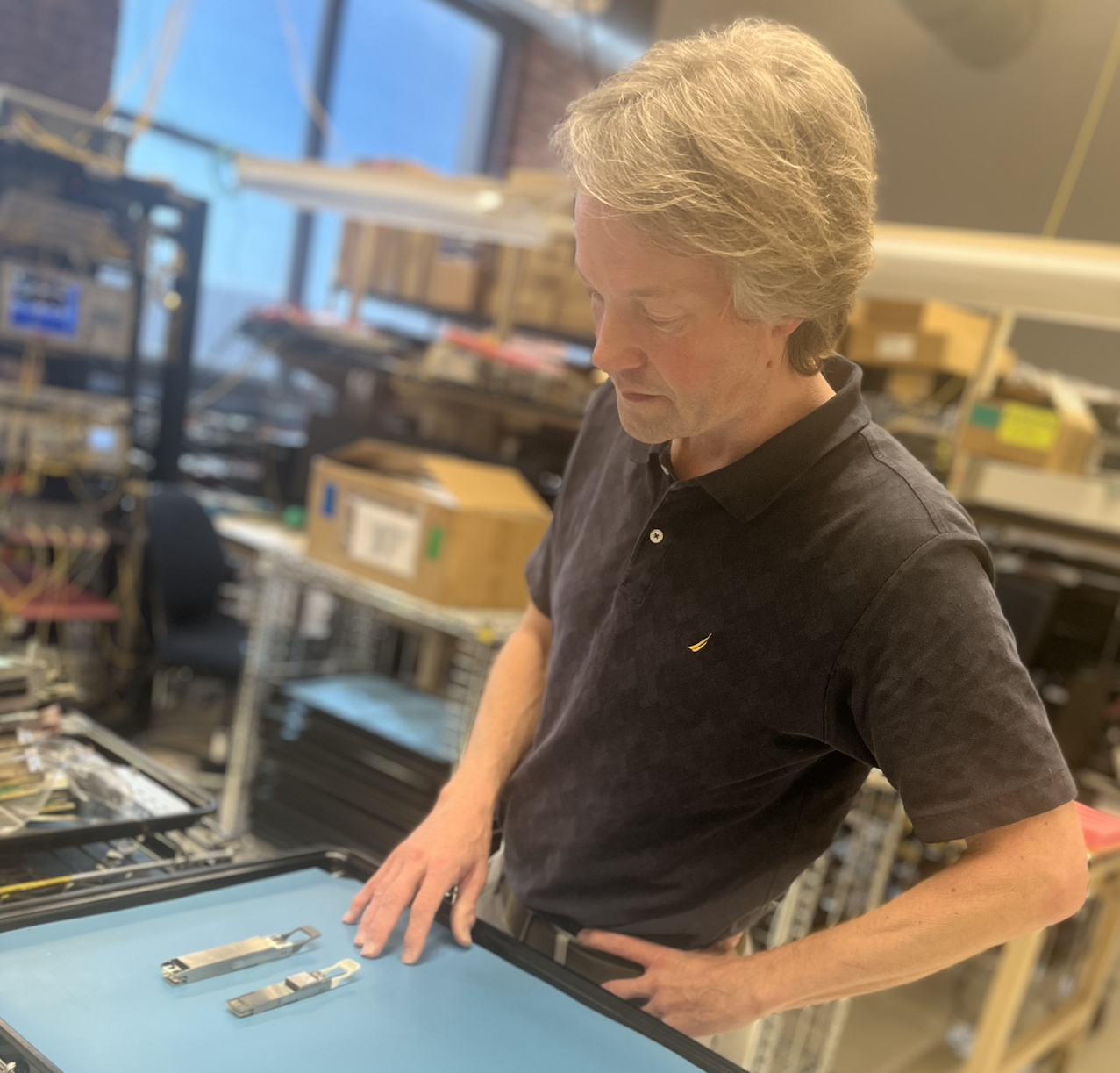
In 2007, Christian Rasmussen made a career-defining gamble. After attending a conference featuring presentations on coherent optical transmission, he returned home, consulted his family, and quit his job at Mintera, then an optical networking equipment maker.
The technology he’d seen discussed promised to solve the transmission impairments associated with direct-detection-based optical transmission – chromatic dispersion and polarisation mode dispersion – that had stymied optical transport to go beyond 40 gigabits-per-second (Gbps).
“We came back and were completely excited that there was a technology that addressed all the problems that we had experienced firsthand,” says Rasmussen, now Chief Technology Officer at Acacia.
His bet paid off. Acacia which he helped co-found in 2009, had a successful IPO in 2016 and would later be acquired by Cisco Systems for $4.5 billion in 2021.
Unfolding coherent optics
Increasing the baud rate has proved spectacularly successful in accommodating traffic growth in the network and reducing transport costs measured in dollar-per-bit.
In 2009, coherent modems operated around 32 gigabaud (GBd) for 100 gigabit-per-second (Gbps) wavelength transmissions. By 2024, the symbol rate has reached 200GBd, enabling 1.6 terabit-per-second (Tbps) wavelengths.
Is the priority still to keep upping the symbol rate of a single carrier when designing next-generation coherent modems?
“We are not just saying that increasing baud rate is right,” says Rasmussen. The fundamental goal is reducing optical transport’s cost and power consumption. “Increasing the baud rate is generally the right approach to achieve that goal but it’s always to a certain degree.”
Acacia’s focus from the beginning has been on integrating the components that make up the coherent modem. The resulting modem need not be expensive and can deliver higher speed and extra bandwidth economically while meeting the power consumption target, he says.
“Until now, we feel that increasing the baud rate has been the right approach,” says Rasmussen. “The question will be how frequently you can go up in baud rate, now that developments are expensive.”
Given the rising cost of developing coherent modems, upping the baud rate only makes sense if designers can double it with each new design, he says. Increasing the baud rate by 30 or 40 percent is too small a return, given the development effort and the costs involved.
That implies Acacia’s follow-on high-end coherent modem will have a symbol rate of around 280GBd.
Acacia’s coherent modules
Acacia’s Coherent Interconnect Module 8 (CIM 8), launched in 2021, was the industry’s first single-carrier 1.2Tbps pluggable module. The module operates at a 140GBd symbol rate.
At ECOC 2024, the company showcased its 800 gigabit ZR+ OSFP pluggable modules, featuring the Delphi coherent DSP implemented in 4nm CMOS process.
The module supports up to 131GBd and implements interoperable probabilistic constellation shaping. The Acacia module has C-band and L-band variants and supports ultra-long-haul distances when sending 400Gbps over a single carrier (see Table).

Challenges and opportunities
The path forward presents challenges and opportunities. There are several design considerations when developing a coherent DSP ASIC.
One is choosing what CMOS process to use. Considerations include cost – the smaller the geometry the more expensive the design, the transistors’ switching speed, whether the chip’s resulting power consumption is acceptable, and the CMOS process’s maturity. If the process is under development, what confidence is there that it will deliver the promised performance once the ASIC design is completed and ready for manufacturing?
The state-of-the-art CMOS process used for coherent DSPs is 3nm. Ciena’s 200GBd WaveLogic 6e is the first coherent DSP to ship using a 3nm CMOS process. Rasmussen is confident that a 3nm CMOS process can achieve at least a 250GBd symbol rate.
Another consideration is to ensure that the DSP’s analogue-to-digital converters (ADCs) and digital-to-analogue converters (DACs) can achieve the required sampling speed and quality. Typically, the ADC sample at 1.1x-1.2x the baud rate, which, for a 250GBd symbol rate, equates to the order of 300 giga-samples a second (GS/s). Achieving such speeds is exceptionally challenging.
Some research is exploring other ways to keep boosting converter sampling speed. One idea is to split the converter’s design between the DSP and a higher-bandwidth III-V material used for the driver or receiver circuitry.
Rasmussen stresses that the key is to keep the ADCs and DACs in CMOS as a part of the DSP. “Once you start going there [splitting the DAC and ADC designs], you start risking your cost and power advantage of the single-carrier approach,” he says.
Acacia timeline
- 2007: Rasmussen attends pivotal conference on coherent transmission
- 2009: Acacia founded; 32GBd coherent modems achieve 100Gbps
- 2014: Acacia is first to ship samples of a coherent pluggable 100G CFP module and announced the industry’s first 100G coherent transceiver in a single silicon photonics integrated circuit package
- 2021: Cisco acquires Acacia for $4.5 billion
- 2021: Launch of CIM 8 (140GBd, 1.2Tbps)
- 2024: Acacia showcases its 800ZR+ OSFP module
Team-oriented approach
As CTO, Rasmussen emphasises the importance of working with colleagues to make decisions. “I’m very passionate about this: team-oriented decision-making,” he says. His role involves extensive conversations with product managers and colleagues that interact with customers to understand market needs, alongside technical discussions and conference attendance to guide technology development.
This collaborative approach has shaped Acacia’s integration strategy as well as the company becoming more vertically integrated. “Owning the whole stack so you always have everything in control,” as Rasmussen puts it, has proven crucial to their success.

From Denmark to Cisco
Rasmussen’s journey began in Denmark, where he completed his electrical engineering degree and doctorate in optical communications before moving to Boston. There, he joined Benny Mikkelsen, now Acacia’s senior vice president and general manager, at Mintera, where they grappled with the limitations of pre-coherent optical systems.
The struggle with 40Gbps direct-detect optical transport systems ultimately led to that pivotal moment in 2007. “It did not make much commercial sense to struggle so much to get to 40 gigabits,” Rasmussen recalls. When coherent transmission emerged as a solution, he and his colleagues seized the opportunity, despite the industry’s post-dot-com bubble and the 2008 financial crisis.
He began working with Mikkelsen and Mehrdad Givehchi on business plans and developing the technology. “Digital signal processing was new to us, so there was a lot of stuff to learn,” he says.
After being turned down by numerous venture capital firms, one – Matrix Parners- backed the Acacia team, which also received corporate funding from OFS, part of Furukawa Electric.
Beyond Technology
Outside the lab, Rasmussen finds balance in gardening, appreciating its immediate rewards compared to the years-long cycle of DSP design. “It’s nice to do something where you can see the immediate result of your work,” he says.
His interests also extend to reading. He recommends “Right Hand, Left Hand” by Chris McManus, praising its exploration of symmetry in nature, and “The Magic of Silence” by Florian Illies, which examines the enduring relevance of painter Caspar David Friedrich.
Looking ahead, Rasmussen remains optimistic about the industry’s innovative capacity.
He says that semiconductor foundries do not tend to publicise their CMOS transistors’ switching frequency, but it is already above 500GHz and approaching 1,000GHz. This suggests that a DSP supporting a baud rate of 400GBd will be possible. And four to five years hence, two more generations of CMOS after 3nm are likely. This all suggests that a further doubling of baud rate to 500GBd is feasible.
“Just look at the record of innovation at Acacia and other companies in the industry; people keep coming up with solutions,” says Rasmussen.


The OIF's coherent optics work gets a ZR+ rating
The OIF has started work on a 1600ZR+ standard to enable the sending of 1.6 terabits of data across hundreds of kilometres of optical fibre.The initiative follows the OIF's announcement last September that it had kicked off 1600ZR. ZR refers to an extended reach standard, sending 1.6 terabits over an 80-120km point-to-point link.
600ZR follows the OIF’s previous work standardising the 400-gigabit 400ZR and the 800-gigabit 800ZR coherent pluggable optics.
The decision to address a ‘ZR+’ standard is a first for the OIF. Until now, only the OpenZR+ Multi-Source Agreement (MSA) and the OpenROADM MSA developed interoperable ZR+ optics.
The OIF’s members’ decision to back the 1600ZR+ coherent modem work was straightforward, says Karl Gass, optical vice chair of the OIF’s physical link layer (PLL) working group. Several companies wanted it, and there was sufficient backing. “One hyperscaler in particular said: ‘We really need that solution’,” says Gass.
OIF, OpenZR+, and OpenROADM
Developing a 1600ZR+ standard will interest telecom operators who, like with 400ZR and the advent of 800ZR, can take advantage of large volumes of coherent pluggables driven by hyperscaler demand. However, Gass says no telecom operator is participating in the OIF 1600ZR+ work.
“It appears that they are happy with whatever the result [of the ZR+ work] will be,” says Gass. Telecom operators are active in the OpenROADM MSA.
Now that the OIF has joined OpenZR+ and the OpenROADM MSA in developing ZR+ designs, opinions differ on whether the industry needs all three.
“There is significant overlap between the membership of the OpenZR+ MSA and the OIF, and the two groups have always maintained positive collaboration,” says Tom Williams, director of technical marketing at Acacia, a leading member of the OpenZR+. “We view the adoption of 1600ZR+ in the OIF as a reinforcement of the value that the OpenZR+ has brought to the market.”
Robert Maher, Infinera’s CTO, believes the industry does not need three standards. However, having three organisations does provide different perspectives and considerations.
Meanwhile, Maxim Kuschnerov, director R&D at Huawei, says the OIF’s decision to tackle ZR+ changes things.”OpenZR+ kickstarted the additional use cases in the industry, and OpenROADM took it away but going forward, it doesn’t seem that we need additional MSAs if the OIF is covering ZR+ for Ethernet clients in ROADM networks,” says Kuschnerov. “Only the OTN [framing] modes need to be covered, and the ITU-T can do that.”
Kuschnerov also would like more end-user involvement in the OIF group. “It would help shape the evolving use cases and not be guided by a single cloud operator,” he says.
ZR history
The OIF is a 25-year-old industry organisation with over 150 members, including hyperscalers, telecom operators, systems and test equipment vendors, and component companies.
In October 2016, the OIF started the 400ZR project, the first pluggable 400-gigabit Ethernet coherent optics specification. The principal backers of the 400ZR work were Google and Microsoft. The standard was designed to link equipment in data centres up to 120km apart.
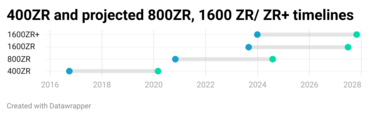
The OIF 400ZR specification also included an un-amplified version with a reach of several tens of kilometres. The first 400ZR specification document, which the OIF calls an Implementation Agreement, was completed in March 2020 (see chart above).
The OIF started the follow-up on the 800ZR specification in November 2020, a development promoted by Google. Gass says the OIF is nearing completion of the 800ZR Implementation Agreement document, expected in the second half of 2024.
If the 1600ZR and ZR+ coherent work projects take a similar duration, the first 1600ZR and 1600ZR+ products will appear in 2027.
Symbol rate and other challenges
Moving to a 1.6-terabit coherent pluggable module using the same modulation scheme – 16-ary quadrature amplitude modulation or 16-QAM – used for 400ZR and 800ZR suggests a symbol rate of 240 gigabaud (GBd).
“That is the maths, but there might be concerns with technical feasibility,” says Gass. “That’s not to say it won’t come together.”
The highest symbol rate coherent modem to date is Ciena’s WaveLogic 6e, which was announced a year ago. The design uses a 3nm CMOS coherent digital signal processor (DSP) and a 200GBd symbol rate. It is also an embedded coherent design, not one required to fit inside a pluggable optical module with a constrained power consumption.
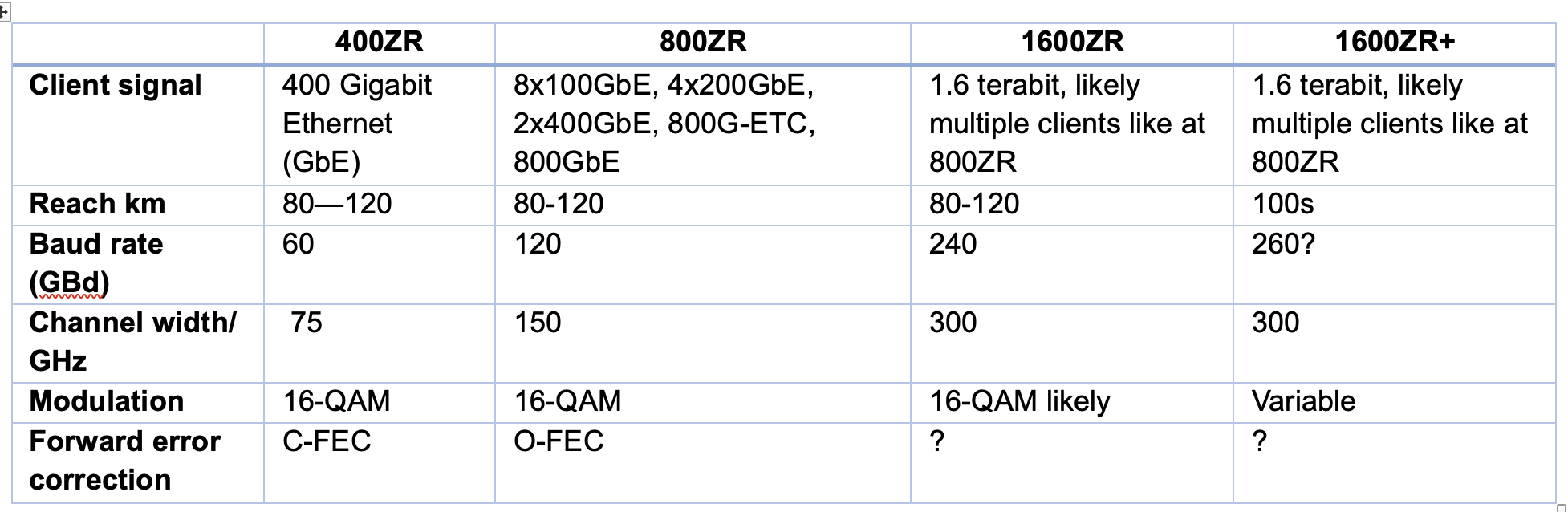
Kuschnerov points out that the baud rates of ZR and ZR+ have differed. And this will likely continue. 800ZR, using Ethernet with no probabilistic constellation shaping, has a baud rate of 118.2GBd, while 800ZR+, which uses OTN and probabilistic constellation shaping, has a baud rate of up to 131.35GBd. Every symbol has a varying probability when probabilistic constellation shaping is used. “This decreases the information per symbol, and thus, the baud rate must be increased,“ says Kuschnerov.
Doubling up for 1600ZR/ ZR+, those numbers become around 236GBd and 262GBd, subject to future standardisation. “So, saying that 1600ZR is likely to be at 240GBd is correct, but one cannot state the same for a potential 1600ZR+,” says Kuschnerov.
Nokia’s view is that for 1600ZR, the industry will look at operating modes that include 16QAM at 240 GBd. Other explored options include 64-QAM with probabilistic constellation shaping at 200GBd and even dual optical carrier solutions with each carrier operating at approximately 130GBd. “However, this last option may be challenging from a power envelope perspective,” says Szilárd Zsigmond, head of Nokia’s optical subsystems group.
In turn, if 1600ZR+ reaches 1,000km distances, the emphasis will be on higher baud rate options than those used for 1600ZR. “This will be needed to enable longer reaches, which will also put pressure on managing power dissipation,” says Zsigmond.
The coherent DSP must also have digital-to-analogue (DACs) and analogue-to-digital converters (ADCs) to sample at least at 240 giga-samples per second. Indeed, the consensus among the players is that achieving the required electronics and optics will be challenging.
“All component bandwidths have to double and that is a significant challenge,” says Josef Berger, associate vice president, cloud optics marketing at Marvell.
The coherent optics – the modulators and receivers – must extend their analogue bandwidth of 120GHz. Infinera is one company that is confident this will be achieved. “Infinera, with our highly integrated Indium Phosphide-based photonic integrated circuits, will be producing a TROSA [transmitter-receiver optical sub-assembly] capable of supporting 1.6-terabit transmission that will fit in a pluggable form factor,” says Maher.
The coherent DSP and optics operating must also meet the pluggable modules’ power and heat limits. “That is an extra challenge here: the development needs to maintain focus on cost and power simultaneously to bring the value network operators need,” says Williams. “Scaling baud rate by itself doesn’t solve the challenge. We need to do this in a cost and power-efficient way.”
Current 800ZR modules consume 30W or more, and since the aim of ZR modules is to be used within Ethernet switches and routers, this is challenging. In comparison, 400ZR modules now consume 20W or less.
“For 800ZR and 800ZR+, the target is to be within the 28W range, and this target is not changing for 1600ZR and 1600ZR+,” says Zsigmond. Coherent design engineers are being asked to double the bit rate yet keep the power envelope constant.
Certain OIF members are also interested in backward compatibility with 800ZR or 400ZR. “That also might affect the design,” says Gass.
Given the rising cost to tape out a coherent DSP using 3nm and even 2nm CMOS process nodes required to reduce power per bit, most companies designing ASICs will look to develop one design for the 1600ZR and ZR+ applications to maximise their return on investment, says Zsigmond, who notes that the risk was lower for the first generations of ZR and ZR+ applications. Most companies had already developed components for long-haul applications that could be optimised for ZR and ZR+ applications.
For 400ZR, which used a symbol rate of 60 GBd, 60-70 GBd optics already existed. For 800 gigabit transmissions, high-performance embedded coherent optics and pluggable, low-power ZR/ZR+ modules have been developed in parallel. “For 1600ZR/ZR+, it appears that the pluggable modules will be developed first,” says Zsigmond. “There will be more technology challenges to address than previous ZR/ZR+ projects.”
The pace of innovation is faster than traditional coherent transmission systems and will continue to reduce cost and power per bit, notes Marvell’s Berger: “This innovation creates technologies that will migrate into traditional coherent applications as well.”
Gass is optimistic despite the challenges ahead: “You’ve got smart people in the room, and they want this to happen.”
OIF's OFC 2024 demo
The OIF has yet to finalise what it will show for the upcoming coherent pluggable module interoperable event at OFC to be held in San Diego in March. But there will likely be 400ZR and 800ZR demonstrations operating over 75km-plus spans and 400-gigabit OpenZR+ optics operating over greater distance spans.

Ribbon offers for trial its 1.2T wavelength 9408 platform
Add Your Into Content Here

Ribbon Communications has started working with operators to trial its latest Apollo 9408 optical transport platform that supports 1.2 terabits per second (Tbps) optical wavelengths.
The company’s modular platform can also send 800 gigabit-per-second (Gbps) wavelengths over 1,000km and 400Gbps wavelengths over ultra-long-haul networks.
“We have conducted trials, including one with a Tier 1 European provider,” says Jonathan Homa, senior director of solutions marketing at Ribbon. “You can get 1.2 terabits within major cities, 800 gigabits covering major states or regions, and 400 gigabits for about as long as you want to go.”
“The Apollo 9408 is Ribbon’s first disaggregated transponder unit or compact modular box using the CIM 8 for up to 1.2Tbps of wavelength speed,” says Jimmy Yu, vice president at market research firm Dell’Oro Group.
Yu believes the product has shipped to a customer this quarter and is likely the first commercial shipment of a 1.2Tbps wavelength system for network deployment.
Acacia’s CIM 8 pluggable coherent modem
The Apollo 9408 uses Acacia’s pluggable Coherent Interconnect Module (CIM 8) coherent modem. The CIM 8 uses Acacia’s 5nm CMOS Jannu digital signal processor (DSP) and its silicon photonics-based coherent optics operating at a symbol rate of up to 140 gigabaud.
“The advantage of this smaller transistor geometry is not only the higher density per die but also lower power and faster processing speed,” says Yu. “All the things needed to help service providers achieve cost and power efficiencies.” This is why the market looks forward to the next generation of coherent DSPs, says Yu.
Acacia started shipping the CIM 8 at the year’s start, and Ribbon says the module’s availability enables the company to leapfrog existing 7nm CMOS-based coherent optical transport solutions.
Before 1.2 Tbps-capable wavelengths, the highest speed was 800Gbps, delivered by Ciena, Huawei, and Infinera, says Yu.
“Ciena was first to market and captured the lion’s share of shipment volumes,” says Yu. “We peg Ciena’s market share of 800 Gbps-capable wavelengths at approximately 70 per cent of the cumulative shipments through 2Q 2023. That is a huge share, benefiting from being first to market.”
Compact modular platform
The compact modular platform format was developed to meet the large-scale data centre operators’ computing needs. The platform is used for data centre interconnect applications while the large communications service providers are become interested in the platform form factor.

Compact modular platforms are 600mm deep and use front-to-back airflow for cooling. In contrast, standard telecom equipment is 300mm deep and uses a left-to-right airflow. The compact modular format thus suits data centres with alternate hot and cold aisles of equipment. The platforms face each other, so the air in a cold aisle is blown through each platform, exiting in the adjacent hot aisles. The efficient cooling scheme enables the equipment to be run hotter.
“With the compact modular platform’s front and back airflow, we can run the CIM 8 to 1.2 terabits,” says Homa. “In our standard [telecom] platform [the Apollo 9600 series], we’re using the same CIM 8 pluggable, but from a power dissipation point of view, we can only run it to 800 gigabits.”
The 9408 supports different channel plans depending on how the platform is used. For a cost-optimised transmission, a 400Gbps wavelength fits in a 75GHz channel, and a performance-optimised 800Gbps or 1.2Tbps wavelength fits in a 150GHz channel.
“With continuous baud rate control from 68-140Gbaud, the CIM 8 can accommodate any channel width such as 112.5GHz with networks that have flexible grid ROADMs [reconfigurable optical add/drop multiplexers],” says Homa. “It also uses probabilistic constellation shaping to maximise the line rate for that channel width.”
Configurations
The Apollo 9408 is a two rack unit (2RU) platform. For high-performance optical transport, it holds four MPJ1200_2 sleds. The sleds slot into the compact modular platform, with each sled hosting two CIM 8 modules. The power consumption of the double CIM 8 sled is 270W or less than 0.12W/gigabit. The total transport capacity is thus 9.6 terabits.
Ribbon plans to double the CIM 8s within the 2RU capacity platform to offer 19.2 terabits of capacity.
Alternatively, the 2RU rack can hold up to four MPQ_8 sleds hosting eight 400-gigabit coherent optical modules for a total capacity of 12.8 terabits. Ribbon uses 64 gigabaud 400-gigabit QSFP-DDs that use a transmit power of 0dBm and are OpenROADM MSA compliant.
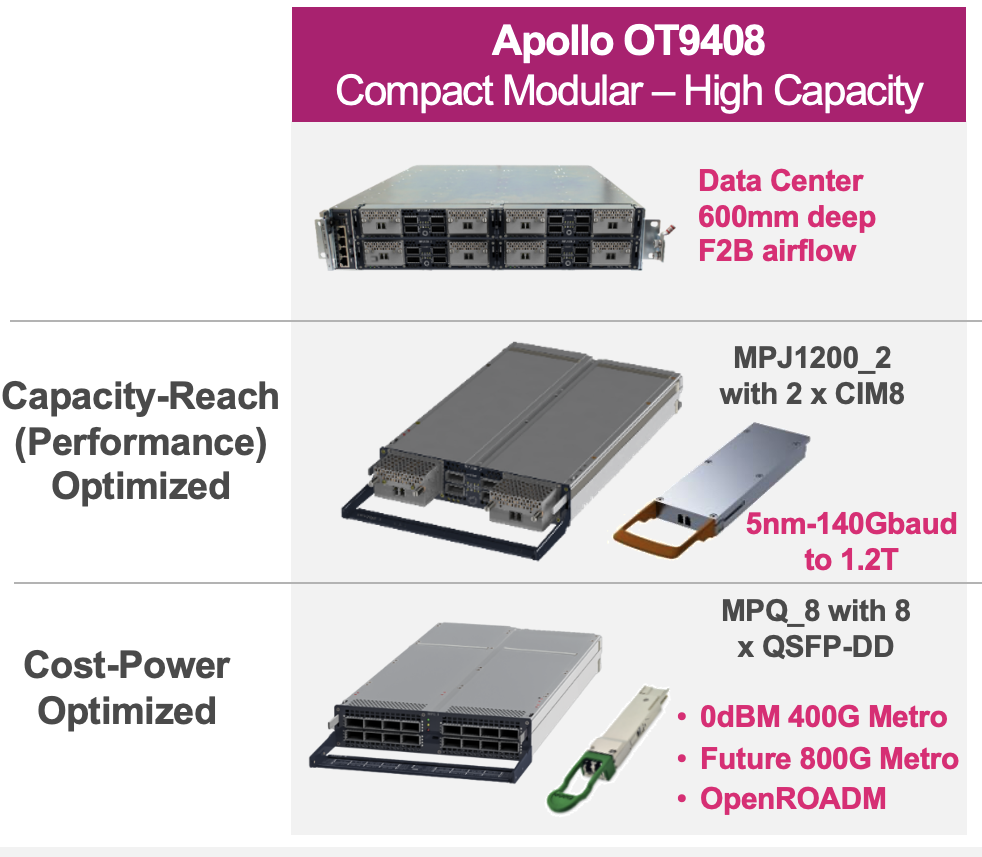
“The MPQ_8 is also designed to accept a new generation of 124Gbaud 800Gbps QSFP-DD pluggables currently in development and expected to be available in early 2025,” says Homa.
Ribbon also offers its standard telecom Apollo 9600 series platforms, from the smallest 2RU 9603 to the 5RU 9608 to the largest 15RU 9624 chassis. The Apollo 9600 modular platforms can use two CIM 8s in the TM800_2 double-slot card for performance-optimised transmission to 800 gigabits, or two CFP2-DCO modules in the TM400_2 single-card slot card for cost-optimised transmission to 400 gigabits.
Industry timing
Optical system vendors that don’t develop their own coherent DSP chips or modems, such as Ribbon, have several supply options. The leading merchant DSP suppliers include Acacia, NEL and Marvell. There are also competitor optical transport providers that source their coherent modem solutions. Ribbon discussed with several coherent modem suppliers but chose Acacia’s CIM 8 for the 9408. Ribbon has worked with Acacia for a decade.
The CIM 8’s 5nm Jannu DSP leapfrogs the 90-100GBd 7nm CMOS generation of coherent DSPs now deployed. This year, 5nm CMOS coherent DSPs have been announced by Nokia and Infinera. Merchant suppliers NEL and Marvell have also detailed their latest coherent DSPs. All these devices operate at symbol rates in the region of 130-150GBd.
Acacia also supplies the CIM 8 to other optical transport vendors such as Cisco, Acacia’s parent company, ZTE, and Adtran. Cisco has announced its Network Convergence System (NCS) 1014 compact modular platform that includes a 2.4Tbps transponder Line using the CIM 8. In March, Adtran reported sending an 800-gigabit signal over 2,200km using the CIM 8 as part of a networking trial. The route included 14 route-and-select flexible-grid ROADMs.
“It will be interesting to see the market dynamics unfold over the next year. There will be more system suppliers of 1.2 Tbps-capable wavelengths,” says Dell’Oro’s Yu. “Many system vendors will use the CIM 8, and some will use NEL’s ExaSpeed GAIA DSP. Some will also develop in-house DSPs such as Huawei and Nokia.”
Every dense wavelength division multiplexing (DWDM) system vendor will have a 1.2 Tbps-capable line card available for sale before the end of 2024, except for Ciena, says Yu: “This is because Ciena will come out with a 1.6 Tbps-capable DSP on a 3nm process node in 2024, one to two years ahead of any other vendors.”
Earlier this year, Ciena announced its WaveLogic 6, the first coherent DSP that operates at 200GBd. Ciena says it will offer its optical transport systems using its 3nm CMOS coherent DSP in the second half of 2024.
Homa believes that the next jump will be 240-plus GBd coherent DSPs, likely implemented using an even smaller 2nm CMOS process node.
The OIF’s 1600ZR 1.6-terabit coherent pluggable module standard will use a 240GBd symbol rate DSP.

ECOC 2023 industry reflections - Final Part
Gazettabyte has been asking industry figures to reflect on the recent ECOC show in Glasgow. The final instalment emphasises coherent technology with contributions from Adtran, Cignal AI, Infinera, Ciena, and Acacia.
Jörg-Peter Elbers, head of advanced technology at Adtran
The ECOC 2023 conference and show was a great event. The exhibition floor was busy and offered ample networking opportunities. In turn, the conference and the Market Focus sessions provided information on the latest technologies, products, and developments.
One hot topic was coherent 800ZR modems. Several vendors demonstrated coherent 800ZR modules and related components. Importantly, these modules also boast new and improved 400 gigabit-per-second (Gbps) modes. The 120 gigabaud (GBd) symbol rate enables 400-gigabit dual-polarisation quadrature phase shift keying (DP-QPSK) transmission over demanding links and long-haul routes. In turn, the advent of 5nm CMOS digital signal processor (DSP) technology enables lower power DP-16QAM than 400ZR modules.
There is broad agreement that the next step in coherent transmission is a 240GBd symbol rate, paving the way to single-wavelength 1.6 terabit-per-second (Tbps) optical transport.
Meanwhile, the use of coherent optical technology closer to the network edge continues. Several players announced plans to follow Adtran and Coherent and jump on the low-power 100 gigabit-per-second ZR (100ZR) ‘coherent lite’ bandwagon. Whether passive optical networking (PON) systems will adopt coherent technology after 50G-PON sparked lively debate but no definitive conclusions.
The OIF 400ZR+ demonstration showed interoperability between a dozen optical module vendors over metro-regional distances. It also highlighted the crucial role of an intelligent optical line system such as Adtran’s FSP3000 OLS in automating operation and optimising transmission performance.
The post-deadline papers detailed fibre capacity records by combining multiple spectral bands and multiple fibre cores. The line-system discussions on the show floor focused on the practical implications of supporting C-, L-, extended, and combined band solutions for customers and markets.
From workshops to the regular sessions, the application of artificial intelligence (AI) was another prominent theme, with network automation a focus area. Examples show not only how discriminative AI can detect anomalies or analyse failures but also how generative AI can improve the interpretation of textual information and simplify human-machine and intent interfaces. For network engineers, ‘Copilot’-like AI assistance is close.
After ECOC is also before ECOC, so please mark in your calendars September 22-26, 2024. ECOC will celebrate its 50th anniversary next year and will take place in Frankfurt, Germany. As one of the General Chairs of the ECOC 2024 event, and on behalf of the entire organising committee, I look forward to welcoming you!
Andrew Schmitt, founder and directing analyst, Cignal AI
ECOC is a great show, it’s like OFC (the annual optical communications and networking event held in the US) but refined to only the critical elements. Here are my key takeaways.
The most impressive demonstration was 800ZR test boards and modules from Marvell and its partners Coherent and Lumentum. Within eight weeks of the first silicon, Marvell has demos up and running in-house and at its partners. The company has at least a 6-month lead in the 800ZR market, making intelligent tradeoffs to achieve this.
Lumentum showed an 8-QAM mode of operation that allows 800 gigabit transmission within a 100GHz channel spacing, which should be interesting. After the massive success of 400ZR, it’s natural to extrapolate the same success for 800ZR, but the use cases for this technology are substantially different. We also heard updates and broader support for 100ZR.
Linear drive pluggable optics (LPO) was a hot topic, although it was our impression that, while optimism ruled public discussion, scepticism was widely expressed in private. There was more agreement than disagreement with our recent report (see the Active Insight: The Linear Drive Market Opportunity). No one is more confident about LPO than the companies who view this as another opportunity to bid for business at hyperscale operators they don’t currently have.
The 200 gigabit per lane silicon/ physical media device (PMD)/ optics development continues, and it is on track to enable 1.6-terabit optics by 2024. Marvell had a more advanced and mature demo of what they showed behind closed doors at OFC. The advancements here are the real threat to adopting LPO, and people need to realise that LPO is competing with the power specs of 200 gigabits per lane, not 100 gigabits per lane solutions.
Also impressive was the comprehensive engineering effort by Eoptolink to show products that covered 100 gigabit and 200 gigabit per lane solutions, both retimed and linear. The company’s actions show that if you have the engineering resources and capital, rather than pick the winning technology, do everything and let the market decide. Also impressive is the CEO, who understood the demos and the seasoned application engineers. Kudos to keeping engaged with the products!
System vendors had a more significant presence at the show, particularly Ciena and Infinera. It’s unsurprising to see more system vendors since they are increasing investments in pluggables, particularly coherent pluggables.
We had many discussions about our forecasts for IPoDWDM deployment growth. This disruption is something that component vendors are excited about, and hardware OEMs view it as an opportunity to adjust how they deliver value to operators (see the Active Insight: Assessing the Impact of IP-over DWDM).
Lastly, the OIF coordinated 400ZR+ and OpenROADM interoperability testing despite the organisation not being directly involved in those industry agreements. The OIF is a fantastic organisation that gets valuable things done that its members need.
Paul Momtahan, director, solutions marketing, Infinera
ECOC 2023 provided an excellent opportunity to catch the latest trends regarding transponder innovation, coherent pluggables and optical line systems. A bonus was getting to the show without needing a passport.
Transponder innovation topics included coherent digital signal processor (DSP) evolution, novel modulators, and the maximum possible baud rate. DSP sessions included the possibility of offloading DSP functions into the photonic domain to reduce power consumption and latency.
There were also multiple presentations on constellation shaping, including enhanced nonlinear performance, reduced power consumption for probabilistic constellation shaping, and potential uses for geometric shaping.
Novel modulators with very high baud rates, including thin-film lithium niobate, barium titanate, plasmonic, and silicon-organic hybrid, were covered. The need for such modulators is the limited bandwidth potential of silicon photonics modulators, though each face challenges such as integration with silicon photonics and manufacturability.
From the baud rate session, the consensus was that 400GBd symbol rates are probable, up to 500GBd might be possible, but higher rates are unlikely. The critical challenges are the radio frequency (RF) interconnects and the digital-to-analogue and analogue-to-digital converters. However, several presenters wondered whether a multi-wavelength transponder might be more sensible for symbol rates above 200 to 250GBd.
Coherent pluggables were another topic, especially at 800 gigabit. However, one controversial topic was the longevity of coherent pluggables in routers (IPoDWDM). Several presenters argued the current period would pass once router port speeds and coherent port speeds no longer align.
As the coherent optical engines approach the Shannon limit, innovation is shifting towards optical line systems and fibres as alternative way to scale capacity.
Several presentations covered ROADM evolution to 64 degrees and even 128 degrees. A contrasting view is that ROADMs’ days are numbered to be replaced by fibre switches and full spectrum transponders, at least in core networks.
Additional options for scaling capacity included increasing the spectrum of existing bands with super-C and super-L. Lighting different bands, such as the S-band (in addition to C+L bands), is seen as the best candidate, with commercial solutions three to five years away.
Overall, it was a great event, and I look forward to seeing how things evolve by the time of next year’s ECOC show in Frankfurt. (For more, click here)
Helen Xenos, senior director, portfolio marketing, Ciena
This was my third year attending ECOC, and the show never disappoints. I always leave this event excited and energised about what we’ve accomplished as an industry.
Every year seems to bring new applications and considerations for coherent optical technology. This year, ECOC showcased the ever-growing multi-vendor ecosystem for 400-gigabit coherent pluggable transceivers, considerations in the evolution to 800-gigabit pluggables, evolution to coherent PON, quantum-secure coherent networking, and the evolution to 200 gigabaud and beyond. When will coherent technology make it into the data centre? A question still open for debate.
Ciena’s optical engineer wizards were on hand to share specifics about our recently announced 3nm CMOS-based WaveLogic 6 technology, which includes the industry’s first performance-optimised 1.6 teraburs-per-second (Tbps) optics as well as 800-gigabit pluggables.
It was exciting for me to introduce customers, suppliers and research graduates to their first view of 3nm chip performance results and show how these enable the next generation of products. And, of course, Ciena was thrilled that WaveLogic 6 was awarded the Most Innovative Coherent Module Product at the event.
Tom Williams, director of technical marketing at Acacia
From my perspective, while there weren’t as many major product announcements as OFC, several trends and technologies continued to progress, including OIF interoperability, 800ZR/ZR+, linear pluggable optics (LPO) and terabit optics.
The OIF interop demonstration was once again a highlight of the show. The booth was at the entrance to the exhibition and seemed to be packed with people each time I passed by.
OIF has expanded the scope of these demonstrations with each show, and this year was the largest ever. In addition to having the participation of 12 module vendors (with 34 modules), the focus was on the ZR+ operation. What was successfully demonstrated was a single-span 400ZR network and a multi-span network.
As co-chair of the OpenZR+ MSA, I was excited by the great collaboration with OIF. These efforts help to drive the industry forward. Karl Gass is not only the most creatively dressed person at every trade show; he is exceptional at coordinating these activities.
It is clear that linear drive pluggable optics (LPO) works in some situations, but views differ about how widespread its adoption will be and how standardisation should be addressed. I lived through the analogue coherent optics (ACO) experience. ACO was essentially a linear interface for a coherent module where the digital processing happened outside the module. For ACO, it was a DSP on the host board and for LPO it is the switch ASIC. The parameters that need to be specified are similar. There is a precedent for this kind of effort. Hopefully, lessons learned there will be helpful for those driving LPO. I am interested to see how this discussion progresses in the industry as some of the challenges are discussed, such as its current limited interoperability and support for 200 gigabits per lane.
There have been announcements from several companies about performance-optimised coherent optics in what we call Class 3 (symbol rates around 140 gigabaud), which support up to 1.2 terabits on a wavelength. Our CIM 8 module has been used in multiple field trials, demonstrating the performance benefits of these solutions.
Our CIM 8 (Coherent Interconnect Module 8) achieves this performance in a pluggable form factor. The CIM 8 uses the same 3D siliconisation technology we introduced for our 400-gigabit pluggables and enables operators to scale their network capacity in a cost- and power-efficient way.
ECOC '22 Reflections - Final Part
Gazettabyte has been asking industry and academic figures for their thoughts after attending ECOC 2022, held last month in Basel, Switzerland. In particular, what developments and trends they noted, what they learned, and what, if anything, surprised them.
In the final part, Dr. Sanjai Parthasarathi of Coherent, Acacia’s Tom Williams, ADVA’s Jörg-Peter Elbers and Fabio Pittalà of Keysight Technologies share their thoughts.
Dr. Sanjai Parthasarathi, Chief Marketing Officer, Coherent
The ECOC event represents an excellent opportunity for us – a vertically-integrated manufacturer selling at all levels of the value chain – to meet with customers, end-customers and partners/ suppliers.
There was a refreshing sense of optimism and excitement for optical communications, driven by relentless bandwidth growth, despite the macroeconomic backdrop.
The roadmap for optical transceivers is dictated by the electrical interface used for Ethernet switch chips. We have seen that play out yet again for 100-gigabit electrical lanes used for 25-terabit and 50-terabit Ethernet switches.
Several transceiver suppliers demonstrated products with 100 gigabit-per-lane electrical interfaces in quad and octal form factors. The optical lane of a transceiver typically begins at the same speed as the electrical lane and then progresses to a faster rate. This transition should be expected for 800-gigabit transceivers as well.
While 100 gigabit-per-lane transceivers, such as the 800G-DR8 and the 2x400G-FR4 devices, there were devices demonstrated that enable the transition to optical 200-gigabit lanes. It was satisfying to see a warm response for the demonstration of Coherent’s 200-gigabit electro-absorption modulated laser (EML) and Semtech’s 200-gigabit EML driver. I am confident that direct detection will play a predominant role in 800-gigabit and 1.6-terabit data centre links.
Despite the great interest in co-packaged optics, nearly all the working demonstrations at the show used pluggable transceiver modules. Industry colleagues are preparing for pluggable transceiver modules using the next 200-gigabit electrical interface. Indeed, at ECOC, there was an OIF-CEI 224G demo by Keysight and Synopsys.
One key topic at the show concerned whether ‘coherent lite’ or direct detect is the preferred solution for data centres and edge aggregation. The debate remains open and no one solution fits all. It will depend on the specific application and architecture. A broad portfolio supported by different technology platforms frees you to select the best approach to serve the customer’s needs.
I saw the industry responding to the need for disaggregation and innovative solutions for access and telecom. Coherent’s 100G ZR announcement is one such example, as well as the extra performance of high-power 400ZR+ coherent transceivers.
We started this trend and we now see others announcing similar solutions.
Arista’s demo, which featured 400ZR connections over a 120km data centre interconnect (DCI) link, enabled by our pluggable optical line system in a QSFP form factor, received much attention and interest.
Tom Williams, Senior Director of Marketing for Acacia, now part of Cisco.
Many of us are still of a mindset where any opportunity to get together and see industry friends and colleagues is a great show.
My focus is very much on the success of 400-gigabit pluggable coherent solutions.
We’ve been talking about these products for a long time, back to the initial OIF 400ZR project starting in late 2016. Since then, 400ZR/ZR+ has been a hot topic at every conference.
The commercial success of these solutions, and the impact that they’re having on network architectures, has been gratifying. These products have ramped in volumes not seen by any previous coherent technology.
The industry has done a great job at 400 gigabits, striking the right balance of power and performance. Now, we’re looking at 800 gigabits and working through some of the same questions. Discussions around 1.6 terabits have even started.
Much work is still required but what we heard from customers at ECOC is that the trend toward pluggable coherent will likely continue.
Jörg-Peter Elbers, Senior Vice President, Advanced Technology, Standards and IPR at ADVA
‘Never say never’ captures well ECOC’s content. There was no one groundbreaking idea but topics discussed in the past are back on the agenda, either because of a need or the technology has progressed.
Here are several of my ECOC takeaways:
- The 130 gigabaud (GBd) class of coherent optics is coming, and the generation after that – 240GBd – is on the horizon.
- Coherent optics continue to push towards the edge. Will there be a Very-High Speed Coherent PON after 50G High-Speed PON?
- Whether co-packaged optics or front-pluggable modules, electro-photonic integration is rapidly advancing with some interesting industry insights shared at the conference.
- Quantum-safe communication is becoming part of the regular conference program.
- Optical Satcom is gaining traction. Optical ground-to-space links are promising yet challenging.
Fabio Pittalà, Product Planner, Broadband and Photonics – Center of Excellence, Keysight Technologies
This was my first ECOC as an employee of Keysight. I spent most of my time at the exhibition introducing the new high-speed Keysight M8199B Arbitrary Waveform Generator.
There were a lot of discussions focusing on technologies enabling the next Ethernet rates. There is a debate about intensity-modulation direct detection (IMDD) versus coherent but also what modulation format, symbol rate or degree of parallelisation.
While the industry is figuring out the best solution, researchers achieved important milestones by transmitting the highest symbol rate and the highest net bitrate.
Nokia Bell-Labs demonstrated record-breaking transmission of 260-gigabaud dual-polarisation quadrature phase-shift keying (DP-QPSK) over 100km single-mode fibre.
Meanwhile, NTT broke the net bitrate record by transmitting more than 2 terabit-per-second using a probabilistic-constellation-shaped dual-polarisation quadrature amplitude modulation (DP-QAM) over different data centre links.


OFC highlights a burgeoning coherent pluggable market

A trend evident at the OFC show earlier this month was the growing variety of coherent pluggable modules on display.
Whereas a coherent module maker would offer a product based on a coherent digital signal processor (DSP) and a basic design and then add a few minor tweaks, now the variety of modules offered reflects the growing needs of the network operators.
Acacia, part of Cisco, announced two coherent pluggable to coincide with OFC. The Bright 400ZR+ QSFP-DD pluggable form factor is based on Acacia’s existing 400ZR+ offering. It has a higher transmit power of up to 5dBm and includes a tunable filter to improve the optical signal-to-noise ratio (OSNR) performance.
Acacia’s second coherent module is the fixed wavelength 400-gigabit 400G ER1 module designed for point-to-point applications.
“I can understand it being a little bit confusing,” says Tom Williams, vice president of marketing at Acacia. “We have maybe five or six configurations of modules based on the same underlying DSP and optical technology.”
Bright 400ZR+
The Bright 400ZR+ pluggable addresses a range of network architectures using the high-density QSFP-DD form factor, says Williams.
“Before you had to use the [larger] CFP2-DCO module, now we are bringing some of the functionality into the -DD,” he says. “The Bright 400ZR+ doesn’t replace the CFP2-DCO but it does move us closer to that.” As such, the module also supports OTN framing.
The Bright 400ZR+ has a higher launch power than the optical specification of the OpenZR+ standard but supports the same protocol so it can operate with OpenZR+ compliant pluggables.
The module uses internal optical amplification to achieve the 5dB launch power. The higher launch power is designed for various architectures and ROADM configurations.
“It is not that it allows a certain greater reach so much as the module can address a wider range of applications,” says Williams. “When you talk about colourless, directionless or colourless-directionless-contentionless (CDC-) reconfigurable optical add-drop multiplexing (ROADM) architectures, these are the types of applications this opens up.”
The integrated tunable filter tackles noise. In colourless ROADM-based networks, because the optical multiplexing occurs without filtering, the broadband out-of-band noise can raise the overall noise floor. This then decreases the overall OSNR. Amplification also increases the noise floor.
The tunable filter is used to knock down the overall noise floor, thereby improving the transmit OSNR.
The output power of the Bright 400ZR+ is configurable. The 5dBm launch power is used for ROADMs with array-waveguide gratings while for colourless multiplexing the tunable filter is used, reducing the output power to just above 1dBm.
“You are seeing an anchoring of interoperability that operators can use and then you are seeing people build on top of that with enhancements that add value and expand the use cases,” says Williams.
400 gigabits over 40km
As part of the OIF industry organisation’s work that defined the 400ZR specification, a 40km point-to-point unamplified link was also included. Acacia’s 400G ER1 is such an implementation with the ‘ER’ referring to extended reach, which IEEE defines as 40km.
“At every data rate there has always been an application for these ER reaches in access and enterprise,” says Williams. “The link is just a fibre, it’s like the 10km LR specification, but this goes over 40km.”
The ER1 has been designed to reduce cost and uses a fixed laser. ”We are not doing OSNR testing, it is based on a power-limited 40km link,” says Williams.
The OIF standard uses concatenated forward-error correction (CFEC) while Acacia employs its openFEC (oFEC) that enhances the reach somewhat.
Shipment updates
Acacia also reported a significant ramp in the shipment of its pluggables that use its Greylock coherent DSP.
It has shipped over 50,000 such pluggables, 20,000 alone shipped in Cisco’s last (second) fiscal quarter. “This is being driven by the expected early adopters of 400ZR, as well as a range of other applications,” says Williams.
Acacia says it has also shipped over 100,000 Pico DSP ports. Each AC1200 multi-haul module has two such ports.
The AC1200 sends up to 1.2 terabits over two wavelengths using Acacia’s 7nm CMOS Pico DSP. The multi-haul module is being used in over 100 networks while three of the four largest hyperscalers use the technology.
Acacia also demonstrated at OFC its latest multi-haul module announced last year, a 1.2 terabits single-wavelength design that uses its latest 5nm CMOS Jannu DSP and which operates at a symbol rate of up to 140 gigabaud.
Acacia says samples of its latest multi-haul module that uses its own Coherent Interconnect Module 8 (CIM 8) form factor will be available this year while general availability will be in 2023.
Post-deadline
Williams also presented a post-deadline paper at OFC.
The work outlined was the demonstration of the optical transmission of 400 Gigabit Ethernet flows over a 927km link. The trial comprised transmission through several networks and showed the interoperability of 400-gigabit QSFP-DD and CFP2 modules.
The work involved Orange Labs, Lumentum, Neophotonics, EXFO and Acacia.
Infinera’s ICE6 crosses the 100-gigabaud threshold

Coherent discourse 3
- The ICE6 Turbo can send two 800-gigabit wavelengths over network spans of 1,100-1,200km using a 100.4 gigabaud (GBd) symbol rate.
- The enhanced reach can reduce the optical transport equipment needed in a network by 25 to 30 per cent.
Infinera has enhanced the optical performance of its ICE6 coherent engine, increasing by up to 30 per cent the reach of its highest-capacity wavelength transmissions.
The ICE6 Turbo coherent optical engine can send 800-gigabit optical wavelengths over 1,100-1,200km compared to the ICE6’s reach of 700-800km.
ICE6 Turbo uses the same coherent digital signal processor (DSP) and optics as the ICE6 but operates at a higher symbol rate of 100.4GBd.
“This is the first time 800 gigabits can hit long-haul distances,” says Ron Johnson, general manager of Infinera’s optical systems & network solutions group.
Baud rates
Infinera’s ICE6 operates at 84-96GBd to transmit two wavelengths ranging from 200-800 gigabits. This gives a total capacity of 1.6 terabits, able to send 4×400 Gigabit Ethernet (GbE) or 16x100GbE channels, for example.
Infinera’s ICE6’s coherent DSP uses sub-carriers and their number and baud rates are tuned to the higher symbol rate.
The bit rate sent is defined using long-codeword probabilistic constellation shaping (LC-PAS) while Infinera also uses soft-decision FEC gain sharing between the DSP’s two channels.
The ICE6 Turbo adds several more operating modes to the DSP that exploit this higher baud rate, says Rob Shore, senior vice president of marketing at Infinera.
Reach
Infinera says that the ICE6 Turbo can also send two 600-gigabit wavelengths over 4,000km.

“This is almost every network in the world except sub-sea,” says Shore, adding that the enhanced reach will reduce the optical transport equipment needed in a network by 25 to 30 per cent.
“One thousand kilometres sending 2×800 gigabits or 4x400GbE is a powerful thing,” adds Johnson. “We’ll see a lot of traction with the content providers with this.”
Increasing symbol rate
Optical transport system designers continue to push the symbol rate. Acacia, part of Cisco, has announced its next 128GBd coherent engine while Infinera’s ICE6 Turbo now exceeds 100GBd.
Increasing the baud rate boosts the capacity of a single coherent transceiver while lowering the cost and power used to transport data. A higher baud rate can also send the same data further, as with the ICE6 Turbo.
“The original ICE6 device was targeted for 84GBd but it had that much overhead in the design to allow for these higher baud rate modes,” says Johnson. “We strived for 84GBd and technically we can go well beyond 100.4GBd.”
This is common, he adds.
The electronics of the coherent design – the silicon germanium modulator drivers, trans-impedance amplifiers, and analogue-to-digital and digital-to-analogue converters – are designed to perform at a certain level and are typically pushed harder and harder over time.
Baud rate versus parallel-channel designs
Shore believes that the industry is fast approaching the point where upping the symbol rate will no longer make sense. Instead, coherent engines will embrace parallel-channel designs.
Already upping the baud rate no longer improves spectral efficiency. “The industry has lost a vector in which we typically expect improvements generation by generation,” says Shore. “We now only have the vector of lowering cost-per-bit.”
At some point, coherent designs will use multiple DSP cores and wavelengths. What matters will be the capacity of the optical engine rather than the capacity of an individual wavelength, says Shore.
“We have had a lot of discussion about parallelism versus baud rate,” adds Johnson.
Already there is fragmentation with embedded and pluggable coherent optics designs. Embedded designs are optimised for high-performance spectral efficiency while for pluggables cost-per-bit is key.
This highlights that there is more than one optimisation approach, says Johnson: “We have got to develop multiple technologies to hit all those different optimisations.”
Infinera will use 5nm and 3nm CMOS for its future coherent DSPs, optimised for different parts of the network.
Infinera will keep pushing the baud rate but Johnson admits that at some point the cost-per-bit will start to rise.
“At present, it is not clear that doubling the baud rate again is the right answer,” says Johnson. “Maybe it is a combination of a little bit more [symbol rate] and parallelism, or it is moving to 200GBd.”
The key is to explore the options and deliver coherent technology consistently.
“If we put too much risk in one area and drive too hard, it has the potential to push our time-to-market out,” says Johnson.
The ICE6 Turbo will be showcased at the OFC show being held in San Diego in March.


Building the data rate out of smaller baud rates

In the second article addressing the challenges of increasing the symbol rate of coherent optical transport systems, Professor Andrew Lord, BT’s head of optical network research, argues that the time is fast approaching to consider alternative approaches.
Coherent discourse 2
Coherent optical transport systems have advanced considerably in the last decade to cope with the relentless growth of internet traffic.
One-hundred-gigabit wavelengths, long the networking standard, have been replaced by 400-gigabit ones while state-of-the-art networks now use 800 gigabits.
Increasing the data carried by a single wavelength requires advancing the coherent digital signal processor (DSP), electronics and optics.
It also requires faster symbol rates.
Moving from 32 to 64 to 96 gigabaud (GBd) has increased the capacity of coherent transceivers from 100 to 800 gigabits.
Last year, Acacia, now part of Cisco, announced the first 1-terabit-plus wavelength coherent modem that uses a 128GBd symbol rate.
Other vendors will also be detailing their terabit coherent designs, perhaps as soon as the OFC show, to be held in San Diego in March.
The industry consensus is that 240GBd systems will be possible towards the end of this decade although all admit that achieving this target is a huge challenge.
Baud rate
Upping the baud rate delivers several benefits.
A higher baud rate increases the capacity of a single coherent transceiver while lowering the cost and power used to transport data. Simply put, operators get more bits for the buck by upgrading their coherent modems.
But some voices in the industry question the relentless pursuit of higher baud rates. One is Professor Andrew Lord, head of optical network research at BT.
“Higher baud rate isn’t necessarily a panacea,” says Lord. “There is probably a stopping point where there are other ways to crack this problem.”
Parallelism
Lord, who took part in a workshop at ECOC 2021 addressing whether 200+ GBd transmission systems are feasible, says he used his talk to get people to think about this continual thirst for higher and higher baud rates.
“I was asking the community, ‘Are you pushing this high baud rate because it is a competition to see who builds the biggest rate?’ because there are other ways of doing this,” says Lord.
One such approach is to adopt a parallel design, integrating two channels into a transceiver instead of pushing a single channel’s symbol rate.
“What is wrong with putting two lasers next to each other in my pluggable?” says Lord. “Why do I have to have one? Is that much cheaper?”
For an operator, what matters is the capacity rather than how that capacity is achieved.
Lord also argues that having a pluggable with two lasers gives an operator flexibility.
A single-laser transceiver can only go in one direction but with two, networking is possible. “The baud rate stops that, it’s just one laser so I can’t do any of that anymore,” says Lord.
The point is being reached, he says, where having two lasers, each at 100GBd, probably runs better than a single laser at 200GBd.
Excess capacity
Lord cites other issues arising from the use of ever-faster symbol rates.
What about links that don’t require the kind of capacity offered by very high baud rate transceivers?
If the link spans a short distance, it may be possibe to use a higher modulation scheme such as 32-ary quadrature amplitude modulation (32-QAM) or even 64-QAM. With a 200GBd symbol rate transceiver, that equates to a 3.2-terabit transceiver. “Yet what if I only need 100 gigabits,” says Lord.
One option is to turn down the data rate using, say, probabilistic constellation shaping. But then the high-symbol rate would still require a 200GHz channel. Baud rate equals spectrum, says Lord, and that would be wasting the fibre’s valuable spectrum.
Another solution would be to insert a different transceiver but that causes sparing issues for the operators.
Alternatively, the baud rate could be turned down. “But would operators do that?” says Lord. “If I buy a device capable of 200GBd, wouldn’t I always operate it at its maximum or would I turn it down because I want to save spectrum in some places?”
Turning the baud rate down also requires the freed spectrum to be used and that is an optical network management challenge.
“If I need to have to think about defragmenting the network, I don’t think operators will be very keen to do that,” says Lord.
Pushing electronics
Lord raises another challenge: the coherent DSP’s analogue-to-digital and digital-to-analogue converters.
Operating at a 200+ GBd symbol rate means the analogue-to-digital converters at the coherent receiver must operate at least at 200 giga-samples per second.
“You have to start sampling incredibly fast and that sampling doesn’t work very well,” says Lord. “It’s just hard to make the electronics work together and there will be penalties.”
Lord cites research work at UCL that suggests that the limitations of the electronics – and the converters in particular – are not negligible. Just connecting two transponders over a short piece of fibre shows a penalty.
“There shouldn’t be any penalty but there will be, and the higher the baud rate, you will get a penalty back-to-back because the electronics are not perfect,” he says.
He suspects the penalty is of the order of 1 or 2dB. That is a penalty lost to the system margin of the link before the optical transmission even starts.
Such loss is clearly unacceptable especially when considering how hard engineers are working to enhance algorithms for even a few tenths of a dB gain.
Lord expects that such compromised back-to-back performance will ultimately lead to the use of multiple adjacent carriers.
“Advertising the highest baudrate is obviously good for publicity and shows industry leadership,” he concludes. “But it does feel that we are approaching a limit for this, and then the way forward will be to build aggregate data rates out of smaller baud rates.”

Acacia's single-wavelength terabit coherent module

- Acacia has developed a 140-gigabaud, 1.2-terabit coherent module
- The module, using 16-ary quadrature amplitude modulation (16-QAM), can deliver an 800-gigabit wavelength over 90 per cent of the links of a North American operator.
Acacia Communications, now part of Cisco, has announced the first 1.2-terabit single-wavelength coherent pluggable transceiver.
And the first vendor, ZTE, has already showcased a prototype using Acacia’s single-carrier 1.2 terabit-per-second (Tbps) design.
The coherent module operates at a symbol rate of up to 140 gigabaud (GBd) using silicon photonics technology. Until now, indium phosphide has always been the material at the forefront of each symbol rate hike.
The module uses Acacia’s latest Jannu coherent digital signal processor (DSP), implemented in 5nm CMOS. The coherent transceiver also uses a custom form-factor pluggable dubbed the Coherent Interconnect Module 8 (CIM-8).
Trends
Acacia refers to its 1.2-terabit coherent pluggable as a multi-haul design, a break from its product categorisation as either embedded or pluggable.
“We are introducing a pluggable module that supports what has traditionally been the embedded market,” says Tom Williams, senior director of marketing at Acacia. “It supports high-capacity edge applications all the way out to long-haul and submarine.”
Pluggables are the fastest-growing segment of the coherent market. Whereas the mix of custom embedded designs to pluggable interoperable is 2:1, that is forecast to change with coherent pluggables accounting for two-thirds of the total ports.
Acacia highlights the growth of coherent pluggables with two examples.
Data centre operator Microsoft used Inphi’s (now Marvell’s) ColorZ direct-detect 100-gigabit modules for data centre interconnect for up to 80km whereas now the industry is moving to the 400ZR coherent MSA.
In turn, while proprietary embedded coherent solutions would be used for reconfigurable optical add-drop multiplexers (ROADMs), now, interoperable pluggable coherent modules are being adopted with the OpenROADM MSA.
“There is still a significant need in the market for full-performance multi-haul solutions but we think their development needs to be informed and influenced by pluggables,” says Williams.
1.2-terabit capacity
As coherent technology matures, the optical transmission performance is approaching the theoretical limit as defined by Claude Shannon.
“There is still opportunity for improvement,” says Williams. “We still have performance enhancements with each generation but it is becoming more incremental.”
Williams highlights how its latest design offers a 20–25 per cent spectral efficiency improvement compared to Acacia’s AC1200 that uses two wavelengths to deliver up to 1.2Tbps.
“As we increase baud rate, that alone does not give any improvement in spectral efficiency,” says Williams. It is the algorithmic enhancements that still boost performance.
Acacia is adopting an enhanced probabilistic constellation shaping (PCS) algorithm as well as an improved forward-error correction scheme. “There are also some benefits of a single carrier as opposed to using multiple carriers,” says Williams.
Design
The latest design is a natural extension of the AC1200 which can send 400 gigabits over ultra-long-haul distances, 800 gigabits using two wavelengths over most spans, and three 400-gigabit payloads over shorter, network-edge reaches. Now, this can all be done using a single wavelength.
A 150GHz channel is used when transmitting the module’s full rate of 1.2Tbps. And with the module’s adaptive baud rate feature, the rate can be reduced to fit a wavelength in a 75GHz-wide channel. Existing 800-gigabit transmissions use 112.5GHz channel widths and the multi-rate module also supports this spacing.
Williams says 16-QAM is the favoured signalling scheme used for transmission. This is what has been chosen for the 400ZR standard at 64GBd. Doubling the symbol rate means 800 gigabits can be sent using 16-QAM.
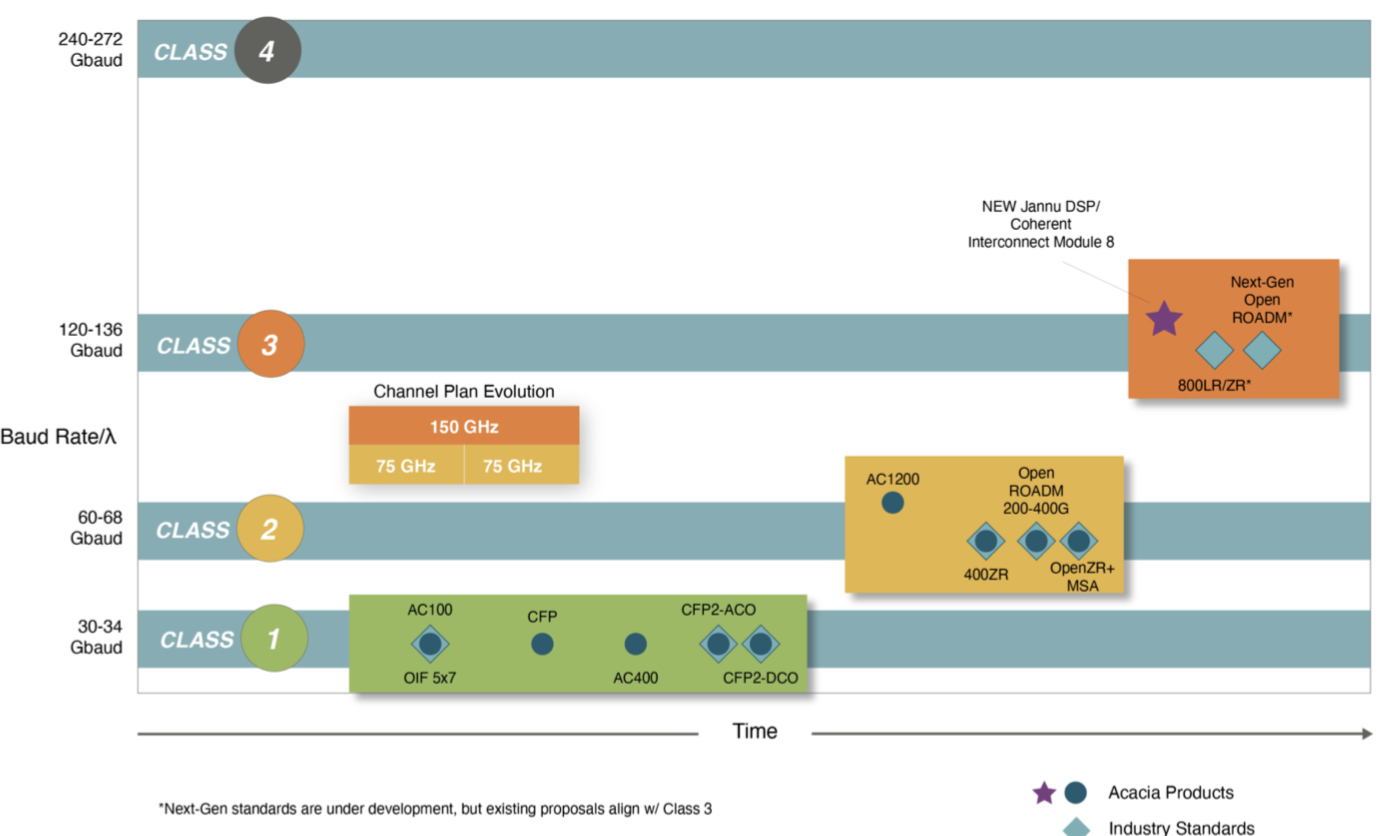
Acacia also highlights that future generation coherent designs, what it calls class 4 (see diagram above), will double the symbol rate again to some 240GBd. But the company is not saying whether the technology enabling such rates will be silicon photonics.
The company has long spoken of the benefits of using a silicon packaging approach for its coherent modules in terms of size, power and automated manufacturing. But as the symbol rate doubles, packaging plays a key role to help tackle challenging radio frequency (RF) design issues.
Acacia stacks the driver and trans-impedance amplifier (TIA) circuitry directly on top of its photonic integrated circuit (PIC) while its coherent DSP is also packaged as part of the design. “This gives us much better signal integrity than if we have the optics and DSP packaged separately,” says Williams.
The key to the design is getting the silicon photonics – the optical modulator, in particular – operating at 140GBd. “If you can, the packaging advantages of silicon are significant,” says Williams.
Acacia points out that with the migration of traffic from 100GbE to 400GbE it makes sense to offer a single-wavelength multi-rate design. And 400GbE will remain the mainstay traffic for a while. But once the transition to 800 gigabit occurs, the idea of supporting two coherent wavelengths – a future dual-wavelength “AC2400” – may make sense.
CIM-8
Acacia is using its own form factor and not a multi-source agreement (MSA) because the 1.2-terabit technology exceeds all existing client-side data rates.
In turn, the power consumption of the 1.2-terabit coherent module requires a custom form factor while launching an MSA based on the CIM-8 would have tipped off the competition, says Williams.
That said, Acacia has made no secret that its next high-end design following on from its 64GBd AC1200 would double the symbol rate and that the company would skip the 96GBd rate used by vendors such as Ciena, Huawei and Infinera already offering 800-gigabit wavelength systems.
For Acacia’s multi-rate design that needs to address submarine applications, the goal is to maximise transmission performance. In contrast, for a ZR+ coherent design that fits in a QSFP-DD, the limited power budget of the module constrains the design’s performance.
With 5nm Jannu DSP, Acacia realised it could not fit the design in the QSFP-DD or OSFP. But it could produce a pluggable multi-haul design with its CIM-8 that is slightly larger than the CFP2 form factor. And pluggables are advantageous when 4-8 can be fitted in a one-rack-unit (1RU) platform.
Acacia says its 140GBd module using 16-QAM will deliver an 800-gigabit wavelength over 90 per cent of the links of a North American operator. For the remaining, longest-distance links (the 10 per cent), it will revert to 400 gigabits.
In contrast, existing 800-gigabit systems operating at 96GBd cover up to 20 per cent of the links before having to revert to the slower speed, says Acacia.
Applications
Hyperscaler data centre operators are the main drivers for 1.2Tbps interconnects. The interface would typically be used in the metro to link smaller data centres to a larger aggregation data centre.
“The 1.2-terabit interface is just trying to maximise cost per bit; pushing more bits over the same set of optics,” says Williams.
The communications service providers’ requirements, meanwhile, are focussed on 400 gigabits and at some point will migrate to 800 gigabits, says Williams.
Several system vendors are expected to announce products using the new module in the coming months.

ADVA’s 800-gigabit CoreChannel causes a stir

ADVA’s latest addition to its FSP 3000 TeraFlex platform provides 800-gigabit optical transmission. But the announcement has caused a kerfuffle among its optical transport rivals.
ADVA’s TeraFlex platform supports various coherent optical transport sleds, a sled being a pluggable modular unit that customises a platform’s functionality.
The coherent sleds use Cisco’s (formerly Acacia Communication’s) AC1200 optical engine. Cisco completed the acquisition of Acacia in March.
The AC1200 comprises a 16nm CMOS Pico coherent digital signal processor (DSP) that supports two wavelengths, each up to 600-gigabit, and two photonic integrated circuits (PICs), for a maximum capacity of 1.2 terabits.
The latest sled from ADVA, dubbed CoreChannel, supports an 800-gigabit stream in a single channel.
ADVA states in its press release that the CoreChannel uses “140 gigabaud (GBd) sub-carrier technology” to deliver 800-gigabit over distances exceeding 1,600km.
This, the company says, improves reach by over 50 per cent compared with state-of-the-art 95GBd symbol rate coherent technologies.
It is these claims that have its rivals reacting.
“Despite their claims – they are not using actual digital sub-carriers,” says one executive from a rival optical transport firm, adding that what ADVA is doing is banding two independent 70GBd 400-gigabit wavelengths together and trying to treat that as a single 800-gigabit signal.
“This isn’t necessarily a bad solution for some applications – each network operator can decide that for themselves,” says the executive. However, he stresses that the CoreChannel is not an 800-gigabit single-channel solution and uses 4th generation 16nm CMOS DSP technology rather than the latest 5th generation, 7nm CMOS DSP technology.
A second executive, from another optical transport vendor providing 800-gigabit single-wavelength solutions, adds that ADVA’s claim of 140GBd is too ‘creative’ for a two-lambda solution.
“It’s not a real 800 gigabit. Not that this must be bad, but one should call things as they are,” the spokesperson said. “What matters to the operators is the cost, power consumption, reach and density of a modem; the number of lambdas is more of an internal feature.”
CoreChannel
ADVA confirms it is indeed using Cisco’s Pico coherent DSP to drive two wavelengths, each at 400 gigabits-per-second (Gbps).
“You can say the CoreChannel is a less challenging requirement because we are not driving it [the Pico DSP] to the maximum modulation or constellation complexity,” says Stephan Rettenberger, senior vice president, marketing and investor relations at ADVA. “It is the lower end of what the AC1200 can do.”
Until now the two wavelengths have been combined externally, and have not been integrated from a software or a command-and-control approach.
“The CoreChannel sled is just another addition to the TeraFlex toolbox,” says Rettenberger. “It has one physical line interface that drives an 800Gbps stream using two wavelengths, each one around 70GBd, that are logically and physically combined.”
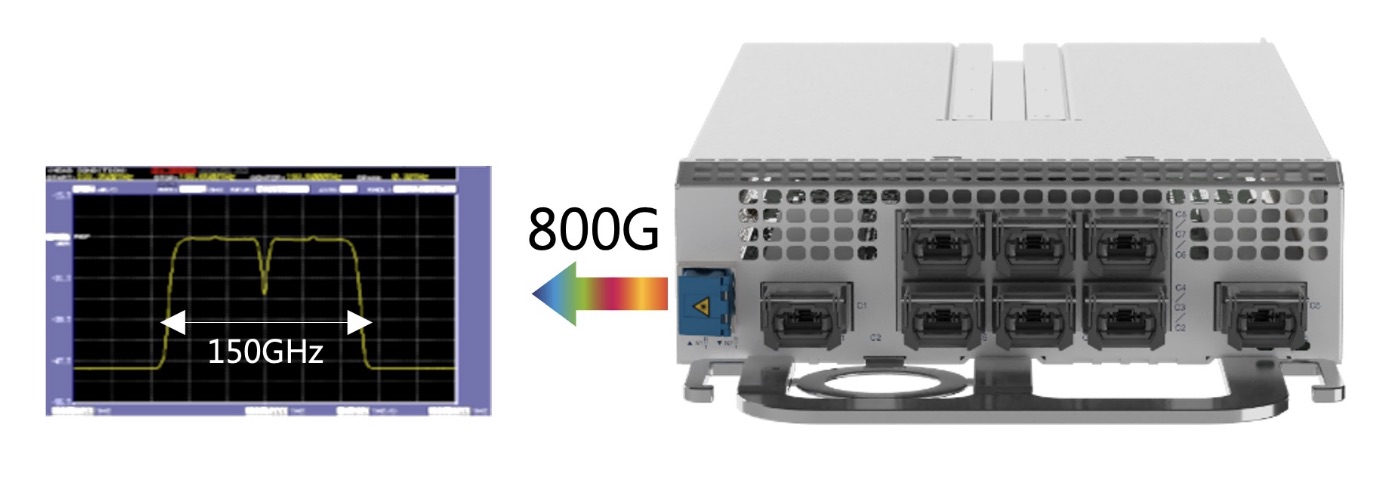
The resulting two-wavelength 800-gigabit stream sits within a 150GHz channel. However, the channel width can be reduced to 125GHz and even 112.5GHz for greater spectral efficiency.
ADVA says the motivation for the design is the customers’ requirement for lower-cost transport and the ability to easily transport 400 Gigabit Ethernet (GbE) client signals.
“With this 800-gigabit line speed, you can go something like 2,000km, that is 50-100 per cent more than what 95GBd single-wavelengths solutions will do,“ says Rettenberger. “And you can also drive it at 400 gigabits and you can do something like 6,000km.”
The reaches quoted are based on a recent field trial involving ADVA.
ADVA uses a single DSP, similar to the latest 800-gigabit systems from Ciena, Huawei and Infinera. Alongside the DSP are two non-hermetically-sealed PICs whereas the 95GBd indium-phosphide solutions use a single hermetically sealed gold box.
ADVA’s solution also requires two lasers whereas the 800-gigabit single-wavelength solutions use one laser.
“Yes, we have two lasers versus one but that is not killing the cost,” says Rettenberger. “And it is also not killing the power consumption because the PIC is so much more power efficient.”
Rettenberger stresses that ADVA is not saying its offering is necessarily a better solution. “But it is a very interesting way to drive 800 gigabits further than these 95 gigabaud solutions,” says Rettenberger. “It has the same cost, space, power efficiency, just greater reach.”
ADVA also agrees that it is not using electrical sub-carriers such as Infinera uses but it is using optical sub-carrier technology.
These two wavelengths are combined logically and also from a physical port interface point of view to fit within a 150GHz window.
The 95GBd, in contrast, is an interim symbol rate step and the resulting 112.5GHz channel width doesn’t easily fit with legacy 25GHz and 50GHz band increments, says ADVA, while the 150GHz band the CoreChannel sled uses is the same channel width that will be used once single-wavelength 140GBd technology becomes available.
Acacia has also long talked about the merit of doubling the baud rate suggesting Cisco’s successor to the AC1200 will have a 140GBd symbol rate. Such a design is expected in the next year or two.
“We feel this [CoreChannel] implementation is already future-proofed,” says Rettenberger.
ADVA says it undertook this development in collaboration with Acacia.
Acacia announced a dual-wavelength single-channel AC1200 solution in 2019. Then, the company unveiled its AC1200-SC2 that delivers 1.2 terabits over an optical channel.
The SC2 (single chip, single channel) is an upgrade of Acacia’s AC1200 module in that it sends 1.2 terabits using two sub-carriers that fit in a 150GHz-wide channel.

Customer considerations
Choosing an optical solution comes down to five factors, each having its weight depending on the network application, says the first executive.
These are capacity-per-wavelength, cost-per-bit, capacity-per- optical-engine or -module, spectral efficiency and hence capacity-per-fibre, and power-per-bit.
“Each is measured for a given distance/ network application,” says the executive. “And the reason the weight changes for different applications is that the importance of each factor is different at different points in the network. For example, the importance of spectral efficiency changes depending on how expensive it is to light up a link (fibre and line system costs).”
For long-haul and submarine, spectral efficiency is the most important factor, while for metro it is typically cost-per-bit. Meanwhile, for data centre interconnect applications, it’s a mix between cost-per-bit and power-per-bit. Capacity-per-wave and capacity-per-optical-engine are valuable because they can reduce the number of wavelengths and modules that need to be deployed, reducing operating expenses and accelerating service activation.
“The reason that 5th generation [7nm CMOS technology] is superior to fourth generation [16nm] DSP technology is that it provides superior performance in every single one of those key criteria,” says the executive. “This fact minimised any potential benefits that could be achieved by banding together two wavelengths using 4th generation technology when compared to a single wavelength using 5th generation technology.”
“It sounds like others feel we have misled the market; that was not the intent,” says Rettenberger.
ADVA does not make its own coherent DSP so it doesn’t care if the chip is implemented using a 16nm, 7nm or a 5nm CMOS process.
“We are trying to build a good solution for transmitting 400GbE signals and, for us, the Pico chip is a wonderful piece of technology that we have now implemented in four different [sled] variants of TeraFlex.”