

QSFP28 MicroMux expands 10 & 40 Gig faceplate capacity
- ADVA Optical Networking's MicroMux aggregates lower rate 10 and 40 gigabit client signals in a pluggable QSFP28 module
- ADVA is also claiming an industry first in implementing the Open Optical Line System concept that is backed by Microsoft
The need for terabits of capacity to link Internet content providers’ mega-scale data centres has given rise to a new class of optical transport platform, known as data centre interconnect.
 Source: ADVA Optical Networking
Such platforms are designed to be power efficient, compact and support a variety of client-side signal rates spanning 10, 40 and 100 gigabit. But this poses a challenge for design engineers as the front panel of such platforms can only fit so many lower-rate client-side signals. This can lead to the aggregate data fed to the platform falling short of its full line-side transport capability.
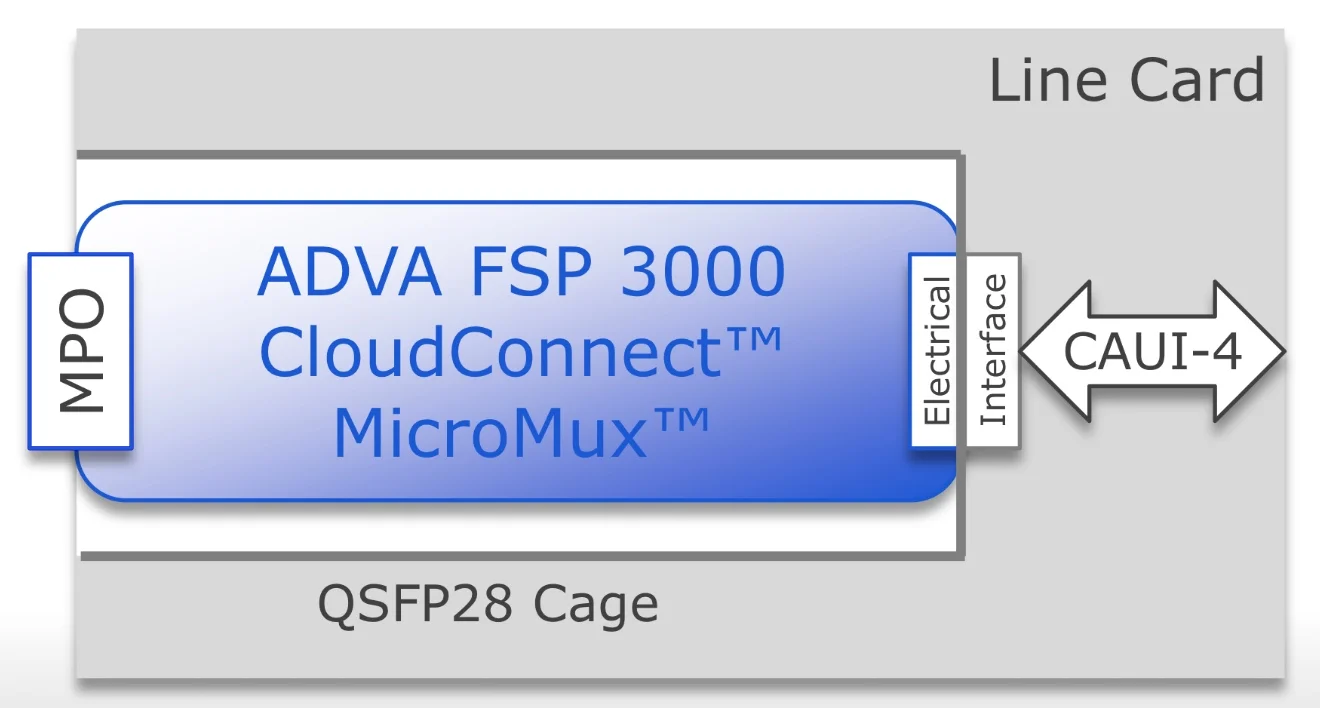
ADVA Optical Networking has tackled the problem by developing the MicroMux, a multiplexer placed within a QSFP28 module. The MicroMux module plugs into the front panel of the CloudConnect, ADVA’s data centre interconnect platform, and funnels either 10, 10-gigabit ports or two, 40-gigabit ports into a front panel’s 100-gigabit port.
"The MicroMux allows you to support legacy client rates without impacting the panel density of the product," says Jim Theodoras, vice president of global business development at ADVA Optical Networking.
Using the MicroMux, lower-speed client interfaces can be added to a higher-speed product without stranding line-side bandwidth. An alternative approach to avoid wasting capacity is to install a lower-speed platform, says Theodoras, but then you can't scale.
ADVA Optical Networking offers four MicroMux pluggables for its CloudConnect data centre interconnect platform: short-reach and long-reach 10-by-10 gigabit QSFP28s, and short-reach and intermediate-reach 2-by-40 gigabit QSFP28 modules.
The MicroMux features an MPO connector. For the 10-gigabit products, the MPO connector supports 20 fibres, while for the 40-gigabit products, it is four fibres. At the other end of the QSFP28, that plugs into the platform, sits a CAUI-4 4x25-gigabit electrical interface (see diagram above).
“The key thing is the CAUI-4 interface; this is what makes it all work," says Theodoras.
Inside the MicroMux, signals are converted between the optical and electrical domains while a gearbox IC translates between 10- or 40-gigabit signals and the CAUI-4 format.
Theodoras stresses that the 10-gigabit inputs are not the old 100 Gigabit Ethernet 10x10 MSA but independent 10 Gigabit Ethernet streams. "They can come from different routers, different ports and different timing domains," he says. "It is no different than if you had 10, 10 Gigabit Ethernet ports on the front face plate."
Using the pluggables, a 5-terabit CloudConnect configuration can support up to 520, 10 Gigabit Ethernet ports, according to ADVA Optical Networking.
The first products will be shipped in the third quarter to preferred customers that help in its development while the products will be generally available at the year-end.
ADVA Optical Networking unveiled the MicroMux at OFC 2016, held in Anaheim, California in March. ADVA also used the show to detail its Open Optical Line System demonstration with switch vendor, Arista Networks.
Two years after Microsoft first talked about the [Open Optical Line System] concept at OFC, here we are today fully supporting it
Open Optical Line System
The Open Optical Line System is a concept being promoted by the Internet content providers to afford them greater control of their optical networking requirements.
Data centre players typically update their servers and top-of-rack switches every three years yet the optical transport functions such as the amplifiers, multiplexers and ROADMs have an upgrade cycle closer to 15 years.
“When the transponding function is stuck in with something that is replaced every 15 years and they want to replace it every three years, there is a mismatch,” says Theodoras.
Data centre interconnect line cards can be replaced more frequently with newer cards while retaining the chassis. And the CloudConnect product is also designed such that its optical line shelf can take external wavelengths from other products by supporting the Open Optical Line System. This adds flexibility and is done in a way that matches the work practices of the data centre players.
“The key part of the Open Optical Line System is the software,” says Theodoras. “The software lets that optical line shelf be its own separate node; an individual network element.”
The data centre operator can then manage the standalone CloudConnect Open Optical Line System product. Such a product can take coloured wavelength inputs and even provide feedback with the source platform, so that the wavelength is tuned to the correct channel. “It’s an orchestration and a management level thing,” says Theodoras.
Arista recently added a coherent line card to its 7500 spine switch family.
The card supports six CFP2-ACOs that have a reach of up to 2,000km, sufficient for most data centre interconnect applications, says Theodoras. The 7500 also supports the layer-two MACsec security protocol. However, it does not support flexible modulation formats. The CloudConnect does, supporting 100-, 150- and 200-gigabit formats. CloudConnect also has a 3,000km reach.
 Source: ADVA Optical Networking
In the Open Optical Line System demonstration, ADVA Optical Networking squeezed the Arista 100-gigabit wavelength into a narrower 37.5GHz channel, sandwiched between two 100 gigabit wavelengths from legacy equipment and two 200 gigabit (PM-16QAM) wavelengths from the CloudConnect Quadplex card. All five wavelengths were sent over a 2,000km link.
Implementing the Open Optical Line System expands a data centre manager’s options. A coherent card can be added to the Arista 7500 and wavelengths sent directly using the CFP2-ACOs, or wavelengths can be sent over more demanding links, or ones that requires greater spectral efficiency, by using the CloudConnect. The 7500 chassis could also be used solely for switching and its traffic routed to the CloudConnect platform for off-site transmission.
Spectral efficiency is important for the large-scale data centre players. “The data centre interconnect guys are fibre-poor; they typically only have a single fibre pair going around the country and that is their network,” says Theodoras.
The joint demo shows that the Open Optical Line System concept works, he says: “Two years after Microsoft first talked about the concept at OFC, here we are today fully supporting it.”

Arista adds coherent CFP2 modules to its 7500 switch
 Martin Hull
Several optical equipment makers have announced ‘stackable’ platforms specifically to link data centres in the last year.
Infinera’s Cloud Xpress was the first while Coriant recently detailed its Groove G30 platform. Arista’s announcement offers data centre managers an alternative to such data centre interconnect platforms by adding dense wavelength-division multiplexing (DWDM) optics directly onto its switch.
For customers investing in an optical solution, they now have an all-in-one alternative to an optical transport chassis or the newer stackable data centre interconnnect products, says Martin Hull, senior director product management at Arista Networks. Insert two such line cards into the 7500 and you have 12 ports of 100 gigabit coherent optics, eliminating the need for the separate optical transport platform, he says.
The larger 11RU 7500 chassis has eight card slots such that the likely maximum number of coherent cards used in one chassis is four or five - 24 or 30 wavelengths - given that 40 or 100 Gigabit Ethernet client-side interfaces are also needed. The 7500 can support up to 96, 100 Gigabit Ethernet (GbE) interfaces.
Arista says the coherent line card meets a variety of customer needs. Large enterprises such as financial companies may want two to four 100 gigabit wavelengths to connect their sites in a metro region. In contrast, cloud providers require a dozen or more wavelengths. “They talk about terabit bandwidth,” says Hull.
With the CFP2-ACO, the DSP is outside the module. That allows us to multi-source the optics
As well as the CFP2-ACO modules, the card also features six coherent DSP-ASICs. The DSPs support 100 gigabit dual-polarisation, quadrature phase-shift keying (DP-QPSK) modulation but do not support the more advanced quadrature amplitude modulation (QAM) schemes that carry more bits per wavelength. The CFP2-ACO line card has a spectral efficiency that enables up to 96 wavelengths across the fibre's C-band.
Did Arista consider using CFP coherent optical modules that support 200 gigabit, and even 300 and 400 gigabit line rates using 8- and 16-QAM? “With the CFP2-ACO, the DSP is outside the module,” says Hull. “That allows us to multi-source the optics.”
The line card also includes 256-bit MACsec encryption. “Enterprises and cloud providers would love to encrypt everything - it is a requirement,” says Hull. “The problem is getting hold of 100-gigabit encryptors.” The MACsec silicon encrypts each packet sent, avoiding having to use a separate encryption platform.
CFP4-ACO and COBO
As for denser CFP4-ACO coherent modules, the next development after the CFP2-ACO, Hull says it is still too early, as it is with for 400 gigabit on-board optics being developed by COBO and which is also intended to support coherent. “There is a lot of potential but it is still very early for COBO,” he says.
“Where we are today, we think we are on the cutting edge of what can be delivered on a line card,” says Hull. “Getting everything onto that line card is an engineering achievement.”
Future developments
Arista does not make its own custom ASICs or develop optics for its switch platforms. Instead, the company uses merchant switch silicon from the likes of Broadcom and Intel.
According to Hull, such merchant silicon continues to improve, adding capabilities to Arista’s top-of-rack ‘leaf’ switches and its more powerful ‘spine’ switches such as the 7500. This allows the company to make denser, higher-performance platforms that also scale when coupled with software and networking protocol developments.
Arista claims many of the roles performed by traditional routers can now be fulfilled by the 7500 such as peering, the exchange of large routing table information between routers using the Border Gateway Protocol (BGP). “[With the 7500], we can have that peering session; we can exchange a full set of routes with that other device,” says Hull.
"We think we are on the cutting edge of what can be delivered on a line card”
The company uses what it calls selective route download where the long list of routes is filtered such that the switch hardware is only programmed with the routes to be communicated with. Hull cites as an example a content delivery site that sends content to subscribers. The subscribers are typically confined to a known geographic region. “I don’t need to have every single Internet route in my hardware, I just need the routes to reach that state or metro region,” says Hull.
By having merchant silicon that supports large routing tables coupled with software such as selective route download, customers can use a switch to do the router’s job, he says.
Arista says that in 2016 and 2017 it will continue to introduce leaf and spine switches that enable data centre customers to further scale their networks. In September Arista launched Broadcom Tomahawk-based switches that enable the transition from 10 gigabit server interfaces to 25 gigabit and the transition from 40 to 100 gigabit uplinks.
Longer term, there will be 50 GbE and iterations of 400 and one terabit Ethernet, says Hull. And all this relates to the switch silicon. At present 3.2 terabit switch chips are common and already there is a roadmap to 6.4 and even 12.8 terabits by increasing both the chip’s pin count and using PAM-4 alongside the 25 gigabit signalling to double input/ output again. A 12.8 terabit switch may be a single chip, says Hull, or it could be multiple 3.2 terabit building blocks integrated together.
“It is not just a case of more ports on a box,” says Hull. “The boxes have to be more capable from a hardware perspective so that the software can harness that.”