

ECOC 2019 industry reflections

Gazettabyte is asking industry figures for their thoughts after attending the recent ECOC show, held in Dublin. In particular, what developments and trends they noted, what they learned and what, if anything, surprised them. Here are the first responses from Huawei, OFS Fitel and ADVA.
James Wangyin, senior product expert, access and transmission product line at Huawei
At ECOC, one technology that is becoming a hot topic is machine learning. There is much work going on to model devices and perform optimisation at the system level.
And while there was much discussion about 400-gigabit and 800-gigabit coherent optical transmissions, 200-gigabit will continue to be the mainstream speed for the coming three-to-five years.
That is because, despite the high-speed ports, most networks are not being run at the highest speed. More time is also needed for 400-gigabit interfaces to mature before massive deployment starts.
BT and China Telecom both showed excellent results running 200-gigabit transmissions in their networks for distances over 1,000km.
We are seeing this with our shipments; we are experiencing a threefold year-on-year growth in 200-gigabit ports.
Another topic confirmed at ECOC is that fibre is a must for 5G. People previously expressed concern that 5G would shrink the investment of fibre but many carriers and vendors now agree that 5G will boost the need for fibre networks.
As for surprises at the show, the main discussion seems to have shifted from high-speed optics to system-level or device-level optimisation using machine learning.
Many people are also exploring new applications based on the fibre network.
For example, at a workshop to discuss new applications beyond 5G, a speaker from Orange talked about extending fibre connections to each room, and even to desktops and other devices. Other operators and systems vendors expressed similar ideas.
Verizon discussed, in another market focus talk, its monitoring of traffic and the speed of cars using fibre deployed alongside roads. This is quite impressive.
We are also seeing the trend of using fibre and 5G to create a fully-connected world.
Such applications will likely bring new opportunities to the optical industry.
Two other items to note.
The Next Generation Optical Transport Network Forum (NGOF) presented updates on optical technologies in China. Such technologies include next-generation OTN standardisation, the transition to 200 gigabits, mobile transport and the deployment of ROADMs. The NGOF also seeks more interaction with the global community.
The 800G Pluggable MSA was also present at ECOC. The MSA is also keen for more companies to join.
Daryl Inniss, director, new business development at OFS Fitel
There were many discussions about co-packaged optics, regarding the growth trends in computing and the technology’s use in the communications market.
This is a story about high-bandwidth interfaces and not just about linking equipment but also the technology’s use for on-board optical interconnects and chip-to-chip communications such as linking graphics processing units (GPUs).
I learned that HPE has developed a memory-centric computing system that improves significantly processing speed and workload capacity. This may not be news but it was new to me. Moreover, HPE is using silicon photonics in its system including a quantum dot comb laser, a technology that will come for others.
As for surprises, there was a notable growing interest in spatial-division multiplexing (SDM). The timescale may be long term but the conversations and debate were lively. Two areas to watch are in proprietary applications such as very short interconnects in a supercomputer and for undersea networks where the hyperscalers quickly consume the capacity on any newly commission link.
Lastly, another topic of note was the use of spectrum outside the C-band and extending the C-band itself to increase the data-carrying capacity of the fibre.
Jörg-Peter Elbers, senior vice president, advanced technology, ADVA
Co-packaging optics with electronics is gaining momentum as the industry moves to higher and higher silicon throughput. The advent of 51.2 terabit-per-second (Tbps) top-of-rack switches looks like a good interception point. Microsoft and Facebook also have a co-packaged optics collaboration initiative.
As for coherent, quo vadis? Well, one direction is higher speeds and feeds. What will the next symbol rate be for coherent after 60-70 gigabaud (GBd)? A half-step or a full-step; incremental or leap-frogging? The growing consensus is a full-step: 120-140 GBd.
Another direction for coherent is new applications such as access/ aggregation networks. Yet cost, power and footprint challenges will have to be solved.
Advanced optical packaging, an example being the OIF IC-TROSA project, as well as compact silicon photonics and next-gen coherent DSPs are all critical elements here.
A further issue arising from ECOC is whether optical networks need to deliver more than just bandwidth.
Latency is becoming increasingly important to address time-sensitive applications as well as for advanced radio technologies such as 5G and beyond.
Additional applications are the delivery of precise timing information (frequency, time of day, phase synchronisation) where the existing fibre infrastructure can be used to deliver additional services.
An interesting new field is the use of the communication infrastructure for sensing, with Glenn Wellbrock giving a presentation on Verizon’s work at the Market Focus.
Other topics of note include innovation in fibres and optics for 5G.
With spatial-division multiplexing, interest in multi-core and multi-mode fibre applications have weakened. Instead, more parallel fibres operating in the linear regime appear as an energy-efficient, space-division multiplexing alternative.
Hollow-core fibres are also making progress, offering not only lower latencies but lower nonlinearity compared to standard fibres.
As for optics for 5G, what is clear is that 5G requires more bandwidth and more intelligence at the edge. How network solutions will look will depend on fibre availability and the associated cost.
With eCPRI, Ethernet is becoming the convergence protocol for 5G transport. While grey and WDM (G.metro) optics, as well as next-generation PON, are all being discussed as optical underlay options. Grey and WDM optics offer an unbundling on the fibre/virtual fibre level whereas (TDM-)PON requires bitstream access.
Another observation is that radio “x-haul” [‘x’ being front, mid or back] will continue to play an important role for locations where fibre is nonexistent and uneconomical.


Acacia bets on silicon as coherent enters its next phase
Gazettabyte interviewed Acacia Communications’ president and CEO, Murugesan ‘Raj’ Shanmugaraj, as the coherent technology company celebrates its 10th anniversary.

Raj Shanmugaraj
Acacia Communications has come a long way since Raj Shanmugaraj (pictured) first joined the company as CEO in early 2010. “It was just a few conference rooms and we didn't have enough chairs,” he says.
The company has since become a major optical coherent player with revenues of $340 million in 2018; revenues that would have been higher but for the four-month trade ban imposed by the US on Chinese equipment maker ZTE, an Acacia customer.
And as the market for coherent technology continues to grow, Acacia and other players are preparing for new opportunities.
“We are still in the early stages of the disruption," says Shanmugaraj. “You will see higher performance [coherent systems] in some parts of the network but there is going to be growth as coherent moves closer to the network edge.”
Here, lower power, flexibility and more integrated coherent solutions will be needed as the technology moves inside the data centre and closer to the network edge with the advent of 5G, higher-speed access and the Internet of Things (IoT).
Competitive landscape
Shanmugaraj prefers to focus on Acacia’s own strengths and products when asked about the growing competition in the coherent marketplace. However, recent developments present challenges for the company.
Systems vendors such as Huawei and Ciena are becoming more vertically integrated, developing not only their own coherent digital signal processor (DSP) ASICs but also optics. Ciena has also made its WaveLogic Ai DSP available to optical module makers Lumentum and NeoPhotonics and will sell its own optical modules using its latest WaveLogic 5 coherent silicon.
>
“You will see higher performance [coherent systems] in some parts of the network but there is going to be growth as coherent moves closer to the network edge ”
New coherent digital signal processor (DSP) players are also expected to enter the marketplace alongside established competitors, NEL and Inphi. The entrance of new players developing coherent DSPs is motivated by the unit volumes promised by 400ZR, the emerging 80km data centre interconnect interface standard.
“We are proponents of the fact that the merchant market will continue to grow, driven by interoperability and standardisation,” says Shanmugaraj. Such growth will lead to multiple markets where coherent technology will play. “There are going to be a few winners, not just one or two,” he says.
Acacia’s revenues were hit in 2018 following the US Department of Commerce’s enforced trade ban imposed on ZTE. However, the company recorded a strong fourth quarter posting revenues of $107 million, up almost a quarter on the revenues a year earlier. This followed strong ZTE orders after the ban was revoked.
Shanmugaraj says diversification has always been a priority for the company, independent of the trade issues between the US and China. The company has also been working to diversify its Chinese customer base. “So we are well positioned as these trade issues get resolved,” he says.
Origins
Acacia was established in mid-2009 by a core team from Mintera, a sub-system supplier that provided 40-gigabit DPSK line cards to network equipment suppliers. But Mintera folded and was eventually sold to Oclaro in July 2010.
Before joining Acacia, Shanmugaraj was at systems vendor Alcatel-Lucent where he learned two lessons.
One is that the long-term success of a company is based on technology leadership. “You want to be driven by technology or you fall behind your competitors,” he says. The second lesson was that the largest systems companies build products internally before an ecosystem becomes established, after which they buy from merchant suppliers.
This matched the vision of Acacia’s founders that sought to exploit their optical expertise gained at Mintera to become a leading merchant supplier of coherent transmission technology.
Stealth years
Acacia remained in secrecy for nearly half its existence, only revealing its technology and products in 2014 with the launch of the AC-100 CFP coherent pluggable module. The AC-100 is aimed at metro networks delivering a transmission reach of 80km to 1,200km. However, Acacia had already been selling 5x7-inch modules for 100-gigabit long-haul and ultra-long-haul applications as well as a 40-gigabit ultra-long-haul module.
“In the early years, there were just a few companies working on coherent,” says Shanmugaraj. “We had to be careful in terms of what products we were developing and what customers we were going after.”
Shanmugaraj says Acacia secured multi-million dollar commitments from customers even before it had a product. “It was the expertise of the founding team as well as the product concepts they were proposing that got them the commitments,” he says.
The backing enabled the company to manage with only $53 million of venture funding prior to its successful initial public offering in 2016.
“This was a pretty significant feat,” says Shanmugaraj. “Hardware start-ups, whether semiconductor or systems companies, use significantly more cash; these are expensive technologies to get off the ground.”
Shanmugaraj describes the early years as intense, with staff working between 60 and 70 hours a week.The then start-up had to be prudent with funding, not growing too quickly yet having sufficient resources to meet orders from systems customers that had their own orders to fulfil.
Coherent technologies
Acacia’s founders chose silicon for its coherent solutions, to replace ‘exotic materials’ such as indium phosphide and lithium niobate used in traditional optical transmission systems.
The company backed silicon photonics for the coherent optics, an industry trailblazing decision. To this aim, Acacia recruited Chris Doerr, the renowned optical integration specialist and Bell Labs Fellow.
The company also decided to develop its own coherent DSPs. By developing the optics and the DSP, Acacia could use a co-design approach when designing the hardware, trading off the performance of the optics and the signal processing to achieve an optimal design.
Shanmugaraj explains that the company chose a silicon-based approach to exploit the huge investment made by the semiconductor industry in chips and their packaging. Basing the components on silicon would not only simplify high-speed networks, he says, but it would also lower their power consumption and enable products to be made more quickly and cheaply.
“The beauty of silicon photonics is that it can be placed right next to a heat source, in this case, the high-power coherent DSP ASIC that generates a lot of heat,” says Shanmugaraj. “This allows for smaller form-factor designs.” In contrast, indium phosphide-based optics need to be temperature controlled when placed next to a hot chip, he says.
“Five or six years ago, people were challenging whether silicon photonics was even going to work at 100 and 200 gigabits,” says Shanmugaraj. Acacia has now used silicon photonics in all its products, including its latest high-end 1.2 terabits AC1200 coherent module.
Shanmugaraj sees Acacia's portfolio of coherent products as the company's biggest achievement: "You see start-ups that come out with one product that is a bestseller but we have continued to innovate and today we have a broad portfolio."
AC1200
The AC1200 module supports two optical wavelengths, each capable of supporting 100 to 600-gigabit transmissions in increments of 50 gigabits.
The AC1200 can be used for data centre interconnect links through to long distance submarine links. Acacia recently demonstrated the AC1200 transmitting a 400-gigabit signal over a 6,600km submarine cable.
“We are seeing strong interest in our AC1200 from network operators and expect our equipment customers to begin deployments this quarter,” says Shanmugaraj.
There are several reasons why network operators are choosing to deploy the AC1200, he says: “High capacity is important in data centre interconnect edge applications where we expect hyperscale operators may use the AC1200 in its full 1.2-terabit mode, but these applications are also sensitive to cost, power and density.”
The AC1200 also provides higher capacity in a smaller footprint than the 5x7-inch form factors currently available, he says, while for longer-reach applications, the AC1200 offers a combination of performance and flexibility that is setting the pace for the competition.
The data centre interconnect market represents a good opportunity for coherent interconnect suppliers because the operators drive and deploy technology at pace, says Shanmugaraj. Hyperscalers are continually looking to add more capacity in the same size and power constraints that exist today. Accordingly, this has been a priority development area for Acacia.
To increase capacity, companies have boosted the symbol rate from 32 gigabaud to 64 gigabaud while systems vendors Ciena and Infinera have recently detailed upcoming systems that support 800-gigabit wavelengths that use a symbol rate approaching 100 gigabaud.
The AC1200, which is due in systems in the coming quarter, demonstrates silicon photonics based modulation operating at up to 70 gigabaud while first indium-phosphide 800-gigabit per wavelength systems are due by the year-end.
“We don’t really see silicon photonics lagging behind indium phosphide,” says Shanmugaraj. “We think there is a path to even higher baud rates with silicon photonics, and 128 gigabaud is the next logical step up because it would double the data rate without needing to increase the modulation order.”
Higher modulation orders are also possible but the benefits must be weighed against increased complexity, he says.
400-gigabit coherent pluggables
Shanmugaraj says that the 400ZR pluggable module standard continues the trend to reduce the size and power consumption of optical transport systems in the data centre.
>
“You want to be driven by technology or you fall behind your competitors”
The current generation of data centre interconnect platforms, ranging from a 1 rack unit pizza box to a several rack-unit-sized chassis, were developed to be more compact than conventional optical transport platforms.
Now, with the advent of 400ZR that fits into a client-side QSFP-DD or OSFP module, data centre operators will be able to do away with such platforms for distances up to 80km by plugging the modules into the switch or router platforms and connecting them to open line systems.
“Costs come down because it [coherent] is getting down to the client-side form factors and that gives the hyperscalers more faceplate density,” says Shanmugaraj. “The hyperscalers also gain multi-vendor interoperability [with 400ZR] which is important as they want standardisation.”
Shanmugaraj admits that with the advent of 400ZR will bring greater competition. But he points out that the 400ZR is a complicated product to built that will challenge companies. Those players that have both the optics and a low-power DSP will have an advantage. “As long as it opens up the market wider, it is good for Acacia as it is in our control how we can win in the market,” says Shanmugaraj.
The industry expectation is that the 400ZR will start to be deployed in the second half of 2020.
There is also industry talk about 400ZR+, an interface that will be able to go beyond 80km that will require more advanced dispersion compensation and forward error correction schemes.
Shanmugaraj says it will be the same DSP ASIC that will support both the 400ZR and 400ZR+. However, a 400ZR+ interface will consume more power and so will likely require a larger module form factor than the ZR.
Meanwhile, the 400-gigabit CFP2-DCO pluggable for metro networks is built along the same lines as the 400ZR, says Shanmugaraj.
“Here you have applications like the Open ROADM MSA where network operators are trying to drive the same interoperability and not be stuck with one vendor,” he says. “This is driving the 400-gigabit evolution in the metro network for some of the largest telcos.”
There is also the open networking packet-optical opportunity, white-box platforms such as the Voyager and Cassini being developed by the Telecom Infra Project (TIP). Shanmugaraj says such white boxes rely on software solutions that are a work-in-progress and that much work is still to be done.
“The first generation showed that there is more work required to standardise the software and how that can be used by the hyperscalers,” he says. “It is an opportunity but we view it as more of a longer-term one.”
Emerging opportunities
The markets that are growing today are the metro, long haul, sub-sea and data centre interconnect, says Shanmugaraj.
The coherent applications that are emerging will result in products within the data centre as well as for 5G, access, the Internet of Things (IoT) and even autonomous vehicles.
Ultimately, what will lead to coherent being adopted within the data centre is the speed of the interfaces. “As you go to higher speeds, direct detection technology gets constrained [due to dispersion and other impairments],” says Shanmugaraj.
But for this to happen certain conditions will need to be met: the speed of interfaces on switches will need to increase, not just to 400 gigabits but 800 gigabits and greater.
“Looking to higher data rates beyond 400 gigabits, it gets more challenging for direct detect to achieve the necessary link budgets cost-effectively,” says Shanmugaraj. “It may be necessary to move from four-lane solutions to eight lanes in order to support the desired reaches. At the same time, we are working to make coherent more cost-effective for these applications.”
The other two conditions are the challenge of what form factors the coherent technology be squeezed into, andcost. Coherent optics is more expensive but its cost is driven by such factors as volumes, the level of automation that can be used to make the module, and the yield.
“There could be inflextion points where coherent becomes cost-competitive for some applications in the data centre,” says Shanmugaraj.
Companies will continue to innovate in both direct detect and coherent technologies and the market will determine the transition points. “But we do believe that coherent can be adopted inside data centres in the future,” he says.
In turn, metro and long-haul networks are already being upgraded in anticipation of 5G and the access requirements. “4G networks have a lot of 1-gigabit and 10-gigabit links but 5G has an order of magnitude higher throughput requirement,” says Shanmugaraj.
That means more capacity is needed for backhaul and that will lead to a proliferation of low-cost 100-gigabit coherent. A similar story is unfolding in access with the likes of the cable operators moving fibre closer to the network edge. This too will need low-cost 100-gigabit coherent interfaces.
IoT is a longer term opportunity and will be dependent on dense deployments of devices before the traffic will require sufficient aggregation to justify coherent.
“I don’t know if your refrigerator will have a coherent interface,” concludes Shanmugaraj. “But as you aggregated these [devices] into aggregation points, that becomes a driver for coherent at the edge.”


Access drives a need for 10G compact aggregation boxes
Infinera has unveiled a platform to aggregate multiple 10-gigabit traffic streams originating in the access network.
The 1.6-terabit HDEA 1600G platform is designed to aggregate 80, 10-gigabit wavelengths. The use of ten-gigabit wavelengths in access continues to grow with the advent of 5G mobile backhaul and developments in cable and passive optical networking (PON).
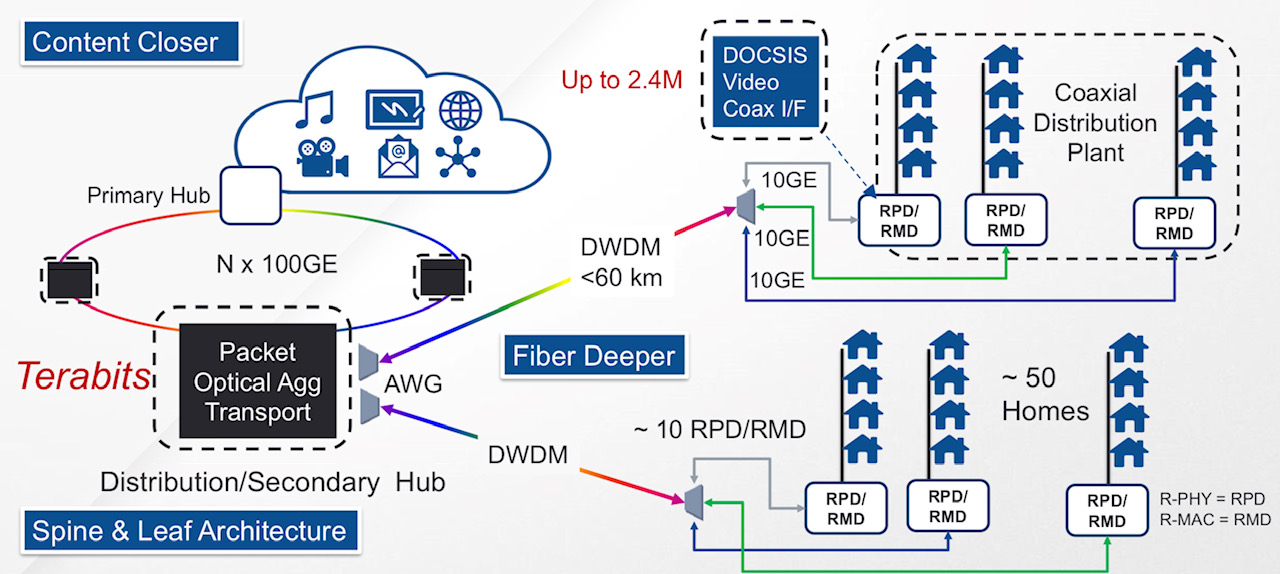
A distributed access architecture being embraced by cable operators. Shown are the remote PHY devices (RPD) or remote MAC-PHY devices (RMD), functionality moved out of the secondary hub and closer to the end user. Also shown is how DWDM technology is moved closer to the edge of the network. Source: Infinera.
A distributed access architecture being embraced by cable operators. Shown are the remote PHY devices (RPD) or remote MAC-PHY devices (RMD), functionality moved out of the secondary hub and closer to the end user. Also shown is how DWDM technology is moved closer to the edge of the network. Source: Infinera.
Infinera has adopted a novel mechanical design for its 1 rack unit (1RU) HDEA 1600G that uses the sides of the platform to fit 80 SFP+ optical modules.
The platform also features a 1.6-terabit Ethernet switch chip that aggregates the traffic from the 10-gigabit streams to fill 100-gigabit wavelengths that are passed to other switching or transport platforms for transmission into the network.
Distributed access architecture
Jon Baldry, metro marketing director at Infinera, cites the adoption of a distributed access architecture (DAA) by cable operators as an example of 10-gigabit links that are set to proliferate in the access network.
DAA is being adopted by cable operators to compete with the telecom operators’ rollout of fibre-to-the-home (FTTH) broadband access technology.
A recent report by market research firm, Ovum, addressing DAA in the North American market, discusses how the architectural approach will free up space in cable headends, reduce the operators’ operational costs, and allow the delivery of greater bandwidth to subscribers.
Implementing DAA involves bringing fibre as well as cable network functionality closer to the user. Such functionality includes remote PHY devices and remote MAC-PHY devices. It is these devices that will use a 10-gigabit interface, says Baldry: “The traffic they will be running at first will be two or three gigabits over that 10-gigabit link.”
Julie Kunstler, principal analyst at Ovum’s Network Infrastructure and Software group, says the choice whether to deploy a remote PHY or a remote MAC-PHY architecture is a issue of an operator's ‘religion’. What is important, she says, is that both options exploit the existing hybrid fibre coax (HFC) architecture to boost the speed tiers delivered to users.

The current, pre-DAA, cable network architecture. Source: Infinera.
In the current pre-DAA architecture, the cable network comprises cable headends and secondary distribution hubs (see diagram above). It is at the secondary hub that the dense wavelength-division multiplexing (DWDM) network terminates. From there, RF over fibre is carried over the hybrid fibre-coax (HFC) plant. The HFC plant also requires amplifier chains to overcome cable attenuation and the losses resulting from the cable splits that deliver the RF signals to the homes.
Typically, an HFC node in the cable network serves up to 500 homes. With the adoption of DAA and the use of remote PHYs, the amplifier chains can be removed with each PHY serving 50 homes (see diagram top).
“Basically DWDM is being pushed out to the remote PHY devices,” says Baldry. The remote PHYs can be as far as 60km from the secondary hub.
“DAA is a classic example where you will have dense 10-gigabit links all coming together at one location,” says Baldry. “Worst case, you can have 600-700 remote PHY devices terminating at a secondary hub.”
The same applies to cellular.
At present 4G networks use 1-gigabit links for mobile backhaul but 5G will use 10-gigabit and 25-gigabit links in a year or two. “So the edge of the WDM network has really jumped from 1 gigabit to 10 gigabit,” says Baldry.
It is the aggregation of large numbers of 10-gigabit links that the HDEA 1600G platform is designed to address.
HDEA 1600G
Only a certain number of pluggable interfaces can fit on the front panel of a 1RH box. To accommodate 80, 10-gigabit streams, the two sides of the platform are used for the interfaces. Using the HDEA’s sides creates much more space for the 1RU’s input-output (I/O) compared to traditional transport kit, says Baldry.
The 40 SFP+ modules on each side of the platform are accessed by pulling the shelf out and this can be done while it is operational (see photo below). Such an approach is used for supercomputing but Baldry believes Infinera is the first to adopt it for a transport product.
Infinera has also adopted MPO connectors to simplify the fibre management involved in connected 80 SFP+, each module requiring a fibre pair.
The HDEA 1600 has two groups of four MPO connectors on the front panel. Each MPO cluster connects 40 modules on each side, with each MPO cable having 20 fibres to connect 10 SFP+ modules.
A site terminating 400 remote PHYs, for example, requires the connection of 40 MPO cables instead of 800 individual fibres, says Baldry, simplifying installation greatly.
>
“DAA is a classic example where you will have dense 10-gigabit links all coming together at one location. Worst case, you can have 600-700 remote PHY devices terminating at a secondary hub.”
The other end of the MPO cable connects to a dense multiplexer-demultiplexer (mux-demux) unit that separates the individual 10-gigabit access wavelengths received over the DWDM link.
Each mux-demux unit uses an arrayed waveguide grating (AWG) that is tailored to the cable operators’ wavelengths needs. The 24-channel mux-demux design supports 20, 100GHz-wide channels for the 10-gigabit wavelengths and four wavelengths reserved for business services. Business services have become an important part of the cable operators’ revenues.
Infinera says the HDEA platform supports the extended C-band for a total of 96 wavelengths.
The company says it will develop different AWG configurations tailored for the wavelengths and channel count required for the different access applications.
In the rack, the HDEA aggregation platform takes up one shelf, while eight mux-demux units take up another 1RU. Space is left in between to house the cabling between the two.

The HDEA 1600G pulled out of the rack, showing the MPO connectors and the space to house the cabling between the HDEA and the rack of compact AWGs. Source: Infinera.
Baldry points out that the four business service wavelengths are not touched by the HDEA platform, Rather, these are routed to separate Ethernet switches dedicated to business customers. "We break those wavelengths out and hand them over to whatever system the operator is using," he says.
The HDEA 1600G also features eight 100-gigabit line-side interfaces that carry the aggregated cable access streams. Infinera is not revealing the supplier of the 1.6 terabit switch silicon - 800-gigabit for client-side capacity and 800-gigabit for line-side capacity - it is using for the HDEA platform.
The platform supports all the software Infinera uses for its EMXP, a packet-optical switch tailored for access and aggregation that is part of Infinera’s XTM family of products. Features include multi-chassis link aggregation group (MC-LAG), ring protection, all the Metro Ethernet Forum services, and synchronisation for mobile networks, says Baldry
Auto-Lambda
Infinera has developed what it calls its Auto-Lambda technology to simplify the wavelength management of the remote PHY devices.
Here, the optics set up the connection instead of a field engineer using a spreadsheet to determine which wavelength to use for a particular remote PHY. Tunable SFP+ modules can be used at the remote PHY devices only with fixed-wavelength (grey) SFP+ modules used by the HDEA platform to save on costs, or both ends can use tunable optics. Using tunable SFP+ modules at each end may be more expensive but the operator gains flexibility and sparing benefits.

Jon Baldry
Establishing a link when using fixed optics within the HDEA platform, the SFP+ is operated in a listening mode only. When a tunable SFP+ transceiver is plugged in at a remote PHY, which could be days later, it cycles through each wavelength. The blocking nature of the AWG means that such cycling does not disturb other wavelengths already in use.
Once the tunable SFP+ reaches the required wavelength, the transmitted signal is passed through the AWG to reach the listening transceiver at the switch. On receipt of the signal, the switch SFP+ turns on its transmitter and talks to the remote transceiver to establish the link.
For the four business wavelengths, both ends of the link use auto-tunable SFP+ modules, what is referred to a duel-ended solution. That is because both end-point systems may not be Infinera platforms and may have no knowledge as to how to manage WDM wavelengths, says Baldry.
In this more complex scenario, the time taken to establish a link is theoretically much longer. The remote end module has to cycle through all the wavelengths and if no connection is made, the near end transceiver changes its transmit wavelength and the remote end’s wavelength cycling is repeated.
Given that a sweep can take two minutes or more, an 80-wavelength system could take close to three hours in the worst case to establish the link; an unacceptable delay.
Infinera is not detailing how its duel-ended scheme works but a combination of scanning and communications is used between the two ends. Infinera had shown such a duel-ended scheme set up a link in 4 minutes and believes it can halve that time.
Finisar detailed its own Flextune fast-tuning technology at ECOC 2018. However, Infinera stresses its technology is different.
Infinera says it is talking to several pluggable optical module makers. “They are working on 25-gigabit optics which we are going to need for 5G,” says Baldry. “As soon as they come along, with the same firmware, we then have auto-tunable for 5G.”
System benefits
Infinera says its HDEA design delivers several benefits. Using the sides of the box means that the platform supports 80 SFP+ interfaces, twice the capacity of competing designs. In turn, using MPO connectors simplifies the fibre management, benefiting operational costs.
Infinera also believes that the platform’s overall power consumption has a competitive edge. Baldry says Infinera incorporates only the features and hardware needed. “We have deliberately not done a lot of stuff in Layer 2 to get better transport performance,” he says. The result is a more power-efficient and lower latency design. The lower latency is achieved using ‘thin buffers’ as part of the switch’s output-buffered queueing architecture, he says.
The platform supports open application programming interfaces (APIs) such that cable operators can make use of such open framework developments as the Cloud-Optimised Remote Datacentre (CORD) initiative being developed by the Open Networking Foundation. CORD uses open-source software-defined networking (SDN) technology such as ONOS and the OpenFlow protocol to control the box.
An operator can also choose to use Infinera’s Digital Network Administrator (DNA) management software, SDN controller, and orchestration software that it has gained following the Coriant acquisition.
The HDEA 1600G is generally available and in the hands of several customers.

Intel targets 5G fronthaul with a 100G CWDM4 module
- Intel announced at ECOC that it is sampling a 10km extended temperature range 100-gigabit CWDM4 optical module for 5G fronthaul.
- Another announced pluggable module pursued by Intel is the 400 Gigabit Ethernet (GbE) parallel fibre DR4 standard.
- Intel, a backer of the CWDM8 MSA, says the 8-wavelength 400-gigabit module will not be in production before 2020.
Intel has expanded its portfolio of silicon photonics-based optical modules to address 5G mobile fronthaul and 400GbE.
 Robert BlumAt the European Conference on Optical Communication (ECOC) being held in Rome this week, Intel announced it is sampling a 100-gigabit CWDM4 module in a QSFP form factor for wireless fronthaul applications.
The CWDM4 module has an extended temperature range, -20°C to +85°C, and a 10km reach.
“The final samples are available now and [the product] will go into production in the first quarter of 2019,” says Robert Blum, director of strategic marketing and business development at Intel’s silicon photonics product division.
Intel also announced it will support the 400GBASE-DR4, the IEEE’s 400 GbE standard that uses four parallel fibres for transmit and four for the receive path, each carrying a 100-gigabit 4-level pulse amplitude modulation (PAM-4) signal.
5G wireless
5G wireless will be used for a variety of applications. Already this year the first 5G fixed and mobile wireless services are expected to be launched. 5G will also support massive Internet of Things (IoT) deployments as well as ultra-low latency applications.
The next-generation wireless standard uses new spectrum that includes millimetre wave spectrum in the 24GHz to 40GHz region. Such higher frequency bands will drive small-cell deployments.
5G’s use of new spectrum, small cells and advanced air interface techniques such as multiple input, multiple output (MIMO) antenna technology is what will enable its greater data speeds and vastly expanded capacity compared to the current LTE cellular standard.
 Source: Intel.
The 5G wireless standard will also drive greater fibre deployment at the network edge. And it is here where mobile fronthaul plays a role, linking the remote radio heads at the antennas with the centralised baseband controllers at the central office (see diagram). Such fronthaul links will use 25-gigabit and 100-gigabit links. “We have multiple customers that are excited about the 100-gigabit CWDM4 for these applications,” says Blum
Intel expects demand for 25-gigabit and 100-gigabit transceivers for mobile fronthaul to begin in 2019.
Intel is now producing over one million PSM4 and CWDM4 modules a year
Client-side modules
Intel entered the optical module market with its silicon photonics technology in 2016 with a 100-gigabit PSM4 module, quickly followed by a 100-gigabit CWDM4 module. Intel is now producing over one million PSM4 and CWDM4 modules a year.
Intel will provide customers with 400-gigabit DR4 samples in the final quarter of 2018 with production starting in the second half of 2019. This is when Intel says large-scale data centre operators will require 400 gigabits.
“The initial demand in hyperscale data centres for 400 gigabits will not be for duplex [fibre] but parallel fibre,” says Blum. “So we expect the DR4 to go to volume first and that is why we are announcing the product at ECOC.”
Intel says the advantages of its silicon photonics approach have already been demonstrated with its 100-gigabit PSM4 module. One is the optical performance resulting from the company’s heterogeneous integration technique combining indium-phosphide lasers with silicon photonics modulators on the one chip. Another advantage is scale using Intel’s 300mm wafer-scale manufacturing.
Intel says demand for the 500m-reach DR4 module to go hand-in-hand with that for the 100-gigabit single- wavelength DR1, given how the DR4 will also be used in breakout mode to interface with four DR1 modules.
“We don’t see the DR1 standard competing or replacing 100-gigabit CWDM4,” says Blum. “The 100-gigabit CWDM4 is now mature and at a very attractive price point.”
Intel is a leading proponent of the CWDM8 MSA, an optical module design based on eight wavelengths, each a 50 gigabit-per-second (Gbps) non-return-to-zero (NRZ) signal. The CWDM8 MSA was created to fast-track 400 gigabit interfaces by avoiding the wait for 100-gigabit PAM-4 silicon.
When the CWDM8 MSA was launched in 2017, the initial schedule was to deploy the module by the end of this year. Intel also demonstrated the module working at the OFC show held in March.
Now, Intel expects production of the CWDM8 in 2020 and, by then, other four-wavelength solutions using 100-gigabit PAM-4 silicon such as the 400G-FR4 MSA will be available.
“We just have to see what the use case will be and what the timing will be for the CWDM8’s deployment,” says Blum.
ONF’s operators seize control of their networking needs
- The eight ONF service providers will develop reference designs addressing the network edge.
- The service providers want to spur the deployment of open-source designs after becoming frustrated with the systems vendors failing to deliver what they need.
- The reference designs will be up and running before year-end.
- New partners have committed to join since the consortium announced its strategic plan
The service providers leading the Open Networking Foundation (ONF) will publish open designs to address next-generation networking needs.
 Timon SloaneThe ONF service providers - NTT Group, AT&T, Telefonica, Deutsche Telekom, Comcast, China Unicom, Turk Telekom and Google - are taking a hands-on approach to the design of their networks after becoming frustrated with what they perceive as foot-dragging by the systems vendors.
“All eight [operators] have come together to say in unison that they are going to work inside the ONF to craft explicit plans - blueprints - for the industry for how to deploy open-source-based solutions,” says Timon Sloane, vice president of marketing and ecosystem at the ONF.
The open-source organisation will develop ‘reference designs’ based on open-source components for the network edge. The reference designs will address developments such as 5G and multi-access edge and will be implemented using cloud, white box, network functions virtualisation (NFV) and software-defined networking (SDN) technologies.
By issuing the designs and committing to deploy them, the operators want to attract select systems vendors that will work with them to fulfil their networking needs.
Remit
The ONF is known for such open-source projects as the Central Office Rearchitected as a Datacenter (CORD) and the Open Networking Operating System (ONOS) SDN controller.
The ONF’s scope has broadened over the years, reflecting the evolving needs of its operator members. The organisation’s remit is to reinvent the network edge. “To apply the best of SDN, NFV and cloud technologies to enable not just raw connectivity but also the delivery of services and applications at the edge,” says Sloane.
The network edge spans from the central office to the cellular tower and includes the emerging edge cloud that extends the ‘edge’ to such developments as the connected car and drones.
The operators have been hopeful the whole vendor community would step up and start building solutions and embracing this approach but it is not happening at the speed operators want, demand and need
“The edge cloud is called a lot of different things right now: multi-access edge computing, fog computing, far edge and distributed cloud,” says Sloane. “It hasn’t solidified yet.”
One ONF open-source project is the Open and Disaggregated Transport Network (ODTN), led by NTT. “ODTN is edge related but not exclusively so,” says Sloane. “It is starting off with a data centre interconnect focus but you should think of it as CORD-to-WAN connectivity.”
The ONF’s operators spent months formulated the initiative, dubbed the Strategic Plan, after growing frustrated with a supply chain that has failed to deliver the open-source solutions they need. “The operators have been hopeful the whole vendor community would step up and start building solutions and embracing this approach but it is not happening at the speed operators want, demand and need,” says Sloane.
The ONF’s initiative signals to the industry that the operators are shifting their spending to open-source solutions and basing their procurement decisions on the reference designs they produce.
“It is a clear sign to the industry that things are shifting,” says Sloane. “The longer you sit on the sidelines and wait and see what happens, the more likely you are to lose your position in the industry.”
If operators adopt open-source software and use white boxes based on merchant silicon, how will systems vendors produce differentiated solutions?
“All this goes to show why this is disruptive and creating turbulence in the industry,” says Sloane.
Open-source design equates to industry collaboration to develop shared, non-differentiated infrastructure, he says. That means system vendors can focus their R&D tackling new issues such as running and automating networks, developing applications and solving challenges such as next-generation radio access and radio spectrum management.
“We want people to move with the mark,” says Sloane. “It is not just building a legacy business based on what used to be unique and expecting to build that into the future.”
Reference designs
The operators have identified five reference designs: fixed and mobile broadband, multi-access edge, leaf-and-spine architectures, 5G at the edge, and next-generation SDN.
The ONF has already done much work in fixed and mobile broadband with its residential and mobile CORD projects. Multi-access edge refers to developing one network to serve all types of customers simultaneously, using cloud techniques to shift networking resources dynamically as needed.
At first glance, it is unclear what the ONF can contribute to leaf-and-spine architectures. But the ONF is developing SDN-controlled switch fabric that can perform advanced packet processing, not just packet forwarding.
The ONF’s initiative signals to the industry that the operators are shifting their spending to open-source solutions and basing their procurement decisions on the reference designs they produce.
Sloane says that many virtualised tasks today are run on server blades using processors based on the x86 instruction set. But offloading packet processing tasks to programmable switch chips - referred to as networking fabric - can significantly benefit the price-performance achieved.
“We can leverage [the] P4 [programming language for data forwarding] and start to do things people never envisaged being done in a fabric,” says Sloane, adding that the organisation overseeing P4 is going to merge with the ONF.
The 5G reference design is one application where such a switch fabric will play a role. The ONF is working on implementing 5G network core functions and features such as network slicing, using the P4 language to run core tasks on intelligent fabric.
The ONF has already done work separating the radio access network (RAN) controller from radio frequency equipment and aims to use SDN to control a pool of resources and make intelligent decisions about the placement of subscribers, workloads and how the available radio spectrum can best be used.
The ONF’s fifth reference design addresses next-generation SDN and will use work that Google has developed and is contributing to the ONF.
The ONF manages the OpenFlow protocol, used to define the separation between the control and data forwarding planes. But the ONF is the first to admit that OpenFlow overlooked such issues as equipment configuration and operational issues.
The ONF is now engaged in a next-generation SDN initiative. “We are taking a step back and looking at the whole problem, to address all the pieces that didn’t get resolved in the past,” says Sloane.
Google has also contributed two interfaces that allow device management and the ONF has started its Stratum project that will develop an open-source solution for white boxes to expose these interfaces. This software residing on the white box has no control intelligence and does not make any packet-forwarding decisions. That will be done by the SDN controller that talks to the white box via these interfaces. Accordingly, the ONF is updating its ONOS controller to use these new interfaces.
 Source: ONF
From reference designs to deployment
The ONF has a clear process to transition its reference designs to solutions ready for network deployment.
The reference designs will be produced by the eight operators working with other ONF partners. “The reference design is to help others in the industry to understand where you might choose to swap in another open source piece or put in a commercial piece,” says Sloane.
This explains how the components are linked to the reference design (see diagram above). The ONF also includes the concept of the exemplar platform, the specific implementation of the reference design. “We have seen that there is tremendous value in having an open platform, something like Residential CORD,” says Sloane. “That really is what the exemplar platform is.”
The ONF says there will be one exemplar platform for each reference design but operators will be able to pick particular components for their implementations. The exemplar platform will inevitably also need to interface to a network management and orchestration platform such as the Linux Foundation’s Open Network Automation Platform (ONAP) or ETSI’s Open Source MANO (OSM).
The process of refining the reference design and honing the exemplar platform built using specific components is inevitably iterative but once completed, the operators will have a solution to test, trial and, ultimately, deploy.
The ONF says that since announcing the strategic plan a month ago, several new partners - as yet unannounced - have committed to join.
“The intention is to have the reference designs up and running before the end of the year,” says Sloane.
Ciena goes stackable with 8180 'white box' and 6500 RLS
Ciena has unveiled two products - the 8180 coherent networking platform and the 6500 reconfigurable line system - that target cable and cellular operators that are deploying fibre deep in their networks, closer to subscribers.
The 6500 line system is also aimed at the data centre interconnect market given how the webscale players are experiencing a near-doubling of traffic each year.
 Source: Ciena
The cable industry is moving to a distributed access architecture (DAA) that brings fibre closer to the network’s edge and splits part of the functionality of the cable modem termination system (CMTS) - the remote PHY - closer to end users. The cable operators are deploying fibre to boost the data rates they can offer homes and businesses.
Both Ciena’s 8180 modular switch and the 6500 reconfigurable line system are suited to the cable network. The 8180 is used to link the master headend with primary and secondary hub sites where aggregated traffic is collected from the digital nodes (see network diagram). The 8180 platforms will use the modular 6500 line system to carry the dense wavelength-division multiplexed (DWDM) traffic.
 “The [cable] folks that are modernising the access network are not used to managing optical networking,” says Helen Xenos, senior director, portfolio marketing at Ciena (pictured). “They are looking for simple platforms, aggregating all the connections that are coming in from the access.”
The 8180 can play a similar role for wireless operators, using DWDM to carry aggregated traffic for 4G and 5G networks.
Ciena says the 6500 optical line system will also serve the data centre interconnect market, complementing the WaveServer Ai, Ciena’s second-generation 1RU modular platform that has 2.4 terabits of client-side interfaces and 2.4 terabits of coherent capacity.
With the 8180, you are only using the capacity on the fibre that you have traffic for
“They [the webscale players] are looking for as many efficiencies as they can get from the platforms they deploy,” says Xenos. “The 6500 reconfigurable line system gives them the flexibility they need - a colourless, directionless, contentionless [reconfigurable optical add-drop multiplexer] and a flexible grid that extends to the L-band.”
A research note from analyst house, Jefferies, published after the recent OFC show where Ciena announced the platforms, noted that in many cable networks, 6-strand fibre is used: two fibre pairs allocated for business services and one for residential. Adding the L-band to the existing C-band effectively doubles the capacity of each fibre pair, it noted.
The 8180
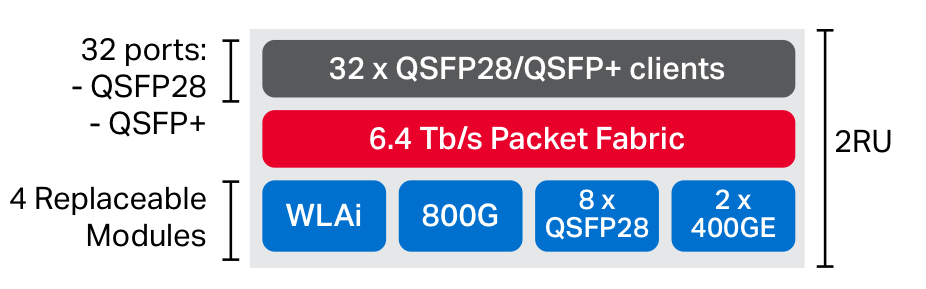
Ciena’s 8180 is a modular packet switch that includes coherent optics. The 8180 is similar in concept to the Voyager and Cassini white boxes developed by the Telecom Infra Project. However, the 8180 is a two-rack-unit (2RU) 6.4-terabit switch compared to the 1RU, 2-terabit Voyager and the 1.5RU 3.2-terabit Cassini. The 8180 also uses Ciena’s own 400-gigabit coherent DSP, the WaveLogic Ai, rather than merchant coherent DSP chips.
The platform comprises 32 QSFP+/ QSFP28 client-side ports, a 6.4-terabit switch chip and four replaceable modules or ‘sleds’, each capable of accommodating 800 gigabits of capacity. The options include an initial 400-gigabit line-side coherent interface (a sled with two coherent WaveLogic Ai DSPs will follow), an 8x100-gigabit QSFP28 sled, a 2x400-gigabit sled and also the option for an 800-gigabit module once they become available.
 Source: Ciena
Using all four sleds as client-side options, the 8180 becomes a 6.4-terabit Ethernet switch. Using only coherent sleds instead, the packet-optical platform has a 1.6-terabit line-side capacity. And because there is a powerful switch chip integrated, the input ports can be over-subscribed.“With the 8180, you are only using the capacity on the fibre that you have traffic for,” says Xenos.
6500 line system
The 6500 reconfigurable line system is also a modular design. Aimed at the cable, wireless, and data centre interconnect markets, only a subset of Ciena’s existing optical line systems features is used.
“The 6500 software has a lot of capabilities that the content providers are not using,” says Xenos. “They just want to use it as a photonic layer.”
There are three 6500 reconfigurable line system platform sizes: 1RU, 2RU and 4RU. The chassis can be stacked and managed as one unit. Card options that fit within the chassis include amplifiers and reconfigurable optical add-drop multiplexers (ROADMs).
The amplifier options area dual-line Erbium-doped fibre amplifiercard that includes an integrated bi-directional optical time-domain reflectometer (OTDR) used to characterise the fibre. There is also a half-line-width RAMAN amplifier card. The line system will support the C and L bands, as mentioned.
The reconfigurable line system also has ROADM cards: a 1x12 wavelength-selective switch (WSS) with integrated amplifier, a colourless 16-channel add-drop that support channels of any size (flexible grid), and a full-width card 1x32 WSS. “The 1x32 would be used for colourless, directionless and directionless [ROADM] configurations,” says Xenos.
The 6500 reconfigurable line system also supports open application porgramming interfaces (APIs) for telemetry, with a user able to program the platform to define the data streamed.“The platform can also be provisioned via REST APIs; something a content provider will do,” she says.
Ciena is a member of the OpenROADM multi-source agreement and was involved in last year’s AT&T OpenROADM trial with its 6500 Converged Packet Optical Transport (POTS) platform.
Will the 6500 reconfigurable line system be OpenROADM-compliant?
“This card [and chassis form factor] could be used for OpenROADM if AT&T preferred this platform to the other [6500 Converged POTS] one,” says Xenos. “You also have to design the hardware to meet the specifications for OpenROADM.”
Ciena expects both platforms to be available by year-end. The 6500 reconfigurable line system will be in customer trials at the end of this quarter while the 8180 will be trialed by the end of the third quarter.
Oclaro makes available its EMLs and backs 400G-FR4
Lumentum’s plan to acquire Oclaro for $1.8 billion may have dominated the news at last month’s OFC show held in San Diego, but it was business as usual for Oclaro with its product and strategy announcements.
 Adam Carter, chief commercial officer (pictured), positions Oclaro’s announcements in terms of general industry trends.
“On the line side, everywhere there are 100-gigabit and 200-gigabit wavelengths, you will see that transition to 400 gigabit and 600 gigabit,” he says. “And on the client side, you have 100 gigabit going to 400 gigabit.”
400G-FR
Oclaro announced it will offer the QSFP56-DD module implementing 400-FR4, the four-wavelength 400-gigabit 2km client-side interface. The 400G-FR4 is a design developed by the 100G Lambda MSA.
“This [QSFP-DD FR4] will enable our customers, particularly network equipment manufacturers, to drive 400 gigabit up to 36 ports in a one-rack-unit [platform],” says Carter.
Oclaro has had the required optical components - its 53-gigabaud lasers and high-end photo-detectors - for a while. What Oclaro has lacked is the accompanying 4-level pulse amplitude modulation (PAM-4) gearbox chip to take the 8x50 gigabits-per-second electrical signals and encode them into four 50-gigabaud ones.
The chips have now arrived for testing and if the silicon meets the specs, Oclaro will deliver the first modules to customers later this year.
Oclaro chose the QSFP-DD first as it expects the form factor to sell in higher volumes but it will offer the 400G-FR4 in the OSFP module.
Certain customers prefer the OSFP, in part because of its greater power-handling capabilities. “Some people believe that the OSFP’s power envelope gives you a little bit more freedom,” he says. “There is still a debate in the industry whether the QSFP-DD will be able to do long-reach [80km data centre interconnect] types of products.”
Oclaro says its transmit and receive optical sub-assemblies (TOSAs and ROSAs) are designed to fit within the more demanding QSFP-DD such they will also suit the OSFP.
If people want to buy the [EML] chips and do next-generation designs, they can come to Oclaro
EMLs for sale
Oclaro has decided to sell its electro-absorption modulated lasers (EMLs), capable of 25, 50 and 100-gigabit speeds.
“If people want to buy the chips and do next-generation designs, they can come to Oclaro for some top-end single-mode chipsets that we have developed for our own use,” says Carter.
Oclaro's EMLs are used for both coarse wavelength-division multiplexing (CWDM) and the tighter LAN-WDM wavelength grid based client-side interfaces and are available in uncooled and cooled packages.
Until now the company only sold its 25-gigabit directly modulated lasers (DMLs). “We have been selling [EMLs] strategically to one very large customer who consigns them to a manufacturer,” says Carter.
The EMLs are being made generally available due to demand. “There are not many manufacturers of this chip in the world,” says Carter, adding that the decision also reflects an evolving climate for business models.
5G and cable
Oclaro claims it is selling the industry’s first 10-gigabit tunable SFP+ operating over industrial temperature (I-temp) ranges: -40 to 85oC. There are two tunable variants spanning 40km and 80km, both supporting up to 96 dense WDM (DWDM) channels on a fibre. The module was first announced at OFC 2017.
Oclaro says cable networks and 5G wireless will require the I-temp tunable SFP+.
The cable industry’s adoption of a distributed access architecture (DAA) brings fibre closer to the network’s edge and splits part of the functionality of the cable modem termination system (CMTS) - the remote PHY - closer to the residential units. This helps cable operators cope with continual traffic growth and their facilities becoming increasingly congested with equipment. Comcast, for example, says it is seeing an annual growth in downstream traffic (to the home) of 40-50 percent.
The use of tunable SFP+ modules boost the capacity that can be sent over a fibre, says Carter. But the tunable SFP+ modules are now located at the remote PHY, an uncontrolled temperature environment.
For 5G, the 10Gbps tunables will carry antenna traffic to centralised base stations. Carter points out that the 40km and 80km reach of the tunable SFP+ will not be needed in all geographies but in China, for example, the goal is to limit the number of central offices such that the distances are greater.
Oclaro also offers an I-temp fixed-wavelength 25-gigabit SFP28 LR module. “It is lower cost than the tunable SFP+ so if you need 10km [for mobile fronthaul], you would tend to go for this transceiver,” says Carter.
Also unveiled is an optical chip combining a 1310nm distributed feedback laser (DFB) laser and a Mach-Zehnder modulator. “The 1310nm device will be used in certain applications inside the data centre,” says Carter. “There are customers that are looking at using PAM-4 interfaces for short-reach connections between leaf and spine switches.” The device will support 50-gigabit and 100-gigabit PAM-4 wavelengths.
Line-side optics
Oclaro announced it is extending its integrated coherent transmitter and integrated coherent receiver to operate in the L-band. The coherent optical devices support a symbol rate of up to 64 gigabaud to enable 400-gigabit and 600-gigabit wavelengths.
Telcos want to use the L-band alongside the C-band to effectively double the capacity of a fibre.
Also announced by Oclaro at OFC was a high-bandwidth co-packaged modulator driver, an indium phosphide-based Mach-Zehnder modulator.
Oclaro was part of the main news story at last year’s OFC when Ciena announced it would share its 400-gigabit WaveLogic Ai coherent digital signal processor (DSP) with three module makers: Oclaro, Lumentum and NeoPhotonics. Yet there was no Oclaro announcement at this year’s OFC regarding the transponder.
Carter says the WaveLogic Ai transponder is sampling and that it has been demonstrated to customers and used in several field trials: “It is still early right now with regard volume deployments so there is nothing to announce yet."
5G-PON: SK Telecom’s unified distribution network
SK Telecom has detailed a networking architecture based on wavelength division multiplexing-passive optical network (WDM-PON) technology that it says will simplify the rollout of 5G while delivering significant cost savings.
 The telecom operator has already deployed the networking architecture, dubbed 5G-PON, for its LTE network and is offering the design to the 5G network standards of the ITU-T.
“SK Telecom is already witnessing a great amount of cost reductions from the deployment of 5G-PON,” says Seungjoo Hong, manager of the Broadband Technology Lab at SK Telecom (pictured).
5G-PON
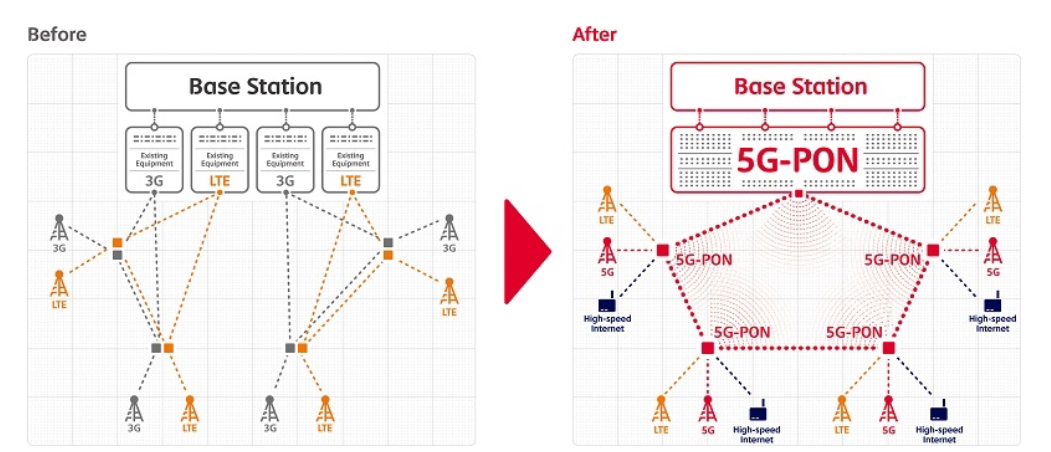
5G-PON provides a single distribution network for both cellular - LTE and 5G - and high-speed wireline broadband (see diagram).
 Source: SK Telecom
The architecture reduces networking costs by reusing existing fibre and optical filters while expanding capacity to support different and growing traffic streams. The architecture also uses passive nodes that do not require electrical power.
The 5G-PON network comprises three main elements: a central office terminal, the remote node and a tunable SFP pluggable module.
The central office terminal is located at the cellular base band unit (BBU) and performs such functions as wavelength conversion for WDM transmission, the monitoring of the optical link, and the management and configuration - location and order - of the remote nodes. The central office terminal also collects and analyses digital diagnostic monitoring information sent over an auxiliary management and control channel.
SK Telecom is already witnessing a great amount of cost reductions from the deployment of 5G-PON
The second element, the remote node, is a passive optical wavelength router, says Hong, and can be placed indoors or outdoors at a remote site. The remote node comprises a filter for coarse WDM (CWDM) and a filter for dense WDM (DWDM) and supports an optical ring topology between the first stage nodes - called the main radio node - as well as multi-stage node configurations such as a main and sub radio nodes (see the diagram below).
 Different 5G-PON configurations. SK Telecom favours a single-fibre ring arrangement. Source: SK Telecom
The central office terminal has knowledge of the order and location of the remote site nodes. This ensures a seamless service by performing delay equalisation due to optical path differences while executing ring protection switching within 50ms when a fibre is cut.
Meanwhile, the tunable SFP is installed at the cellular remote radio head (RRH). The tunable SFP is a low-cost design; it does not use a wavelength locker such that the SFP’s tunable laser is not dependent on a specific wavelength grid. The SFP is operated at the remote radio head using a software wavelength locking function that tracks the centre of the WDM filter using received optical power information from the central office terminal sent via an auxiliary management and control channel.
5G-PON has halved the cost of installation while operations and maintenance costs have been reduced 70 percent
CWDM architecture
5G-PON’s WDM-PON architecture uses CWDM with sub-channels.
The architecture can use existing installed fibre and filters while expanding capacity to a total of 256 wavelengths (16 sub-channels in each of 16 CWDM 20nm-wide bands), such that it can work alongside existing CWDM, DWDM and time-division multiplexing PON (TDM-PON) deployments.
“To expand network capacity in an area, operators can easily deploy a basestation using their existing fibre infrastructure, saving a great amount of installation cost,” says Hong. “5G-PON also allows operators to cover new areas with the least amount of cost.”
Hong says deploying 5G-PON has halved the cost of installation while operations and maintenance costs have been reduced 70 percent due to the intelligent operation and management of the passive nodes and the use of tunable SFPs at the remote sites.
SK Telecom has worked with local vendors including Solid, HFR, SunwaveTec and Coweaver to develop the 5G-PON architecture.
Status
The 5G-PON deployed for SK Telecom’s LTE front-haul network uses single-fibre bidirectional 3-gigabit and 6-gigabit 20km tunable SFPs that support 96 optical links on CPRI/ OBSAI interface channel cards.
Hong says that in 2018, SK Telecom will have bidirectional 10-gigabit tunable SFPs and will start developing of 25-gigabit bidirectional tunable SFPs and eCPRI interface channel cards for its 5G radio access network.
SK Telecom’s own preference is to use 5G-PON in a ring architecture to ensure service continuity in the event of a fibre cut. But depending on the operator, various topologies can be supported.
The operator plans to roll out 5G-PON in 85 areas nationwide, with further deployments expected thereafter.
Creating a long-term view for the semiconductor industry
The semiconductor industry is set for considerable change over the next 15 years.
“We are at an inflection point in the history of the [chip] industry,” says Thomas Conte, an IEEE Fellow. “It will be very different and very diverse; there won’t be one semiconductor industry.”
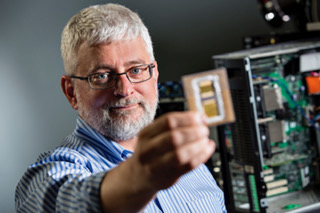
Conte (pictured) is co-chair of the IEEE Rebooting Computing initiative that is sponsoring the International Roadmap of Devices and Systems (IRDS) programme (See The emergence of the IRDS, below). The IRDS is defining technology roadmaps over a 15-year horizon and in November will publish its first that spans nine focus areas.
The focus of the IRDS on systems and devices and the broadening of technologies being considered is a consequence of the changing dynamics of the chip industry.
Conte stresses that it is not so much the ending of Moore’s Law that is causing the change as the ending of CMOS. Transistors will still continue to shrink even though it is becoming harder and costlier to achieve but the scaling benefits that for decades delivered a constant power density for chips with each new CMOS process node ended a decade ago.
“Back in the day it was pretty easy to plot it [the roadmap] because the technology was rather static in what we wanted to achieve,” says Conte. That ‘cushy ride’ that CMOS has delivered is ending. “The question now is: Are there other technologies we should be investing in that help applications move forward?” says Conte.
Focus groups
The IRDS has set up nine focus groups and in March published the first white papers from the teams.
The most complete white paper is from the More Moore focus group which looks at how new generations of smaller transistor features will be achieved. “It is clear that for the next 10 to 15 years we still have a lot of CMOS nodes left,” says Conte. “We still have to track what happens to CMOS.”
Conte says it is becoming clearer that ICs, in general, are going to follow the course of flash memory and be constructed as 3D monolithic designs. “We are just beginning to understand how to do this," says Conte.
"This does not mean we are going to get transistors that make computing faster without doing something different,” he says. This explains the work of the Beyond CMOS (Emerging Research Devices) focus team that is looking at alternative non-CMOS technologies to advance systems performance.
It is clear that for the next 10 to 15 years we still have a lot of CMOS nodes left
A third IRDS focus group is Outside System Connectivity which includes interface technologies such as photonic interconnect needed for future systems. “Outside System Interconnect is an important focus group and it is also our interface to the IEEE 5G roadmap team,” he says.
Conte also highlights two other IRDS focus teams: System and Architecture, and Applications Benchmarking. “These two focus teams are really important as to what the IRDS is all about,” says Conte.
The System and Architecture group has identified four systems views that it will focus on: the data centre, mobile handsets and tablets, edge devices for the Internet of Things, and control systems for the cyber-physical world such as automation, robotics and automotive systems.
The Application Benchmarking focus group is tasked with predicting key applications, quantifying how their performance is evolving and identifying roadblocks that could hinder their progress. Feature recognition, an important machine learning task, is one such example.
The IRDS is also continuing the working format established by the ITRS whereby every odd year a new 15-year roadmap is published while updates are published every even year.
Roadmapping
Three communities contribute to the development of the IRDS roadmap: industry, government and academia.
Industry is more concerned with solving their immediate problems and do not have the time or resources to investigate something that might or might not work in 15 years’ time, says Conte. Academia, in contrast, is more interested in addressing challenging problems over a longer term, 15-year horizon. Government national labs in the US and Europe’s imec sit somewhere in between and try to come up with mid-range solutions. “It is an interesting tension and it seems to work,” says Conte.
Contributors to the IRDS are from the US, Europe, Japan, South Korea and Taiwan but not China which is putting huge effort to be self-sufficient in semiconductors.
“We have not got participation for China yet,” says Conte. “It is not that we are against that, we just have not made the connections yet.” Conte believes China’s input would be very good for the roadmap effort. “They are being very aggressive and bright and they are more willing to take risks than the West,” he says.
What will be deemed a success for the IRDS work?
“It is to come up with a good prediction that is 15 years out and identify what the roadblocks are to getting there.”
____________________________________________________________
The emergence of the IRDS
The IRDS was established in 2016 by the IEEE after it took over the roadmap work of the International Technology Roadmap for Semiconductors (ITRS), an organisation sponsored by the five leading chip manufacturing regions in the world.
“The [work of the] ITRS was a bottoms-up roadmap, driven by the semiconductor industry,” says Conte. “It started with devices and didn't really go much higher.”
With the end of scaling, whereby the power density of chips remained constant with each new CMOS process node, the ITRS realised its long-established roadmap work needed a rethink which resulted in the establishment of ITRS 2.0.
“The ITRS 2.0 was an attempt to do a top-down approach looking at the system level and working down to devices,” says Conte. It was well received by everyone but the sponsors, says Conte, which was not surprising given their bottoms-up focus. It resulted in the sponsors of the ITRS 2.0 such as the US Semiconductor Industry Association (SIA) pulling out and the IEEE stepping in.
“This is much closer to what we are trying to do with the Rebooting Computing so it makes sense this group comes into the IEEE band and we act as a sponsor,” says Conte.
Telefonica tests XGS-PON
Part 1: XGS and TWDM passive optical networks
Telefonica is the latest operator to test XGS-PON, the 10-gigabit passive optical networking standard.
“Operators want to show they are taking the maximum from their fibre investment,” says Ana Pesovic, marketing manager for fibre at Nokia, the supplier of the XGS-PON equipment used for the operator’s lab tests. “Telefonica has been really aggressive in their fibre deployments in the last couple of years.”
 Ana Pesovic
XGS-PON
Approved by the ITU-T in 2016, XGS-PON supports two rates: 10-gigabit symmetrical and the asymmetrical rate of 10 gigabits downstream (to the user) and 2.5 gigabits upstream.
XGS-PON has largely superseded the earlier XG-PON standard which supports the 10-gigabit asymmetrical rate only. “It is fair to say there is no traction for XG-PON,” says Pesovic. “Even in China [an early adopter of XG-PON], we see the interest slowly moving to XGS-PON.”
Nokia says it has now been involved in 40 XGS-PON trials and nine customers have deployed the technology. “These have just started and they are not massive deployments,” says Pesovic.
Nokia’s XGS-PON customers include China Telecom and SK Broadband. SK Broadband has deployed XGS-PON alongside the more advanced TWDM-PON (time wavelength division multiplexing, passive optical network), the ITU-T NG-PON2 standard.
XGS-PON uses a fixed wavelength to deliver either the 10-gigabit symmetrical or asymmetrical service. The standard supports a distance of 20km and a split ratio of up to 1:128 - one XGS-PON optical line terminal (OLT) serving up to 128 optical network units (ONUs). In contrast, TWDM-PON supports four wavelengths enabling up to 40-gigabit symmetrical rates. And unlike XGS-PON, TWDM-PON supports flexible wavelengths using tuneable lasers.
The wavelengths used by XGS-PON and TWDM-PON have been specified such that the two standards can operate alongside GPON on the same fibre. Accordingly, with SK Broadband’s deployment, the two PON standards along with GPON support an aggregate capacity of 52.5 gigabits-per-second.
As well as testing XGS-PON's performance, Telefonica has tested that XGS-PON works without disturbing existing broadband services over its GPON networks, says Pesovic.
For the test, Telefonica used an 8-port line card where each port can be configured for XGS-PON or as a wavelength of a TWDM-PON. The line card fits within Nokia’s 7360 Intelligent Services Access Manager (ISAM) FX platform.
5G will require the deployment of many more small cells. With XGS-PON, multiple small cells can be served using a single PON
Applications
XGS-PON with its symmetrical 10-gigabit rate is suited to business services. "Operators can use one network to converge business and residential; today they are two overlay networks,” says Pesovic. Many businesses require 1-gigabit connectivity or less but by having a 10-gigabit link, multiple enterprises can be aggregated on one PON.
Nokia says that in countries such as South Korea as well as in Europe and North America there is also interest in a 10-gigabit PON for residential services. “People are taking the downstream bandwidth for granted and now the upstream is becoming a differentiator, making the quality of experience much better,” says Pesovic.
The bulk of traffic is still predominately downstream but increasingly users want to upload large files and video. Even if these uploads are of shorter duration, the network must deliver, says Pesovic.
Operators are also eyeing XGS-PON for the emerging 5G cellular standard. Nokia points out that 5G will require the deployment of many more small cells. With XGS-PON, multiple small cells can be served using a single PON.
Nokia expects XGS-PON will be deployed for years to come. Broadband is advancing by adding more wavelengths. To GPON, which uses one wavelength, can be added a second wavelength supporting 10-gigabit XGS-PON. Using TWDM-PON adds four and potentially eight more wavelengths - 40 gigabits and 80 gigabits of bandwidth, respectively. “It really doesn’t matter what the technology is called,” says Pesovic.
One North American operator is looking at TWDM-PON as a way to save power. During the night when there is less broadband usage, the operator wants to use wavelength mobility to migrate users onto a single wavelength.
TWDM-PON
Besides wavelength count, TWDM-PON differs from XGS-PON in its use of tuneable lasers.
Having tuneable wavelengths delivers several benefits to the operators. One is load balancing. If users on one wavelength start to exhaust its capacity, several users can be moved to a second wavelength that is less heavily loaded.
TWDM-PON also benefits network sharing and wavelength unbundling. A third-party operator can offer its fibre to interested operators. “Each operator could then operate on a single wavelength,” says Pesovic. If a user changes operator, they can simply be moved from one wavelength to another.
There are also operational benefits. If a fault develops on a board, users can be migrated to a second card without service interruption and the faulty board replaced.
One North American operator is looking at TWDM-PON as a way to save power, says Pesovic. During the night when there is less broadband usage, the operator wants to use wavelength mobility to migrate users onto a single wavelength. This would deliver sufficient bandwidth to those users that are active while allowing the remaining wavelengths to be powered down, saving power.
The issue impeding the uptake of TWDM-PON remains the high cost of tuneable lasers. Nokia expects it to be at least another year before the cost of tuneable lasers becomes more economical for PON. That said, service providers delivering businesses services may still be tempted to adopt TWDM-PON despite the higher cost of tuneable lasers given that the average revenue per user (ARPU) of business users is 5x that of residential users, says Pesovic.
See Part 2: FSAN unveils roadmap plans, click here