

Ciena: Changing bandwidth on the fly
Ciena has announced its latest coherent chipset that will be the foundation for its future optical transmission offerings. The chipset, dubbed WaveLogic 3, will extend the performance of its 100 Gigabit links while introducing transmission flexibility that will trade capacity with reach.
Feature: Beyond 100 Gigabit - Part 1
 "We are going to be deployed, [with WaveLogic 3] running live traffic in many customers’ networks by the end of the year"
Michael Adams, Ciena
"This is changing bandwidth modulation on the fly," says Ron Kline, principal analyst, network infrastructure group at market research firm, Ovum. “The capability will allow users to dynamically optimise wavelengths to match application performance requirements.”
WaveLogic 3 is Ciena's third-generation coherent chipset that introduces several firsts for the company.
- The chipset supports single-carrier 100 Gigabit-per-second (Gbps) transmission in a 50GHz channel.
- The chipset includes a transmit digital signal processor (DSP) - which can adapt the modulation schemes as well as shape the pulses to increase spectral efficiency. The coherent transmitter DSP is the first announced in the industry.
- WaveLogic 3's second chip, the coherent receiver DSP, also includes soft-decision forward error correction (SD-FEC). SD-FEC is important for high-capacity metro and regional, not just long-haul and trans-Pacific routes, says Ciena.
The two-ASIC chipset is implemented using a 32nm CMOS process. According to Ciena, the receiver DSP chip, which compensates for channel impairments, measures 18 mm sq. and is capable of 75 Tera-operations a second.
Ciena says the chipset supports three modulation formats: dual-polarisation bipolar phase-shift keying (DP-BPSK), quadrature phase-shift keying (DP-QPSK) and 16-QAM (quadrature amplitude modulation). Using a single carrier, these equate to 50Gbps, 100Gbps and 200Gbps data rates. Going to 16-QAM may increase the data rate to 200Gbps but it comes at a cost: a loss in spectral efficiency and in reach.
"This software programmability is critical for today's dynamic, cloud-centric networks," says Michael Adams, Ciena’s vice president of product & technology marketing.
WaveLogic 3 has also been designed to scale to 400Gbps. "This is the first programmable coherent technology scalable to 400 Gig," says Adams. "For 400 Gig, we would be using a dual-carrier, dual-polarisation 16-QAM that would use multiple [WaveLogic 3] chipsets."
Performance
Ciena stresses that this is a technology not a product announcement. But it is willing to detail that in a terrestrial network, a single carrier 100Gbps link using WaveLogic 3 can achieve a reach of 2,500+ km. "These refer to a full-fill [wavelengths in the C-Band] and average fibre," says Adams. "This is not a hero test with one wavelength and special [low-loss] fibre.”
 Metro to trans-Pacific: The different reaches and distances over terrestrial and submarine using Ciena's WaveLogic 3. SC stands for single carrier. Source: Ciena/ Gazettabyte
When the modulation is changed to BPSK, the reach is effectively doubled. And Ciena expects a 9,000-10,000km reach on submarine links.
The same single-carrier 50GHz channel reverting to 16-QAM can transmit a 200Gbps signal over distances of 750-1,000km. "A modulation change [to 16-QAM] and adding a second 100 Gigabit Ethernet transceiver and immediately you get an economic improvement," says Adams.
For 400Gbps, two carriers, each 16-QAM, are needed and the distances achieved are 'metro regional', says Ciena.
The transmit DSP also can implement spectral shaping. According to Ciena, by shaping the signals sent, a 20-30% bandwidth improvement (capacity increase) can be achieved. However that feature will only be fully exploited once networks deploy flexible grid ROADMs.
At OFC/NFOEC. Ciena will be showing a prototype card that will demonstrate the modulation going from BPSK to QPSK to 16-QAM. "We are going to be deployed, running live traffic in many customers’ networks by the end of the year," says Adams.
Analysis
Sterling Perrin, senior analyst, Heavy Reading
Heavy Reading believes Ciena's WaveLogic 3 is an impressive development, compared to its current WaveLogic 2 and to other available coherent chipsets. But Perrin thinks the most significant WaveLogic 3 development is Ciena’s single-carrier 100Gbps debut.
Until now, Ciena has used two carriers within a 50GHz, each carrying 50Gbps of data.
"The dual carrier approach gave Ciena a first-to-market advantage at 100Gbps, but we have seen the vendor lose ground as Alcatel-Lucent rolled out its single carrier 100Gbps system," says Perrin in a Heavy Reading research note. "We believe that Alcatel-Lucent was the market leader in 100Gbps transport in 2011."
Other suppliers, including Cisco Systems and Huawei, have also announced single-carrier 100Gbps, and more single-wavelength 100Gbps announcements will come throughout 2012.
Heavy Reading believes the ability to scale to 400Gbps is important, as is the use of multiple carriers (or super-channels). But 400 Gigabit and 1 Terabit transport are still years away and 100Gbps transport will be the core networking technology for a long time yet.
"The vendors with the best 100G systems will be best-positioned to capture share over the next five years, we believe," says Perrin.
Ron Kline, principal analyst for Ovum’s network infrastructure group.
For Ron Kline, Ciena's announcement was less of a surprise. Ciena showcased WaveLogic 3's to analysts late last year. The challenge with such a technology announcement is understanding the capabilities and how it will be rolled out and used within a product, he says.
"Ciena's WaveLogic 3 is the basis for 400 Gig," says Kline. "They are not out there saying 'we have 400 Gig'." Instead, what the company is stressing is the degree of added capacity, intelligence and flexibility that WaveLogic 3 will deliver. That said, Ciena does have trials planned for 400 Gig this year, he says.
What is noteworthy, says Ovum, is that 400Gbps is within Ciena's grasp whereas there are still some vendors yet to record revenues for 100Gbps.
"Product differentiation has changed - it used to be about coherent," says Kline. "But now that nearly all vendors have coherent, differentiation is going to be determined by who has the best coherent technology."

The great data rate-reach-capacity tradeoff
 Source: Gazettabyte
Optical transmission technology is starting to bump into fundamental limits, resulting in a three-way tradeoff between data rate, reach and channel bandwidth. So says Brandon Collings, JDS Uniphase's CTO for communications and commercial optical products. See the recent Q&A.
This tradeoff will impact the coming transmission speeds of 200, 400 Gigabit-per-second and 1 Terabit-per-second. For each increased data rate, either the channel bandwidth must increase or the reach must decrease or both, says Collings.
Thus a 200Gbps light path can be squeezed into a 50GHz channel in the C-band but its reach will not match that of 100Gbps over a 50GHz channel (Shown on the graph with a hashed line). A wider version of 200Gbps could match the reach to the 100Gbps, but that would probably need a 75GHz channel, says Collings.
For 400Gbps, the same situation arises suggesting two possible approaches: 400Gbps fitting in a 75GHz channel but with limited reach (for metro) or a 400Gbps signal placed within a 125GHz channel to match the reach of 100Gbps over a 50GHz channel.
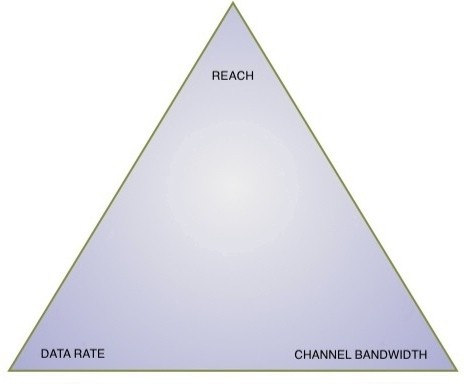 Optical transmission technology is starting to bump into fundamental limits resulting in a three-way tradeoff between data rate, reach and channel bandwidth.
"Continue this argument for 1 Terabit as well," says Collings. Here the industry consensus suggests a 200GHz-wide channel will be needed.
Similarly, within this compromise, other options are available such as 400Gbps over a 50GHz channel. But this would have a very limited reach.
Collings does not dismiss the possibility of a technology development which would break this fundamental compromise, but at present this is the situation.
As a result there will likely be multiple formats hitting the market which align the reach needed with the minimised channel bandwidth, says Collings.