

Reflections on OFC 2017
Mood, technologies, notable announcements - just what are the metrics to judge the OFC 2017 show held in Los Angeles last week?
It was the first show I had attended in several years and the most obvious changes were how natural the presence of the internet content providers now is alongside the telecom operators, as well as systems vendors exhibiting at the show. Chip companies, while also present, were fewer than before.
 Source: OSA
Another impression were the latest buzz terms: 5G, the Internet of Things and virtual reality-augmented reality. Certain of these technologies are more concrete than others, but their repeated mention suggests a consensus that the topics are real enough to impact optical components and networking.
It could be argued that OFC 2017 was the year when 400 Gigabit Ethernet became a reality
The importance of 5G needs no explanation while the more diffuse IoT is expected to drive networking with the huge amounts of data it will generate. But what are people seeing about virtual reality-augmented reality that merits inclusion alongside 5G and IoT?
Another change is the spread of data rates. No longer does one rate represent the theme of an OFC such as 40 Gigabits or 100 Gigabits. It could be argued that OFC 2017 was the year when 400 Gigabit Ethernet became a reality but there is now a mix of relevant rates such as 25, 50, 200 and 600 gigabits.
Highlights
There were several highlights at the show. One was listening to Jiajin Gao, deputy general manager at China Mobile Technology, open the OIDA Executive Forum event by discussing the changes taking place in the operator's network. Gao started by outlining the history of China Mobile's network before detailing the huge growth in ports at different points in the network over the last two years. He then outlined China Mobile's ambitious rollout of new technologies this year and next.
China's main three operators have 4G and FTTx subscriber numbers that dwarf the rest of the world. Will 2017 eventually be seen as the year when the Chinese operators first became leaders in telecom networking and technologies?
The Executive Forum concluded with an interesting fireside discussion about whether the current optical market growth is sustainable. The consensus among representatives from Huawei, Hisense, Oclaro and Macom was that it is; that the market is more varied and stable this time compared to the boom and bust of 1999-2001. As Macom’s Preetinder Virk put it: "The future has nothing to do with the past". Meanwhile, Huawei’s Jeffrey Gao still expects strong demand in China for 100 gigabits in 2017 even if growth is less strong than in 2016. He also expects the second quarter this year to pick up compared to a relatively weak first quarter.
OFC 2017 also made the news with an announcement that signals industry change: Ciena's decision to share its WaveLogic Ai coherent DSP technology with optical module vendors Lumentum, Oclaro and NeoPhotonics.
The announcement can be viewed several ways. One is that the initiative is a response to the success of Acacia as a supplier of coherent modules and coherent DSP technology. System vendors designed their own coherent DSP-ASICs to differentiate their optical networking gear. This still holds true but the deal reflects how the progress of merchant line-side optics from the likes of Acacia is progressing and squeezing the scope for differentiation.
The deal is also a smart strategic move by Ciena which, through its optical module partners, will address new markets and generate revenues as its partners start to sell modules using the WaveLogic Ai. The deal also has a first-mover advantage. Other systems vendors may now decide to offer their coherent DSPs to the marketplace but Ciena has partnerships with three leading optical module makers and is working with them on future DSP developments for pluggable modules.
The deal also raises wider questions as to the role of differentiated hardware and whether it is subtly changing in the era of network function virtualisation, or whether it is a reflection of the way companies are now collaborating with each other in open hardware developments like the Telecom Infra Project and the Open ROADM MSA.
Another prominent issue at the show is the debate as to whether there is room for 200 Gigabit Ethernet modules or whether the industry is best served by going straight from 100 to 400 Gigabit Ethernet.
Facebook and Microsoft say they will go straight to 400 gigabits. Cisco agrees, arguing that developing an interim 200 Gigabit Ethernet interface does not justify the investment. In contrast, Finisar argues that 200 Gigabit Ethernet has a compelling cost-per-bit performance and that it will supply customers that want it. Google supported 200 gigabits at last year’s OFC.
Silicon photonics
Silicon photonics was one topic of interest at the show and in particular how the technology continues to evolve. Based on the evidence at OFC, silicon photonics continues to progress but there were no significant developments since our book (co-written with Daryl Inniss) on silicon photonics was published late last year.
One of the pleasures of OFC is being briefed by key companies in rapid succession. Intel demonstrated at its booth its silicon photonics products including its CWDM4 module which will be generally available by mid-year. Intel also demonstrated a 10km 4WDM module. The 4WDM MSA, created last year, is developing a 10km reach variant based on the CWDM4, as well as 20km and 40km based designs.
Meanwhile, Ranovus announced its 200-gigabit CFP2 module based on its quantum dot laser and silicon photonics ring resonator technologies with a reach approaching 100km. The 200 gigabit is achieved using 28Gbaud optics and PAM-4.
Elenion Technologies made several announcements including the availability of its monolithically integrated coherent modulator receiver after detailing it was already supplying a 200 gigabit CFP2-ACO to Coriant. The company was also demonstrating on-board optics and, working with Cavium, announced a reference architecture to link network interface cards and switching ICs in the data centre.
I visited Elenion Technologies in a hotel suite adjacent to the conference centre. One of the rooms had enough test equipment and boards to resemble a lab; a lab with a breathtaking view of the hills around Los Angeles. As I arrived, one company was leaving and as I left another well-known company was arriving. Elenion was using the suite to demonstrate its technologies with meetings continuing long after the exhibition hall had closed.
Two other silicon photonics start-ups at the show were Ayar Labs and Rockley Photonics.
Ayar Labs in developing a silicon photonics chip based on a "zero touch" CMOS process that will sit right next to complex ASICs and interface to network interface cards. The first chip will support 3.2 terabits of capacity. The advantage of the CMOS-based silicon photonics design is the ability to operate at high temperatures.
Ayar Labs is using the technology to address the high-bandwidth, low-latency needs of the high-performance computing market, with the company expecting the technology to eventually be adopted in large-scale data centres.
Rockley Photonics shared more details as to what it is doing as well as its business model but it is still to unveil its first products.
The company has developed silicon photonics technology that will co-package optics alongside ASIC chips. The result will be packaged devices with fibre-based input-output offering terabit data rates.
Rockley also talked about licensing the technology for a range of applications involving complex ICs including coherent designs, not just for switching architectures in the data centre that it has discussed up till now. Rockley says its first product will be sampling in the coming months.
Looking ahead
On the plane back from OFC I was reading The Undoing Project by Michael Lewis about the psychologists Danny Kahneman and Amos Tversky and their insights into human thinking.
The book describes the tendency of people to take observed facts, neglecting the many facts that are missed or could not be seen, and make them fit a confident-sounding story. Or, as the late Amos Tversky put it: "All too often, we find ourselves unable to predict what will happen; yet after the fact, we explain what did happen with a great deal of confidence. This 'ability' to explain that which we cannot predict, even in the absence of any additional information, represents an important, though subtle, flaw in our reasoning."
So, what to expect at OFC 2018? More of the same and perhaps a bombshell or two. Or to put it another way, greater unpredictability based on the impression at OFC 2017 of an industry experiencing an increasing pace of change.

Telefónica tackles video growth with IP-MPLS network
- Telefónica’s video growth in one year has matched nine years of IP traffic growth
- Optical mesh network in Barcelona will use CDC-ROADMs and 200-gigabit coherent line cards
Telefónica has started testing an optical mesh network in Barcelona, adding to its existing optical mesh deployment across Madrid. Both mesh networks are based on 200-gigabit optical channels and high-degree reconfigurable add-drop multiplexers (ROADMs) that are part of the optical infrastructure that underpins the operator’s nationwide IP-MPLS network that is now under construction.
 Maria Antonia CrespoThe operator decided to become a video telco company in late 2014 to support video-on-demand and over-the-top streaming video services.
Telefónica realised its existing IP and aggregation networks would not be able to accommodate the video traffic growth and started developing its IP-MPLS network.
“What we are seeing is that the traffic is growing very quickly,” says Maria Antonia Crespo, IP and optical networking director at Telefónica. “In one year we are getting the same
figures as we got from internet traffic in the last nine years.”
The operator is rolling out the IP-MPLS network across Spain. Juniper Networks and Nokia are the suppliers of the IP router equipment, while Huawei and Nokia were chosen to supply the optical networking equipment.
IP-MPLS
Telefónica set about reducing the number of layers and number of hops when designing its IP-MPLS network. “At each hop, we have to invest money if we want to increase capacity,” says Crespo.
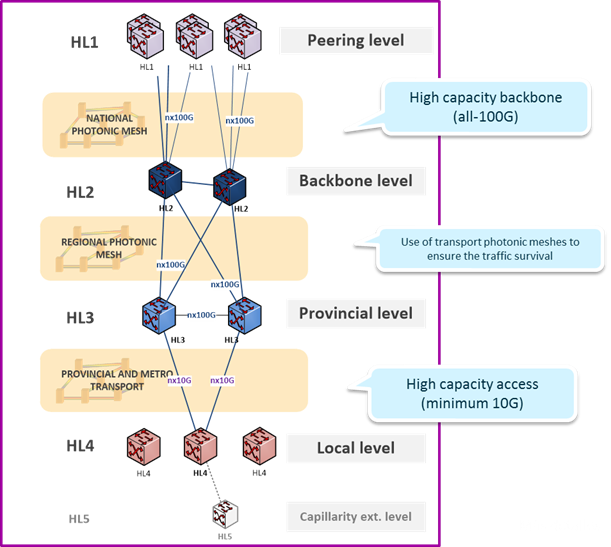
The result is an IP-MPLS network comprising four layers (see diagram). The uppermost Layer 1, dubbed HL1, connects the network to the internet world, while HL2 is a backbone transit layer. The HL3 layer is also a transit layer but at the provincial level. Spain is made up of 52 provinces. HL4 is where the services will reside, where Telefonica will deliver such services as Layer 2 and Layer 3 virtual private networks.
Between HL1 and HL2 is a national GMPLS-based photonic mesh, says Crespo, and between HL3 and HL4 there are the metro mesh networks. “Now we are deploying two GMPLS-based mesh networks, in Madrid and Barcelona,” she says. “Then, in the rest of the country, we are deploying [optical] rings.”
Systems requirements
Telefónica says it had several requirements when choosing the optical transport equipment, requirements common to both its backbone and regional networks.
One is the need to scale capacity at 10 gigabits and 100 gigabits, while network availability and robustness are also key. Telefónica says its network is designed to withstand two or more simultaneous fibre failures. “We have long experience with the GMPLS control plane to support different fibre impairments in the network,” says Alberto Colomer, optical technology manager at Telefónica.
The operator also wants its equipment to support high-speed interfaces and more granular rates to allow it to transition away from legacy traffic such as SDH and 1GbE. Operational improvements are another requirement: Telefónica wants to reduce the manual intervention its network needs. Optical time-domain reflectometers (OTDR) are being integrated into the network to monitor the fibre, as is the ability to automatically equalise the different optical channels.
 Alberto ColomerLastly, Telefónica is looking to reduce its capital expenditure and operational expense. It is deploying flexible rate 200-gigabit transponders in its Barcelona and Madrid networks and the same line cards will support 400-gigabit and even 1 terabit channels in future, as well as flexible grid to support the most efficient use of a fibre’s spectrum.
The 200-gigabit transponders use 16-quadrature amplitude modulation (16-QAM). Such transponders have enough reach to span each of the two cities but Colomer says Telefónica is still studying how many ROADM stages the 16-QAM transponders can cross.
It is like a pilot changing the engines while flying a plane
The ROADMs Telefónica is deploying in Madrid are directionless and are able to support up to 20 degrees. “You need some connectivity inside the mesh but also the mesh has to be connected to rings that cover all the counties around Madrid,” says Colomer.
Barcelona will be the first location where the ROADMs will also be colourless and contentionless (CDC-ROADMs). “We need to understand in a better way what are the advantages that come with that functionality,” says Colomer.
Telefónica has deployed Huawei’s Optix OSN 9800 platform in Madrid while in Barcelona Nokia’s 1830 Photonic Service Switch with the latest PSE-2 Coherent DSP-ASIC technology is being deployed.
Nokia’s PSS-1830 is designed to support the L-band as well as the C-band but Telefonica does not see the need for the L-band in the near future. “We are going in the direction of increasing capacity per channel: 400-gigabit channels and one terabit channels,” says Colomer. By deploying a photonic mesh and high-degree ROADMs, it will also be possible to increase capacity on a specific link by adding a fibre pair.
Status
The mesh in Madrid is already completed while Telefónica is deploying optical rings around Barcelona while it tests the contentionless ROADMs. These deployments are aligned with the IP-MPLS deployment, says Crespo, which is expected to be completed by 2018.
Crespo says the nationwide IP-MPLS rollout is a challenge. The deployment involves learning new technology that needs to be deployed alongside its existing network. "My boss likens it to a pilot changing the engines while flying a plane," says Crespo. "We are testing in the labs, duplicating it [the network], and migrating the traffic without impacting the customer."
ECOC 2013 review - Part 2
- Oclaro's Raman and hybrid amplifier platform for new networks
- MxN wavelength-selective switch from JDSU
- 200 Gigabit multi-vendor coherent demonstration
- Tunable SFP+ designs proliferate
- Finisar extends 40 Gigabit QSFP+ to 40km
- Oclaro’s tackles wireless backhaul with 2km SFP+ module
 Finisar's 40km 40 Gig QSFP+ demo. Source: Finisar
Amplifier market heats up
Oclaro detailed its high performance Raman and hybrid Raman/ Erbium-doped fibre amplifier platform. "The need for this platform is the high-capacity, high channel rates being installed [by operators] and the desire to be scalable - to support 400 Gig and Terabit super-channels in future," says Per Hansen, vice president of product marketing, optical networks solutions at Oclaro.
"Amplifiers are 'hot' again," says Daryl Inniss, vice president and practice leader components at market research firm, Ovum. For the last decade, amplifier vendors have been tasked with reducing the cost of their amplifier designs. "Now there is a need for new solutions that are more expensive," says Inniss. "It is no longer just cost-cutting."
Amplifiers are used in the network backbone to boost the optical signal-to-noise ratio (OSNR). Raman amplification provides significant noise improvement but it is not power efficient so a Raman amplifier is nearly always matched with an Erbium one. "You can think of the Raman as often working as a pre-amp, and the Erbium-doped fibre as the booster stage of the hybrid amplifier," says Hansen. System houses have different amplifier approaches and how they connect them in the field, while others build them on one card, but Raman/ Erbium-doped fibre are almost always used in tandem, says Hansen.
Oclaro provides Raman units and hybrid units that combine Raman with Erbium-doped fibre. "We can deliver both as a super-module that vendors integrate on their line cards or we can build the whole line card for them" says Hansen.
The Raman amplifier market is way bigger than people have forecast
Since Raman launches a lot of pump power into the fibre, it is vital to have low-loss connections that avoid attenuating the gain. "Raman is a little more sensitive to the quality of the connections and the fibre," says Hansen. Oclaro offers scan diagnostic features that characterise the fibre and determine whether it is safe to turn up the amplification.
"It can analyse the fibre and depending on how much customers want us to do, we can take this to the point that it [the design] can tell you what fibre it is and optimise the pump situation for the fibre," says Hansen. In other cases, the system vendors adopt their own amplifier control.
Oclaro says it is in discussion with customers about implementations. "We are shipping the first products based on this platform," says Hansen.
"[The] Raman [amplifier market] is way bigger than people have forecast," says Inniss. This is due to operators building long distance networks that are scalable to higher data rates. "Coherent transmission is the focal point here, as coherent provides the mechanism to go long distance at high data rates," says Ovum analyst, Inniss.
Wavelength-selective switches
JDSU discussed its wavelength-selective switch (WSS) products at ECOC. The company has previously detailed its twin 1x20 port WSS, which has moved from development to volume production.
At ECOC, JDSU detailed its work on a twin MxN WSS design. "It is a WSS that instead of being a 1xN - 1x20 or a 1x9 - it is an MxN," says Brandon Collings, chief technology officer, communications and commercial optical products at JDSU. "So it has multiple input and output ports on both sides." Such a design is used for the add and drop multiplexer for colourless and directionless reconfigurable optical add/ drop multiplexers (ROADMs).
"People have been able to build colourless and directionless architectures using conventional 1xN WSSes," says Collings. The MxN serves the same functionality but in a single integrated unit, halving the volume and cost for colourless and directionless compared to the current approach.
JDSU says it is also completing the development of a twin multicast switch, the add and drop multiplexer suited to colourless, directionless and contentionless ROADM designs.
200 Gigabit coherent demonstration
ClariPhy Communications, working with NeoPhotonics, Fujitsu Optical Components, u2t Photonics and Inphi, showcased a reference-design demonstration of 200 Gig coherent optical transmission using 16 quadrature amplitude modulation (16-QAM).
For the demonstration, ClariPhy provided the coherent silicon: the digital-to-analogue converter for transmission and the receiver analogue-to digital and digital signal processing (DSP) used to counter channel transmission impairments. NeoPhotonics provided the lasers, for transmission and at the receiver, u2t Photonics supplied the integrated coherent receiver, Fujistu Optical Components the lithium niobate nested modulator while Inphi provided the quad-modulator driver IC.
ClariPhy is developing a 28nm CMOS Lightspeed chip suited for metro and long-haul coherent transmission. The chip will support 100 and 200 Gigabit-per-second (Gbps) data rates and have an adjustable power consumption tailored to the application. The chip will also be suited for use within a coherent CFP module.
"All the components that we are talking about for 100 Gig are either ready or will soon be ready for 200 and 400 Gig," says Ferris Lipscomb, vice president of marketing at NeoPhotonics. To achieve 400Gbps, two 16-QAM channels can be used.
The DWDM market for 10 Gig is now starting to plateau
Tunable SFPs
JDSU first released a 10Gbps SFP+ optical module tunable across the C-band in 2012, a design that dissipates up to 2W. The SFP+ MSA agreement, however, calls for no greater than a 1.5W power consumption. "Our customers had to deal with that higher power dissipation which, in a lot of cases, was doable," says JDSU Collings.
 Robert Blum, Oclaro
JDSU's latest tunable SFP+ design now meets the 1.5W power specification. "This gets into the MSA standard's power dissipation envelop and can now go into every SFP+ socket that is deployed," says Collings. To achieve the power target involved a redesign of the tunable laser. The tunable SFP+ is now sampling and will be generally available one or two quarters hence.
Oclaro and Finisar also unveiled tunable SFP+ modules at ECOC 2013. "The design is using the integrated tunable laser and Mach-Zehnder modulator, all on the same chip," says Robert Blum, director of product marketing for Oclaro's photonic components.
Neither Oclaro nor Finisar detailed their SFP+'s power consumption. "The 1.5W is the standard people are trying to achieve and we are quite close to that," says Blum.
Both Oclaro's and Finisar's tunable SFP+ designs are sampling now.
Reducing a 10Gbps tunable transceiver to a SFP+ in effect is the end destination on the module roadmap. "The DWDM market for 10 Gig is now starting to plateau," says Rafik Ward, vice president of marketing at Finisar. "From an industry perspective, you will see more and more effort on higher data rates in future."
40G QSFP+ with a 40km reach
Finisar demonstrated a 40Gbps QSFP+ with a reach of 40km. "The QSFP has embedded itself as the form-factor of choice at 40 Gig," says Ward.
Until now there has been the 850nm 40GBASE-SR4 with a 100m reach and the 1310nm 40GBASE-LR4 at 10km. To achieve a 40km QSFP+, Finisar is using four uncooled distributed feedback (DFB) lasers and an avalanche photo-detector (APD) operating using coarse WDM (CWDM) wavelengths spaced around 1310nm. The QSFP+ is being used on client side cards for enterprise and telecom equipment, says Finisar.
Module for wireless backhaul
Oclaro announced an SFP+ that supports the wireless Common Public Radio Interface (CPRI) and Open Base Station Architecture Initiative (OBSAI) standards used to link equipment in a wireless cell's tower and the base station controller.
Until now, optical modules for CPRI have been the 10km 10GBASE-LR4 modules. "You have a relatively expensive device for the last mile which is the most cost sensitive [part of the network]," says Oclaro's Hansen.
Oclaro's 1W SFP+ reduces module cost by using a simpler Fabry-Perot laser but at the expense of a 2km reach only. However, this is sufficient for a majority of requirements, says Hansen. The SFP supports 2.5G, 3Gbps, 6Gbps and 10Gbps rates. "CPRI has been used mostly at 3 Gig and 6 Gig but there is interest in 10 Gig due to growing mobile data traffic and the adoption of LTE," says Hansen.
The SFP+ module is sampling and will be in volume production by year end.
For Part 1, click here