

Oclaro demonstrates flexible rate coherent pluggable module
- The CFP2 coherent optical module operates at 100 and 200 Gig
- Samples are already with customers, with general availability in the first half of 2015
- Oclaro to also make more CFP2 100GBASE-LR4 products

The CFP2 is not just used in metro/ regional networks but also in long-haul applications
Robert Blum
The advent of a pluggable CFP2, capable of multi-rate long-distance optical transmission, has moved a step closer with a demonstration by Oclaro. The optical transmission specialist showed a CFP2 transmitting data at 200 Gigabits-per-second.
The coherent analogue module demonstration, where the DSP-ASIC resides alongside rather than within the CFP2, took place at ECOC 2014 held in September at Cannes. Oclaro showcased the CFP2 to potential customers in March, at OFC 2014, but then the line side module supported 100 Gig only.
"What has been somewhat surprising to us is that the CFP2 is not just used in metro/ regional networks but also in long-haul applications," says Robert Blum, director of strategic marketing at Oclaro. "We are also seeing quite significant interest in data centre interconnect, where you want to get 400 Gig between sites using two CFP2s and two DSPs." Oclaro says that the typical distances are from 200km to 1,000km.
The CFP2 achieves 200 Gig using polarisation multiplexing, 16-quadrature amplitude modulation (PM-16-QAM) while working alongside ClariPhy's merchant DSP-ASIC. ClariPhy announced at ECOC that it is now shipping its 200 Gig LightSpeed-II CL20010 coherent system-on-chip, implemented using a 28nm CMOS process.
"One of the beauties of an analogue CFP2 is that it works with a variety of DSPs," says Blum. Other merchant coherent DSPs are becoming available, while leading long-haul optical equipment vendors have their own custom coherent DSPs.
Oclaro's CFP2, even when operating at 200 Gig, falls within the 12W module's power rating. "One of the things you need to have for 200 Gig is a linear modulator driver, and such drivers consume slightly more power [200mW] than limiting modulator drivers [used for 100 Gig only]," says Blum.
Oclaro will offer two CFP2 line-side variants, one with linear drivers and one using limiting ones. The limiting driver CFP2 will be used for 100 Gig only whereas the linear driver CFP2 supports 100 Gig PM-QPSK and 200 Gig PM-16-QAM schemes. "Some customers prefer the simplicity of a limiting interface; for the linear interface you have to do more calibration or set-up," says Blum. "Linear also allows you to do pre-emphasis of the signal path, from the DSP all the way to the modulator." Pre-emphasis is used to compensate for signal path impairments.
By consuming under 12W, up to eight line-side CFP2 interfaces can fit on a line card, says Blum, who also stresses the CFP2 has a 0dBm output power at 200 Gig. Achieving such an output power level means the 200 Gig signal is on a par with 100 Gig wavelengths. "When you launch a 200 Gig signal, you want to make sure that there is not a big difference between signals," says Blum.
To achieve the higher output power, the micro integrable tunable laser assembly (micro-iTLA) includes a semiconductor optical amplifier (SOA) with the laser, while SOAs are also added to the Mach–Zehnder modulator chip. "That allows us to compensate for some of the [optical] losses," says Blum.
Customers received first CFP2 samples in May, with the module currently at the design validation stage. Oclaro expects volume shipments to begin in the first half of 2015.
100 Gig and the data centre
Oclaro also announced at ECOC that it has expanded manufacturing capacity for its CFP2-based 100GBASE-LR4 10km-reach module.
One reason for the flurry of activity around 100 Gig mid-reach interfaces that span 500m-2km in the data centre is that the 100GBASE-LR4 module is relatively expensive. Oclaro itself has said it will support the PSM-4, CWDM4 and CLR4 Alliance mid-reach 100 Gig interfaces. So why is Oclaro expanding manufacturing of its CFP2-based 100GBASE-LR4?
It is about being pragmatic and finding the most cost-effective solution for a given problem
"There is no clear good solution to get 100 Gig over 500m or 2km right now," says Blum. "CFP2 is here, it is a mature technology and we have made improvements both in performance and cost."
Oclaro has improved its EML design such that the laser needs less cooling, reducing overall power dissipation. The accompanying electronic functions such as clock data recovery have also been redesigned using one IC instead of two such that the CFP2 -LR4's overall power consumption is below 8W.
Demand has been so significant, says Blum, that the company has been unable to meet customer demand. Oclaro expects that towards year-end, it will have increased its CFP2 100GBASE-LR4 manufacturing capacity by 50 percent compared to six months earlier.
"It is about being pragmatic and finding the most cost-effective solution for a given problem," says Blum. "There are other [module] variants that are of interest [to us], such as the CWDM4 MSA that offers a cost-effective way to get to 2km."

Verizon on 100G+ optical transmission developments
 Source: Gazettabyte
Feature: 100 Gig and Beyond. Part 1:
Verizon's Glenn Wellbrock discusses 100 Gig deployments and higher speed optical channel developments for long haul and metro.
The number of 100 Gigabit wavelengths deployed in the network has continued to grow in 2013.
According to Ovum, 100 Gigabit has become the wavelength of choice for large wavelength-division multiplexing (WDM) systems, with spending on 100 Gigabit now exceeding 40 Gigabit spending. LightCounting forecasts that 40,000, 100 Gigabit line cards will be shipped this year, 25,000 in the second half of the year alone. Infonetics Research, meanwhile, points out that while 10 Gigabit will remain the highest-volume speed, the most dramatic growth is at 100 Gigabit. By 2016, the majority of spending in long-haul networks will be on 100 Gigabit, it says.
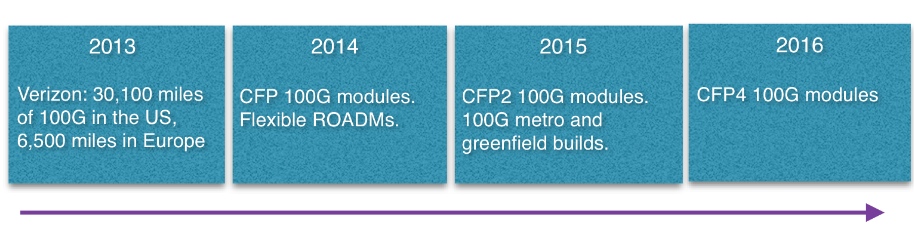
The market research firms' findings align with Verizon's own experience deploying 100 Gigabit. The US operator said in September that it had added 4,800, 100 Gigabit miles of its global IP network during the first half of 2013, to total 21,400 miles in the US network and 5,100 miles in Europe. Verizon expects to deploy another 8,700 miles of 100 Gigabit in the US and 1,400 miles more in Europe by year end.
"We expect to hit the targets; we are getting close," says Glenn Wellbrock, director of optical transport network architecture and design at Verizon.
Verizon says several factors are driving the need for greater network capacity, including its FiOS bundled home communication services, Long Term Evolution (LTE) wireless and video traffic. But what triggered Verizon to upgrade its core network to 100 Gig was converging its IP networks and the resulting growth in traffic. "We didn't do a lot of 40 Gig [deployments] in our core MPLS [Multiprotocol Label Switching] network," says Wellbrock.
The cost of 100 Gigabit was another factor: A 100 Gigabit long-haul channel is now cheaper than ten, 10 Gig channels. There are also operational benefits using 100 Gig such as having fewer wavelengths to manage. "So it is the lower cost-per-bit plus you get all the advantages of having the higher trunk rates," says Wellbrock.
Verizon expects to continue deploying 100 Gigabit. First, it has a large network and much of the deployment will occur in 2014. "Eventually, we hope to get a bit ahead of the curve and have some [capacity] headroom," says Wellbrock.
We could take advantage of 200 Gig or 400 Gig or 500 Gig today
Super-channel trials
Operators, working with optical vendors, are trialling super-channels and advanced modulation schemes such as 16-QAM (quadrature amplitude amplitude). Such trials involve links carrying data in multiples of 100 Gig: 200 Gig, 400 Gig, even a Terabit.
Super-channels are already carrying live traffic. Infinera's DTN-X system delivers 500 Gig super-channels using quadrature phase-shift keying (QPSK) modulation. Orange has a 400 Gigabit super-channel link between Lyon and Paris. The 400 Gig super-channel comprises two carriers, each carrying 200 Gig using 16-QAM, implemented using Alcatel-Lucent's 1830 photonic service switch platform and its photonic service engine (PSE) DSP-ASIC.
"We could take advantage of 200 Gig or 400 Gig or 500 Gig today," says Wellbrock. "As soon as it is cost effective, you can use it because you can put multiple 100 Gig channels on there and multiplex them."
The issue with 16-QAM, however, is its limited reach using existing fibre and line systems - 500-700km - compared to QPSK's 2,500+ km before regeneration. "It [16-QAM] will only work in a handful of applications - 25 percent, something of this nature," says Wellbrock. This is good for a New York to Boston, he says, but not New York to Chicago. "From our end it is pretty simple, it is lowest cost," says Wellbrock. "If we can reduce the cost, we will use it [16-QAM]. However, if the reach requirement cannot be met, the operator will not go to the expense of putting in signal regenerators to use 16-QAM do, he says.
Earlier this year Verizon conducted a trial with Ciena using 16-QAM. The goals were to test 16-QAM alongside live traffic and determine whether the same line card would work at 100 Gig using QPSK and 200 Gig using 16-QAM. "The good thing is you can use the same hardware; it is a firmware setting," says Wellbrock.
We feel that 2015 is when we can justify a new, greenfield network and that 100 Gig or versions of that - 200 Gig or 400 Gig - will be cheap enough to make sense
100 Gig in the metro
Verizon says there is already sufficient traffic pressure in its metro networks to justify 100 Gig deployments. Some of Verizon's bigger metro locations comprise up to 200 reconfigurable optical add/ drop multiplexer (ROADM) nodes. Each node is typically a central office connected to the network via a ROADM, varying from a two-degree to an eight-degree design.
"Not all the 200 nodes would need multiple 100 Gig channels but in the core of the network, there is a significant amount of capacity that needs to be moved around," says Wellbrock. "100 Gig will be used as soon as it is cost-effective."
Unlike long-haul, 100 Gigabit in the metro remains costlier than ten 10 Gig channels. That said, Verizon has deployed metro 100 Gig when absolutely necessary, for example connecting two router locations that need to be connected using 100 Gig. Here Verizon is willing to pay extra for such links.
"By 2015 we are really hoping that the [metro] crossover point will be reached, that 100 Gig will be more cost effective in the metro than ten times 10 [Gig]." Verizon will build a new generation of metro networks based on 100 Gig or 200 Gig or 400 Gig using coherent receivers rather than use existing networks based on conventional 10 Gig links to which 100 Gig is added.
"We feel that 2015 is when we can justify a new, greenfield network and that 100 Gig or versions of that - 200 Gig or 400 Gig - will be cheap enough to make sense."
Data Centres
The build-out of data centres is not a significant factor driving 100 Gig demand. The largest content service providers do use tens of 100 Gigabit wavelengths to link their mega data centres but they typically have their own networks that connect relatively few sites.
"If you have lots of data centres, the traffic itself is more distributed, as are the bandwidth requirements," says Wellbrock.
Verizon has over 220 data centres, most being hosting centres. The data demand between many of the sites is relatively small and is served with 10 Gigabit links. "We are seeing the same thing with most of our customers," says Wellbrock.
Technologies
System vendors continue to develop cheaper line cards to meet the cost-conscious metro requirements. Module developments include smaller 100 Gig 4x5-inch MSA transponders, 100 Gig CFP modules and component developments for line side interfaces that fit within CFP2 and CFP4 modules.
"They are all good," says Wellbrock when asked which of these 100 Gigabit metro technologies are important for the operator. "We would like to get there as soon as possible."
The CFP4 may be available by late 2015 but more likely in 2016, and will reduce significantly the cost of 100 Gig. "We are assuming they are going to be there and basing our timelines on that," he says.
Greater line card port density is another benefit once 100 Gig CFP2 and CFP4 line side modules become available. "Lower power and greater density which is allowing us to get more bandwidth on and off the card." sats Wellbrock.
Existing switch and routers are bandwidth-constrained: they have more traffic capability that the faceplate can provide. "The CFPs, the way they are today, you can only get four on a card, and a lot of the cards will support twice that much capacity," says Wellbrock.
With the smaller form factor CFP2 and CFP4, 1.2 and 1.6 Terabits card will become possible from 2015. Another possible development is a 400 Gigabit CFP which would achieve a similar overall capacity gains.
Coherent, not just greater capacity
Verizon is looking for greater system integration and continues to encourage industry commonality in optical component building blocks to drive down cost and promote scale.
Indeed Verizon believes that industry developments such as MSAs and standards are working well. Wellbrock prefers standardisation to custom designs like 100 Gigabit direct detection modules or company-specific optical module designs.
Wellbrock stresses the importance of coherent receiver technology not only in enabling higher capacity links but also a dynamic optical layer. The coherent receiver adds value when it comes to colourless, directionless, contentionless (CDC) and flexible grid ROADMs.
"If you are going to have a very cost-effective 100 Gigabit because the ecosystem is working towards similar solutions, then you can say: 'Why don't I add in this agile photonic layer?' and then I can really start to do some next-generation networking things." This is only possible, says Wellbrock, because of the tunabie filter offered by a coherent receiver, unlike direct detection technology with its fixed-filter design.
"Today, if you want to move from one channel to the next - wavelength 1 to wavelength 2 - you have to physically move the patch cord to another filter," says Wellbrock. "Now, the [coherent] receiver can simply tune the local oscillator to channel 2; the transmitter is full-band tunable, and now the receiver is full-band tunable as well." This tunability can be enabled remotely rather than requiring an on-site engineer.
Such wavelength agility promises greater network optimisation.
"How do we perhaps change some of our sparing policy? How do we change some of our restoration policies so that we can take advantage of that agile photonics later," says Wellbroack. "That is something that is only becoming available because of the coherent 100 Gigabit receivers."
Part 2, click here