

Ciena sends a 1.6T optical lambda over a 470km link

- Ciena has detailed the first live field trial using its WaveLogic 6 Extreme coherent modem.
- The WaveLogic 6 modem will be generally available from the end of the month.
Ciena’s newest coherent optical modem has sent 1.6 terabits of data over a 470km link. The field trial used Ciena’s WaveLogic 6 Extreme coherent modem in telecom operator Arelion’s live network.
The link connects an Equinix data centre in Ashburn to a Telxius submarine cable landing station, both sites in the state of Virginia.
“The fact that we are achieving 1.6-terabit wavelengths across close to 500 kilometres is a testament to the performance and integrity of the design,” says Helen Xenos, senior director of portfolio marketing at Ciena.
Ciena has won over 20 orders for the WaveLogic 6 Extreme from telecom operators and hyperscalers.
In Ciena’s latest quarterly results, CEO Gary Smith mentioned how Ciena had won business with significant cloud providers covering terrestrial, submarine, and coherent pluggable applications. “The majority [of these are] driven by expected growth in AI and cloud traffic,” said Smith.
WaveLogic 6 Extreme DSP
Ciena announced its WaveLogic 6 Extreme digital signal processor (DSP) early in 2023.
The WaveLogic 6 Extreme is the industry’s first 3nm CMOS process coherent DSP with a maximum symbol rate of 200 gigabaud (GBd). Current leading coherent DSPs deployed use symbol rates ranging from 120-150GBd and support up to 1.2-terabit wavelengths.
The Ciena DSP can execute 1,600 trillion (1.6 x 10¹⁵) operations per second and uses the equivalent of 4km of on-chip copper interconnect.
In contrast, Ciena’s leading deployed DSP device—the WaveLogic 5 Extreme, announced in 2019—is a 7nm CMOS DSP. Over 300 customers have ordered the WaveLogic 5 Extreme.
When it was first announced, the WaveLogic 5 had a baud rate ranging from 60 to 95GBd. Now, its baud rate ranges from 71.0 to 106.9GBd. This highlights how the coherent modem performance has been improved over the years and the same should be expected for the WaveLogic 6 Extreme.
Arelion trial
The Arelion trial is the first Ciena has announced.
“It’s a high bandwidth route connecting a submarine landing station to the data centre capital of the world – Ashburn, Virginia,” says Xenos. “It’s an ideal link to show how WaveLogic 6 can support this massive data volume transmission at today’s fastest speeds.”
The optical wavelength sent 1.6 terabits per second (Tbps) of data over nearly 500 km reach. The WaveLogic 5 Extreme, when first announced, sent 800Gbps some 200km.
“The performance that we can achieve at the highest line rate with WaveLogic 6 is better than what we were able to achieve at the highest line rate with WaveLogic 5 Extreme,” says Xenos. This is because a 3nm CMOS process can cram more digital logic on-chip, enabling the execution of advanced digital signal processing algorithms.
The WaveLogic 6 Extreme improves spectral efficiency by 15 per cent over existing links. The device also delivers 0.25-1 decibel (dB) of signal performance improvement by better tackling nonlinearities introduced by the communication channel during transmission.
The DSP also uses multi-dimensional coding technology to tackle noisy and nonlinear impaired fibre links.
Ciena expects to be able to send 1.6-terabit wavelengths several hundred kilometres over metro networks that feature reconfigurable optical add-drop multiplexers (ROADMs).
The Arelion trial used Ciena’s Waveserver, a two-rack-unit (2RU) optical transport chassis and Ciena’s open 6500 reconfigurable line system (see image below).
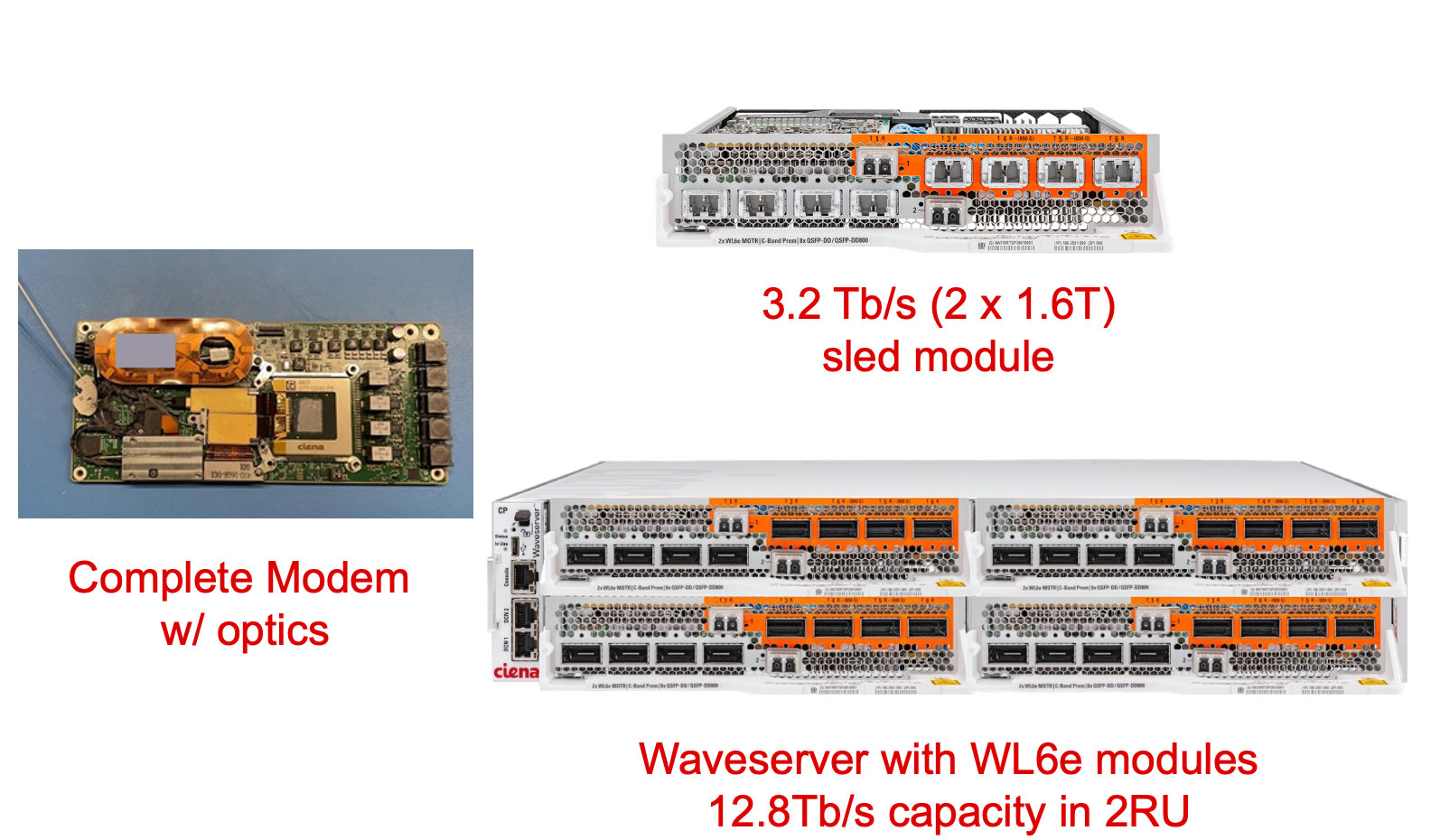
The Waveserver chassis uses insertable sleds, each sled hosting two WaveLogic 6 Extreme coherent modems. Four sleds fit into the Waveserver chassis for a total of eight optical wavelengths and 12.8Tbps transmission capacity.
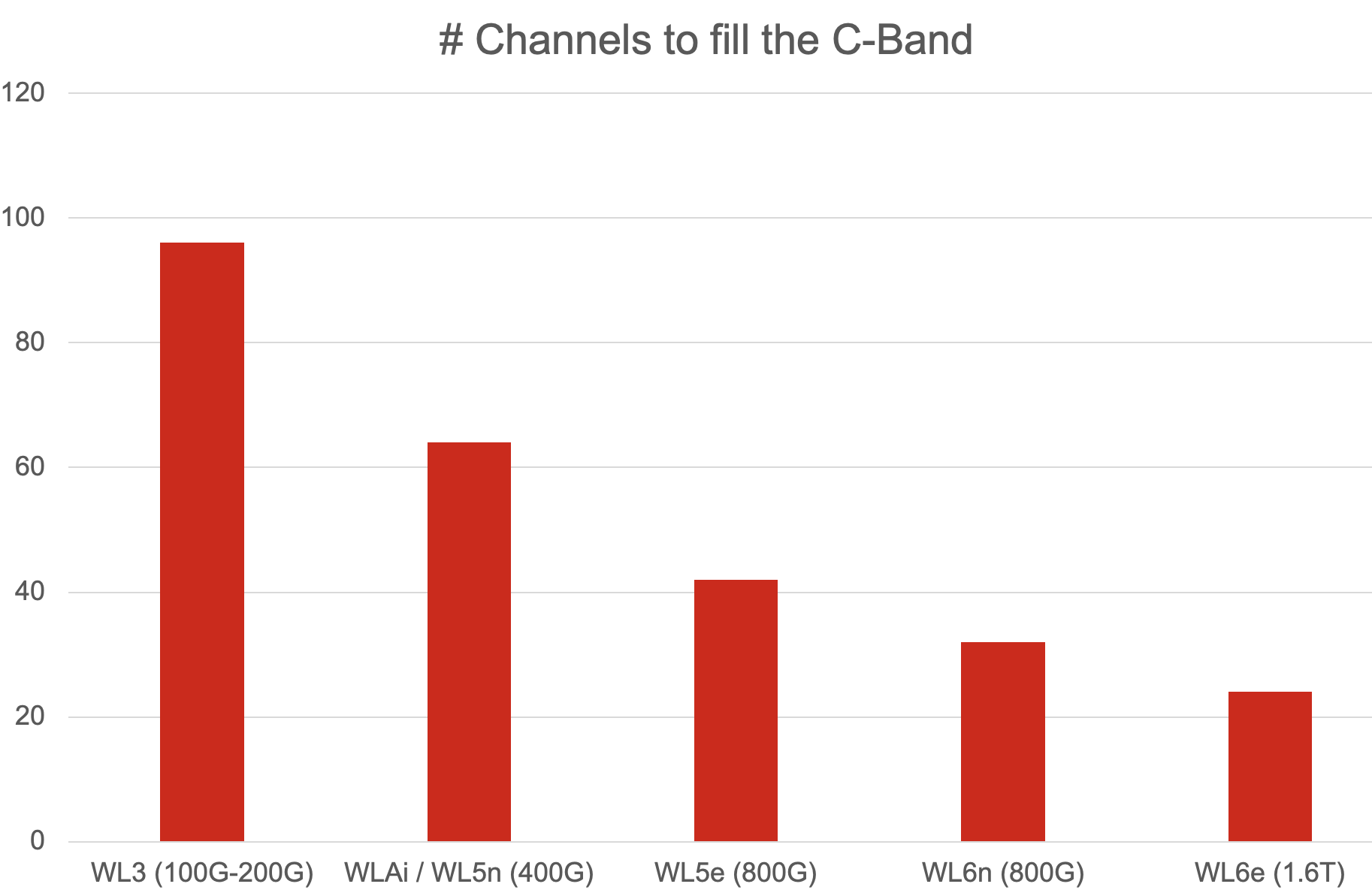
Overall, 24 1.6Tbps wavelengths, each occupying a 200GHz channel, fit into a fibre’s C-band spectrum, giving a total capacity of 38.4Tbps. The same applies to the fibre’s L-band.
“You are filling up the full C-band with only 24 wavelengths,” says Xenos. “It wasn’t that long ago when we filled the C-band with 96, 100-gigabit channels or 64, 400-gigabit channels.” (See chart.)
Ciena says other field trials are planned. Based on its simulation work, Ciena expects its latest coherent modem to send 1.2Tbps across the Atlantic Ocean, 1Tbps across the Pacific Ocean, and 800Gbps over 3,000km. “We expect to see performance improvements because we are still tweaking,” says Xenos.
Embedded and pluggable modules
Coherent pluggable optics continue to advance, especially with the demands of hyperscalers. Coherent pluggable modules, driven by hyperscalers’ data centre interconnect demands, also continue to advance. So, is the requirement for the highest-performance embedded modules diminishing?
Ciena believes that both classes of devices are needed: performance-optimised (embedded) and pluggable coherent optical modules.
“There are more capabilities that are becoming available in pluggables, with the 800-gigabit generation extending to 1,000km and beyond and with L-band offerings coming in the near future,” she says. “If you can integrate the pluggable into a router platform, that allows you to save on space and power.”
However, the pluggable can’t match the spectral efficiency of an embedded coherent module. An 800-gigabit pluggable uses a 150GHz channel spacing, which is the same spectral efficiency as the earlier generation Ciena WaveLogic AI.
The latest embedded modules, in contrast, can be significantly better than equivalent line reate pluggables: from 1.3x to 2x. This is an important consideration in environments where fibre is scarce.
Another point Xenos makes is the nature of the optical network and its total cost, not just the optics (embedded or pluggable) but also the optical line system. If a link has many amplification stages and ROADMs, the optical line makes a more significant contribution to the overall cost. Here embedded optics is needed to span the more complex optical route while being one part of the overall cost.
“You have to look at the total overall cost of building the network,” says Xenos. “It is the optics and the photonic line system.”
General availability
The WaveLogic 6 Extreme will be generally available at the end of September 2024.
When Ciena first announced the coherent DSP, the company expected the device to be generally available in the first half of 2024. In March at OFC 2024, Ciena gave an update saying trials would start this summer.
Xenos says the delivery date did slip by several months. But she stresses the achievement of delivering such a complex coherent modem system. As well as designing the chip in a 3nm CMOS process, the DSP also includes very high-speed mixed-signal analogue-to-digital and digital-to-analogue converters.
“When you target a certain availability, it is the best date that is also realistic,” says Xenos. “The fact that we’re only a few months off means that the team has executed to deliver a working product.”
Ciena is also integrating WaveLogic 6 into its 6500 optical transport platform and will make a coherent WaveLogic 6 module available for OEMs or developers that have custom equipment requirements.
Meanwhile, Ciena continues to develop the Nano, the second WaveLogic 6 device designed for the coherent pluggable market. The WaveLogic 6 Nano is expected to be sampled at the end of the year.
Market consolidation
In June, Nokia announced its intention to acquire Infinera. If the deal passes regulatory approval, it will reduce the number of companies capable of developing high-end coherent DSPs.
More players mean greater competition which pushes the marketplace. But developing coherent DSPs using shrinking CMOS nodes is getting more expensive. One fewer player can be viewed as good news for the rest. Xenos says Ciena has expected fewer high-end coherent players going forward.
“Those who are vertically integrated have an advantage of improved cost efficiencies that they can offer to their end-customers,” she says. “And we’ve been investing in vertical integration because it allows us to control our destiny and come to market with new technology at an earlier time.”
This is what the company has done with the WaveLogic 6 Extreme, where Ciena had to develop its own 100GHz analogue bandwidth coherent optics to achieve the 200GBd symbol rate.
Future developments
The roadmap for coherent pluggable modules is well defined due to the industry organisation, the OIF’s 1600ZR and 1600ZR+ 1.6Tbps coherent pluggable modules which are expected from 2028. For embedded modules the roadmap is less clear.
“There is nothing to announce at this time, but we know that the next step has to be bold enough to provide a meaningful benefit for its adoption into the network,” says Xenos.


The OIF's coherent optics work gets a ZR+ rating
The OIF has started work on a 1600ZR+ standard to enable the sending of 1.6 terabits of data across hundreds of kilometres of optical fibre.The initiative follows the OIF's announcement last September that it had kicked off 1600ZR. ZR refers to an extended reach standard, sending 1.6 terabits over an 80-120km point-to-point link.
600ZR follows the OIF’s previous work standardising the 400-gigabit 400ZR and the 800-gigabit 800ZR coherent pluggable optics.
The decision to address a ‘ZR+’ standard is a first for the OIF. Until now, only the OpenZR+ Multi-Source Agreement (MSA) and the OpenROADM MSA developed interoperable ZR+ optics.
The OIF’s members’ decision to back the 1600ZR+ coherent modem work was straightforward, says Karl Gass, optical vice chair of the OIF’s physical link layer (PLL) working group. Several companies wanted it, and there was sufficient backing. “One hyperscaler in particular said: ‘We really need that solution’,” says Gass.
OIF, OpenZR+, and OpenROADM
Developing a 1600ZR+ standard will interest telecom operators who, like with 400ZR and the advent of 800ZR, can take advantage of large volumes of coherent pluggables driven by hyperscaler demand. However, Gass says no telecom operator is participating in the OIF 1600ZR+ work.
“It appears that they are happy with whatever the result [of the ZR+ work] will be,” says Gass. Telecom operators are active in the OpenROADM MSA.
Now that the OIF has joined OpenZR+ and the OpenROADM MSA in developing ZR+ designs, opinions differ on whether the industry needs all three.
“There is significant overlap between the membership of the OpenZR+ MSA and the OIF, and the two groups have always maintained positive collaboration,” says Tom Williams, director of technical marketing at Acacia, a leading member of the OpenZR+. “We view the adoption of 1600ZR+ in the OIF as a reinforcement of the value that the OpenZR+ has brought to the market.”
Robert Maher, Infinera’s CTO, believes the industry does not need three standards. However, having three organisations does provide different perspectives and considerations.
Meanwhile, Maxim Kuschnerov, director R&D at Huawei, says the OIF’s decision to tackle ZR+ changes things.”OpenZR+ kickstarted the additional use cases in the industry, and OpenROADM took it away but going forward, it doesn’t seem that we need additional MSAs if the OIF is covering ZR+ for Ethernet clients in ROADM networks,” says Kuschnerov. “Only the OTN [framing] modes need to be covered, and the ITU-T can do that.”
Kuschnerov also would like more end-user involvement in the OIF group. “It would help shape the evolving use cases and not be guided by a single cloud operator,” he says.
ZR history
The OIF is a 25-year-old industry organisation with over 150 members, including hyperscalers, telecom operators, systems and test equipment vendors, and component companies.
In October 2016, the OIF started the 400ZR project, the first pluggable 400-gigabit Ethernet coherent optics specification. The principal backers of the 400ZR work were Google and Microsoft. The standard was designed to link equipment in data centres up to 120km apart.
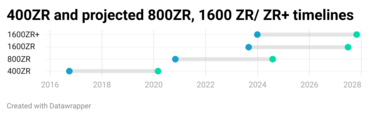
The OIF 400ZR specification also included an un-amplified version with a reach of several tens of kilometres. The first 400ZR specification document, which the OIF calls an Implementation Agreement, was completed in March 2020 (see chart above).
The OIF started the follow-up on the 800ZR specification in November 2020, a development promoted by Google. Gass says the OIF is nearing completion of the 800ZR Implementation Agreement document, expected in the second half of 2024.
If the 1600ZR and ZR+ coherent work projects take a similar duration, the first 1600ZR and 1600ZR+ products will appear in 2027.
Symbol rate and other challenges
Moving to a 1.6-terabit coherent pluggable module using the same modulation scheme – 16-ary quadrature amplitude modulation or 16-QAM – used for 400ZR and 800ZR suggests a symbol rate of 240 gigabaud (GBd).
“That is the maths, but there might be concerns with technical feasibility,” says Gass. “That’s not to say it won’t come together.”
The highest symbol rate coherent modem to date is Ciena’s WaveLogic 6e, which was announced a year ago. The design uses a 3nm CMOS coherent digital signal processor (DSP) and a 200GBd symbol rate. It is also an embedded coherent design, not one required to fit inside a pluggable optical module with a constrained power consumption.
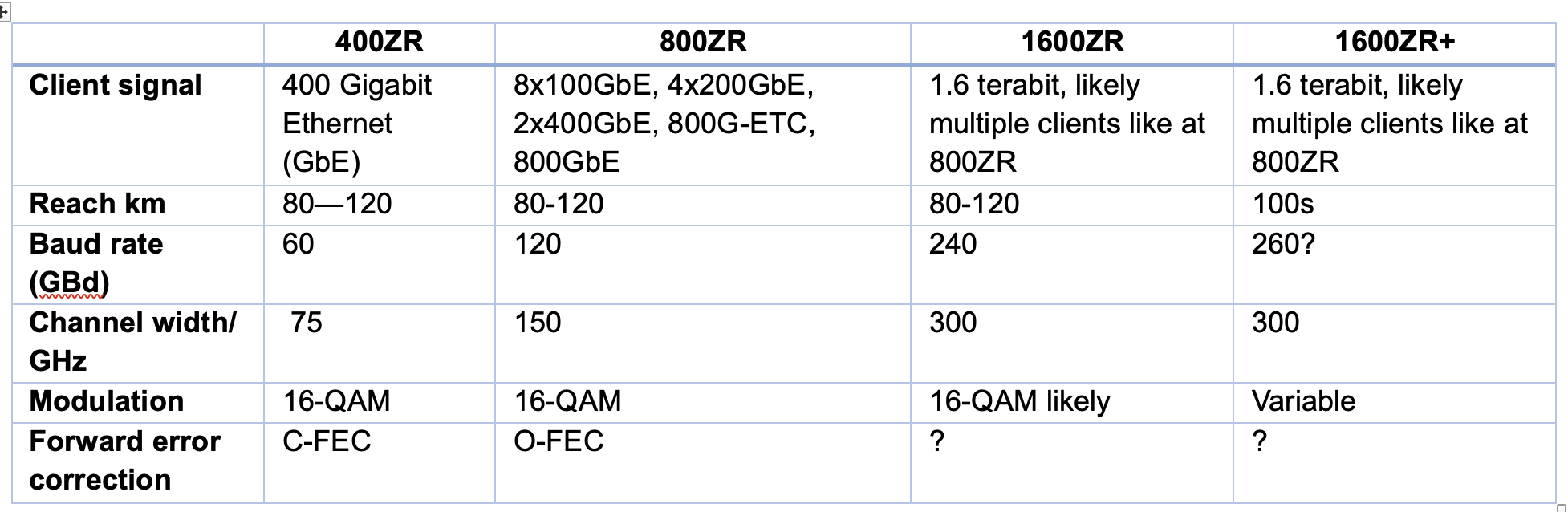
Kuschnerov points out that the baud rates of ZR and ZR+ have differed. And this will likely continue. 800ZR, using Ethernet with no probabilistic constellation shaping, has a baud rate of 118.2GBd, while 800ZR+, which uses OTN and probabilistic constellation shaping, has a baud rate of up to 131.35GBd. Every symbol has a varying probability when probabilistic constellation shaping is used. “This decreases the information per symbol, and thus, the baud rate must be increased,“ says Kuschnerov.
Doubling up for 1600ZR/ ZR+, those numbers become around 236GBd and 262GBd, subject to future standardisation. “So, saying that 1600ZR is likely to be at 240GBd is correct, but one cannot state the same for a potential 1600ZR+,” says Kuschnerov.
Nokia’s view is that for 1600ZR, the industry will look at operating modes that include 16QAM at 240 GBd. Other explored options include 64-QAM with probabilistic constellation shaping at 200GBd and even dual optical carrier solutions with each carrier operating at approximately 130GBd. “However, this last option may be challenging from a power envelope perspective,” says Szilárd Zsigmond, head of Nokia’s optical subsystems group.
In turn, if 1600ZR+ reaches 1,000km distances, the emphasis will be on higher baud rate options than those used for 1600ZR. “This will be needed to enable longer reaches, which will also put pressure on managing power dissipation,” says Zsigmond.
The coherent DSP must also have digital-to-analogue (DACs) and analogue-to-digital converters (ADCs) to sample at least at 240 giga-samples per second. Indeed, the consensus among the players is that achieving the required electronics and optics will be challenging.
“All component bandwidths have to double and that is a significant challenge,” says Josef Berger, associate vice president, cloud optics marketing at Marvell.
The coherent optics – the modulators and receivers – must extend their analogue bandwidth of 120GHz. Infinera is one company that is confident this will be achieved. “Infinera, with our highly integrated Indium Phosphide-based photonic integrated circuits, will be producing a TROSA [transmitter-receiver optical sub-assembly] capable of supporting 1.6-terabit transmission that will fit in a pluggable form factor,” says Maher.
The coherent DSP and optics operating must also meet the pluggable modules’ power and heat limits. “That is an extra challenge here: the development needs to maintain focus on cost and power simultaneously to bring the value network operators need,” says Williams. “Scaling baud rate by itself doesn’t solve the challenge. We need to do this in a cost and power-efficient way.”
Current 800ZR modules consume 30W or more, and since the aim of ZR modules is to be used within Ethernet switches and routers, this is challenging. In comparison, 400ZR modules now consume 20W or less.
“For 800ZR and 800ZR+, the target is to be within the 28W range, and this target is not changing for 1600ZR and 1600ZR+,” says Zsigmond. Coherent design engineers are being asked to double the bit rate yet keep the power envelope constant.
Certain OIF members are also interested in backward compatibility with 800ZR or 400ZR. “That also might affect the design,” says Gass.
Given the rising cost to tape out a coherent DSP using 3nm and even 2nm CMOS process nodes required to reduce power per bit, most companies designing ASICs will look to develop one design for the 1600ZR and ZR+ applications to maximise their return on investment, says Zsigmond, who notes that the risk was lower for the first generations of ZR and ZR+ applications. Most companies had already developed components for long-haul applications that could be optimised for ZR and ZR+ applications.
For 400ZR, which used a symbol rate of 60 GBd, 60-70 GBd optics already existed. For 800 gigabit transmissions, high-performance embedded coherent optics and pluggable, low-power ZR/ZR+ modules have been developed in parallel. “For 1600ZR/ZR+, it appears that the pluggable modules will be developed first,” says Zsigmond. “There will be more technology challenges to address than previous ZR/ZR+ projects.”
The pace of innovation is faster than traditional coherent transmission systems and will continue to reduce cost and power per bit, notes Marvell’s Berger: “This innovation creates technologies that will migrate into traditional coherent applications as well.”
Gass is optimistic despite the challenges ahead: “You’ve got smart people in the room, and they want this to happen.”
OIF's OFC 2024 demo
The OIF has yet to finalise what it will show for the upcoming coherent pluggable module interoperable event at OFC to be held in San Diego in March. But there will likely be 400ZR and 800ZR demonstrations operating over 75km-plus spans and 400-gigabit OpenZR+ optics operating over greater distance spans.
Optical transmission: sending more data over a greater reach
Keysight Technologies' chart plots the record-setting optical transmission systems of recent years.
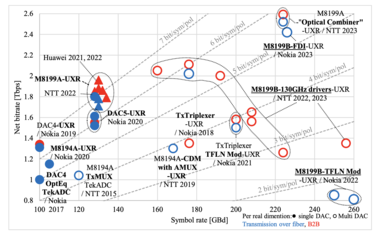
The chart, compiled by Dr Fabio Pittalá, product planner, broadband and photonic center of excellence at Keysight, is an update of one previously published by Gazettabyte.
The latest chart adds data from last year’s conferences at OFC 2023 and ECOC 2023. And new optical transmission achievements can be expected at the upcoming OFC 2024 show, to be held in San Diego, CA in March.

Ribbon offers for trial its 1.2T wavelength 9408 platform
Add Your Into Content Here

Ribbon Communications has started working with operators to trial its latest Apollo 9408 optical transport platform that supports 1.2 terabits per second (Tbps) optical wavelengths.
The company’s modular platform can also send 800 gigabit-per-second (Gbps) wavelengths over 1,000km and 400Gbps wavelengths over ultra-long-haul networks.
“We have conducted trials, including one with a Tier 1 European provider,” says Jonathan Homa, senior director of solutions marketing at Ribbon. “You can get 1.2 terabits within major cities, 800 gigabits covering major states or regions, and 400 gigabits for about as long as you want to go.”
“The Apollo 9408 is Ribbon’s first disaggregated transponder unit or compact modular box using the CIM 8 for up to 1.2Tbps of wavelength speed,” says Jimmy Yu, vice president at market research firm Dell’Oro Group.
Yu believes the product has shipped to a customer this quarter and is likely the first commercial shipment of a 1.2Tbps wavelength system for network deployment.
Acacia’s CIM 8 pluggable coherent modem
The Apollo 9408 uses Acacia’s pluggable Coherent Interconnect Module (CIM 8) coherent modem. The CIM 8 uses Acacia’s 5nm CMOS Jannu digital signal processor (DSP) and its silicon photonics-based coherent optics operating at a symbol rate of up to 140 gigabaud.
“The advantage of this smaller transistor geometry is not only the higher density per die but also lower power and faster processing speed,” says Yu. “All the things needed to help service providers achieve cost and power efficiencies.” This is why the market looks forward to the next generation of coherent DSPs, says Yu.
Acacia started shipping the CIM 8 at the year’s start, and Ribbon says the module’s availability enables the company to leapfrog existing 7nm CMOS-based coherent optical transport solutions.
Before 1.2 Tbps-capable wavelengths, the highest speed was 800Gbps, delivered by Ciena, Huawei, and Infinera, says Yu.
“Ciena was first to market and captured the lion’s share of shipment volumes,” says Yu. “We peg Ciena’s market share of 800 Gbps-capable wavelengths at approximately 70 per cent of the cumulative shipments through 2Q 2023. That is a huge share, benefiting from being first to market.”
Compact modular platform
The compact modular platform format was developed to meet the large-scale data centre operators’ computing needs. The platform is used for data centre interconnect applications while the large communications service providers are become interested in the platform form factor.

Compact modular platforms are 600mm deep and use front-to-back airflow for cooling. In contrast, standard telecom equipment is 300mm deep and uses a left-to-right airflow. The compact modular format thus suits data centres with alternate hot and cold aisles of equipment. The platforms face each other, so the air in a cold aisle is blown through each platform, exiting in the adjacent hot aisles. The efficient cooling scheme enables the equipment to be run hotter.
“With the compact modular platform’s front and back airflow, we can run the CIM 8 to 1.2 terabits,” says Homa. “In our standard [telecom] platform [the Apollo 9600 series], we’re using the same CIM 8 pluggable, but from a power dissipation point of view, we can only run it to 800 gigabits.”
The 9408 supports different channel plans depending on how the platform is used. For a cost-optimised transmission, a 400Gbps wavelength fits in a 75GHz channel, and a performance-optimised 800Gbps or 1.2Tbps wavelength fits in a 150GHz channel.
“With continuous baud rate control from 68-140Gbaud, the CIM 8 can accommodate any channel width such as 112.5GHz with networks that have flexible grid ROADMs [reconfigurable optical add/drop multiplexers],” says Homa. “It also uses probabilistic constellation shaping to maximise the line rate for that channel width.”
Configurations
The Apollo 9408 is a two rack unit (2RU) platform. For high-performance optical transport, it holds four MPJ1200_2 sleds. The sleds slot into the compact modular platform, with each sled hosting two CIM 8 modules. The power consumption of the double CIM 8 sled is 270W or less than 0.12W/gigabit. The total transport capacity is thus 9.6 terabits.
Ribbon plans to double the CIM 8s within the 2RU capacity platform to offer 19.2 terabits of capacity.
Alternatively, the 2RU rack can hold up to four MPQ_8 sleds hosting eight 400-gigabit coherent optical modules for a total capacity of 12.8 terabits. Ribbon uses 64 gigabaud 400-gigabit QSFP-DDs that use a transmit power of 0dBm and are OpenROADM MSA compliant.
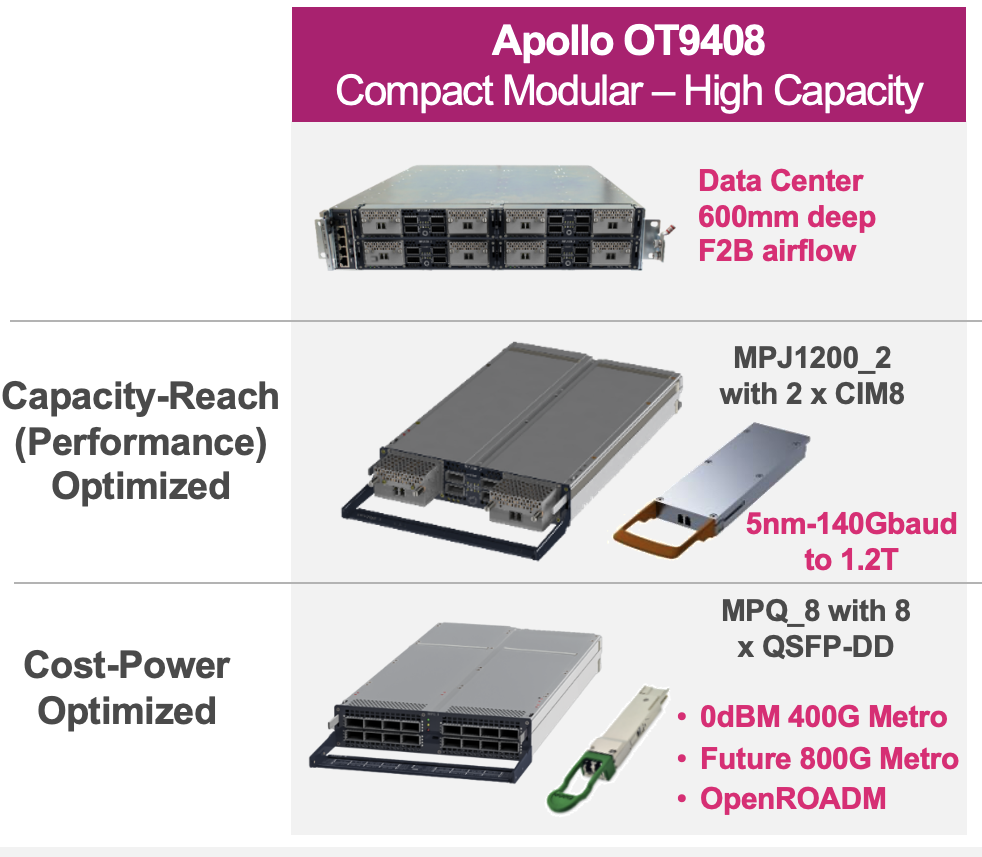
“The MPQ_8 is also designed to accept a new generation of 124Gbaud 800Gbps QSFP-DD pluggables currently in development and expected to be available in early 2025,” says Homa.
Ribbon also offers its standard telecom Apollo 9600 series platforms, from the smallest 2RU 9603 to the 5RU 9608 to the largest 15RU 9624 chassis. The Apollo 9600 modular platforms can use two CIM 8s in the TM800_2 double-slot card for performance-optimised transmission to 800 gigabits, or two CFP2-DCO modules in the TM400_2 single-card slot card for cost-optimised transmission to 400 gigabits.
Industry timing
Optical system vendors that don’t develop their own coherent DSP chips or modems, such as Ribbon, have several supply options. The leading merchant DSP suppliers include Acacia, NEL and Marvell. There are also competitor optical transport providers that source their coherent modem solutions. Ribbon discussed with several coherent modem suppliers but chose Acacia’s CIM 8 for the 9408. Ribbon has worked with Acacia for a decade.
The CIM 8’s 5nm Jannu DSP leapfrogs the 90-100GBd 7nm CMOS generation of coherent DSPs now deployed. This year, 5nm CMOS coherent DSPs have been announced by Nokia and Infinera. Merchant suppliers NEL and Marvell have also detailed their latest coherent DSPs. All these devices operate at symbol rates in the region of 130-150GBd.
Acacia also supplies the CIM 8 to other optical transport vendors such as Cisco, Acacia’s parent company, ZTE, and Adtran. Cisco has announced its Network Convergence System (NCS) 1014 compact modular platform that includes a 2.4Tbps transponder Line using the CIM 8. In March, Adtran reported sending an 800-gigabit signal over 2,200km using the CIM 8 as part of a networking trial. The route included 14 route-and-select flexible-grid ROADMs.
“It will be interesting to see the market dynamics unfold over the next year. There will be more system suppliers of 1.2 Tbps-capable wavelengths,” says Dell’Oro’s Yu. “Many system vendors will use the CIM 8, and some will use NEL’s ExaSpeed GAIA DSP. Some will also develop in-house DSPs such as Huawei and Nokia.”
Every dense wavelength division multiplexing (DWDM) system vendor will have a 1.2 Tbps-capable line card available for sale before the end of 2024, except for Ciena, says Yu: “This is because Ciena will come out with a 1.6 Tbps-capable DSP on a 3nm process node in 2024, one to two years ahead of any other vendors.”
Earlier this year, Ciena announced its WaveLogic 6, the first coherent DSP that operates at 200GBd. Ciena says it will offer its optical transport systems using its 3nm CMOS coherent DSP in the second half of 2024.
Homa believes that the next jump will be 240-plus GBd coherent DSPs, likely implemented using an even smaller 2nm CMOS process node.
The OIF’s 1600ZR 1.6-terabit coherent pluggable module standard will use a 240GBd symbol rate DSP.

Working at the limit of optical transmission performance

- Expect to see new optical transmission records at the upcoming ECOC 2023 conference.
- Keysight Technologies’ chart plots the record-setting optical transmission systems of recent years.
- The chart reveals optical transmission performance issues and the importance of the high-speed converters between the analogue and digital domains for test equipment and, by implication, for coherent digital signal processors (DSPs).
Engineers keep advancing optical systems to send more data across an optical fibre.
It requires advances in optical and electronic components that can process faster, higher-bandwidth signals, and that includes the most essential electronics part of all: the coherent DSP chip.
Coherent DSPs use state-of-the-art 5nm and 3nm CMOS chip manufacturing processes. The chips support symbol rates from 130-200 gigabaud (GBd). At 200GBd, the coherent DSP’s digital-to-analogue converters (DACs) and analogue-to-digital converters (ADCs) must operate at at least 200 giga samples-per-second (GSps) and likely closer to 250GSps. DACs drive the optical modulator in the optical transmission path while the ADCs are used at the optical receiver to recover the signal.
Spare a thought for the makers of test equipment used in labs that drive such coherent optical transmission systems. The designers must push their equipments’ DACs and ADCs to the limit to generate and sample the waveforms of these prototype next-generation optical transmission systems.
Optical transmission records
The recent history of record-setting optical transmission systems reveals the design challenges of coherent components and how ADC and DAC designs are evolving.
It is helpful to see how test equipment designers tackle ADC and DAC design, given the devices are a critical element of the coherent DSP, and when vendors are reluctant to detail how they achieve 200GBd baud rates using on-chip CMOS-based ADCs and DACs.
Nokia and Keysight Technologies published a post-deadline paper at the ECOC 2022 conference detailing the transmission of a 260GBd single-wavelength signal over 100km of fibre.
The system achieved the high baud rate using a thin-film lithium niobate modulator driven by Keysight’s M8199B arbitrary waveform generator. The M8199B uses a design consisting of two interleaved DACs to generate signals at 260GSps.
A second post-deadline ECOC 2022 paper, published by NTT, detailed the sending of over two terabits-per-second (Tbps) on a single wavelength. This, too, used Keysight’s M8199B arbitrary waveform generator.
The chart above highlights optical transmission records since 2015, plotting the systems’ net bit rate – from 800 gigabits to 2.2 Tbps – against a symbol rate measured in GBd.
As with commercial coherent optical transport systems, the goal is to keep increasing the symbol rate. A higher symbol rate sends more data over the same fibre spans. For example, the 400ZR coherent transmission standard uses a symbol rate of some 60GBd to send a 400Gbps wavelength, while 800ZR doubles the baud rate to some 120GBd to transmit 800Gbps over similar distances.
“With the 1600ZR project just started by the OIF, this trend will likely continue,” says Fabio Pittalá, product planner, broadband and photonic center of excellence at Keysight.
The signal generator test equipment options include the use of different materials – CMOS and silicon germanium – and moving from one DAC to a parallel multiplexed DAC design.
Single DACs
In 2017, Nokia achieved a 1Tbps transmission using a 100GBd symbol rate. Nokia used a Micram 6-bit 100GSps DAC in silicon germanium for the modulation.
For its next advancement in transmission performance, in 2019, Nokia used the same DAC but a faster ADC at the receiver, moving from a Tektronix instrument using a 70GHz ADC to the Keysight UXR oscilloscope with a 110GHz bandwidth ADC. The resulting net bit rate was nearly 1.4 terabits.
Keysight also developed the M8194A arbitrary waveform generator based on a CMOS-based DAC. The higher sampling rate of this arbitrary waveform generator increased the baud rate to 105GBd, but because of the bandwidth limitation, the net bit rate was lower.
The bandwidth of CMOS DACs can be improved but it tops out in the region of 50-60GHz. “It’s very difficult to scale to a higher baud rate using this technology,” says Pittalá. Silicon germanium, by contrast, supports much higher bandwidths but has a higher power consumption.
In 2020, Nokia reached 1.6Tbps at 128GBd using the Micram DAC5, an 8-bit 128GSps DAC based on silicon germanium. A year later, Keysight released the M8199A arbitrary waveform generator. “This was also based on 8-bit silicon germanium DACs operating at 128GSps, but the signal-to-noise ratio was greatly improved, allowing to generate higher-order quadrature amplitude modulation formats with more than sixteen levels,” says Pittalá.
This arbitrary waveform generator was used in systems that, coupled with advanced equalisation schemes, pushed the net bit rate to almost 2Tbps.
Going parallel
For the subsequent advances in baud rate, parallel DAC designs, multiplexing two or more DACs together, were implemented by different research labs.
In 2015, NTT multiplexed two DACs that advanced the symbol rate from 105GBd to 120GBd. In 2019, NTT moved to a different type of multiplexer, which, used with the same DAC, increased the baud rate to around 170GBd. Nokia also demonstrated a multiplexed design concept, which, together with a novel thin-film lithium niobate modulator, extended the symbol rate to 200GBd, achieving a 1.6Tbps net bit rate.
Last year, Keysight introduced its latest arbitrary waveform generator, the M8199B. The design also adopted a multiplexed DAC design.

Multiplexing two DACs. SR refers to sample rate, BW refers to bandwidth. Source: Keysight.
“There are two 128GSps 8-bit silicon germanium DACs that are time-interleaved to get a higher speed signal per dimension,” says Pittalá. If the two DACs are shifted in time and added together, the result is a higher sampling rate overall. However, Pittalá points out that while the sample rate is effectively doubled, the overall bandwidth is defined by the individual DACs (see diagram above).
Pittalá also mentions another technique, based on active clocking, that does increase the bandwidth of the system. The multiplexer is clocked and acts like a fast switch between the two DAC channels. “In principle, you can double the bandwidth, ” he says. (See diagram below.)

The Keysight’s M8199B’s improved performance, combined with advances in components such as NTT’s 130GHz indium phosphide amplifier, resulted in over 2Tbps transmission, as detailed in the ECOC 2022 paper. As the baud rate was increased, the modulation scheme used and the net bit rate decreased. (Shown by the red dots on the chart).
In parallel, Keysight worked with Nokia, which used a thin-film lithium niobate modulator for their set-up, a different modulator to NTT’s. The test equipment directly drove the thin-film modulator; no external modulator driver was needed. The system was operated as high as 260GBd, achieving a net bit rate of 800Gbps.
Pittalà notes that while the NTT system differs from Nokia’s, Nokia’s two red points on the extreme right of the chart continue the trajectory of NTT’s six red points as the baud rate increases.
OFC’23 O-band record
The post-deadline papers at the OFC 2023 conference earlier this year did not improve the transmission performances of the ECOC papers.
A post-deadline paper published at OFC 2023 showed a record of coherent transmission in the O-Band. Working with Keysight, McGill University showed 1.6Tbps coherent transmission over 10km using a thin-film lithium niobate modulator. The system operated at 167GBd, used a 64-QAM modulation scheme, and used the Keysight M8199B.
Pittalà expects that at ECOC 2023, to be held in Glasgow in October, new record-breaking transmissions will be announced.
His chart will need updating.
Further information
Thin-film lithium niobate modulators, click here