

Acacia's single-wavelength terabit coherent module

- Acacia has developed a 140-gigabaud, 1.2-terabit coherent module
- The module, using 16-ary quadrature amplitude modulation (16-QAM), can deliver an 800-gigabit wavelength over 90 per cent of the links of a North American operator.
Acacia Communications, now part of Cisco, has announced the first 1.2-terabit single-wavelength coherent pluggable transceiver.
And the first vendor, ZTE, has already showcased a prototype using Acacia’s single-carrier 1.2 terabit-per-second (Tbps) design.
The coherent module operates at a symbol rate of up to 140 gigabaud (GBd) using silicon photonics technology. Until now, indium phosphide has always been the material at the forefront of each symbol rate hike.
The module uses Acacia’s latest Jannu coherent digital signal processor (DSP), implemented in 5nm CMOS. The coherent transceiver also uses a custom form-factor pluggable dubbed the Coherent Interconnect Module 8 (CIM-8).
Trends
Acacia refers to its 1.2-terabit coherent pluggable as a multi-haul design, a break from its product categorisation as either embedded or pluggable.
“We are introducing a pluggable module that supports what has traditionally been the embedded market,” says Tom Williams, senior director of marketing at Acacia. “It supports high-capacity edge applications all the way out to long-haul and submarine.”
Pluggables are the fastest-growing segment of the coherent market. Whereas the mix of custom embedded designs to pluggable interoperable is 2:1, that is forecast to change with coherent pluggables accounting for two-thirds of the total ports.
Acacia highlights the growth of coherent pluggables with two examples.
Data centre operator Microsoft used Inphi’s (now Marvell’s) ColorZ direct-detect 100-gigabit modules for data centre interconnect for up to 80km whereas now the industry is moving to the 400ZR coherent MSA.
In turn, while proprietary embedded coherent solutions would be used for reconfigurable optical add-drop multiplexers (ROADMs), now, interoperable pluggable coherent modules are being adopted with the OpenROADM MSA.
“There is still a significant need in the market for full-performance multi-haul solutions but we think their development needs to be informed and influenced by pluggables,” says Williams.
1.2-terabit capacity
As coherent technology matures, the optical transmission performance is approaching the theoretical limit as defined by Claude Shannon.
“There is still opportunity for improvement,” says Williams. “We still have performance enhancements with each generation but it is becoming more incremental.”
Williams highlights how its latest design offers a 20–25 per cent spectral efficiency improvement compared to Acacia’s AC1200 that uses two wavelengths to deliver up to 1.2Tbps.
“As we increase baud rate, that alone does not give any improvement in spectral efficiency,” says Williams. It is the algorithmic enhancements that still boost performance.
Acacia is adopting an enhanced probabilistic constellation shaping (PCS) algorithm as well as an improved forward-error correction scheme. “There are also some benefits of a single carrier as opposed to using multiple carriers,” says Williams.
Design
The latest design is a natural extension of the AC1200 which can send 400 gigabits over ultra-long-haul distances, 800 gigabits using two wavelengths over most spans, and three 400-gigabit payloads over shorter, network-edge reaches. Now, this can all be done using a single wavelength.
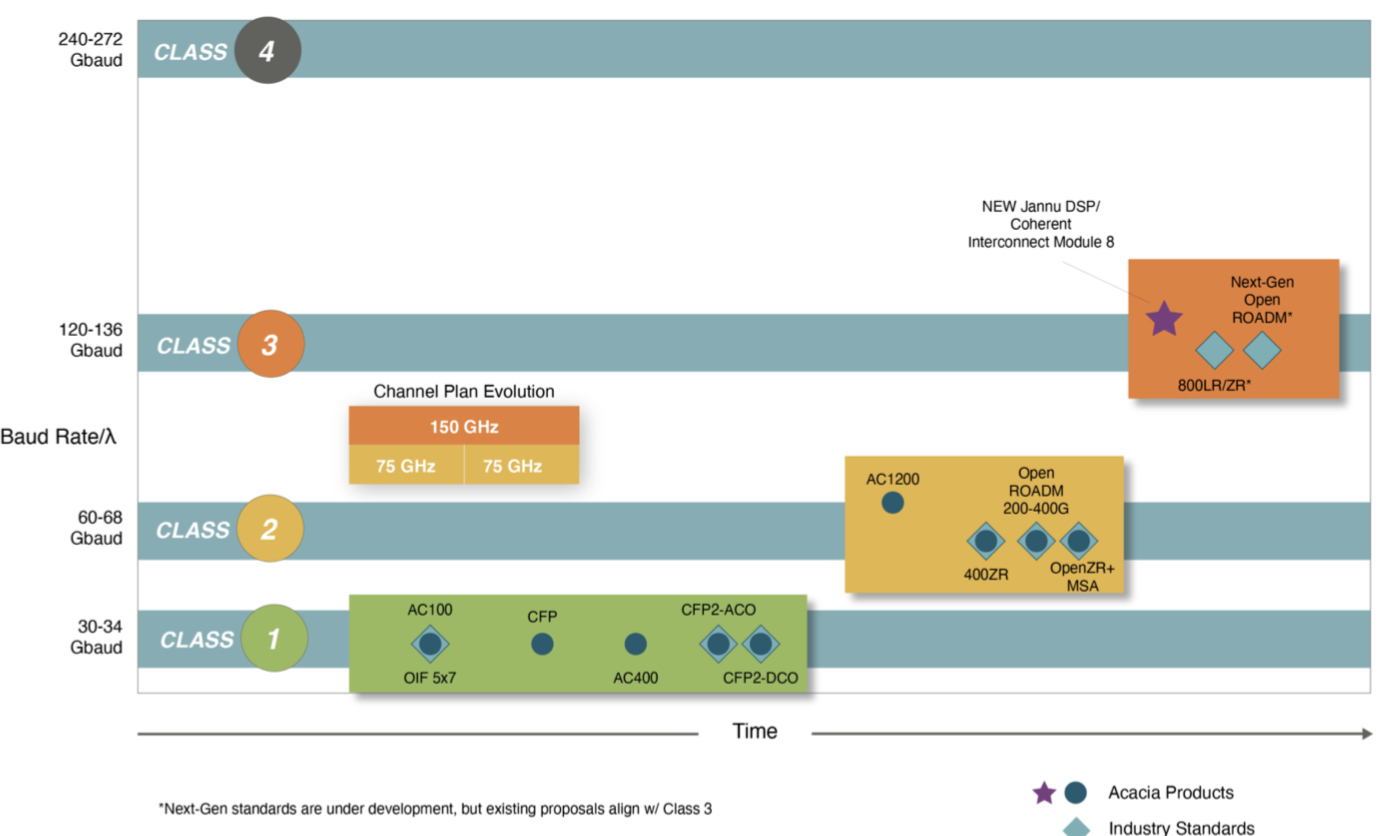
A 150GHz channel is used when transmitting the module’s full rate of 1.2Tbps. And with the module’s adaptive baud rate feature, the rate can be reduced to fit a wavelength in a 75GHz-wide channel. Existing 800-gigabit transmissions use 112.5GHz channel widths and the multi-rate module also supports this spacing.
Williams says 16-QAM is the favoured signalling scheme used for transmission. This is what has been chosen for the 400ZR standard at 64GBd. Doubling the symbol rate means 800 gigabits can be sent using 16-QAM.
Acacia also highlights that future generation coherent designs, what it calls class 4 (see diagram above), will double the symbol rate again to some 240GBd. But the company is not saying whether the technology enabling such rates will be silicon photonics.
The company has long spoken of the benefits of using a silicon packaging approach for its coherent modules in terms of size, power and automated manufacturing. But as the symbol rate doubles, packaging plays a key role to help tackle challenging radio frequency (RF) design issues.
Acacia stacks the driver and trans-impedance amplifier (TIA) circuitry directly on top of its photonic integrated circuit (PIC) while its coherent DSP is also packaged as part of the design. “This gives us much better signal integrity than if we have the optics and DSP packaged separately,” says Williams.
The key to the design is getting the silicon photonics – the optical modulator, in particular – operating at 140GBd. “If you can, the packaging advantages of silicon are significant,” says Williams.
Acacia points out that with the migration of traffic from 100GbE to 400GbE it makes sense to offer a single-wavelength multi-rate design. And 400GbE will remain the mainstay traffic for a while. But once the transition to 800 gigabit occurs, the idea of supporting two coherent wavelengths – a future dual-wavelength “AC2400” – may make sense.
CIM-8
Acacia is using its own form factor and not a multi-source agreement (MSA) because the 1.2-terabit technology exceeds all existing client-side data rates.
In turn, the power consumption of the 1.2-terabit coherent module requires a custom form factor while launching an MSA based on the CIM-8 would have tipped off the competition, says Williams.
That said, Acacia has made no secret that its next high-end design following on from its 64GBd AC1200 would double the symbol rate and that the company would skip the 96GBd rate used by vendors such as Ciena, Huawei and Infinera already offering 800-gigabit wavelength systems.
For Acacia’s multi-rate design that needs to address submarine applications, the goal is to maximise transmission performance. In contrast, for a ZR+ coherent design that fits in a QSFP-DD, the limited power budget of the module constrains the design’s performance.
With 5nm Jannu DSP, Acacia realised it could not fit the design in the QSFP-DD or OSFP. But it could produce a pluggable multi-haul design with its CIM-8 that is slightly larger than the CFP2 form factor. And pluggables are advantageous when 4-8 can be fitted in a one-rack-unit (1RU) platform.
Acacia says its 140GBd module using 16-QAM will deliver an 800-gigabit wavelength over 90 per cent of the links of a North American operator. For the remaining, longest-distance links (the 10 per cent), it will revert to 400 gigabits.
In contrast, existing 800-gigabit systems operating at 96GBd cover up to 20 per cent of the links before having to revert to the slower speed, says Acacia.
Applications
Hyperscaler data centre operators are the main drivers for 1.2Tbps interconnects. The interface would typically be used in the metro to link smaller data centres to a larger aggregation data centre.
“The 1.2-terabit interface is just trying to maximise cost per bit; pushing more bits over the same set of optics,” says Williams.
The communications service providers’ requirements, meanwhile, are focussed on 400 gigabits and at some point will migrate to 800 gigabits, says Williams.
Several system vendors are expected to announce products using the new module in the coming months.


ADVA’s 800-gigabit CoreChannel causes a stir

ADVA’s latest addition to its FSP 3000 TeraFlex platform provides 800-gigabit optical transmission. But the announcement has caused a kerfuffle among its optical transport rivals.
ADVA’s TeraFlex platform supports various coherent optical transport sleds, a sled being a pluggable modular unit that customises a platform’s functionality.
The coherent sleds use Cisco’s (formerly Acacia Communication’s) AC1200 optical engine. Cisco completed the acquisition of Acacia in March.
The AC1200 comprises a 16nm CMOS Pico coherent digital signal processor (DSP) that supports two wavelengths, each up to 600-gigabit, and two photonic integrated circuits (PICs), for a maximum capacity of 1.2 terabits.
The latest sled from ADVA, dubbed CoreChannel, supports an 800-gigabit stream in a single channel.
ADVA states in its press release that the CoreChannel uses “140 gigabaud (GBd) sub-carrier technology” to deliver 800-gigabit over distances exceeding 1,600km.
This, the company says, improves reach by over 50 per cent compared with state-of-the-art 95GBd symbol rate coherent technologies.
It is these claims that have its rivals reacting.
“Despite their claims – they are not using actual digital sub-carriers,” says one executive from a rival optical transport firm, adding that what ADVA is doing is banding two independent 70GBd 400-gigabit wavelengths together and trying to treat that as a single 800-gigabit signal.
“This isn’t necessarily a bad solution for some applications – each network operator can decide that for themselves,” says the executive. However, he stresses that the CoreChannel is not an 800-gigabit single-channel solution and uses 4th generation 16nm CMOS DSP technology rather than the latest 5th generation, 7nm CMOS DSP technology.
A second executive, from another optical transport vendor providing 800-gigabit single-wavelength solutions, adds that ADVA’s claim of 140GBd is too ‘creative’ for a two-lambda solution.
“It’s not a real 800 gigabit. Not that this must be bad, but one should call things as they are,” the spokesperson said. “What matters to the operators is the cost, power consumption, reach and density of a modem; the number of lambdas is more of an internal feature.”
CoreChannel
ADVA confirms it is indeed using Cisco’s Pico coherent DSP to drive two wavelengths, each at 400 gigabits-per-second (Gbps).
“You can say the CoreChannel is a less challenging requirement because we are not driving it [the Pico DSP] to the maximum modulation or constellation complexity,” says Stephan Rettenberger, senior vice president, marketing and investor relations at ADVA. “It is the lower end of what the AC1200 can do.”
Until now the two wavelengths have been combined externally, and have not been integrated from a software or a command-and-control approach.
“The CoreChannel sled is just another addition to the TeraFlex toolbox,” says Rettenberger. “It has one physical line interface that drives an 800Gbps stream using two wavelengths, each one around 70GBd, that are logically and physically combined.”
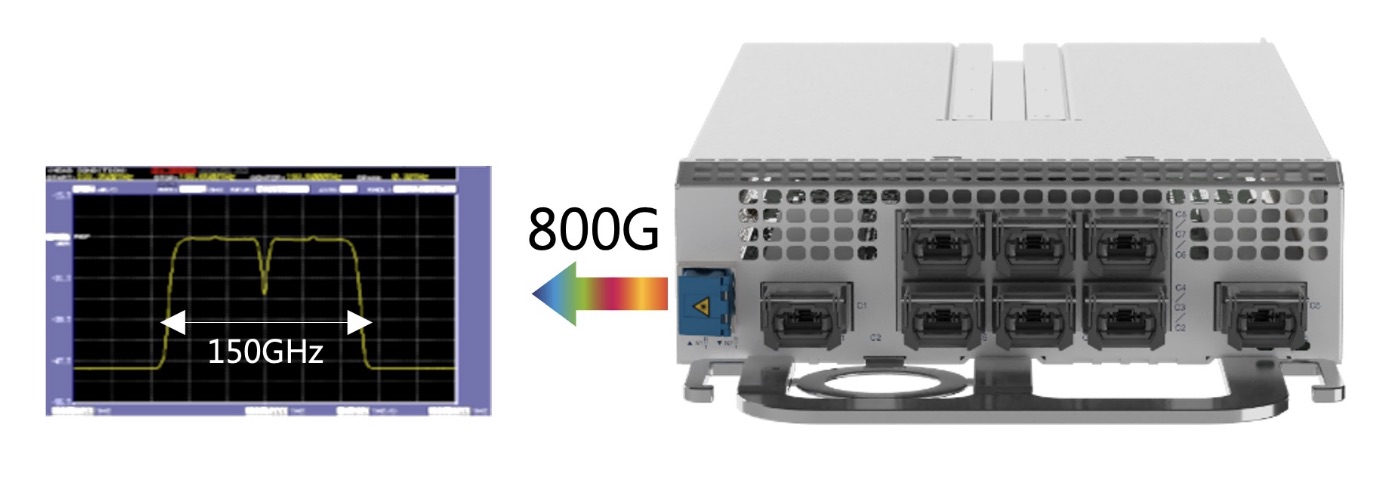
The resulting two-wavelength 800-gigabit stream sits within a 150GHz channel. However, the channel width can be reduced to 125GHz and even 112.5GHz for greater spectral efficiency.
ADVA says the motivation for the design is the customers’ requirement for lower-cost transport and the ability to easily transport 400 Gigabit Ethernet (GbE) client signals.
“With this 800-gigabit line speed, you can go something like 2,000km, that is 50-100 per cent more than what 95GBd single-wavelengths solutions will do,“ says Rettenberger. “And you can also drive it at 400 gigabits and you can do something like 6,000km.”
The reaches quoted are based on a recent field trial involving ADVA.
ADVA uses a single DSP, similar to the latest 800-gigabit systems from Ciena, Huawei and Infinera. Alongside the DSP are two non-hermetically-sealed PICs whereas the 95GBd indium-phosphide solutions use a single hermetically sealed gold box.
ADVA’s solution also requires two lasers whereas the 800-gigabit single-wavelength solutions use one laser.
“Yes, we have two lasers versus one but that is not killing the cost,” says Rettenberger. “And it is also not killing the power consumption because the PIC is so much more power efficient.”
Rettenberger stresses that ADVA is not saying its offering is necessarily a better solution. “But it is a very interesting way to drive 800 gigabits further than these 95 gigabaud solutions,” says Rettenberger. “It has the same cost, space, power efficiency, just greater reach.”
ADVA also agrees that it is not using electrical sub-carriers such as Infinera uses but it is using optical sub-carrier technology.
These two wavelengths are combined logically and also from a physical port interface point of view to fit within a 150GHz window.
The 95GBd, in contrast, is an interim symbol rate step and the resulting 112.5GHz channel width doesn’t easily fit with legacy 25GHz and 50GHz band increments, says ADVA, while the 150GHz band the CoreChannel sled uses is the same channel width that will be used once single-wavelength 140GBd technology becomes available.
Acacia has also long talked about the merit of doubling the baud rate suggesting Cisco’s successor to the AC1200 will have a 140GBd symbol rate. Such a design is expected in the next year or two.
“We feel this [CoreChannel] implementation is already future-proofed,” says Rettenberger.
ADVA says it undertook this development in collaboration with Acacia.
Acacia announced a dual-wavelength single-channel AC1200 solution in 2019. Then, the company unveiled its AC1200-SC2 that delivers 1.2 terabits over an optical channel.
The SC2 (single chip, single channel) is an upgrade of Acacia’s AC1200 module in that it sends 1.2 terabits using two sub-carriers that fit in a 150GHz-wide channel.

Customer considerations
Choosing an optical solution comes down to five factors, each having its weight depending on the network application, says the first executive.
These are capacity-per-wavelength, cost-per-bit, capacity-per- optical-engine or -module, spectral efficiency and hence capacity-per-fibre, and power-per-bit.
“Each is measured for a given distance/ network application,” says the executive. “And the reason the weight changes for different applications is that the importance of each factor is different at different points in the network. For example, the importance of spectral efficiency changes depending on how expensive it is to light up a link (fibre and line system costs).”
For long-haul and submarine, spectral efficiency is the most important factor, while for metro it is typically cost-per-bit. Meanwhile, for data centre interconnect applications, it’s a mix between cost-per-bit and power-per-bit. Capacity-per-wave and capacity-per-optical-engine are valuable because they can reduce the number of wavelengths and modules that need to be deployed, reducing operating expenses and accelerating service activation.
“The reason that 5th generation [7nm CMOS technology] is superior to fourth generation [16nm] DSP technology is that it provides superior performance in every single one of those key criteria,” says the executive. “This fact minimised any potential benefits that could be achieved by banding together two wavelengths using 4th generation technology when compared to a single wavelength using 5th generation technology.”
“It sounds like others feel we have misled the market; that was not the intent,” says Rettenberger.
ADVA does not make its own coherent DSP so it doesn’t care if the chip is implemented using a 16nm, 7nm or a 5nm CMOS process.
“We are trying to build a good solution for transmitting 400GbE signals and, for us, the Pico chip is a wonderful piece of technology that we have now implemented in four different [sled] variants of TeraFlex.”