

Hybrid integration specialist Kaiam acquires Gemfire
Kaiam Corp. has secured US $16M in C-round funding and completed the acquisition of Gemfire.

"We have a micro-machine technology that allows us to use standard pick-and-place electronic assembly tools, and with our micro-machine, we achieve sub-micron alignment tolerances suitable for single-mode applications"
Byron Trop, Kaiam
With the acquisition, Kaiam gains planar lightwave circuit (PLC) technology and Gemfire's 8-inch wafer fab in Scotland. This is important for the start-up given there are few remaining independent suppliers of PLC technology.
Working with Oplink Communications, Kaiam has also demonstrated recently a 100 Gigabit 10x10 MSA 40km CFP module.
Hybrid integration technology
Kaiam has developed hybrid integration technology that achieves sub-micron alignment yet only requires standard electronic assembly tools.
"With single-mode optics, it is very, very difficult to couple light between components," says Byron Trop, vice president of marketing and sales at Kaiam. "Most of the cost in our industry is associated with aligning components, testing them and making sure everything works."
The company has developed a micro-machine-operated lens that is used to couple optical components. The position of the lens is adjustable such that standard 'pick-and-place' manufacturing equipment with a placement accuracy of 20 microns can be used. "If you set everything [optical components] up in a transceiver with a 20-micron accuracy, nothing would work," says Trop.
Components are added to a silicon breadboard and the micro-machine enables the lens to be moved in three dimensions to achieve sub-micron alignment. "We have the ability to use coarse tools to manipulate the machine, and at the far end of that machine we have a lens that is positioned to sub-micron levels," says Trop. Photo-diodes on a PLC provide the feedback during the active alignment.
Another advantage of the technique is that any movement when soldering the micro-machine in position has little impact on the lens alignment. "Any movement that happens following soldering is dampened over the distance to the lens," says Trop. "Therefore, movement during the soldering process has negligible impact on the lens position."
Kaiam buys its lasers and photo-detector components, while a fab make its micro-machine. Hybrid integration is used to combine the components for its transmitter optical sub-assembly (TOSA) and receiver optical sub-assembly (ROSA) designs, and these are made by contract manufacturers. Kaiam has a strategic partnership with contract manufacturer, Sanmina-SCI.
The company believes that by simplifying alignment, module and systems companies have greater freedom in the channel count designs they can adopt. "Hybrid integration, this micro-alignment of optical components, is no longer a big deal," says Trop. "You can start thinking differently."
"We will also do more custom optical modules where somebody is trying to solve a particular problem; maybe they want 16 or 20 lanes of traffic"
For 100 Gigabit modules, companies have adopted 10x10 Gigabit-per-second (Gbps) and 4x28Gbps designs. The QSFP28 module, for example, has enabled vendors to revert back to four channels because of the difficulties in assembly.
"Our message is not more lanes is better," says Trop. "Rather, what is the application and don't consider yourself limited because the alignment of sub-components is a challenge."
With the Gemfire acquisition, Kaiam has its own PLC technology for multiplexing and de-multiplexing multiple 10Gbps and, in future, 25Gbps lanes. "Our belief is that PLC is the best way to go and allows you to expand into larger lane counts," says Trop.
Gemfire also owned intellectual property in the areas of polymer waveguides and semiconductor optical amplifiers.
Products and roadmap
Kaiam sells 40Gbps QSFP TOSAs and ROSAs for 2km, 10km and 40km reaches. The company is now selling its 40km 10x10 MSA TOSA and ROSA demonstrated at the recent OFC/NFOEC show. Trop says that the 40km 10x10 CFP MSA module is of great interest to Internet exchange operators that want low cost, point-to-point links.
"Low cost, highly efficient optical interconnect is going to be important and it is not all at 40km reaches," says Trop. "Much of it is much shorter distances and we believe we have a technology that will enable that."
The company is looking to apply its technology to next-generation optical modules such as the CFP2, CFP4 and QSFP28. "We will also do more custom optical modules where somebody is trying to solve a particular problem; maybe they want 16 or 20 lanes of traffic," says Trop.


Effdon Networks extends the 10x10 MSA to 80km
Effdon Networks has demonstrated a 100 Gigabit CFP module with an 80km reach; a claimed industry first. The company has also developed the Qbox, a 1 rack unit (1RU) extended reach platform capable of 400-800 Gigabit-per-second (Gbps) with a reach of 80-200km.
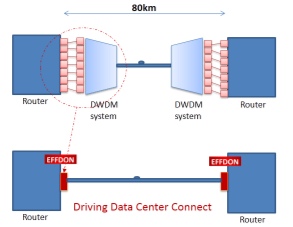 Effdon's CFP does not require the use of external DWDM multiplexing/ demultiplexing and can be added directly onto a router. Source: Effdon Networks
Available 100 Gigabit CFP modules have so far achieved 10km. Now with the Effdon module a 80km reach has been demonstrated that uses 10Gbps optics and no specialist silicon.
Effdon's design is based on the 10x10 MSA (multi-source agreement). "We have managed to resolve the technology barriers - using several techniques - to get to 80km," says Eitan Efron, CEO of Effdon Networks.
There is no 100 Gigabit standard for 80km. The IEEE has two 100 Gigabit standards: the 10km long reach 100GBASE-LR4 and the 40km extended reach 100GBASE-ER4.
Meanwhile, the 100 Gigabit 10x10 MSA based on arrays of 10, 10 Gigabit lasers and detectors, has three defined reaches: 2km, 10km and 40km. At the recent OFC/NFOEC exhibition, Oplink Communication and hybrid integration specialist, Kaiam, showed the 10x10 MSA CFP achieving 40km.
Effdon has not detailed how it has achieved 80km but says its designers have a systems background. "All the software that you need for managing wavelength-division multiplexing (WDM) systems is in our device," says Efron. "Basically we have built a system in a module."
These system elements include component expertise and algorithmic know-how. "Algorithms and software; this is the main IP of the company," says Efron. "We are using 40km components and we are getting 80km."
100 Gigabit landscape
Efron says that while there are alternative designs for 100 Gigabit transmission at 80km or more, each has challenges.
A 100Gbps coherent design achieves far greater reaches but is costly and requires a digital signal processor (DSP) receiver ASIC that consumes tens of watts. No coherent design has yet been implemented using a pluggable module.
Alternative CFP-based 100Gbps direct-detection designs based on a 4x28Gbps architecture exist. But their 28Gbps lanes experience greater dispersion that make achieving 80km a challenge.
MultiPhy's MP1100Q DSP chip counters dispersion. The chip used in a CFP module achieves a 55km point-to-point reach using on-off keying and 800km for dense WDM metro networks using duo-binary modulation.
Finisar and Oclaro also offer 100Gbps direct detection CFP modules for metro dense WDM using duo-binary modulation but without a receiver DSP. ADVA Optical Networking is one system vendor that has adopted such 100Gbps direct-detect modules. Another company developing a 4x28Gbps direct detect module is Oplink Communications.
But Effdon points out that its point-to-point CFP achieves 80km without using an external DWDM multiplexer and demultiplexer - the multiplexing/demultiplexing of the wavelengths is done within the CFP - or external amplification and dispersion compensation. As a result, the CFP plugs straight into IP routers and data centre switches.
"What they [data centre managers] want is what they have today at 10 Gig: ZR [80km] optical transceivers," says Efron

Market demand
"We see a lot of demand for this [80km] solution," says Efron. The design, based on 10 Gigabit optics, has the advantage of using mature high volume components while 25Gbps component technology is newer and available in far lower volumes.
"This [cost reduction associated with volume] will continue; we see 10 Gig lasers going into servers, base stations, data centre switches and next generation PON," says Efron. "Ten Gigabit optical components will remain in higher volume than 25 Gig in the coming years."
The 10x10 MSA CFP design can also be used to aggregate multiple 10 Gig signals in data centre and access networks. This is an emerging application and is not straightforward for the more compact, 4x25Gbps modules as they require a gearbox lane-translation IC.
Reach extension
Effdon Networks' Qbox platform provides data centre managers with 400-800Gbps capacity while offering a reach up to 200km. The box is used with data centre equipment that support CXP or QSFP modules but not the CFP. The 1RU box thus takes interfaces with a reach of several tens of meters to deliver extended transmission.
Qbox supports eight client-side ports - either 40 or 100 Gbps - and four line-facing ports at speeds of 100Gbps or 200Gbps for a reach of 80 to 200km. In future, the platform will deliver 400Gbps line speeds, says Efron.
Samples of the 80km CFP and Qbox are available for selected customers, says Effdon, while general availability of the products will start in the fourth quarter of 2013.

Kotura demonstrates a 100 Gigabit QSFP
 “QSFP will be the long-term winner at 100 Gig; the same way QSFP has been a high volume winner at 40 Gig”
Arlon Martin, Kotura
The device is aimed at plugging the gap between vertical-cavity surface-emitting laser (VCSEL) -based 100GBASE-SR10 designs that have span 100m, and the CFP-based 100GBASE-LR4 that has a 10km reach.
“It is aimed at the intermediate space, which the IEEE is looking at a new standard for," says Arlon Martin, vice president of marketing at Kotura.
The device is similar to Luxtera's 100 Gigabit-per-second (Gbps) QSFP, also detailed at the OFC/NFOEC 2013 exhibition, and is targeting the same switch applications in the data centre. “Where we differ is our ability to do wavelength-division multiplexing (WDM) on a chip,” says Martin. Kotura also uses third-party electronics such as laser drivers and transimpedance amplifiers (TIA) whereas Luxtera develops and integrates its own.
The Kotura QSFP uses four wavelengths, each at 25Gbps, that operate around 1550nm. “We picked 1550nm because that is where a lot of the WDM applications are," says Martin. “There are also some customers that want more than four channels.” The company says it is also doing development work at 1310nm.
Although Kotura's implementation doesn't adhere to an IEEE standard - the standard is still work in progress - Martin points out that the 10x10 MSA is also not an IEEE standard, yet is probably the best selling client-side 100Gbps interface.
Optical component and module vendors including Avago Technologies, Finisar, Oclaro, Oplink, Fujitsu Optical Components and NeoPhotonics all announced CFP2 module products at OFC/NFOEC 2013. The CFP2 is the next pluggable form factor on the CFP MSA roadmap and is approximately half the size of the CFP.
The advent of the CFP2 enables eight 100Gbps pluggable modules on a system's front panel compared to four CFPs. But with the QSFP, up to 24 modules can be fitted while 48 are possible when mounted double sidedly - ’belly-to-belly’ - across the panel. “QSFP will be the long-term winner at 100 Gig; the same way QSFP has been a high volume winner at 40 Gig,” says Martin.
The QSFP uses 28Gbps pins, which is also called the QSFP28, but Kotura refers to it 100Gbps product as a QSFP. The design consumes 3.5W and uses two silicon photonic chips. Kotura says 80 percent of the total power consumption is due to the electronics.
One of the two chips is the silicon transmitter which houses the platform for the four lasers (gain chips) combined as a four-channel array. Each is an external cavity laser where part of the cavity is within the indium phosphide device and the rest in the silicon photonics waveguide. The gain chips are flip-chipped onto the silicon. The transmitter also includes a grating that sets each laser's wavelength, four modulators, and a WDM multiplexer to combine the four wavelengths before transmission on the fibre.
 Kotura's 4x25 Gig transmitter and receiver chips. Source: Kotura
The receiver chip uses a four-channel demultiplexer with each channel fed to a germanium photo-detector. Two chips are used as it is easier to package each as a transmitter optical sub-assembly (TOSA) or receiver optical sub-assembly (ROSA), says Martin. The 100Gbps QSFP will be generally available in 2014.
Disruptive system design
The recent Compass-EOS IP router announcement is a welcome development, says Kotura, as it brings the optics inside the system - an example of mid-board optics - as opposed to the front panel. Compass-EOS refers to its novel icPhotonics chip combining a router chip and optics as silicon photonics but in practice it is an integrated optics design. The 168 VCSELs and 168 photodetectors per chip is massively parallel interconnect, says Martin.
“The advantage, from our point of view of silicon photonics, is to do WDM on the same fibre in order to reduce the amount of cabling and interconnect needed,” he says. At 100 Gigabit this reduces the cabling by a factor of four and this will grow with more 25Gbps wavelength channels used to 10x or even 40x eventually.
“What we want to do is transition from the electronics to the optical domain as close to those large switching chips as possible,” says Martin. “Pioneers [like Compass-EOS] demonstrating that style of architecture are to be welcomed."
Kotura says that every company that is building large switching and routing ASICs is looking at various interface options. "We have talked to quite a few of them,” says Martin.
One solution suited to silicon photonics is to place the lasers on the front panel while putting the modulation, detection and WDM devices - packaged using silicon photonics - right next to the ASICs. This way the laser works at the cooler room temperature while the rest of the circuitry can be at the temperature of the chip, says Martin.
2012: A year of unique change
The third and final part on what CEOs, executives and industry analysts expect during the new year, and their reflections on 2011.
Karen Liu, principal analyst, components telecoms, Ovum @girlgeekanalyst

"We’ve entered the next decade for real: the mobile world is unified around LTE and moving to LTE Advanced, complete with small cells and heterogenous networks including Wi-Fi."
Last year was a long one. Looking back, it is hard to believe that only one year has elapsed between January 2011 and now.
In fact, looking back it is hard to remember how things looked a year ago: natural disasters were considered rare occurrences. WiMAX’s role was still being discussed, some viewed TDD LTE as a Chinese peculiarity. For that matter, cloud-RAN was another weird Chinese idea. But no matter, China could do anything given its immunity to economics and need for a return-on-investment.
Femtocells were consumer electronics for the occasional indoor coverage fix, and Wi-Fi was not for carriers.
Only optical could do 100Mbps to the subscriber, who, by the way, was moving on to 10 Gig PON in short order. Flexible spectrum ROADMS meant only Finisar could play, and high port-count wavelength-selective switches had come and gone. 100 Gigabit DWDM took several slots, hadn’t shipped for real, and even the client-side interface was a problem.
As for modules, 40 Gigabit Ethernet (GbE) client was CFP-sized, and high-density 100GbE looked so far away that the non-standard 10x10 MSA was welcomed.
NeoPhotonics was a private company, doing that wacky planar integration thing that works OK for passives but not actives.
Now it feels like we’ve entered the next decade for real: the mobile world is unified around LTE and moving to LTE Advanced, complete with small cells and heterogenous networks including Wi-Fi.
Optical is one of several ways to do backhaul or PC peripherals. 40GbE, even single-mode, comes in a QSFP package, tunable comes in an SFP — both of which, by the way, use optical integration.
Most optical transport vendors, even metro specialists, have 100 Gigabit coherent in trial stage at least. Thousands of 100 Gig ports and tens of thousands of 40 Gig have shipped.
Flexible spectrum is being standardised and CoAdna went public. The tunable laser start-up phase concluded with Santur finding a home in NeoPhotonics, now a public company.
But we also have a new feeling of vulnerability.
Optical components revenues and margins slid back down. Bad luck can strike twice, with Opnext taking the hit from both the spring earthquake and the fall floods. China turns out not to be immune after all, and time hasn’t automatically healed Europe.
What will happen this year? At this rate, I think we’ll see a lot of news at OFC in a couple of months' time. By then I’ll probably think: "Was it as recently as January when the world looked so different?"
Brian Protiva, CEO of ADVA Optical Networking @ADVAOpticalNews
Last year was an incredible year for networks. In many respects it was a watershed moment. Optical transport took a huge step forward with the genuine availability of 100 Gigabit technologies.
What's even more incredible is that 100 Gigabit emerged in more than the core: we saw 100 Gig metro solutions enter the marketplace. This means that for the first time enterprises and service providers have the opportunity to deploy 100 Gig solutions that fit their needs. Thanks to the development of direct-detection 100 Gig technology, cost is becoming less and less of an issue. This is a game changer.
In 2012, 100 Gig deployments will continue to be a key topic, with more available choices and maturing systems. However, I firmly believe the central focus of 2012 will be automation and multi-layer network intelligence.

"We need to see networks that can effectively govern and optimise themselves."
Talking to our customers and the industry, it is clear that more needs to be done to develop true network automation. There are very few companies that have successfully addressed this issue.
We need to see networks that can effectively govern and optimise themselves. That can automatically deliver bandwidth on demand, monitor and resolve problems before they become service disrupting, and drive dramatically increased efficiency.
The future of our networks is all about simplicity. The continued fierce bandwidth growth can no longer be supported by today's complex operational inefficiencies. Streamlined operations are essential if operators are to drive for further profitable growth.
I'm excited about helping to make this happen.
Arie Melamed, head of marketing, ECI Telecom @ecitelecom
The existing momentum of major traffic growth with no proportional revenue increase has continued - even intensified - in 2011. This means that operators have to invest in their networks without being able to generate the proportional revenue increase from this investment. We expect to see new business models crop up as operators cope with over-the-top (OTT) services.
To differentiate themselves from competition, operators must make the network a core part of the end-customer experience. To do so, we expect operators to introduce application-awareness in the network – optimising service delivery to avoid network expansions and introduce new revenues.
We also expect operators to offer quality-of-service assurance to end users and content application providers, turning a lose-lose situation around.
Larry Schwerin, CEO of Capella Intelligent Subsystems @CapellaPhotonic
Over 2011, we witnessed the demand for broadband access increase at an accelerated rate. Much of this has been fueled by the continuation of mass deployments of broadband access - PON/FTTH, wireless LTE, HFC, to name a few - as well as the ever-increasing implementation of cloud computing, requiring instantaneous broadband access. Video and rich media are a small but growing piece of this equation.
The ultimate of this is yet to be felt, as people start to draw more narrowcast versus broadcast content. The final element will be when upstream content via appliances similar to Sling Media, as well as the various forms of video conferencing, become more widespread. This will lead to more symmetrical bandwidth from an upstream perspective.

'Change is definitely in order for the optical ecosystem. The question is how and when?'
Along with this, the issue of falling revenue-per-bit is forcing network operators to develop more cost-effective ways for managing this traffic.
All of aforementioned is driving demand for higher capacity and more flexible support at the fundamental optical layer.
I believe this will work to translate into more bits-per-wavelength, more wavelengths-per-fibre, and finally more flexibility for network operators. They will be able to more easily manage the traffic at the optical layer. This points to good news for transponder, tunable and ROADM/ WSS suppliers.
2011 also pointed out certain issues within the optical communications sector. Most notably, entering 2011, the financial marketplace was bullish on the optical sector following rapid quarter-on-quarter growth of certain larger optical players. Then, the “Ides of March” came and optical stocks lost as much as 40% of their value when it was deemed there was a pull back in demand by a very few, but nonetheless important players in the sector.
Later in the year came the flooding in Thailand, which hampered the production capabilities of many of the optical components players.
Overall margins in the sector remain at unacceptable levels furthering the speculation that things need to change in order for a more robust environment to exist.
What will 2012 bring?
I believe demand for bandwidth will continue to grow. Data centres will gain more focus as cloud computing continues to gain traction. This will lead to more demand for fundamental technologies in the area of optical transmission and management.
The next phase of wavelength management solutions will start to emerge - both at the high port count (1x20) as well as low-port count (1x2, 1x4) for edge applications. More emphasis will be placed on monitoring and control as more complex optical networks are built.
Change is definitely in order for the optical ecosystem. The question is how and when? Will it simply be consolidation? How will vertical integration take shape? How will new technologies influence potential outcomes?
2012 should be a year of unique change.
Terry Unter, president and general manager, optical networks solutions, Oclaro
Discussion and progress on defining next-generation ROADM network architectures was a very important development in 2011. In particular, consensus on feature requirements and technology choices to enable a more cost-efficient optical network layer was generally agreed amongst the major network equipment manufacturers. Colourless, directionless and, to a significant degree, contentionless are clear goals, while we continue to drive down the cost of the network.

"We expect to see a host of system manufacturers making decisions on 100 Gig supply partners. This should be an exciting year."
Coherent detection transponder technology is a critical piece of the puzzle ensuring scalability of network capacity while leveraging a common technology platform. We succeeded in volume production shipments of a 40 Gig coherent transponder and we announced our 100 Gig transponder.
2012 will be an important year for 100 Gig. The availability of 100 Gig transponder modules for deployment will enable a much wider list of system manufacturers to offer their customers more spectrally-efficient network solutions. The interest is universal from metro applications to the long haul and ultra-long haul market segments.
While there is much discussion about 400 Gig and higher rates, standards are in very early stages. The industry as a whole expects 100 Gig to be a key line rate for several years.
As we enter 2012, we expect to see a host of system manufacturers making decisions on 100 Gig supply partners. This should be an exciting year.
For Part 1, click here
For Part 2, click here
Next-gen 100 Gigabit optics
Briefing: 100 Gigabit
Part 2: Interview
Gazettabyte spoke to John D'Ambrosia about 100 Gigabit technology
 John D'Ambrosia, chair of the IEEE 100 Gig backplane and copper cabling task force
John D'Ambrosia laughs when he says he is the 'father of 100 Gig'.
He spent five years as chair of the IEEE 802.3ba group that created the 40 and 100 Gigabit Ethernet (GbE) standards. Now he is the chair of the IEEE task force looking at 100 Gig backplane and copper cabling. D'Ambrosia is also chair of the Ethernet Alliance and chief Ethernet evangelist in the CTO office of Dell's Force10 Networks.
“People are also starting to talk about moving data operations around the network based on where electricity is cheapest”
"Part of the reason why 100 Gig backplane technology is important is that I don't know anybody that wants a single 100 Gig port off whatever their card is," says D'Ambrosia. "Whether it is a router, line card, whatever you want to call it, they want multiple 100 Gig [interfaces]: 2, 4, 8 - as many as they can."
Earlier this year, there was a call for interest for next-generation 100 Gig optical interfaces, with the goal of reducing the cost and power consumption of 100 Gig interfaces while increasing their port density. "This [next-generation 100 Gig optical interfaces] is going to become very interesting in relation to what is going on in the industry,” he said.
Next-gen 100 Gig
The 10x10 MSA is an industry initiative that is an alternative 100 Gig interface to the IEEE 100 Gigabit Ethernet standards. Members of the 10x10 MSA include Google, Brocade, JDSU, NeoPhotonics (Santur), Enablence, CyOptics, AFOP, MRV, Oplink and Hitachi Cable America.
"Unfortunately, that [10x10 MSA] looks like it could cause potential interop issues,” says D'Ambrosia. That is because the 10x10 MSA has a 10-channel 10 Gigabit-per-second (Gbps) optical interface while the IEEE 100GbE use a 4x25Gbps optical interface.
The 10x10 interface has a 2km reach and the MSA has since added a 10km variant as well as 4x10x10Gbps and 8x10x10Gbps versions over 40km.
The advent of the 10x10 MSA has led to an industry discussion about shorter-reach IEEE interfaces. "Do we need something below 10km?” says D’Ambrosia.
Reach is always a contentious issue, he says. When the IEEE 802.3ba was choosing the 10km 100GBASE-LR4, there was much debate as to whether it should be 3 or 4km. "I won’t be surprised if you have people looking to see what they can do with the current 100GBASE-LR4 spec: There are things you can do to reduce the power and the cost," he says.
One obvious development to reduce size, cost and power is to remove the gearbox chip. The gearbox IC translates between 10x10Gbps and the 4x25Gbps channels. The chip consumes several watts each way (transmit to receive and vice versa). By adopting a 4x25Gbps input electrical interface, the gearbox chip is no longer needed - the electrical and optical channels will then be matched in speed and channel count. The result is that the 100GbE designs can be put into the upcoming, smaller CFP2 and even smaller CFP4 form factors.
As for other next-gen 100Gbps developments, these will likely include a 4x25Gbps multi-mode fibre specification and a 100 Gig, 2km serial interface, similar to the 40GBASE-FR.
The industry focus, he says, is to reduce the cost, power and size of 100Gbps interfaces rather than develop multiple 100 Gig link interfaces or expand the reach beyond 40km. "We are going to see new systems introduced over the next few years not based on 10 Gig but designed for 25 Gig,” says D’Ambrosia. The ASIC and chip designers are also keen to adopt 25Gbps signalling because they need to increase input-output (I/O) yet have only so may pins on a chip, he says.
D’Ambrosia is also part of an Ethernet bandwidth assessment ad-hoc committee that is part of the IEEE 802.3 work. The group is working with the industry to quantify bandwidth demand. “What you see is a lot of end users talking about needing terabit and a lot of suppliers talking about 400 Gig,” he says. Ultimately, what will determine the next step is what technologies are going to be available and at what cost.
Backplane I/0 and switching
Many of the systems D'Ambrosia is seeing use a single 100Gbps port per card. "A single port is a cool thing but is not that useful,” he says. “Frankly, four ports is where things start to become interesting.”
This is where 25Gbps electrical interfaces come into play. "It is not just 25 Gig for chip-to-chip, it is 25 Gig chip-to-module and 25 Gig to the backplane."
Moreover modules, backplane speeds, and switching capacity are all interrelated when designing systems. Designing a 10 Terabit switch, for example, the goal is to reduce the number of traces on a board and that go through the backplane to the switch fabric and other line cards.
Using 10Gbps electrical signals, between 1,200 to 2,000 signals are needed depending on the architecture, says D'Ambrosia. With 25Gbps the interface count reduces to 500-750. “The electrical signal has an impact on the switch capacity,” he says.
100 Gig in the data centre
D’Ambrosia stresses that care is needed when discussing data centres as the internet data centres (IDC) of a Google or a Facebook differ greatly from those of enterprises. “In the case of IDCs, those people were saying they needed 100 Gig back in 2006,” he says.
Such mega data centres use tens of thousands of servers connected across a flat switching architecture unlike traditional data centres that use three layers of aggregated switching. According to D'Ambrosia such flat architectures can justify using 100Gbps interfaces even when the servers each have a 1 Gig Ethernet interfaces only. And now servers are transitioning to 10 GbE interfaces.
“You are going to have to worry about the architecture, you are going to have to worry about the style of data centre and also what the server applications are,” says D'Ambrosia. “People are also starting to talk about moving data operations around the network based on where electricity is cheapest.” Such an approach will require a truly wide, flat architecture, he says.
D'Ambrosia cites the Amsterdam Internet exchange that announced in May its first customer using a 100 Gig service. "We are starting to see this happen,” he says.
One lesson D'Ambrosia has learnt is that there is no clear relationship between what comes in and out of the cloud and what happens within the cloud. Data centres themselves are one such example.
100 Gig direct detection
In recent months lower power, 200km to 800km reach, 100Gbps direct detection interfaces that are cheaper than coherent transmission have been announced by ADVA Optical Networking and MultiPhy. Such interfaces have a role in the network and are of varying interest to telco operators. But these are vendor-specific solutions.
D’Ambrosia stresses the importance of standards such as the IEEE and the work of the Optical Internetworking Forum (OIF) that has adopting coherent. “I still see customers that want a standards-based solution,” says D'Ambrosia, who adds that while the OIF work is not a standard, it is an interoperability agreement. “It allows everyone to develop the same thing," he says.
There are also other considerations regarding 100 Gig direct-detection besides cost, power and a pluggable form factor. Vendors and operators want to know how many people will be able to source this, he says.
D'Ambrosia says that new systems being developed now will likely be deployed in 2013. Vendors must assess the attractiveness of any alternative technologies to where industry backed technologies like coherent and the IEEE standards will be then.
The industry will adopt a variety of 100Gbps solutions, he says, with particular decisions based on a customer’s cost model, its long term strategy and its network.
For Part 1 - 100 Gig: An operator view click here
MultiPhy boosts 100 Gig direct-detection using digital signal processing
The MP1100Q chip is being aimed at two cost-conscious metro networking requirements: 100 Gigabit point-to-point links and dense wavelength-division multiplexing (DWDM) metro networks.
 The MP1100Q as part of a 100 Gig CFP module design. Source: MultiPhy
The 100 Gigabit market is still in its infancy and the technology has so far been used to carry traffic across operators’ core networks. Now 100 Gigabit metro applications are emerging.
Data centre operators want short links that go beyond the IEEE-specified 10km (100GBASE-LR4) and 40km (100GBASE-ER4) reach interfaces, while enterprises are looking to 100 Gigabit-per-second (Gbps) DWDM solutions to boost the capacity and reach of their rented fibre. Existing 100Gbps coherent technologies, designed for long-haul, are too expensive and bulky for the metro.
“There is long-haul and the [IEEE] client interfaces and a huge gap in between,” says Avishay Mor, vice president of product management at MultiPhy.
It is this metro 'gap' that MultiPhy is targeting with its MQ1100Q chip. And the fabless chip company's announcement is one of several that have been made in recent weeks.
ADVA Optical Networking has launched a 100Gbps metro line card that uses a direct-detection CFP, while Transmode has detailed a 100Gbps coherent design tailored for the metro. The 10x10 MSA announced in August a 10km interface as well as a 40km WDM design alongside its existing 10x10Gbps MSA that has a 2km reach.
MultiPhy's MP1100Q IC will enable two CFP module designs: a point-to-point module to connect data centres with a reach of up to 80km, and a DWDM design for metro core and regional networks with a reach up to 800km.
"MLSE is recognised as the best solution for mitigating inter-symbol interference."
Design details
The M1100Q uses a 4x28Gbps direct-detection design, the same approach announced by ADVA Optical Networking for its 100Gbps metro card. But MultiPhy claims that the 100Gbps DWDM CFP module will squeeze the four bands that make up the 100Gbps signal into a 100GHz-wide channel rather than 200GHz, while its IC implements the maximum likelihood sequence estimation (MLSE) algorithm to achieve the 800km reach.
The four optical channels received by a CFP are converted to electrical signals using four receiver optical subassemblies (ROSAs) and sampled using the MP1100Q’s four analogue-to-digital (a/d) converters operating at 28Gbps.
The CFP design using MultiPhy’s chip need only use 10Gbps opto-electronics for the transmit and receive paths. The result is a 100Gbps module with a cost structure based on 4x10Gbps optics.
The lower bill-of-materials impacts performance, however. “When you over-drive these 10Gbps opto-electronics - on the transmit and the receive side - you create what is called inter-symbol interference," says Neal Neslusan, vice president of sales and marketing at MultiPhy.
Inter-symbol interference is an unwanted effect where the energy of a transmitted bit leaks into neighboring signals. This increases the bit-error rate and makes the detector's task harder. "The way that we get around it is using MLSE, recognised as the best solution for mitigating inter-symbol interference," says Neslusan.
Unwanted channel effects introduced by the fibre, like chromatic dispersion, also induce inter-symbol interference and are also countered by the MLSE algorithm on the MP1100Q.
MultiPhy is proposing two CFP designs for its chip. One is based on on-off-keying modulation to achieve 80km point-to-point links and which will require a 200GHz channel to accommodate the 100Gbps signal. The second uses optical duo-binary modulation to achieve the longer reach and more spectrally efficient 100GHz spacings.
The company says the resulting direct-detection CFP using its IC will cost some US $10,000 compared to an estimated $50,000 for a coherent design. In turn the 100G metro CFP’s power consumption is estimated at 24W whereas a coherent design consumes 70W.
MP1100Q samples have been with the company since June, says Mor. First samples will be with customers in the fourth quarter of this year, with general availability starting in early 2012.
If all goes to plan, first CFP module designs using the chip will appear in the second half of 2012, claims MultiPhy.
100 Gigabit for the metro
The firm claims this is an industry first: a direct-detection-based 100 Gigabit-per-second (Gbps) design using four, 28Gbps channels rather than current 10x10Gbps schemes.

"Data centre operators want to make best use of the fibre insfrastructure and get lower overall cost, footprint and power consumption"
Jörg-Peter Elbers, ADVA Optical Networking
The card, designed for the FSP 3000 platform, delivers a 2.5x greater spectral efficiency compared to 10Gbps dense WDM (DWDM) systems. In turn, the 100Gbps metro card has half the cost of a 100 Gigabit coherent design while requiring half the power and space.
ADVA Optical Networking is using a CFP optical module to implement the 100Gbps metro design. This allows the card to use other CFP-based interfaces such at the IEEE 100 Gigabit Ethernet (GbE) standards. The design also benefits from the economies of scale of the CFP as the module of choice for 100GbE, and from future smaller modules such as the CFP2 and CFP4 being developed as the 100GbE market evolves.
The 100Gbps metro CFP's four, 28Gbps signals are modulated using optical duo-binary. By choosing duo-binary, cheaper 10Gbps optics can be used akin to a 4x10Gbps design. Duo-binary is also more resilient to dispersion than standard on-off keying.
The CFP-based card requires 200GHz of spectrum for each 100Gbps light path. This is 2.5x more spectrally efficient than 10x10Gbps based on 50GHz channel spacings. However, while the design is cheaper, denser and less power hungry than 100Gbps coherent, it has only a quarter of the spectral efficiency of coherent (see chart).
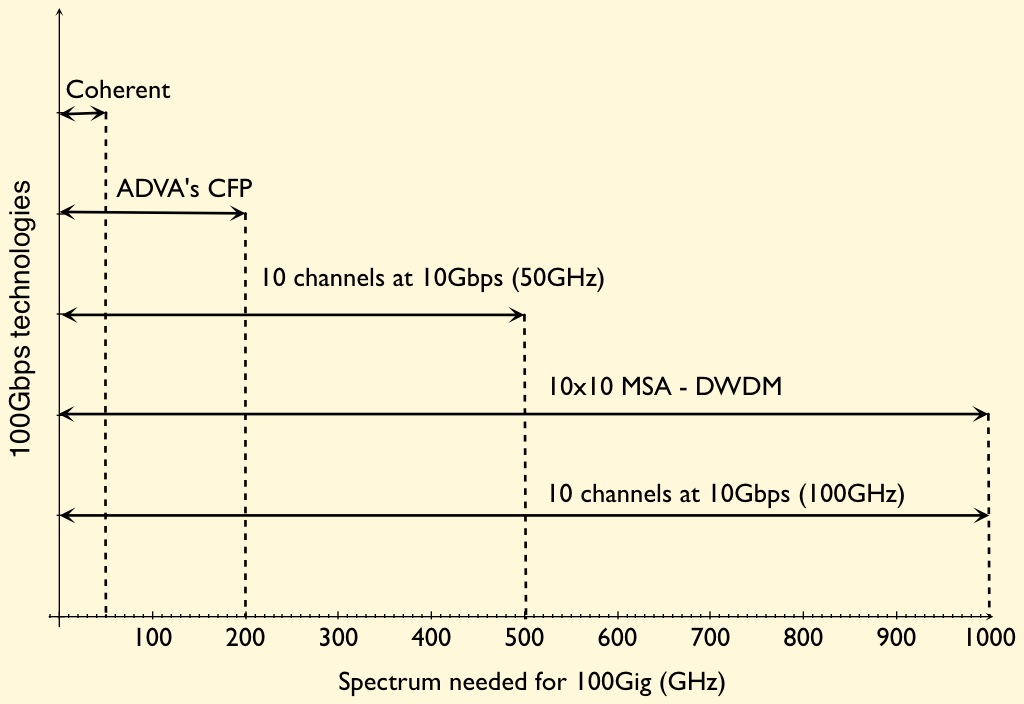
Jörg-Peter Elbers, vice president, advanced technology at ADVA Optical Networking, says duo-binary delivers closer channel spacing such that a doubling in spectral density will be possible in a future design (100Gbps in a 100GHz channel). The 100Gbps metro card supports 500km links using dispersion-compensated fibre.
Non-coherent designs for the metro are starting to appear despite 100Gbps optical transport being in its infancy. Besides ADVA Optical Networking's design, a component vendor is promoting a 100Gbps direct detection DWDM design for the metro. The 10x10 MSA has also announced a DWDM extension that will support four and eight 100Gbps channels.
 The 100G metro card showing the CFP. Source: ADVA Optical Networking
Metro direct-detection also faces competition from system vendors developing coherent designs tailored for the metro.
System vendors, module makers, optical and IC component companies all believe there is a market for lower cost 100Gbps metro transport. This is backed by keen interest from service providers and large content providers that want cheaper 100Gbps interfaces to connect data centres.
Elbers highlights two such applications that will first likely use the 100 Gigabit metro card.
One is connecting the data centres of enterprises that use rented fibre. "They have a multitude of interfaces and services - 10GbE, 8 Gigabit Fibre Channel - and they often rent fibre," says Elbers. "They need to get as much capacity as possible to make the fibre rent worthwhile while being constrained on rack space and power."
The second application is to connect 100GbE-enabled IP routers across the metro. Here service providers may not have heavily loaded DWDM networks and can afford to use a 100Gbps metro link rather than the more spectrally efficient, if more expensive, 100Gbps coherent interface. Equally, such links may be less than 500km while coherent is designed for long-haul links, 1000km or greater.
Elbers says samples of the metro card are available now with volume production beginning at the end of 2011.
Introducing 100G Metro (ADVA Optical video)
CyOptics gets $50m worth of new investors and funding

“Volume production scale is very important to having a successful business”
Ed Coringrato, CyOptics
The $50m investment in CyOptics has two elements: the amount paid by new investors in CyOptics to replace existing ones and funding for the company.
“This is different from the years-ago, traditional funding round but not all that different from what is more and more taking place,” says Ed Coringrato, CEO of CyOptics. “Fifty million is a big number but it is a ‘primary/ secondary’: the secondary is tendering out current investors that are choosing to exit, while the primary is what people think of as a traditional investment.” CyOptics has not detailed how the $50m is split between the two.
The funding is needed to bolster the company’s working capital, says Coringrato, despite CyOptics achieving over $100m in revenues in 2010. The money is required because of growth, he says: inventories the company holds are growing, there is more cash outstanding and the company’s payments are also rising.
There is also a need to invest in the company. “For the first time in a long time we are starting to make significant capital investments in our business,” says Coringrato. “We are ramping the fab, the packaging capability, and the assembly and test.”
The company is investing in R&D. At the moment 11 percent of its revenue is invested in R&D and the company wants to approach 13 percent. “That is a challenge in our industry – the investment in R&D is pretty significant,” says Coringrato. “If we are to continue to be significant and have leading-edge products, we must continue to make that investment.”
Manufacturing
CyOptics acquired Triquint Semiconductor’s optoelectronics operations in 2005, and before that Triquint had bought the optoelectronics operations of Agere Systems. This resulted in CyOptics inheriting automated manufacturing facilities and as a result it never felt the need to move manufacturing to the Far East to achieve cost benefits. CyOptics does use some contract manufacturing but its high-end products are made in-house.
“We have been focussed on automated production, cycle-time reduction and yield improvement,” says Coringrato. “The capital investment is to replicate what we have, adding more machines to get more output.”
Markets
CyOptics supplies fibre-to-the-x (FTTx) components to transmit optical subassembly (TOSA) and receive optical subassembly (ROSA) makers, optical transceiver players and board manufacturers. FTTx is an important market for CyOptics as it is a volume driver. “Volume production scale is very important to having a successful business,” says Coringrato.
The company also supplies 2.5 and 10 Gigabit-per-second (Gbps) TOSAs and ROSAs for XFP and SFP pluggable modules for the metro. “We want to play at the higher end as well as that is the where the growth opportunities are and the healthier margins,” says Coringrato.
CyOptics is also active in what it calls high-end product areas.
One area is as a supplier of components for the US defence industry. CyOptics entered the defence market in 2005. “These are custom products designed for specific applications,” says Stefan Rochus, vice president of marketing and business development. These include custom chip fabrication and packaging undertaking for defence contractors that supply the US Department of Defense. “When you look around there are not many companies that can do that,” says Rochus. One example CyOptics cites is a 1480nm pump-laser, part of a fibre-optic gyroscope for use in a satellite.

“We are shipping 40Gbps and 100Gbps coherent receivers into the PM-QPSK market”
Stefan Rochus, CyOptics
The defence market may require long development cycles but CyOptics believes that in the next few years several of its products could lead to reasonable volumes and a better average selling price than telecom components.
Another high-end product segment CyOptics is pursuing is photonic integrated circuits (PICs) using the company's indium-phosphide and planar lightwave circuit expertise.
Rochus says the company has several PIC developments including 10x10Gbps TOSAs and ROSAs as well as emerging 40GBASE-LR4 and coherent detection designs. “We are shipping 40Gbps and 100Gbps coherent receivers into the PM-QPSK market,” says Rochus.
CyOptics’ product portfolio is a good balance between high-volume and high average selling price components, says Rochus.
10x10 MSA
CyOptics is part of the recent 10X10 MSA, the 100Gbps multi-source agreement that includes Google and Brocade. “There is a follow-up high density 10x10Gbps MSA and we will be a member of this as well,” says Rochus. “This [10x10G design] is for short reach, up to 2km, but we are also shipping product for DWDM for an Nx10Gbps TOSA/ROSA solution.”
Why is CyOptics supporting the Google-backed 10x10Gbps MSA?
“The IEEE has only standardised the 100GBASE-SR10 which is 100m and the 100GBASE-LR4 which is 10km, there is a gap in the middle for [a] 2km [interface] which the MSA tries to solve,” says Rochus. “This is particularly important for the larger data centres.”
Rochus claims the 10x10Gbps design is the cheapest solution and that the volumes that will result from growth in the 10 Gigabit PON market will further reduce the component costs used for the interface. Furthermore the interface will be lower power.
That said, CyOptics is backing both interface styles, selling TOSAs and ROSAs for the 10x10Gbps interface and lasers for the 4x25Gbps-styled 100 Gigabit interfaces.
What next?
“The bigger we can get in terms of volume and revenue, the better our financials,” says Coringrato. “Potentially CyOptics is not only attractive for our preferred path, which is an IPO offering at the right time, but also I think it won't discourage others from being interested in us.”
Further reading