

Europe gets its first TWDM-PON field trial
Vodafone is conducting what is claimed to be the first European field trial of a multi-wavelength passive optical networking system using access equipment from Alcatel-Lucent.
 Source: Alcatel-Lucent
The time- and wavelength-division multiplexed passive optical network (TWDM-PON) technology being used is a next-generation access scheme that follows on from 10 gigabit GPON (XG-PON1) and 10 gigabit EPON.
“There appears to be much more 'real' interest in TWDM-PON than in 10G GPON,” says Julie Kunstler, principal analyst, components at Ovum.
The TWDM-PON standard is close to completion in the Full Service Access Network (FSAN) Group and ITU and supports up to eight wavelengths, each capable of 10 gigabit symmetrical or 10/ 2.5 gigabit asymmetrical speeds.
“You can start building hardware solutions that are fully [standard] compliant,” says Stefaan Vanhastel, director of fixed access marketing at Alcatel-Lucent.
TWDM-PON’s support for additional functionality such as dynamic wavelength management, whereby subscribers could be moved between wavelengths, is still being standardised.
The combination of time and wavelength division multiplexing, allows TWDM-PON to support multiple PONs, each sharing its capacity among 16, 32, 64 or even 128 end points depending on the operator’s chosen split ratio.
There appears to be much more 'real' interest in TWDM PON than in 10G GPON
Alcatel-Lucent first detailed its TWDM-PON technology last year. The system vendor introduced a four-wavelength TWDM-PON based on a 4-port line-card, each port supporting a 10 gigabit PON. The line card is used with Alcatel-Lucent’s 7360 Intelligent Services Access Manager FX platform, and supports fixed and tunable SFP optical modules.
“Several vendors also offer the possibility to use fixed wavelength - XG-PON1 or 10G EPON optics," says Vanhastel. "This reduces the initial cost of a TWDM-PON deployment while allowing you to add tunable optics later."
Operators can thus start with a 10 gigabit PON using fixed-wavelength optics and move to TWDM-PON and tunable modules as their capacity needs grow. “You won’t have to swap out legacy XG-PON1 hardware two years from now,” says Vanhastel.
Alcatel-Lucent has been involved in 16 customer TWDM-PON trials overall, half in Asia Pacific and the rest split between North America and EMEA. Besides Vodafone, Alcatel-Lucent has named two other TWDM-PON triallists: Telefonica and Energia, an energy utility in Japan.
You won’t have to swap out legacy XG-PON1 hardware two years from now
Vanhastel says the company has been surprised that operators are also eyeing the technology for residential access. The high capacity and relative expense of tunable optics made the vendor think that early demand would be for business services and mobile backhaul only.
 Source: Gazettabyte
There are several reasons for the operator interest in TWDM-PON, says Vanhastel. One is its ample bandwidth - 40 gigabit symmetrical in a four-wavelength implementation - and that wavelengths can be assigned to different aggregation tasks such as backhaul, business and residential. Operators can also pay for wavelengths as needed.
TWDM-PON also allows wavelengths to be shared between operators as part of wholesale agreements. Operators deploying TWDM-PON can lease a wavelength to each other in their respective regions.
Vodafone, for example, is building its own fibre network but is also expanding its overall fixed broadband coverage by developing wholesale agreements across Europe. Vodafone's European broadband network covers 62 million households: 26 million premises covered with its own network and 36 million through wholesale agreements.
First operator TWDM-PON pilot deployments will occur in 2016, says Alcatel-Lucent.
Further reading:
White Paper: TWDM PON is on the horizon: facilitating fast FTTx network monetization, click here

OFC/NFOEC 2013 product round-up - Part 2
Second and final part
- Custom add/drop integrated platform and a dual 1x20 WSS module
- Coherent receiver with integrated variable optical attenuator
- 100/200 Gigabit coherent CFP and 100 Gigabit CFP2 roadmaps
- Mid-board parallel optics - from 150 to over 600 Gigabit.
- 10 Gigabit EPON triplexer
Add/drop platform and wavelength-selective switches
Oclaro announced an add/drop routing platform for next-generation reconfigurable optical add/drop multiplexers (ROADMs). The platform, which supports colourless, directionless, contentionless (CDC) and flexible grid ROADMs, can be tailored to a system vendor's requirements and includes such functions as cross-connect switching, arrayed amplifiers and optical channel monitors.
 "If we make the whole thing [add/drop platform], we can integrate in a much better way"
Per Hansen, Oclaro
After working with system vendors on various line card designs, Oclaro realised there are significant benefits to engineering the complete design.
"You end up with a controller controlling other controllers, and boxes that get bolted on top of each other; a fairly unattractive solution," says Per Hansen, vice president of product marketing, optical networks solutions at Oclaro. "If we make the whole thing, we can integrate in a much better way."
The increasingly complex nature of the add/drop card is due to the dynamic features now required. "You have support for CDC and even flexible grid," says Hansen. "You want to have many more features so that you can control it remotely in software."
A consequence of the add/drop's complexity and automation is a need for more amplifiers. "It is a sign that the optics is getting mature; you are integrating more functionality within your equipment and as you do that, you have losses and you need to put amplifiers into your circuits," says Hansen.
Oclaro continues to expand its amplifier component portfolio. At OFC/NFOEC, the company announced dual-chip uncooled pump lasers in the 10-pin butterfly package multi-source agreement (MSA) it announced at ECOC 2012.
"We have two 500mW uncooled pumps in a single package with two fibres, each pump being independently controlled," says Robert Blum, director of product marketing for Oclaro's photonic components unit.
The package occupies half the space and consumes less than half the power compared to two standard discrete thermo-electrically cooled pumps. The dual-chip pump lasers will be available as samples in July 2013.
Oclaro gets requests to design 4- and 8-degree nodes; with four- and eight-degree signifying the number of fibre pairs emanating from a node.
"Depending on what features customers want in terms of amplifiers and optical channel monitors, we can design these all the way down to single-slot cards," says Hansen. Vendors can then upgrade their platforms with enhanced switching and flexibility while using the same form factor card.
Meanwhile, Finisar demonstrated at OFC/NFOEC a module containing two 1x20 liquid-crystal-on-silicon-based wavelength-selective switches (WSSes). The module supports CDC and flexible grid ROADMs. "This two-port module supports the next-generation route-and-select [ROADM] architecture; one [WSS] on the add side and one on the drop side," says Rafik Ward, vice president of marketing at Finisar.
100Gbps line side components
NeoPhotonics has added two products to its 100 Gigabit-per-second (Gbps) coherent transport product line.
The first is an coherent receiver that integrates a variable optical attenuator (VOA). The VOA sits in front of the receiver to screen the dynamic range of the incoming signal. "This is even more important in coherent systems as coherent is different to direct detection in that you do not have to optically filter the channels coming in," says Ferris Lipscomb, vice president of marketing at NeoPhotonics.
 "That is the power of photonic integration: you do a new chip with an extra feature and it goes in the same package."
Ferris Lipscomb, NeoPhotonics
In a traditional system, he says, a drop port goes through an arrayed waveguide grating which filters out the other channels. "But with coherent you can tune it like a heterodyne radio," says Lipscomb. "You have a local oscillator that you 'beat' against the signal so that the beat frequency for the channel you are tuned to will be within the bandwidth of the receiver but the beat frequency of the adjacent channel will be outside the bandwidth of the receiver."
It is possible to do colourless ROADM drops where many channels are dropped, and using the local oscillator, the channel of interest is selected. "This means that the power coming in can be more varied than in a traditional case," says Lipscomb, depending on how many other channels are present. Since there can be up to 80 channels falling on the detector, the VOA is needed to control the dynamic range of the signal to protect the receiver.
"Because we use photonic integration to make our integrated coherent receiver, we can put the VOA directly on the chip," says Lipscomb. "That is the power of photonic integration: you do a new chip with an extra feature and it goes in the same package."
The VOA integrated coherent receiver is sampling and will be generally available in the third quarter of 2013.
NeoPhotonics also announced a narrow linewidth tunable laser for coherent systems in a micro integrated tunable laser assembly (micro-ITLA). This is the follow-on, more compact version of the Optical Internetworking Forum's (OIF) ITLA form factor for coherent designs.
While the device is sampling now, Lipscomb points out that is it for next-generation designs such that it is too early for any great demand.
Sumitomo Electric Industries and ClariPhy Communications demonstrated 100Gbps coherent CFP technology at OFC/NFOEC.
ClariPhy has implemented system-on-chip (SoC) analogue-to-digital (ADC) and digital-to-analogue (DAC) converter blocks in 28nm CMOS while Sumitomo has indium phosphide modulator and driver technology as well as an integrated coherent receiver, and an ITLA.
The SoC technology is able to support 100Gbps and 200Gbps using QPSK and 16-QAM formats. The companies say that their collaboration will result in a pluggable CFP module for 100Gbps coherent being available this year.
Market research firm, Ovum, points out that the announcement marks a change in strategy for Sumitomo as it enters the long-distance transmission business.
In another development, Oclaro detailed integrated tunable transmitter and coherent receiver components that promise to enable 100 Gigabit coherent modules in the CFP2 form factor.
The company has combined three functions within the transmitter. It has developed a monolithic tunable laser that does not require an external cavity. "The tunable laser has a high-enough output power that you can tap off a portion of the signal and use it as the local oscillator [for the receiver]," says Blum. Oclaro has also developed a discrete indium-phosphide modulator co-packaged with the laser.
The CFP2 100Gbps coherent pluggable module is likely to have a reach of 80-1,000km, suited to metro and metro regional networks. It will also be used alongside next-generation digital signal processing (DSP) ASICs that will use a more advanced CMOS process resulting in a much lower power consumption .
To be able to meet the 12W power consumption upper limit of the CFP2, the DSP-ASIC will reside on the line card, external to the module. A CFP, however, with its upper power limit of 32W will be able to integrate the DSP-ASIC.
Oclaro expects such an CFP2 module to be available from mid-2014 but there are several hurdles to be overcome.
One is that the next-generation DSP-ASICs will not be available till next year. Another is getting the optics and associated electronics ready. "One challenge is the analogue connector to interface the optics and the DSP," says Blum.
Achieving the CFP2 12W power consumption limit is non-trivial too. "We have data that the transmitter already has a low enough power dissipation," says Blum.
Board-mounted optics
Finisar demonstrated its board-mounted optical assembly (BOA) running at 28Gbps-per-channel. When Finisar first detailed the VCSEL-based parallel optics engine, it operated at 10Gbps.
The mid-board optics, being aimed at linking chassis and board-to-board interconnect, can be used in several configurations: 24 transmit channels, 24 receive channels or as a transceiver - 12 transmit and 12 receive. When operated at full rate, the resulting data rate is 672Gbps (24x28Gbps) simplex.
The BOA is protocol-agnostic operating at several speeds ranging from 10Gbps to 28Gbps. For example 25Gbps supports Ethernet lanes for 100Gbps while 28Gbps is used for Optical Transport Network (OTN) and Fibre Channel. Overall the mid-board optics supports Ethernet, PCI Express, Serial Attached SCSI (SAS), Infiniband, Fibre Channel and proprietary protocols. Finisar has started shipping BOA samples.
Avago detailed samples of higher-speed Atlas optical engine devices based on its 12-channel MicroPod and MiniPod designs. The company has extended the channel speed from 10Gbps to 12.5Gbps and to 14Gbps, giving a total bandwidth of 150Gbps and 168Gbps, respectively.
"There is enough of a market demand for applications up to 12.5Gbps that justifies a separate part number," says Sharon Hall, product line manager for embedded optics at Avago Technologies.
The 12x12.5Gbps optical engines can be used for 100GBASE-SR10 (10x10Gbps) as well as quad data rate (QDR) Infiniband. The extra capacity supports Optical Transport Network (OTN) with its associated overhead bits for telecom. There are also ASIC designs that require 12.5Gbps interfaces to maximise system bandwidth.
The 12x14Gbps supports the Fourteen Data Rate (FDR) Infiniband standard and addresses system vendors that want yet more bandwidth.
The Atlas optical engines support channel data rates from 1Gbps. The 12x12.5Gbps devices have a reach of 100m while for the 12x14Gbps devices it is 50m.
Hall points out that while there is much interest in 25Gbps channel rates, the total system cost can be expensive due to the immaturity of the ICs: "It is going to take a little bit of time." Offering a 14Gbps-per-channel rate can keep the overall system cost lower while meeting bandwidth requirements, she says.
10 Gig EPON
Operators want to increase the split ratio - the number of end users supported by a passive optical network - to lower the overall cost.
A PON reach of 20km is another important requirement to operators, to make best use of their central offices housing the optical line terminal (OLT) that serves PON subscribers.
To meet both requirements, the 10G-EPON has a PRX40 specification standard which has a sufficiently high optical link budget. Finisar has announced a 10G-EPON OLT triplexer optical sub-assembly (OSA) that can be used within an XFP module among others that meets the PRX40 specification.
The OSA triplexer supports 10Gbps and 1G downstream (to the user) and 1Gbps upstream. The two downstream rates are needed as not all subscribers on a PON will transition to a 10G-EPON optical network unit (ONU).
To meet the standard, a triplexer design typically uses an externally modulated laser. Finisar has met the specification using a less complex directly modulated laser. The result is a 10G-EPON triplexer supporting a split ratio of 1:64 and higher, and that meets the 20km reach requirement.
Finisar will sell the OSA to PON transceiver makers with production starting first quarter, 2014. Up till now the company has used its designs for its own PON transceivers.
See also:
OFC/NFOEC 2013 product round-up - Part 1, click here
PMC-Sierra delivers silicon for 10 Gigabit EPON
PMC-Sierra has announced the availability of symmetric 10 Gigabit EPON chips. The devices complete the company's 10 Gigabit PON portfolio which also includes XGPON designs.
The 10G-EPON devices comprise two PAS9000 optical networking unit (ONU) and four PAS8000 optical line terminal (OLT) chips that support asymmetrical and symmetrical 10G-EPON: 10Gbps downstream (to the user) and 1Gbps upstream, and 10Gbps downstream and upstream, respectively. PMC-Sierra claims it is the first to market with a dual-mode 10G-EPON ONU device.
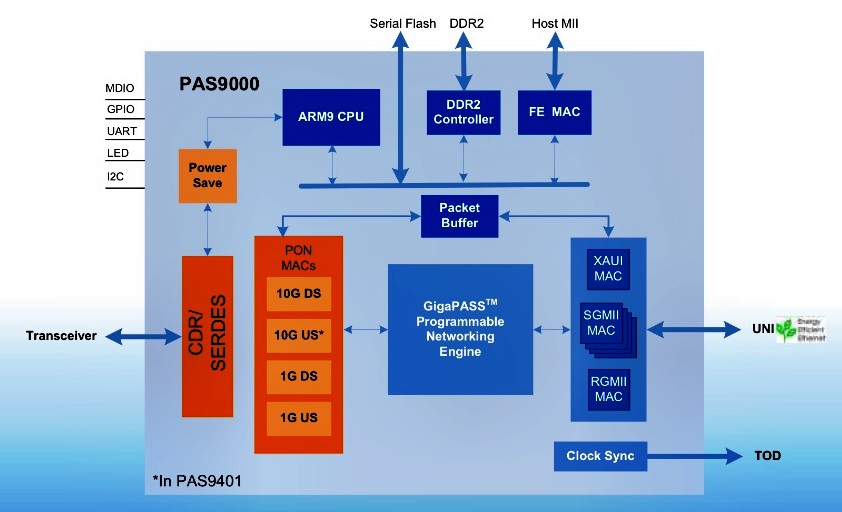 The PAS9000 optical network unit chip architecture. There are two devices in the family. One, the PAS9401, also supports 10G-EPON symmetric mode. Source: PMC-Sierra.
PON Market
PMC-Sierra says that the total market for PON is set for strong growth through 2015.
Using market data from Gartner and IDC, PMC says the 2010 market for EPON silicon was US $120M, growing to $180M for EPON and 10G-EPON speeds in 2015. In contrast, the GPON market was $35M in 2010 but will total $175M for both GPON and XGPON by 2015.
"China is going to be a very large market [for PON] compared to elsewhere," says Rammy Bahalul, senior marketing manager, FTTH division at PMC-Sierra.
Field trials of 10G-EPON have already been conducted in South Korea, Japan and China, says Bahalul: "We see Japan being the first to move to 10G-EPON, followed by Korea and China."
PMC expects 10G-EPON deployments to start in 2013, with the first application being multi-dwelling units. Meanwhile, the company expects first deployments of XGPON in 2014, with field trials starting in 2013. China is expected to deploy XGPON first, followed by North America.
10G-EPON ICs
The 40nm CMOS PAS8000 OLT family comprises four devices.
The PAS8301 and PAS8311 support asymmetric (1Gbps upstream) 10G-EPON. The two chips differ in that the PAS8311 has an on-chip traffic manager/ packet processor which inspects and classifies packets as well as rate-limits particular service flows.
The remaining two devices, the PAS8401 and PAS8411, support symmetric and asymmetric modes. However, the PAS8401 does not include the traffic manager/ packet processor.
All four have the Power Save mode which PMC claims halves the power consumption compared to existing ONUs. For example, it allows the ONU to be shut down when appropriate. The OLT devices also support synchronisation protocols required for mobile backhaul.
Another feature of the PAS8000 family is an on-chip optical time-domain reflectometer (OTDR). The OTDR function enables operators to locate fibre faults without using standalone test equipment, and can diagnose the nature and location of a fault to within a 2m accuracy, says Bahalul.
The PAS9000 ONU family comprises two devices: the asymmetric PAS9301 and the asymmetric/ symmetric PAS9401. The devices support the power save mode and mobile backhaul. And by delivering 10G-EPON symmetric and asymmetric modes, the PAS9401 ONU IC enables operators to plan five years ahead using silicon available now, says Bahalul.
Meanwhile, the company's XGPON OLT and ONU are asymmetric designs - 10Gbps downstream and 2.5Gbps upstream. The system-on-chip XGPON versions have still to be taped out with the designs currently implemented as FPGAs. The XGPON design was part of a recent successful interoperability test, conducted by industry body FSAN (Full Service Access Network), says PMC.
PMC-Sierra says it has a single software development kit that allows software developed on one platform to be reused across all its products.
Photonic integration specialist OneChip tackles PON
Briefing: PON
Part 1: Monolithic integrated transceivers
OneChip Photonics is moving to volume production of PON transceivers based on its photonic integrated circuit (PIC) design. The company believes that its transceivers can achieve a 20% price advantage.

"We will be able to sell [our integrated PON transceivers] at a 20% price differential when we reach high volumes"
Andy Weirich, OneChip Photonics
OneChip Photonics has already provided transceiver engineering samples to prospective customers and will start the qualification process with some customers this month. It expects to start delivering limited quantities of its optical transceivers in the next quarter.
The company's primary products are Ethernet PON (EPON) and Gigabit PON (GPON) transceivers. But it is also considering selling a bi-directional optical sub-assembly (BOSA), a component of its transceivers, to those system providers that want to attach the BOSA directly to the printed circuit board (PCB) in their optical network units (ONUs).
"The BOSA is the sub-assembly that contains all the optics, usually the TIA [trans-impedance amplifier] and sometimes the laser driver," says Andy Weirich, OneChip Photonics' vice president of product line management.
The company will roll out its Ethernet PON (EPON) ONU transceivers in the second quarter of 2012, followed by GPON ONU transceivers in the third quarter.
PON Technologies
EPON operates at 1.25 Gigabit-per-second (Gbps) upstream and downstream. OneChip had planned to develop a 2.5Gbps EPON variant which, says OneChip, has been standardised by the China Communications Standards Association (CCSA). But the company has abandoned the design since volumes have been extremely small and there have been no deployments in China.
GPON is a 2.5Gbps downstream/ 1.25Gbps upstream technology. The main differences between GPON and EPON transceiver optical components are the requirement of the ONU's receiver optics and circuitry, and the laser type, says Weirich. GPON's Class B+ specification, used for nearly all the GPON deployments, calls for a 28-29dB sensitivity. This is a more demanding specification requirement to meet than EPON's. GPON also calls for a Distributed Feedback (DFB) laser, whereas an EPON ONU may use either a Fabry-Perot laser or a DFB laser.
OneChip uses the same DFB for GPON and EPON ONUs. Where the PIC designs differ is the receiver assembly where GPON requires amplification. This, says Weirich, is achieved using either an avalanche photodiode (APD) or a semiconductor optical amplifier (SOA).
OneChip will start with an APD but will progress to an SOA. Once it integrates an SOA as part of the PIC, a simpler, cheaper photo-detector can be used.
Weirich admits that it has taken OneChip longer than it expected to develop its monolithically-integrated design.
Part of the challenge has been the issue of packaging the PIC. "Because of our integrated approach and non-alignment-requiring assembly, we have had to solve a few more technology problems," he says. "Our suppliers have had a challenge with some of those issues, and it has taken a couple of iterations to solve."
OneChip says that the good news is that the price erosion of EPON transceivers has slowed down in the last two years. So while Weirich admits the market is more competitive now, what is promising is that volumes have continued to grow.
"There is no sign of saturation happening either in the EPON or GPON markets," he says. And OneChip believes it can compete on price. "What we are saying is that we will be able to sell [our monolithically integrated PON transceivers) at a 20% price differential when we reach high volumes." That is because the monolithic design is simpler and the optical components that make up the design are cheaper, says the company.
10G EPON and XGPON
OneChip believes the end of 2012 will be when 10G EPON volumes start to ramp. "10G EPON is a significantly larger market than 10G GPON [XGPON]," says Weirich, pointing out that some of the largest operators such as China Telecom have backed 10G EPON.
With 10G EPON there are two flavours: the asymmetric (10Gbps downstream and 1.25Gbps upstream) and the symmetric (10Gbps bidirectional) versions.
For an asymmetric 10Gbps ONU transceiver, the laser does not need to change but the optics and electronics at the receiver do, because of the 10Gbps receive signal and because operators want 28-29dB optical link budgets so that 10G EPON can run on the same fibre plant as EPON. "This is an order of magnitude more difficult from a sensitivity perspective than for EPON," says Weirich.
There is demand for the 10G symmetric EPON but it is much lower than the asymmetric version primarily due to cost. "The ONU transceiver with its 10 Gbps laser and photo-detector is quite a bit more costly," says Weirich, complicating the PON's business case.
OneChip says it has a 10G EPON in its product roadmap, but it has not yet made any announcements or made any demonstrations to customers.
Challenges
OneChip is not aware of any other company developing a monolithic integrated design for PON transceivers, in part due to the challenge. It has to be made cheaply enough to compete with the traditional TO-can design. The key is to develop low-cost integration techniques and processes right at the start of the PIC design, he says.
The company says that it is also exploring using its PIC technology to address data centre connectivity.
OneChip Photonics at a glance
OneChip employs some 80 staff and is headquartered in Ottawa, Canada, where it has a 4,000 sq. ft. cleanroom. The start-up also has a regional office in Shenzhen, China which includes a test lab to serve regional customers.
The company is primarily a transceiver supplier and its main target customers are the tier-one system vendors that supply OLT and ONU equipment. "When you think of the big three players in China, Huawei, ZTE and Fiberhome would be among those we are targeting," says Steve Bauer, vice president of marketing and communications, as well as players such as Alcatel-Lucent and Motorola. As mentioned, the company is also considering selling its BOSA design to ONU makers.
In May 2011 the company received $18M in its latest round of funding. "We are transitioning from product development to becoming operationally ready to manufacture in volume," says Bauer.
Fabrinet and Sanmina-SCI are two contract manufacturers that the company is using for transceiver testing and assembly while it has partnerships with several other fabs for supply of wafers, wafer fabrication and silicon optical benches.
Next-Gen PON: An interview with BT
 Peter Bell, Access Platform Director, BT Innovate & Design
Q: The status of 10 Gigabit PON – 10G EPON and 10G GPON (XG-PON): Applications, where it will be likely be used, and why is it needed?
PB: IEEE 10G EPON: BT not directly involved but we have been tracking it and believe the standard is close to completion (gazettabyte: The standard was ratified in September 2009.)
ITU-T 10Gbps PON: This has been worked on in the Full Service Access Network group (FSAN) where it became known as XG-PON. The first version XG-PON1 is 10Gbps downstream and 2.5Gbps upstream and work has started on this in ITU-T with a view to completion in the 2010 timeframe. The second version XG-PON2 is 10Gbps symmetrical and would follow later.
Not specific to BT’s plans but an operator may use 10Gbps PON where its higher capacity justified the extra cost. For example: business customers, feeding multi-dwelling units (MDUs) or VDSL street cabinets
Q: BT's interest in WDM-PON and how would it use it?
PB: BT is actively researching WDM-PON. In a paper presented at ECOC '09 conference in Vienna (24th September 2009) we reported the operation of a compact DWDM comb source on an integrated platform in a 32-channel, 50km WDM-PON system using 1.25Gbps reflective modulation.
We see WDM-PON as a longer term solution providing significantly higher capacity than GPON. As such we are interested in the 1Gbps per wavelength variants of WDM-PON and not the 100Mbps per wavelength variants.
Q: FSAN has two areas of research regarding NG PON: What is the status of this work?
PB: NG-PON1 work is focussed on 10 Gbps PON (known as XG-PON) and has advanced quite quickly into standardisation in ITU-T.
NG-PON2 work is longer term and progressing in parallel to NG-PON1
Q: BT's activities in next gen PON – 10G PON and WDM-PON?
PB: It is fair to say BT has led research on 10Gbps PONs. For example an early 10Gbps PON paper by Nesset et al from ECOC 2005 we documented the first, error-free physical layer transmission at 10Gbps, over a 100km reach PON architecture for up and downstream.
We then partnered with vendors to achieve early proof-of-concepts via two EU funded collaborations.
Firstly in MUSE we collaborated with NSN et al to essentially do first proof-of-concept of what has become known as XG-PON1 (see attached long reach PON paper).
Secondly, our work with NSN, Alcatel-Lucent et al on 10Gbps symmetrical hybrid WDM/TDMA PONs in EU project PIEMAN has very recently been completed.
Q: What are the technical challenges associated with 10G PON and especially WDM-PON?
For 10Gbps PONs in general the technical challenges are:
- Achieving the same loss budgets - reach - as GPON despite operating at higher bitrate and without pushing up the cost.
- Coexistence on same fibres as GPON to aid migration.
- For the specific case of 10Gbps symmetrical (XG-PON2) the 10 Gbps burst mode receiver to use in the headend is especially challenging. This has been a major achievement of our work in PIEMAN.
For WDM-PONs the technical challenges are:
- Reducing the cost and footprint of the headend equipment (requires optical component innovation)
- Standardisation to increase volumes of WDM-PON specific optical components thereby reducing costs.
- Upgrade from live GPON/EPON network to WDM-PON (e.g. changing splitter technology)
Q: There are several ways in which WDM-PON can be implemented, does BT favour one and why, or is it less fussed about the implementation and more meeting its cost points?
PB: We are only interested in WDM-PONs giving 1Gbps per wavelength or more and not the 100Mbps per wavelength variants. In terms of detailed implementation we would support the variant giving lowest cost, footprint and power consumption.
Q: What has been happening with BT's Long Reach PON work
PB: We have done lots of work on the long reach PON concept which is summarised in a review published paper from IEEE JLT and includes details of our work to prototype a next-generation PON capable of 10Gbps, 100km reach and 512-way split. This includes EU collaborations MUSE and PIEMAN
From a technical perspective, Class B+ and C+ GPON (G.984.2) could reach a high percentage of UK customers from a significantly reduced number of BT exchanges. Longer reach PONs would then increase the coverage further.
Following our widely published work in amplified GPON, extended reach GPON has now been standardised (G.984.6) to have 60 km reach and 128-way split, and some vendors have early products. And 10Gbps PON standards are expected to have same reach as GPON.