

100-gigabaud optics usher in the era of terabit transmissions
Telecom operators are in a continual battle to improve the economics of their optical transport networks to keep pace with the relentless growth of IP traffic.
One approach is to increase the symbol rate used for optical transmission. By operating at a higher baud rate, more data can be carried on an optical wavelength.

Ferris Lipscomb
Alternatively, a higher baud rate allows a simpler modulation scheme to be used, sending the same amount of data over greater distances. That is because the fewer constellation points of the simpler modulation scheme help data recovery at the receiver.
NeoPhotonics has detailed two optical components - a coherent driver-modulator and an intradyne coherent receiver (micro-ICR) - that operate at over 100 gigabaud (GBd). The symbol rate suits 800-gigabit systems and can enable one-terabit transmissions.
NeoPhotonics’ coherent devices were announced to coincide with the ECOC 2020 show.
Class 60 components
The OIF has a classification scheme for coherent optical components based on their analogue bandwidth performance.
A Class 20 receiver, for example, has a 3-decibel (dB) bandwidth of 20GHz. NeoPhotonics announced at the OFC 2019 show Class 50 devices with a 50GHz 3dB bandwidth. The Class 50 modulator and receiver devices are now deployed in 800-gigabit coherent systems.
NeoPhotonics stresses the classes are not the only possible operating points. “It is possible to use baud rates in between these standard numbers,” says Ferris Lipscomb, vice president of marketing at NeoPhotonics. “These classes are shorthand for a range of possible baud rates.”
“To get to 96 gigabaud, you have to be a little bit above 50GHz, typically a 55GHz 3dB bandwidth,” says Lipscomb. “With Class 60, you can go to 100 gigabaud and approach a terabit.”
It is unclear whether one-terabit coherent transponders will be widely used. Instead, Class 60 devices will likely be the mainstay for transmissions up to 800 gigabits, he says.
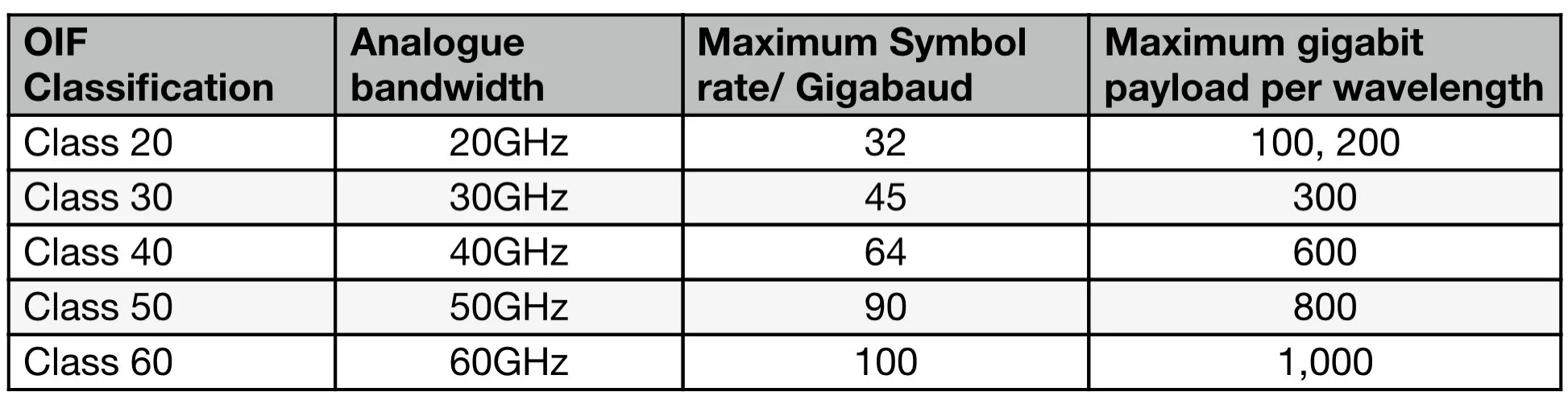
Source: NeoPhotonics, Gazettabyte
Design improvements
Several aspects of the components are enhanced to achieve Class-60 performance.
At the receiver, the photodetector’s bandwidth needs to be enhanced, as does that of the trans-impedance amplifier (TIA) used to boost the received signals before digitisation. In turn, the modulator driver must also be able to operate at a higher symbol rate.
“This is mainly analogue circuit design,” says Lipscomb. “You have to have a detector that will respond at those speeds so that means it can’t be a very big area; you can’t have much capacitance in the device.”
Similarly, the silicon germanium drivers and TIAs, to work at those speeds, must also keep the capacitance down given that the 3dB bandwidth is inversely proportional to the capacitance.
Systems vendors Ciena, Infinera, and Huawei all have platforms supporting 800-gigabit wavelengths while Nokia‘s latest PSE-Vs coherent digital signal processor (DSP) supports up to 600 gigabit-per-wavelength.
Next-generation symbol rate
The next jump in symbol rate will be in the 120+ gigabaud range, enabling 1.2-terabit transmissions.
“As you push the baud rate higher, you have to increase the channel spacing,” says Lipscomb. “Channels can’t be arbitrary if you want to have any backward compatibility.”
A 50GHz channel is used for 100- and 200-gigabit transmissions at 32GBd. Doubling the symbol rate to 64GBd requires a 75GHz channel while a 100GBd Class 60 design occupies a 100GHZ channel. For 128GBd, a 150GHz channel will be needed. “For 1.2 terabit, this spacing matches well with 75GHz channels,” says Lipscomb.
It remains unclear when 128GBd systems will be trialled but Lipscomb expects it will be 2022, with deployments in 2023.
Upping the baud rate enhances the reach and reduces channel count but it does not improve spectral efficiency. “You don’t start getting more data down a fibre,” says Lipscomb.
To boost transport capacity, a fibre’s C-band can be extended to span 6THz, dubbed the C++ band, adding up to 50 per cent more capacity. The L-band can also be used and that too can be extended. But two sets of optics and optical amplification are required when the C and L bands are used.
400ZR and OpenZR+
Lipscomb says the first 400ZR coherent pluggable deployments that link data centres up to 120km apart will start next year. The OIF 400ZR coherent standard is implemented using QSFP-DD or OSFP client-side pluggable modules.
“There is also an effort to standardise around OpenZR+ that has a little bit more robust definition and that may be 2022 before it is deployed,” says Lipscomb.
NeoPhotonics is a contributor member to the OpenZR+ industry initiative that extends optical performance beyond 400ZR’s 120km.
800-gigabit coherent pluggable
The OIF has just announced it is developing the next-generation of ZR optics, an 800-gigabit coherent line interface supporting links up to 120km. The 800-gigabit specification will also support unamplified fixed-wavelength links 2-10km apart.
“This [800ZR standard] will use between Class 50 and Class 60 optics and a 5nm CMOS digital signal processor,” says Lipscomb.
NeoPhotonics’ Class 60 coherent modulator and receiver components are indium phosphide-based. For the future 800-gigabit coherent pluggable, a silicon photonics coherent optical subassembly (COSA) integrating the modulator with the receiver is required.
NeoPhotonics has published work showing its silicon photonics operating at around 90GBd required for 800-gigabit coherent pluggables.
“This is a couple of years out, requiring another generation of DSP and another generation of optics,” says Lipscomb.


Infinera’s ICE flow
Infinera’s newest Infinite Capacity Engine 5 (ICE5) doubles capacity to 2.4 terabits. The ICE, which comprises a coherent DSP and a photonic integrated circuit (PIC), is being demonstrated this week at the OFC show being held in San Diego.
Infinera has also detailed its ICE6, being developed in tandem with the ICE5. The two designs represent a fork in Infinera’s coherent engine roadmap in terms of the end markets they will address.
 Geoff BennettThe ICE5 is targeted at data centre interconnect and applications where fibre in being added towards the network edge. The next-generation access network of cable operators is one such example. Another is mobile operators deploying fibre in preparation for 5G.
First platforms using the ICE5 will be unveiled later this year and will ship early next year.
Infinera’s ICE6 is set to appear two years after the ICE5. Like the ICE4, Infinera’s current Infinite Capacity Engine, the ICE6 will be used across all of Infinera’s product portfolio.
Meanwhile, the 1.2 terabit ICE4 will now be extended to work in the L-band of optical wavelengths alongside the existing C-band, effectively doubling a fibre’s capacity available for service providers.
Infinera’s decision to develop two generations of coherent designs follows the delay in bringing the ICE4 to market.
“The fundamental truth about the industry today is that coherent algorithms are really hard,” says Geoff Bennett, director, solutions and technology at Infinera.
By designing two generations in parallel, Infinera seeks to speed up the introduction of its coherent engines. “With ICE5 and ICE6, we have learnt our lesson,” says Bennett. “We recognise that there is an increased cadence demanded by certain parts of the industry, predominately the internet content providers.”
ICE5
The ICE5 uses a four-wavelength indium-phosphide PIC that, combined with the FlexCoherent DSP, supports a maximum symbol rate of 66Gbaud and a modulation rate of up to 64-ary quadrature amplitude modulation (64-QAM).
Infinera says that the FlexCoherent DSP used for ICE5 is a co-development but is not naming its partners.
Using 64-QAM and 66Gbaud enables 600-gigabit wavelengths for a total PIC capacity of 2.4 terabits. Each PIC is also ‘sliceable’, allowing each of the four wavelengths to be sent to a different location.
Infinera is not detailing the ICE5’s rates but says the design will support lower rates, as low as 200 gigabit-per-second (Gbps) or possibly 100Gbps per wavelength.
Bennett highlights 400Gbps as one speed of market interest. Infinera believes its ICE5 design will deliver 400 gigabits over 1,300km. The 600Gbps wavelength implemented using 64-QAM and 66Gbaud will have a relatively short reach of 200-250km.
“A six hundred gigabit wavelength is going to be very short haul but is ideal for data centre interconnect,” says Bennett, who points out that the extended reach of 400-gigabit wavelengths is attractive and will align with the market emergence of 400 Gigabit Ethernet client signals.
Probabilistic shaping squeezes the last bits of capacity-reach out of the spectrum
Hybrid Modulation
The 400-gigabit will be implemented using a hybrid modulation scheme. While Infinera is not detailing the particular scheme, Bennett cites several ways hybrid modulation can be implemented.
One hybrid modulation technique is to use a different modulation scheme on each of the two light polarisations as a way of offsetting non-linearities. The two modulation schemes can be repeatedly switched between the two polarisation arms. “It turns out that the non-linear penalty takes time to build up,” says Bennett.
Another approach is using blocks of symbols, varying the modulation used for each block. “The coherent receiver has to know how many symbols you are going to send with 64-QAM and how many with 32-QAM, for example,” he says
A third hybrid modulation approach is to use sub-carriers. In a traditional coherent system, a carrier is the output of the transmit laser. To generate sub-carriers, the coherent DSP’s digital-to-analogue converter (DAC) applies a signal to the modulator which causes the carrier to split into multiple sub-carriers.
To transmit at 32Gbaud, four sub-carriers can be used, each modulated at 8Gbaud, says Bennett. Nyquist shaping is used to pack the sub-carriers to ensure there is no spectral efficiency penalty.
“You now have four parallel streams and you can deal with them independently,” says Bennett, who points out that 8Gbaud turns out to be an optimal rate in terms of minimising non-linearities made up of cross-phase and self-phase modulation components.
Sub-carriers can be described as a hybrid modulation approach in that each sub-carrier can be operated at a different baud rate and use a different modulation scheme. This is how probabilistic constellation shaping - a technique that improves spectral efficiency and which allows the data rate used on a carrier to be fine-tuned - will be used with the ICE6, says Infinera.
For the ICE5, sub-carriers are not included. “For the applications we will be using ICE5 for, the sub-carrier technology is not as important,” says Bennett. “Where it is really important is in areas such as sub-sea.”
Silicon photonics has a lower carrier mobility. It is going to be harder and harder to build such parts of the optics in silicon.
Probabilistic constellation shaping
Infinera is not detailing the longer-term ICE6 beyond highlights two papers that were presented at the ECOC show last September that involved a working 100Gbaud sub-carrier-driven wavelength and probabilistic shaping applied to a 1024-QAM signal.
The 100Gbaud rate will enable higher capacity transponders while the use of probabilistic shaping will enable greater spectral efficiency. “Probabilistic shaping squeezes the last bits of capacity-reach out of the spectrum,” says Bennett.
“In ICE6 we will be doing different modulation on each sub-carrier,” says Bennett. “That will be part of probabilistic constellation shaping.” And assuming Infinera adheres to 8Gbaud sub-carriers, 16 will be used for a 100Gbaud symbol rate.
Infinera argues that the interface between the optics and the DSP becomes key at such high baud rates and it argues that its ability to develop both components will give it a system design advantage.
The company also argues that its use of indium phosphide for its PICs will be a crucial advantage at such high baud rates when compared to silicon photonics-based solutions. “Silicon photonics has a lower carrier mobility,” says Bennett. “It is going to be harder and harder to build such parts of the optics in silicon.”
ICE4 embraces the L-band
Infinera’s 1.2 terabit six-wavelength ICE4 was the first design to use Nyquist sub-carriers and SD-FEC gain sharing, part of what Infinera calls its advanced coherent toolkit.
At OFC, Infinera announced that the ICE4 will add the L-band in addition to the C-band. It also announced that the ICE4 has now been adopted across Infinera’s platform portfolio.
The first platforms to use the ICE4 were the Cloud Xpress 2, the compact modular platform used for data centre interconnect, and the XT-3300, a 1 rack-unit (1RU) modular platform targeted at long-haul applications.
A variant of the platform tailored for submarine applications, the XTS-3300, achieved a submarine reach of 10,500km in a trial last year. The modulation format used was 8-QAM coupled with SD-FEC gain-sharing and Nyquist sub-carriers. The resulting spectral efficiency achieved was 4.5bits/s/Hz. In comparison, standard 100-gigabit coherent transmission has a spectral efficiency of 2bits/s/Hz. The total capacity supported in the trial was 18.2 terabits.
Since then, the ICE4 has been added the various DTN-X chassis including the XT-3600 2.4 terabit 4RU platform.