


-
-
-
- Oriole’s next-generation platform, the Prism Ultra, will scale to 1 million AI accelerators (xPUs).
- xPUs with up to 51.2 terabits of input-output (I/O) will be supported by using four new XPO modules.
-
-
AI models continue to advance, but this progress requires increasingly capable hardware—from xPUs to the networks that connect them.
AI supercomputers already deploy up to 100,000 xPUs across racks spanning entire data centres. Even that is proving insufficient, as AI service providers begin linking multiple data centres to pool resources for large-scale workloads. But scaling compute depends on scaling the network: within racks, across racks, and increasingly, across data centres.
Electrical switches today form the backbone of these systems, arranged in hierarchical network topologies.
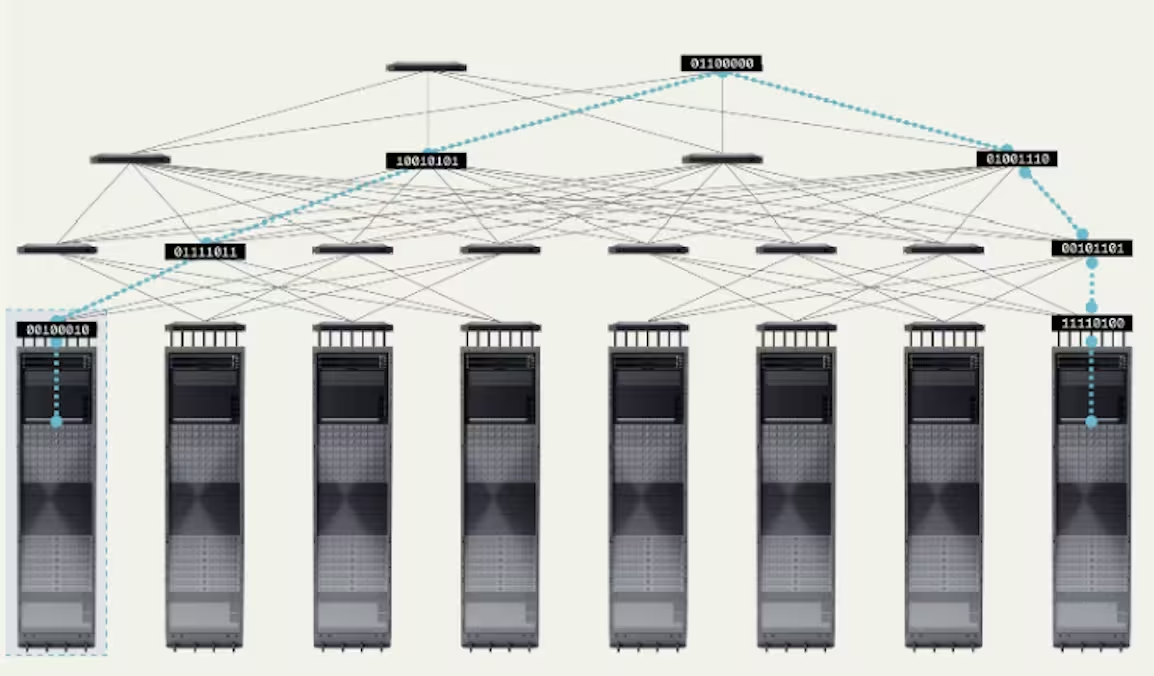
Switch silicon continues to improve, doubling in capacity roughly every two years. For example, the latest Broadcom Tomahawk 6 delivers 102.4 terabits per second of switching capacity. However, xPU I/O bandwidth is growing even faster. Processors with tens of terabits per second of I/O are already being discussed.
Even with future 400-terabit switch chips, this would support only a limited number of fully non-blocking xPU connections—on the order of single digits. The result will be deeper network hierarchies, more switching layers, higher power consumption, and increased latency.
Google is already using optical circuit switches in its data centres to link its TPU AI accelerator chips. An optical circuit switch creates a temporary light path between two network endpoints, with the data sent as optical signals. Google’s first used optical circuit switches was to replace the top (Spine) layer of electrical switches resulting in significant power and cost savings. Google also uses optical circuit switches to tailor clusters of TPUs to AI workloads. Indeed, TPUs with optical circuit switches is now the dominant AI system deployed by Google.
Meanwhile, Broadcom and Nvidia have started adding optical interfaces to their switches, an approach known as co-packaged optics (CPO). Co-packaged optics-based electrical switching platforms is an alternative to traditional switch platforms that use pluggable optical transceivers. Using co-packaged optics saves power and has demonstrated greater system reliability but it does not address the issue of switching capacity. To date, deployments of co-packaged optics-based switching have been limited.
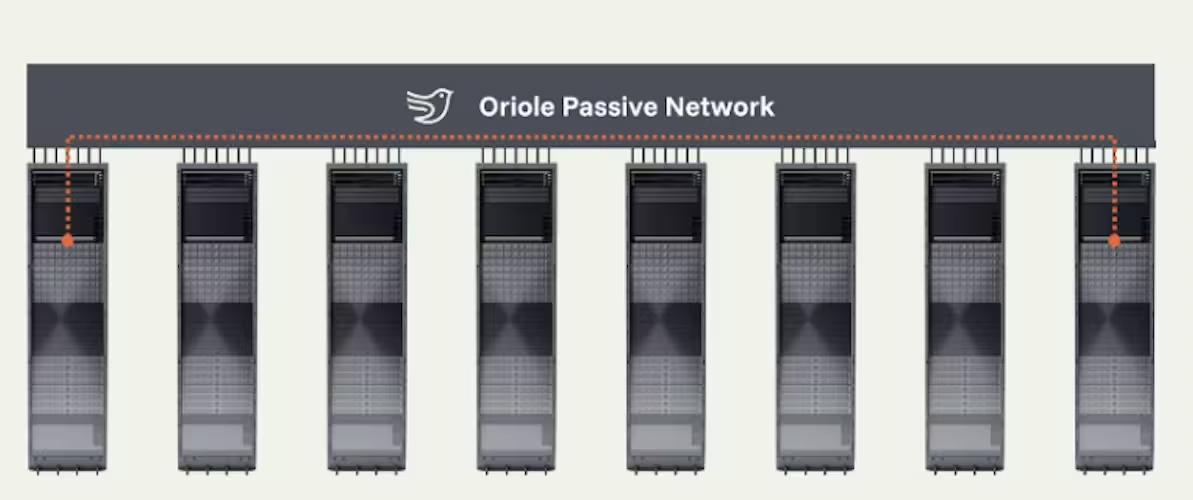
Oriole is taking a more radical design approach. The UK start-up has developed an interconnect architecture that removes electrical switching altogether. Oriole’s argument is that as the xPU count grows, and the data each xPU sends, electrical switching will not keep up. But optical switching will.
But electrical switching dominates data centre traffic for a reason: it supports all types of packet flows including short ones. Conventional optical switching is good for very long packet flows – 100 gigabytes, says Oriole – because of the time it takes to set up a path i.e. when data is sent between the two end-points for a duration much greater than the switch path set-up time.
But Oriole claims its architecture tackles this issue of setup latency versus flow duration.
“Our complete solution allows you to run an optical circuit switch with the packet granularity of electrical switches,” says James Regan, CEO and co-founder of Oriole Networks.
Prism system
Oriole’s Prism architecture connects each xPU to an optical module, dubbed XTR by Oriole, using a PCI Express (PCIe) network interface card (NIC).
Oriole’s XTR module uses a tunable laser to generate optical signals at different wavelengths. The XTR adds further scale by using several fibre outputs, a form of space switch. The XTR also uses time-multiplexing sending data in 100-nanosecond (ns) windows and can switch – set up a new optical path – in 10ns.
The XTR modules connect to Oriole’s second system element, the photonic routing platform that acts as a passive optical network. The combination of the XTR and photonic routing platform results in a nanosecond-reconfigurable optical circuit switch-based network.
Design challenges
Oriole has had to tackle two issues to replace electrical packet switching with optical circuit switches.
The first issue is switching fast enough such that the time needed to create a signal path is a tiny fraction of the time the connection is active. Otherwise, xPUs remain idle while the path setup. AI inference traffic, for example, can involve small, frequent exchanges—often on the order of kilobytes, says Oriole. If each path incurs a millisecond-scale switching penalty, the network becomes inefficient. Since Oriole’s network can switch in 10ns, the overhead is insignificant.
A second challenge is transceiver synchronisation. Conventional optical systems require re-locking after each reconfiguration, which can take milliseconds. Oriole claims to maintain synchronisation across switching events, eliminating this penalty—though details remain undisclosed.
Together, these capabilities allow optical switching to operate at packet-like granularity, a key requirement for replacing electrical networks.
The implication is significant. Instead of routing traffic through multiple layers of electrical switches, data can move directly between endpoints over dynamically configured optical paths.
Scaling to one million xPUs
Oriole’s Prism product is now running in test environments, validating the core switching and synchronisation technology. The XTR optics is being manufactured using Tower Semiconductor’s commercial heterogenous process using technology from OpenLight. And Oriole is working on a full rack inference system trial with AMD, using the chip company’s AI processors. Prism is expected to become available from 2027.
Now Oriole is working on its second-generation Prism Ultra product. With the Prism Ultra, Oriole is no longer using a NIC card. Instead, it is connecting the processor directly to the optical switch. This is because the PCIe bus cannot support terabits of I/O traffic xPUs will soon generate.
“You can’t run that amount of traffic through PCIe; it will require an insane number of sockets,” says Regan.
The Prism Ultra will use the industry’s new XPO (eXternal Pluggable Optics) pluggable form factor announced by Arista and others at OFC in March.
An XPO module support up to 12.8 terabits with its multiple electrical and optical lanes. Oriole will use co-packaged copper and flyover cables to link the xPU to the XPO pluggables. Four xPOs will support 51.2 terabits-per-second of AI processor I/O.
The Prism Ultra still needs networking intelligence given the NIC will be removed from the design.
“The intelligence that was inside the NIC or FPGA now becomes part of the xPUs,” says George Zervas, CTO and co-founder of Oriole.
Oriole says its Prism Ultra will directly connect thousands of xPUs. But to scale further, a way is needed to link between the ‘scale-up’ clusters. Here, an intermediate switching step using an electrical engine of the xPU is used. The engine selects a wavelength and path to address the entry XPO residing in another scale-up cluster hosting the XPU to receive the data. Accordingly, only one hop is needed for the system to link any two xPUs in, effectively, a one-million 2D array of xPUs.
Oriole’s approach promises a significant reduction in power consumption by eliminating large numbers of electrical switches in huge XPU superclusters. Latency will decrease while reliability will improve as the number of active components in the network decreases, says Regan. The total number of transceivers required will also fall, simplifying system design.
Oriole has not said when the Prism Ultra will be available.
Latest funding round
Oriole has already raised $35 million and is now undertaking a new funding round. Its challenge is to translate a technically compelling concept into a deployable, widely adopted solution.
Oriole’s proposal runs counter to the established industry’s direction. Considerable investment continues to flow into scaling electrical switching and into co-packaged optics-based switch designs. These approaches extend familiar models rather than replacing them. Oriole’s architecture, by contrast, suggests a more optical approach to next-generation AI infrastructure.
Whether the industry continues its incremental path or adopts more radical approaches is unclear. Should Oriole’s nanosecond optical switching prove practical, it will offer an alternative way to scale AI supercomputers.