

NewPhotonics has unveiled a near-packaged optics (NPO) product, broadening its optical engine portfolio.
Near-packaged optics refers to an optical engine placed close to the main processing chip (ASIC) on the host board, rather than on the rack’s front panel like traditional pluggable modules.
NewPhotonics, a fabless semiconductor start-up based in Tel Aviv, also demonstrated an early co-packaged optics (CPO) design at the OFC show held in Los Angeles earlier this month. Co-packaged optics refers to integrating an optical engine into the same package as the main processor chip, effectively adding optical input-output (I/O) to the chip.
The start-up views near-packaged optics as a way to enable customers to enhance system power efficiency and signal integrity while simplifying integration into existing architectures. In comparison, co-packaged optics requires more substantial changes to the hardware.
Focus on pluggables
Despite the industry’s growing interest in tightly integrated optical architectures for AI systems, NewPhotonics stresses the importance of pluggable transceivers.
“It’s an existing, very fast-growing market and a strong business to be in,” says Doron Tal, Senior Vice President and General Manager of Optical Connectivity at NewPhotonics.
NewPhotonics highlights the large deployment of OSFP pluggable modules by hyperscalers building AI clusters. Pluggables remain a standards-based market, defined by interoperability and established supply chains – all factors that favour steady, incremental improvements.
Now, by adding the near-packaged optics product and following the co-packaged optics demonstration, NewPhotonics is showing it is addressing the full spectrum of optical interconnects.
Integrated laser PICs
NewPhotonics has developed a toolkit of novel technologies to differentiate its photonic IC (PIC) products.
The company has adopted heterogeneous integration IP from OpenLight, now available as a process design kit at foundry Tower Semiconductor, to embed lasers into its pluggable module PICs.
Conventional 1.6-terabit optical modules typically use external lasers, modulators, lenses, isolators, and multiple optical coupling interfaces. Each element adds complexity, loss, and manufacturing overhead, says NewPhotonics.
With a PIC optical engine, there are fewer assembly steps, lower coupling loss, reduced system power consumption, and streamlined manufacturing.
“In semiconductors, integration is key, and that is exactly our focus,” says Tal.
NewPhotonics has two product PICs for 1.6-terabit optical modules. One, the NPG10204, is for digital signal processor (DSP)-based optical modules. It integrates eight lasers and eight modulators for use in a 1.6-terabit DR8 module, with eight electrical input channels, each at 224-gigabit PAM4.
A full DSP-based module consumes 28W, while a half-retimed module (also known as Retimed Transmitter Linear Receiver, RTLR) consumes 23W. A RTLR module using NeoPhotonics’ PIC, the power is 15W.
The second 1.6 terabit PIC is the NPG10203, for a 224-gigabit signalling linear pluggable optics (LPO) design that uses no DSP. These toolkit capabilities are the basis for NewPhotonics’ LPO+ product, which embeds NewPhotonics’ optical signal processing engine to address signal impairments. The resulting 1.6-terabit pluggable module consumes fewer than 10W.
Centera Photonics is the first announced customer to use the LPO+ engine.
Optical domain equalisation
In conventional high-speed links, equalisation is performed electronically using a DSP for feed-forward equalisation (FFE) and continuous-time linear equalisation (CTLE). Decision feedback equalisation (DFE) can also be used to tackle non-linear distortions.
“What is common for all these methods is that they are all some kind of filter,” says Professor Yosef Ben-Ezra, CTO and co-founder of NewPhotonics.
NewPhotonics, on the other hand, performs signal repair in the optical domain. The merits of the approach, says Ben-Ezra, are that it is very fast, reduces power consumption, and is not limited by the data rate.
Tellingly, the optical signal processing compensates for impairments across the channel, not just electrical impairments but also those introduced by the optical front end.
“With electronic equalisation, only part of the channel is visible,” says Ben-Ezra. “With our optical signal processor, the entire channel is equalised.”
NewPhotonics says its compensation approach restores up to 8dB over the longest channels.
The optical signal processor is programmable and adaptive, with monitoring and control circuitry based on another of the start-up’s novel technologies.
Called Niox, it enables the monitoring and control of optical circuits without using photodetectors to tap off light signals. Using Niox, the system can compensate for channel variations in real time, making maintenance easier and improving system stability.
NewPhotonics says its optical signal processor is so efficient at restoring margin that its LPO+ modules will work with all other vendors’ LPO modules. No ‘bookended solution’ is needed, says Tal.
“With the first generation of LPO [at 100Gbps] it was ’remove the DSP and pray,’” says Tal. “What we’re doing now [at 200Gbps] is making LPO interoperable.”
NewPhotonics has also announced a 3.2-terabit DR8 PIC that supports 448 gigabit per second (Gbps) signalling, with sampling scheduled for year-end. The PIC can be used for modules and for pluggable sockets.
Near-packaged optics: a bridge architecture
NewPhotonics’ move into near-packaged optics reflects a broader industry search for architectures that reduce power and improve signal integrity without the full disruption of co-packaged optics.
For Tal, near-packaged optics are a pragmatic solution on the pathway to co-packaged optics.
The key advantage, he says, is that near-packaged optics can be used without redesigning the entire system. Unlike co-packaged optics, which require tight co-design of optics and the ASIC, near-packaged optics maintains much of the existing electrical architecture, enabling easier upgrades and faster deployment.
NewPhotonics says it already has customers using its near-packaged optics solution, dubbed the NPC50503, a 1.6 terabit photonic engine.
The PIC builds on the same platform as its pluggable products. It combines integrated lasers, modulators, and its optical signal processing capability into a compact optical engine. Multiple near-packaged 1.6-terabit optics engines can be used alongside a switch or an AI accelerator.
While the electrical environment is simpler than in pluggable systems, challenges remain, including signal integrity across substrates and interconnect layers. Here, NewPhotonics also uses optical signal processing.

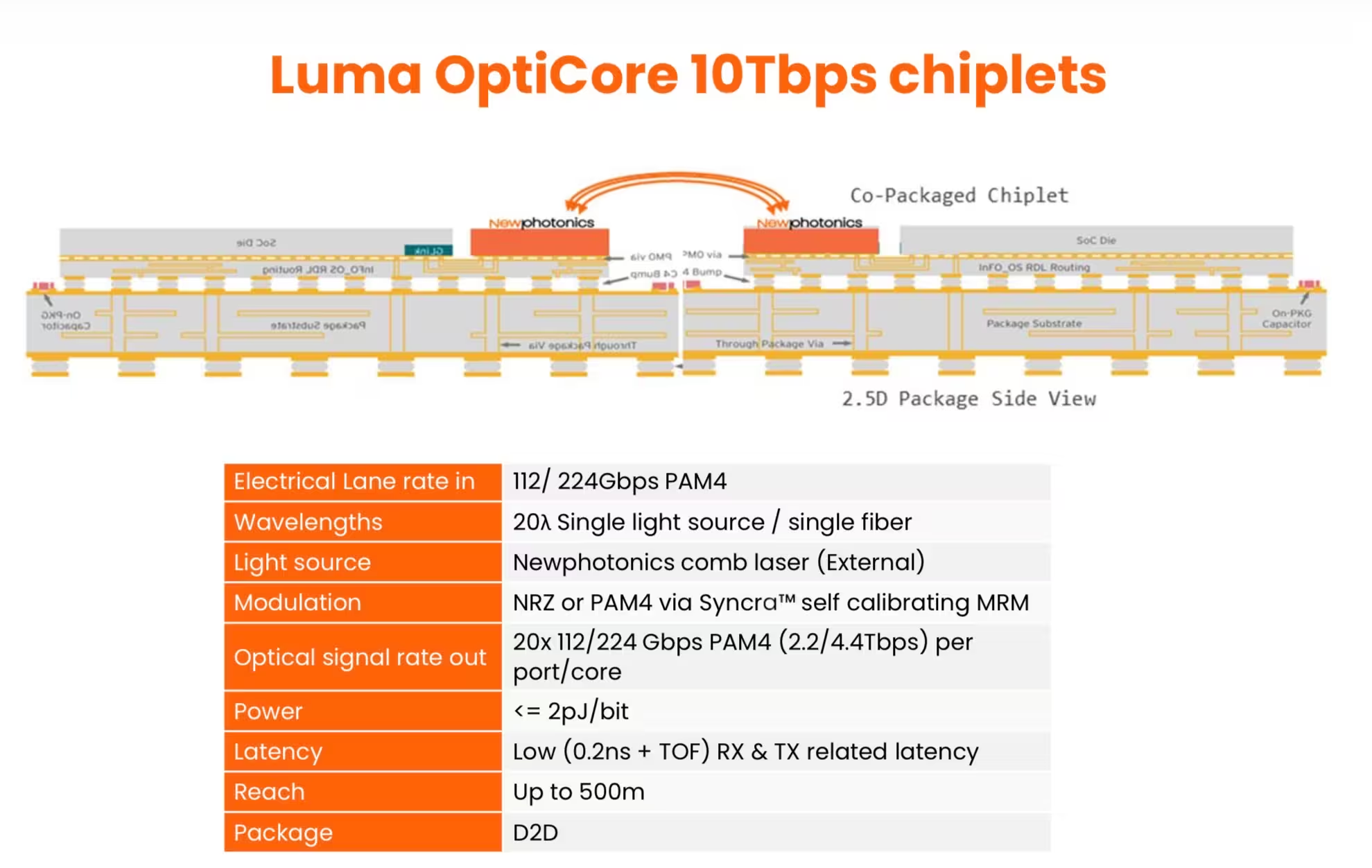
Luma Opticore demonstration
NewPhotonics demoed at OFC a co-packaged optics engine, offering a glimpse of its longer-term development work.
Co-packaged optics promises improvements in bandwidth density and power efficiency, but it also introduces significant challenges in packaging, thermal management, and system design.
NewPhotonics’ co-packaged optics demonstration differs from its pluggable and near-packaged optics products in that the engine uses an external laser source.
This reflects a broader industry view that external lasers are more practical in co-packaged optics systems, where thermal constraints and reliability requirements differ from those in pluggable modules.
The company says the design aligns with the newly announced Optical Compute Interconnect MSA (OCI MSA) introduced at OFC by founding members Meta, Microsoft, OpenAI, AMD, Broadcom, and Nvidia. The OCI MSA supports multiple wavelengths per fibre.
NewPhotonics’ design uses micro-ring resonator modulators to support five wavelengths per fibre.
Moreover, the micro-ring modulators do not require thermal control, simplifying the overall design. “The resonators are controlled but not thermally,” says Tal.
The co-packaged optics engine’s electrical input supports 53-gigabit non-return-to-zero (NRZ) and 112-gigabit PAM4 data rates, while its next-generation design will support 224Gbps and 448Gbps rates.
For the optical output, there are five wavelengths per fibre and twenty fibres overall, referred to as a tile. Each engine has five tiles, a total of 100 ring resonators. If each wavelength carries 112 Gbps, that is 11.2Tbps in total. NewPhotonics refers to its co-packaged optics engine as the 10-terabit Luma Opticore.
In the OFC demo, the start-up showed the Luma Opticore on a glass substrate with five fibres in and 20 fibres out.
It also demonstrated its micro-ring resonator modulator operating at 53 Gbps, with error-free operation despite temperature variations.
NewPhotonics is essentially betting that it will take longer for co-packaged optics to become established than many expect. For the start-up, the opportunity lies in improving what exists today while quietly preparing for what comes next.