
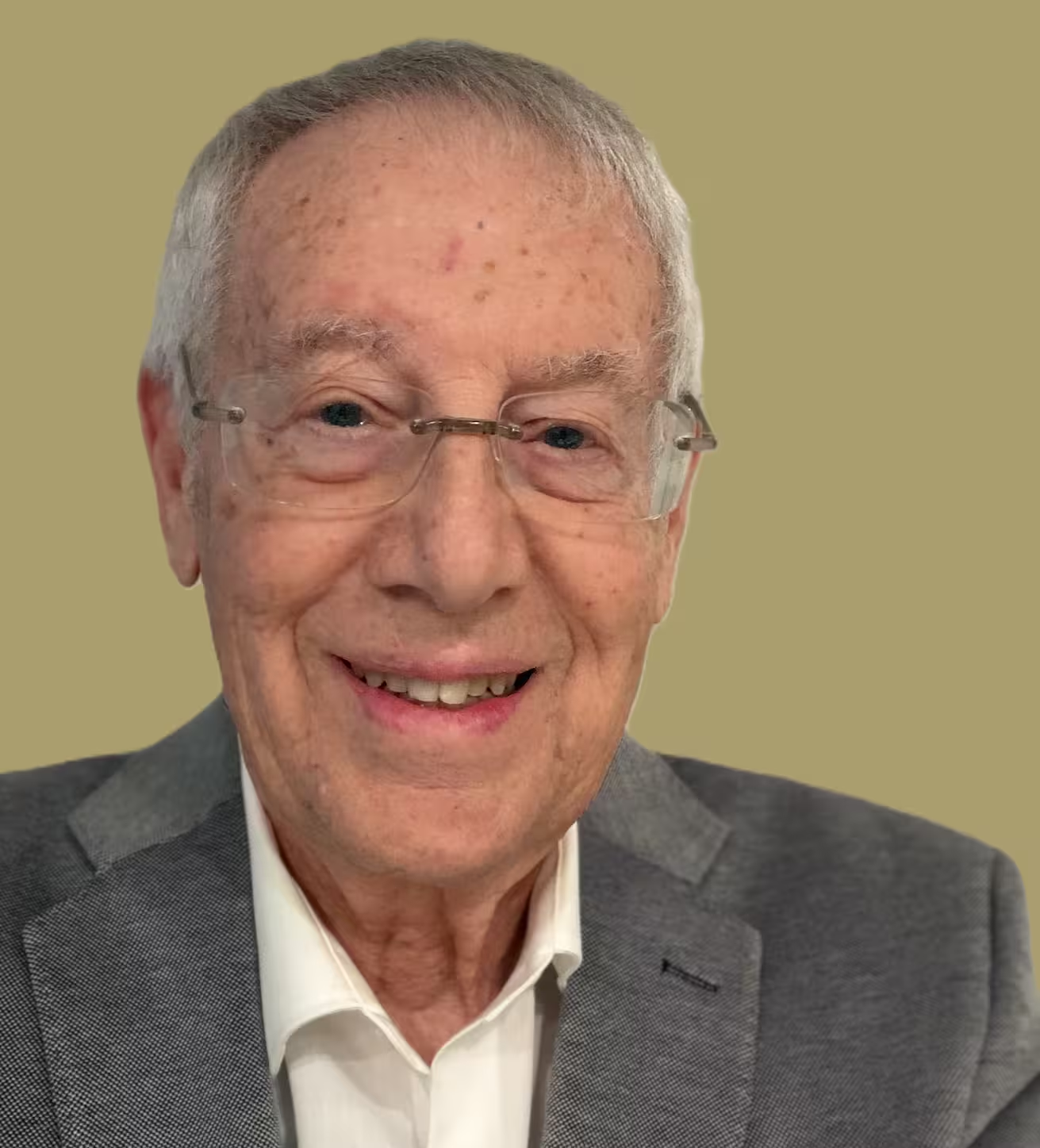
Professor Richard Soref, pictured, shares his thoughts on promising areas in photonics.
Richard Soref has been thinking about light in silicon for longer than most photonic engineers have been working in the field.
His wide-ranging interests extend beyond photonics: two decades ago, he published a poetry book titled: “Your Fate.”
Over the course of his career, silicon photonics has moved from a speculative research topic to a foundational technology of modern data centres. Today, however, Soref operates far from the commercial momentum he helped set in motion.
Now approaching his 90th year, Soref no longer manages a research group, nor is his work funded: until recently, he had access to grants. Yet his engagement with photonics, optical computing, and emerging computing paradigms remains active and wide-ranging.
“I don’t rank opportunities,” Soref says. “If something looks interesting, I explore it.”
An eclectic view of photonics
Soref’s broad research interests make for a long list: mid-infrared sensing, optical and optoelectronic computing, artificial intelligence (AI) acceleration, and terahertz systems.
That breadth reflects a career spent moving between materials, wavelength regimes, and applications rather than following a single roadmap.
This is how he came to see silicon as a promising material for light.
In 1985, the only photonic chip that could interface to fibre was the III-V semiconductor chip. Soref wondered if a silicon chip could be used, and whether it might even do a better job.
He had read in a textbook that silicon is relatively transparent at the 1.30- and 1.55-micron wavelengths used for telecom, which inspired him to look at silicon as a material for optical waveguides.
Silicon promised the potential of using the chip industry’s advanced manufacturing infrastructure for electro-optical integration, and aligned with Soref’s interest in materials.
“I’m a science guy, and I have curiosity and fascination with what the world of materials offers,” he told Gazettabyte a decade ago. “If I have an avenue like that, I like to explore where the physics takes us.”
Silicon photonics and AI data centres
One current interest is the intersection of silicon photonics and AI infrastructure. The rapid scaling of AI workloads has placed unprecedented strain on data centres in terms of power consumption and data movement.
For Soref, it is not whether photonics will matter, but how it will be incorporated.
“Photonic analogue neural computing should be deployed alongside electronic GPUs,” he says. “They should share the computing tasks.”
In a recent multi-author paper, Soref and colleagues propose large-scale opto-electronic neurons capable of implementing transformer-based large language models. The approach is not to replace GPUs. Instead, photonic systems would handle specific workloads, offering advantages in processing speed and energy efficiency.
“This combined approach would improve overall processing performance and power efficiency,” says Soref.
The implications are substantial. The paper predicts that such architectures could reduce data-centre power consumption by an order of magnitude. Crucially, the proposed systems rely on optoelectronics manufactured through hybrid bonding to 12-inch (300mm) silicon wafers, aligning with existing semiconductor manufacturing infrastructure rather than requiring exotic processes.
Beyond today’s AI models
Soref is also looking beyond current generative AI systems. He points to emerging ideas such as spatial AI and world models, where machines integrate multiple sensor inputs and interact with physical environments.
“The inputs are not just digital data scraped from the internet,” he says. “They come from sensors—vision and other modalities.”
Such systems, he argues, could place even greater demands on computing efficiency and data handling, making optoelectronic approaches increasingly relevant.
Optical and quantum computing
Quantum computing inevitably enters the discussion. Soref approaches the topic with caution. He does not question its importance, rather he is wary of assuming that quantum systems will dominate future computing.
His exploration is for alternative approaches to quantum, including semiconductor-based single-photon detectors aimed at room-temperature quantum operation.
In a paper published in APL Quantum, Soref and collaborators proposed that by gating computation on nanosecond timescales, the impact of detector dark counts could be mitigated. Dark counts refer to false signals that occur even when no photons are present, a significant source of noise in photonic quantum systems. By using nanosecond timescales, the idea is to “listen” to the photon detectors during tiny windows only when quantum information is expected to arrive.
“It’s a different way of thinking about the problem,” says Soref.
The work has not gained widespread traction, something Soref attributes partly to inertia and to the heavy investment already committed to superconducting approaches. By contrast, he sees optical and optoelectronic computing as closer to engineering reality, even if still technically challenging.
Soref’s work philosophy
A striking aspect of Soref’s work is how he does it. His long history of funding from the U.S. Air Force Office of Scientific Research ended in mid-2025. When the grant expired, he chose not to apply for another. “That was a turning point,” he says.
Today, he works without sponsorship and without institutional affiliation.
He spends his time reading academic papers, scanning arXiv, and following developments across multiple subfields. When something catches his interest, he reaches out directly to researchers.
Some collaborations flourish. Others never begin.
“It’s getting harder,” he admits. “Everyone has their own obligations. I’m not their primary focus.”
Nevertheless, several long-term collaborations continue. In Europe, he has worked for more than a decade with researchers exploring novel photonic structures and materials.
One collaboration with Italian academics focuses on terahertz photonics. Working with colleagues in Italy, Soref has explored topological photonic crystals in silicon designed to guide terahertz waves with low loss and sharp bends.
By integrating phase-change materials and graphene micro-heaters, these structures could act as electro-optical switches at terahertz frequencies. The work is early-stage and largely theoretical, but it exemplifies Soref’s willingness to engage with problems outside mainstream commercial priorities.
Choosing freedom over pressure
Given his long-standing experience, Soref could take on formal advisory roles, industry consulting positions, or editorial leadership posts.
He was recently asked to serve as editor-in-chief of a new journal, but he declined due to the time and responsibilities involved. What he values is flexibility: the freedom to think, explore, and collaborate without managerial or institutional constraints.
But Soref admits he is conflicted. “Part of me wants to keep going with innovation. Part of me wonders whether I should phase out.”
Soref’s other pursuits also take up his time: he likes to travel and is an avid photographer with his work shared online. And it was at the Bread Loaf Writers’ Conference in Ripton, Vermont, where he refined and then published his book of poems.
But for now, he continues—reading, thinking, collaborating, and occasionally publishing—driven not by funding cycles or commercial pressure, but by intellectual curiosity.
“I do this for the intellectual reward,” says Soref.