

Books of 2024: Final Part
Gazettabyte has been asking industry figures to pick their reads of 2024. In the final part, Professor Polina Bayvel, Hojjat Salemi, Professor Laura Lechuga, and the editor of Gazettabyte share their selections.
Professor Polina Bayvel, Royal Society Research Professor & Head of the Optical Networks Group, Department of Electronic & Electrical Engineering, UCL
I recently attended a Royal Society Discussion Meeting where Leslie Valiant gave a brilliant talk on educability as a better definition than intelligence. A Harvard professor, he has developed many algorithms that underpin today’s networks, including Valiant’s load balancing. He is a profound thinker, and I wanted immediately to read his book, The Importance of Being Educable: A New Theory of Human Uniqueness.’
Although written in a popular style, it argues that educability (a precisely defined computational model) is a better term than intelligence, for which no agreed definition exists. He explains how we, as a human race, have been able to create the technological civilisation that we have and argues that this civilisation enabler is educability. He also implies that current AI models are not educable. The book is masterful in its lucidity in explaining complex concepts in computation. I really could not put it down.
Another read which has taken my breath away is A. N. Tolstoy’s The Road to Calvary (Russian: Хождение по мукам, romanised: Khozhdeniye po mukam, lit. ’Walking Through Torments’), also translated as Ordeal, is a trilogy set just before the Russian Revolution (starting 1914) and follows the lives of two sisters and their lovers/ husbands goes through the revolution and the Russian Civil War. It was a staple in Soviet schools, but leaving at age 12, I missed it and have only recently read it.
It’s a monument to history, and when one reads it, one realises that the well-to-do Russian liberals who argued for change and the removal of the Czarist rules had no idea what fate would face them or how their lives would change forever.
It made me think of today’s parallel – do we always understand the consequences of wanting liberal changes? The Russian pre-Revolution liberals, the intelligentsia, wanted democracy and more power for the people. What they got was the opposite – totalitarian oppression.
I was also struck by the stark realisation that had WWI not occurred, there would not have been a revolution, and the lives of so many people, including that of my own family, would have followed a completely different course.
Hojjat Salemi, Chief Business Development Officer, Ranovus
Several years ago, I decided to avoid social media platforms like Instagram and TikTok, as well as the news channels Fox News and CNN. I found them to be major distractions and wasteful of time.
I used the time instead to read and listen to author interviews (podcasts) on YouTube, which often provide deeper insights into why they wrote their books and their key ideas. One of the best decisions I’ve made is controlling what I watch on YouTube—without ads! If you’re looking for good books about technology, here are my recommendations:
The book that won the Financial Times Business Book of the Year for 2024 is Supremacy: AI, ChatGPT, and the Race that Will Change the World by Party Olson.
It offers a fascinating narrative starting in 2012, focusing on how AI systems have developed, with a spotlight on two main figures: Dennis Hassabis, co-founder of DeepMind, and Sam Altman, the co-founder of OpenAI.
The book explores three major themes:
- how AI could reshape society as it grows increasingly intelligent,
- the unintended consequences of the technologies we create,
- and the moral dilemmas and risks of pushing these innovations too far. It’s a fast-paced, thought-provoking look at the future.
Another suggestion is Read Write Own: Building the Next Era of the Internet by Chris Dixon. The book is written clearly and engagingly and explains complex ideas like blockchain, NFTs, and decentralised networks. Dixon describes the evolution of the internet: the early days of reading information, the read-write era of social media where people shared but didn’t own content, and the emerging read-write-own era (Web3), where blockchain allows users to own digital assets.
While I’ve been thinking about decentralised networks a lot, I’m still not convinced they can take off, given our geopolitical challenges. Take Bitcoin, for example; if something goes wrong, who do you call? Moreover, Web3’s dominant players still rely on centralised computing power. It’s a thoughtful read, but only time will tell how Web3 unfolds.
Lastly, I recommend Ethics of Socially Disruptive Technologies: An Introduction. The book, available as a free PDF, is highly educational on how new technologies disrupt societal norms and ethical frameworks.
The book examines four specific technologies: social media, robots, climate engineering, and artificial wombs. For instance, social media was supposed to give everyone a voice and bring people together. Instead, it has often divided us, spread misinformation, and allowed foreign powers to interfere in elections. It challenges the idea of “government of the people, by the people, for the people” today. This book is perfect for anyone wanting to understand new technologies’ unintended consequences.
Professor Laura Lechuga, Head of the Nanobiosensors and Bioanalytical Application Group at the Catalan Institute of Nanoscience and Nanotechnology (ICN2).
I love reading and do it frequently, especially during the many work trips I take throughout the year.
My favourite reading of 2024 was Chip War: The Fight for the World’s Most Critical Technology by Chris Miller. It is an impressive book about the development of microelectronics and the pivotal role of chips in shaping the world powers.
Having a PhD focused on microelectronics, I enjoyed reading a book that will become a masterpiece. What I appreciated most were the personal stories of the brilliant scientists and engineers who conceived, developed, and solved all the technical obstacles to transforming the semiconductor industry that helped found some of the most influential companies in the world. This is a must-read book.
My second favourite book was The Maniac by Benjamin Labatut. The book is a combination of history and novel in which Labatut tells the story of brilliant physicists such as John von Neumann, a genius able to invent new fields. But the same prodigy whose work impacted future advances in computing terrified the people around him, and his personal life was miserable. The book describes the evolution of von Neumann’s work through to the battle between AI and a world champion player of the game Go. It is a book that reflects on the limits of technology, an original, addictive, and beautiful read.
Another book I loved in 2024 was Lessons in Chemistry by Bonnie Garmus. It is a feminist novel about how difficult a professional career was for women scientists in the 1960s. I felt totally reflected in it, as our position has not changed much. It is a book that mixes funny and sad situations, is easy to read, very enjoyable, and has a clear message.
My last recommendation is the old Atlas Shrugged book by Ayn Rand. It isn’t easy to read due to its length but it is a fascinating futuristic story about a dystopian United States, and is now more actual than ever. It is a story of how human stupidity gains a significant advantage over intelligence and the devastating consequences for the U.S. This could also be extended to the rest of the world, perhaps a prophecy to be fulfilled in the coming years.
Roy Rubenstein, Editor of Gazettabyte
I read many books in 2024 and will highlight three. One is Strength in What Remains by Tracy Kidder. I had read his most recent book, Rough Sleepers: Dr. Jim O’Connell’s Urgent Mission to Bring Healing to Homeless People, and this was my follow-up read. Kidder is a master storyteller who finds the most remarkable individuals to write about. I highly recommend both.
Dame Hilary Mantel is best known for her Wolf Hall trilogy. Last year, a book of her writings—articles for literary magazines, essays, film reviews, and her BBC Reith Lectures—was published. A Memoir of My Former Self: A Life in Writing is an excellent read by a fabulous writer.
Lastly, I recommend the 55-hour audible version of Alexandre Dumas’s The Count of Monte Cristo. While listening, I walked past the local cinema and realised there was a 2024 film version being shown. I entered, showed the attendant the audible version and asked if the film was shorter.


Books of 2024: Part 3
Gazettabyte is asking industry figures to pick their reads of the year. In the penultimate entry, Prof. Yosef Ben Ezra, Dave Welch, William Webb, and Abdul Rahim share their favourite reads.
Professor Yosef Ben Ezra, PhD, CTO, NewPhotonics
My reading in 2024 continued to augment my technical knowledge with insights on how to bring innovation to the market.
As part of our mission to shift the industry with innovative products, I have been focussing on decision-making as the key to transitioning from technology development to product-market impact and fit. Our company entered a new phase at the beginning of last year, moving from an early-stage technology start-up to a customer-centred growth company. In reading The Lean Startup: How Today’s Entrepreneurs Use Continuous Innovation to Create Radically Successful Businesses by Eric Ries, I better understood how we must apply evidence-based decision-making even as we establish a more agile environment where rapid experimentation and learning from customer input takes precedence over extensive planning and development cycles. This insight was critical as we moved from research to delivering a product that met market demand.
Another instrumental read in 2024 was Thinking, Fast and Slow by Daniel Kahneman. With our team growing quickly, the company leadership began facing significantly broader input and issues tied to decision-making that reached beyond engineering. Kahneman’s insights on the interplay between two systems of thinking—intuitive and deliberate—provided an expanded mindset for dealing with a range of cognitive perspectives and biases that influence contextual, practical, and effective decision-making, which is vital to our progress.
The final book I’ll reference has proven to be an essential follow-up to an earlier read that played an instrumental role in starting our company: Blue Ocean Strategies. We strongly identify with this, so Peter Thiel’s Zero to One: Notes on Startups, or How to Build the Future, was an excellent follow-up for me. Ultimately, it spotlights the importance of originality and boldness in innovation. It aligns strongly with our aim to avoid imitation and incremental improvements to connectivity and instead seek transformative advances that offer substantial, long-term value.
I identify strongly with the idea of pursuing a daring and groundbreaking product introduction that reaches new heights, like the distinction Thiel explains in horizontal versus vertical innovation.
Dave Welch, CEO and Founder, AttoTude
One Summer: America, 1927, by Bill Bryson. A fun read about a similarly fascinating time of technology, politics, and human behavior.
William Webb, Independent Consultant, Board Member and Author
I much prefer fact to fiction and often read books about politics, economics and philosophy. But occasionally Amazon suggests something different and I give it a try. Two such random suggestions this year stood out.
The first is Ingrained: The Making of a Craftsman by Callum Robinson. A true story of a woodworker in Scotland with his own small company that has to suddenly change tack when a major client cancelled a huge order. It’s beautifully written with a love for woodwork, craftsmanship and friends. It’s not normally my sort of thing, but this book is one that you won’t put down and will make you think again about what’s important in life.
My second suggestion is completely different – Why Machines Learn: The Elegant Maths Behind Modern AI by Anil Ananthaswamy. The book sets out the mathematics behind how large language models and other AI systems work. It is written for someone with fairly rudimentary mathematical skills. It isn’t a light read, but I found it valuable to understand just how models are trained and the compromises and choices behind it all. AI is so important for the future and now I feel that I’ve got a good handle on how it works.
Abdul Rahim, Ecosystem Manager, PhotonDelta
The book I enjoyed most this year is Overcrowded: Designing Meaningful Products in a World Awash with Ideas, by Roberto Verganti.
The book treats innovation as a gift towards the beneficiaries of innovation and presents a framework for innovation of meaning. This framework is different from design thinking, which is geared towards finding solutions to a problem in an empathetic manner. Roberto’s framework requires a sparring partner who challenges, questions and criticises in the journey of innovation of meaning. The photonics integrated circuit (PIC) community can learn a lot from this book.
The other book I read – well, listened to – is How to Win Friends and Influence People, by Dale Carnegie. This one needs no explanation.

Books of 2024: Part 2
Gazettabyte asks industry figures to pick their reads of the year. In Part 2, Scott Wilkinson, Nigel Toon and Kailem Anderson select their best reads.
Scott Wilkinson, Lead Analyst, Networking Components, Cignal AI
I spent the year enjoying a poem a day from Brian Bilston’s Days Like These: An Alternative Guide to the Year in 366 Poems.
You may have seen his poems on social media, as he’s sometimes called The Poet Laureate of Twitter. It’s been a joy to end the day with one of his hilarious, occasionally poignant, and always topical poems.
I ended the year completing Andrew Roberts’ Napoleon: A Life. After the disappointing 2023 film, I wanted to know more about the person for whom an era of European history is named. At almost 1,000 pages, the author is remarkably thorough. Napoleon had a brilliant mind and his many achievements are lost in the legend of his military wins and losses. There’s no way I’ll remember all the details in the biography, but living in it for a few months was fascinating.
One book that I recommend to everyone is An Immense World: How Animal Senses Reveal the Hidden Realms Around Us by Ed Yong. In this amazing book, the author spends a chapter on the senses and looks at how animals experience the world around us. We have historically coloured the world based on our ability to perceive it, which is just a small fraction of the stimuli surrounding us. The author doesn’t just cover the five senses that humans rely on but investigates echolocation, the ability of seals to follow fish trails through water, magnetic navigation, and more.
I guarantee you won’t be able to read a chapter without relaying fascinating facts to anyone sitting nearby. The chapter on smell will change how you walk your dog. The chapter on sight will help you understand why we use RGB colour codes – and why they wouldn’t be the right choice for other animals. The chapters on senses humans don’t use will blow your mind and leave you wondering how much you’re missing on a casual walk through the park. It’s a book that any engineer, scientist, or curious mind will enjoy, and it is a great gift. And no, I don’t get residuals.
Every year at the holidays, I get a huge stack of books, a few of which I discovered through these articles. I didn’t get through my complete stack this year thanks to Mr. Bonaparte’s rich history, but that won’t stop me from picking up a few more again this holiday season. I look forward to seeing everyone else’s picks.
Nigel Toon, co-founder and CEO at Graphcore
My recommendation is Henry Kissinger on China. The book offers amazing insights into the relationship between the USA and China, which is as relevant today as when it was written in 2011.
Kailem Anderson, Vice President, Global Products & Delivery, Blue Planet
I love reading books on the history of technology. I’m currently reading Palo Alto: A History of Silicon Valley Capitalism and the World by Malcolm Harris. As an industry, it’s amazing how new technology can become old and then the old becomes new again. We forget the old and recycle many of the same issues from one technology transition to the next. I’m fascinated by learning from the past to see if solutions from our technology past can apply to the future.
I’m also reading Stephen Hawking’s Brief Answer to the Big Questions. This is a great book that stretches the mind on abstract concepts such as the universe, technology, predicting the future, and examining whether artificial intelligence will outsmart us. The book provides an insight into one of the most amazing minds, Stephen Hawking, and asks big-picture questions that we are afraid to ask ourselves.
Lastly, I would recommend Ali—A Life by Jonathan Eig. The book is an amazing read about Muhammad Ali’s life, how he took on the establishment, and how he broke down stereotypes and prejudices. Despite being rejected for his beliefs, Ali stood by his convictions to change people’s perceptions and become one of the greatest and most admired people of the 20th century.

AI’s next wave

The spectacular rise in the capabilities of artificial intelligence (AI) is directly attributable to the scaling of the computing hardware used to train AI models.
“People discovered early on that if you increase the size of those models and the amount of data to train those models, you get a big step-up in accuracy and performance,” says Nigel Toon, CEO and chairman of AI processor firm Graphcore. “The results have been stunning.”
Toon cites research that shows that for large language models the size of the model and the data must be scaled equally.
However, AI developers have started to see a slowdown in the gains achieved solely by such scaling. This is leading to new thinking in how engineers build an AI model and how it generates its output when prompted. The result is a new wave of AI, says Toon.
Model changes
Toon introduces several concepts to explain the characteristics of AI’s latest wave.
Instead of a single model containing all the learned information, models can be combined, each with its own expertise, an approach known as a mixture of experts.
GPT-4 was the first time OpenAI started down this path with some eight experts, says Toon, while DeepSeek, a Chinese research company, has taken it much further by using many experts, he says.
“Rather than having one model that contains all the information, you end up with many more models, each of which is an expert in a particular area,” says Toon. “Then you find a way of working out which of those experts you will call upon at any particular moment.”
Another crucial development is how the model performs its reasoning, referred to as agentic AI. What is notable about agentic workflows is that instead of producing a one-shot output, the model performs what Toon calls a chain of thought. The model goes back and does some reflection, says Toon. The results are promising, delivering performance akin to using a much larger model.
We are thus on the cusp of a new wave of AI, says Toon, with Open AI’s o1 release one of the first indications of this. DeepSeek also uses a reasoning approach coupled with its large mixture-of-experts.
This ability to go back and apply reasoning is also important in terms of context, a concept that reflects how much of a view an AI model can keep track of.
Toon cites the example of using a large language model to generate a long piece of text or an AI model creating a video sequence. Maintaining context across a whole piece becomes more and more difficult, especially with video.
“In generating that, you want to go back, you want to try different trains of thought, you want to pull in different pieces of information, and you probably want to pull in different experts,” says Toon. “The complexity of the models you end up building and the inference process that you apply over those models are just increasing.”
AI system scaling
Toon stresses that the next wave of AI will require continual computing and networking system scaling.
“On the one hand, you can say the age of scaling is maybe over, but it is one-dimensional scaling that is over,” says Toon. “The models will still get bigger and will be much more complex.”
The next wave of models will need more computing power and their underlying structure will change. They will consist of multiple models working together, and there will be numerous steps before the model generates its output.
Toon expects clusters of AI accelerators such as graphics processing units (GPUs) to become larger still while the way the accelerators interact will also change: “It’s going to become more complex.” The way a GPU talks to memory will also change because of the need to store context. “You will want to pull pieces back and forth,” says Toon.
So not only will the model’s make-up change, but inferencing will becoming increasingly important.
“Rather than just producing a set of tokens, it’s going backwards and forwards, maybe producing multiple sets of tokens, working out which are the right ones, and changing things,” says Toon. “There’s a real imperative here [with inferencing], because that is cost to the user.”
Performing the inferencing promptly and computationally efficiently will thus be key.
Open-source AI
Toon is a proponent of an open-source approach to AI.
“When you’re in a phase of dynamic innovation, which we’re still at, sharing that knowledge across different innovative groups will allow people to move forward much more quickly.”
Adopting an open-source approach will benefit more responsible AI. “The more eyeballs you have on it from clever people, the better it will be,” says Toon.
Graphcore
Softbank Group acquired Toon’s company, Graphcore, in July 2024 as part of the Group’s broader AI strategy.
“Distinct from the Vision Fund, [a huge technology investment fund managed by Softbank], we are a SoftBank Group company,” says Toon. “We sit alongside ARM under the SoftBank Group, which is helping us build the next generation of products.”
Softbank’s telecommunications arm, Softbank Corp., is one of several Asian telcos that view AI as a crucial business opportunity.
In September, SoftBank Corp announced that it is working with photonics chip specialist, NewPhotonics, to develop technology for linear pluggable optics, co-packaged optics, and an all-optics switch fabric for the AI-RAN initiative.
Toon notes a growing divide in AI strategy between Asia, and the US and Europe. “I’m not sure if it’s a good thing, but it is part of what is going on in the world,” he says. He is also a member on the UK Research and Innovation (UKRI) board, a non-government body sponsored by the UK’s Department of Science, Innovation and Technology. “It helps to steer £9 billion ($11.5 billion) from the UK government into universities and the research councils that fit within UKRI and Innovate UK,” says Toon.
Toon authored the book: How AI thinks: How we built it, how it can help us, and how we can control it, that was published in 2024.

Books of 2024: Part 1
Gazettabyte asks industry figures to pick their notable reads during the year. Harald Bock, Jonathan Homa, and Maxim Kuschenrov kick off with their chosen books.
Harald Bock, Vice President Network Architecture, Infinera
I love reading but have not read as many books as I would have liked in recent years. I decided to change that in 2024.
My pick of fictional books this year was mainly classic science fiction after seeing the movie Dune Part 2 with my family. I read the book Dune by Frank Herbert, published in 1965, a while ago, and I wasn’t sure that the movies did the book justice.
My son advised me to launch myself into all five sequels of Dune, which kept me busy. While the sequels are for die-hard fans, I recommend the first of the books whether or not you’ve seen the movie. Frank Herbert’s modern and sophisticated thinking adds unconventional perspectives to up-to-date societal, environmental and political questions.
I went on to read Ray Bradbury’s The Martian Chronicles and H.G. Wells’ Time Machine, published in 1950 and 1895, respectively. The two books are fascinating as they are timeless and do not require any adaptation to modern times. They are classics of their genre.
I also found time for non-fictional books. I was looking for unconventional thoughts by unlikely authors to challenge my thinking.
One that adds to the discussions about sustainability is a book by Fred Vargas, a French author who normally writes crime fiction and is an archaeologist and historian. ‘L’humanité en péril: Virons de bord, toute !‘ was published as a follow-up to an older, shorter text by the same author read on the occasion of the conference on climate change COP24 in Paris in 2018. Surprisingly, the book does not yet exist in English.
Another interesting author is a professor of computer science, Katharina Zweig. Her books: Awkward Intelligence: Where AI Goes Wrong, Why It Matters, and What We Can Do about It and Die KI war’s: Von absurd bis tödlich: Die Tücken der künstlichen Intelligenz (‘It was the AI: From absurd to deadly: The pitfalls of artificial intelligence’, in German only to date) do a good job exploring considerations, boundary conditions, and limits of using AI systems in practical decision-making.
Jonathan Homa, Senior Director of Solutions Marketing at Ribbon Communications
I recommend a book I re-read this year: The Name of the Rose by Umberto Eco. As my wife points out, re-reading a book is its own recommendation.
This is an intricate and beautifully written murder mystery novel set in late medieval Europe. Through the eyes of the protagonist, Brother William of Baskerville, we begin to see glimpses of enlightenment. I also recommend the 1986 movie by the same name, starring Sean Connery.
Maxim Kuschnerov, director of R&D at Huawei
I had a light year of reading. One book I did read was Nuclear War: A Scenario by Annie Jacobsen which details the scenario of how a nuclear war would go down if someone started it. The answer: a surprisingly quick annihilation of humankind.
I also read Angela Merkel’s autobiography, Freedom: Memoirs 1954 – 2021 – that was published recently. I was hoping for more insight into her thinking when dealing with the immigration crisis or with Vladimir Putin, but the book added nothing that I didn’t already know about her. The book clarified how Angela Merkel was profoundly shaped in her upbringing by Eastern German communism and Russia.
The request to highlight my reads of 2024 made me think about what I have been reading this past year. Perhaps disappointingly, it turned out to be mostly not-noteworthy fiction.

Podcast: Is AI driving a new wave of photonic innovation?

AI is still in its infancy, but it’s already pushing the photonics and computing industries to rethink product roadmaps and drive new levels of innovation.
Adtran’s Gareth Spence talks with authors and analysts Daryl Inniss and the editor of Gazettabyte about the fast pace of AI development and the changes needed to unlock its full potential. They also discuss the upcoming sequel to their book on silicon photonics and its focus on AI.
To listen to the podcast, click here.
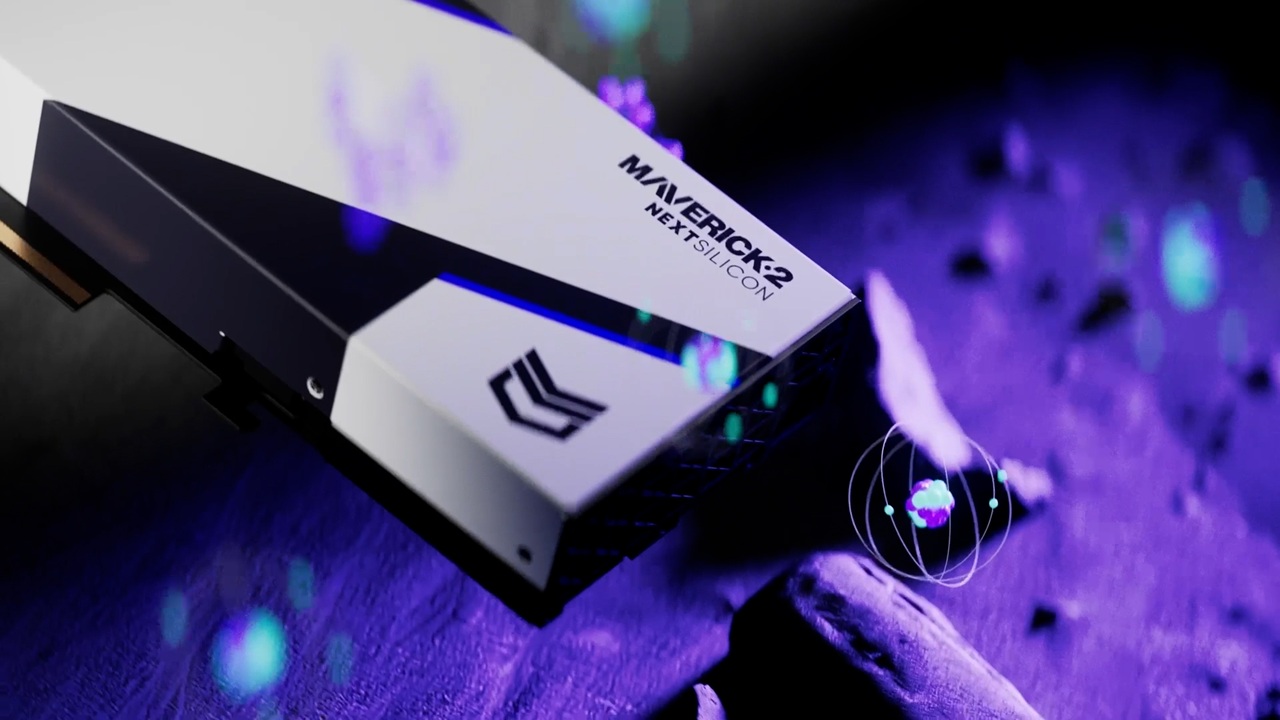
NextSilicon’s Maverick-2 locks onto bottleneck code
- NextSilicon has developed a novel chip that adapts its hardware to accelerate high-performance computing applications.
- The Maverick-2 is claimed to have up to 4x the processing performance per watt of graphics processing units (GPUs) and 20x that of high-performance general processors (CPUs).
After years of work, the start-up NextSilicon has detailed its Maverick-2, what it claims is a new class of accelerator chip.
A key complement to the chip is NextSilicon’s software, which parses the high-performance computing application before mapping it onto the Maverick-2.
“CPUs and GPUs treat all the code equally,” says Brandon Draeger, vice president of marketing at NextSilicon. “Our approach looks at the most important, critical part of the high-performance computing application and we focus on accelerating that.”
With the unveiling of the Maverick-2 NextSilicon has exited its secrecy period.
Founded in 2017, the start-up has raised $303 million in funding and has 300 staff. The company is opening two design centres—in Serbia and Switzerland—with a third planned for India. The bulk of the company’s staff is located in Israel.
High-performance computing and AI
High-performance computing simulates complex physical processes such as drug design and weather forecasting. Such computations require high-precision calculations and use 32-bit or 64-bit floating-point arithmetic. In contrast, artificial intelligence (AI) workloads have more defined computational needs, and can use 16-bit and fewer floating-point formats. Using these shorter data formats results in greater parallelism per clock cycle.
Using NextSilicon’s software, a high-performance computing workload written in such programming languages as C/C++, Fortran, OpenMP, or Kokkos, is profiled to identify critical flows. These are code sections that run most frequently and benefit from acceleration.
“We look at the most critical part of the high-performance computing application and focus on accelerating that,” says Draeger.
This is an example of the Pareto principle: a subset of critical code (the principle’s 20 per cent) that runs most (80 per cent) of the time. The goal is to accelerate these most essential code segments.
The Maverick-2
These code flows are mapped onto the Maverick-2 processor and replicated hundreds or thousands of times, depending on their complexity and the on-chip resources available.
However, this is just the first step. “We run telemetry with the application,” says Draeger. “So, when the chip first runs, the telemetry helps us to size and identify the most likely codes.” The application’s mapping onto the hardware is then refined as more telemetry data is collected, further improving performance.
“In the blink of an eye, it can reconfigure what is being replicated and how many times,” says Draeger. “The more it runs, the better it gets.”
 Source: NextSilicon
The time taken is a small fraction of the overall run time (see diagram). “A single high-performance computing simulation can run for weeks,” says Draeger. “And if something significant changes within the application, the software can help improve performance or power efficiency.”
NextSilicon’s software saves developers months of effort when porting applications ported onto a high-performance computing accelerator, it says.
NextSilicon describes the Maverick-2 as a new processor class, which it calls an Intelligent Compute Accelerator (ICA). Unlike a CPU or GPU, it differentiates the code and decides what is best to speed up. The configurable hardware of the Maverick-2 is thus more akin to a field-programmable gate array (FPGA). But unlike an FPGA, the Maverick-2’s hardware adapts on the fly.
Functional blocks and specifications
The Maverick-2 is implemented using a 5nm CMOS process and is based on a dataflow architecture. Its input-output (I/O) includes 16 lanes of PCI Express (PCIe 5.0) and a 100 Gigabit Ethernet interface. The device features 32 embedded cores in addition to the main silicon logic onto which the flows are mapped. The chip’s die is surrounded by four stacks of high-bandwidth memory (HBM3E), providing 96 gigabytes (GB) of high-speed storage.
NextSilicon is also developing a dual-die design – two Maverick-2s combined – designed with the OCP Acceleration Module (OAM) packaged form factor in mind. The OAM variant, arriving in 2025, will use HBM3E memory for an overall store capacity of 192 gigabytes (GB) (see diagram).
 Source: NextSilicon
The OCP, the open-source industry organisation, has developed an open-source Universal Base Board (OBB) specification that hosts up to eight such OAMs or, in this case, Maverick-2s. NextSilicon is aiming to use the OAM dual-die design for larger multi-rack platforms.
The start-up says it will reveal the devices’ floating-point operations per second (FLOPS) processing performance and more details about the chip’s architecture in 2025.
 Source: NextSilicon

Partners
NextSilicon has been working with vendor Penguin Solutions to deliver systems that integrated their PCI Express modules based on its first silicon, the Maverick-1, a proof-of-concept design. Sandia National Laboratories led a consortium of US labs, including Lawrence Livermore National Laboratory and Los Alamos National Laboratory, in trialling the first design.
“We’re currently sampling dozens of customers across national labs and commercial environments. That’s been our focus,” says Draeger. “We have early-adopter programs that will be available at the start of 2025 with Dell Technologies and Penguin Solutions, where customers can get engaged with an evaluation system.”
Volume production is expected by mid-2025.
Next steps
AI and high-performance computing are seen as two disparate disciplines, but Draeger says AI is starting to interact with the latter in exciting ways.
Customers may pre-process data sets using machine-learning techniques before running a high-performance computing simulation. This is referred to as data cleansing.
A second approach is the application of machine-learning to the simulation’s results for post-processing analysis. Here, the simulation results are used to improve AI models that aim to approximate what a simulation is doing, to deliver results deemed ‘good enough’. Weather forecasting is one application example.
An emerging approach is to run small AI models in parallel with the high-performance simulation. “It offers a lot of promise for longer-running simulations that can take weeks, to ensure that the simulation is on track,” says Draeger.
Customers welcome anything that speeds up the results or provides guidance while the calculations are taking place.
NextSilicon is focussing on HPC but is eyeing data centre computing.
“We’re starting with HPC because that market has many unique requirements, says Draeger. “If we can deliver performance benefits to high-performance computing customers then AI is quite a bit simpler.”
There is a need for alternative accelerator chips that are flexible, power efficient, and can adapt in whatever direction a customer’s applications or workloads take them, says Draeger.
NextSilicon is betting that its mix of software and self-optimising hardware will become increasingly important as computational needs evolve.

By invitation: Professor Roel Baets on Silicon Photonics 4.0

Roel Baets, Emeritus Professor at Ghent University and former Group Leader at imec gave a plenary talk on ‘Silicon Photonics 4.0’ at the recent ECOC conference. “It will be important for silicon photonics to make use of smart and agile manufacturing, a notion associated with Industry 4.0,” said Professor Baets, explaining the title.
In a guest piece, he explains his thoughts and discusses what he saw at ECOC. He also has a request.
One of the things I discussed in my ECOC plenary talk was the large gap between research and product development for new applications of photonic integrated circuits (PICs) on the one hand, and product sales and new industrial process flows on the other.
Among many reasons for this gap, one stands out: the major barriers that fabless start-ups face when developing a product based on a still immature industrial supply chain.
This often implies that part of the start-up’s non-recurring engineering (NRE) budget needs to be spent on co-investment in a new process flow by a technology provider, which can easily be too expensive for a start-up. The growing diversity in materials added to silicon photonics process flows to meet the needs of new applications is a major compounding factor in this context.
I showed a slide that listed the companies that I am aware of that sell non-transceiver products based on PICs (silicon or other). I try to keep this list up to date with my Ghent University colleague, Prof. Wim Bogaerts, chair of ePIXfab. The slide showed only seven companies, while there are probably between 100 and 200 companies around the world that develop such products.
These companies are Genalyte (biosensors for diagnostics), Anello (optical gyroscope), Sentea and PhotonFirst (fibre Bragg grating readout), Quix (quantum processor), Thorlabs (>100GHz opto-electronic converter) and iPronics (originally a programmable photonic processor company now focussing on optical switching). These companies will likely sell only in modest numbers, but at least they sell a product.
After my talk, I eagerly went to the ECOC exhibition in the hope of spotting additional companies. I found two that I could add to the list: Chilas (tunable low-linewidth lasers) and SuperLight Photonics (supercontinuum lasers).
A few weeks later, I discovered yet another fledgling company ready to sell: hQphotonics (ultra-low-noise microwave oscillators). So the list is double-digit now! Perhaps this is an important milestone towards Silicon Photonics 4.0.
Interestingly, four of those ten companies use Silicon-on-Insulator (SOI) technology, four use silicon nitride PICs, one uses InP, and one uses thin-film Lithium Niobate (TFLN).
Undoubtedly, the list is incomplete. There may be other companies with a product (not just a prototype or a demo kit or a technology service) that we do not know.
So let me make a call to contact me if you know of any company not on the list of ten that sells a non-transceiver product based on PICs.
roel.baets@ugent.be

ECOC 2024 industry reflections - Final Part
In the final part, industry figures share their thoughts after attending the recent 50th-anniversary ECOC show in Frankfurt. Contributions are from Adtran’s Jörg-Peter Elbers, Lightwave Logic’s Michael Lebby, and Heavy Reading’s Sterling Perrin.
ECOC exhibition floor
Jörg-Peter Elbers, senior vice presendent, advanced technology, standards and IPR, Adtran, and a General Chair at this year’s ECOC.
ECOC celebrated its 50th anniversary this year. It was great to see scientists, engineers, and industry leaders from all around the globe at a vibrant gathering in Frankfurt.
ECOC dates to September 1975 when the inaugural event – dubbed the “European Conference on Optical Fiber Technology” – was held in London. In the early days, the focus was on megabit-per-second transmission for telephony applications. Now, we are advancing to petabit-per-second speeds to meet AI and cloud services demands.
This year’s ECOC explored various cutting-edge topics, including 1.6 and 3.2 terabit-per-second (Tb/s) transceivers, multi-band and spatial division multiplexing (SDM) transmission, and innovations in access and home networks. Other discussions centred on the merits of linear drive versus regenerated optics, pluggable modules versus co-packaged engines, and the latest IP-over-DWDM architectures and technologies for the coherent edge.
The 50 years of ECOC symposium celebrated the amazing progress of optical communications in the past and painted a promising picture for the future.
David Payne, one of the luminary speakers, stated that hollow-core fibre would enable a new generation of WDM transmission systems (“amplifier-less”) with simpler terminals and higher fibre capacity. In a post-deadline paper, Linfiber reported a hollow-core fibre deployment with a fibre loss lower than solid-core fibre and progress on manufacturing and deployment issues, critical for mass-market adoption.
In the ECOC plenary session, Arista’s Andy Bechtolsheim discussed the race to build AI clusters for generative AI learning and inference. He emphasized that the next generation of hyperscale AI data centres could contain a million AI nodes requiring more than 3GW of electrical power—comparable to the output of a vast nuclear plant. These data centres present opportunities for millions of cost-efficient, low-power terabit-per-second optical interconnects.
The theme of optics for AI was complemented by exploring AI for optics, with multiple contributions examining how generative AI and agent-based models could streamline network operations. The accuracy, predictability, and the explainability of results remain active research topics.
Another highlight was the optical satellite symposium, which discussed using 100 gigabit-per-second (Gbps) coherent optics for satellite communications. While inter-satellite links in commercial low-earth orbit (LEO) constellations use coherent transceiver technology, the use of optical ground links is still in its infancy. Panelists emphasised the challenges of maintaining cloud-free line-of-sight conditions and compensating for atmospheric turbulence to ensure continuous communication. They agreed that combining adaptive optics with time diversity (e.g., by interleaving) offers the best solution for turbulence mitigation, though it adds latency.
Other discussions covered fibre sensing for infrastructure and environmental monitoring and the commercial potential of quantum technologies, sparking much interest and heated debate in this year‘s Rump Session.
As ECOC 2024 concluded, it was clear that the conference not only celebrated five decades of advancement in optical communications but also set the stage for future innovations and challenges.
Dr. Michael Lebby, CEO, Lightwave Logic
As the Chair of the Market Focus at ECOC’s Industry Exhibit, I can say that this year, we had probably the best sessions in ECOC’s 50-year history. For three days, each seat was taken at the Market Focus, which featured wall-to-wall programming on commercial trends, technologies, and roadmaps in optical communications.
Presentations at the market focus sessions supported the big-show exhibition themes. Many talks focused on modules and subsystems. Lightwave Logic showed polymer silicon slot modulators with reliability data operating at 200Gbps with less than 1V drive, with initial results of polymer-plasmonic modulators operating with open 400Gbps eyes. While 400Gbps lanes are still on the roadmap, there were many discussions on what technologies could reach this level of performance, especially modulators. Polymer-plasmonic-based modulators seem to be the leader, with optical bandwidths exceeding 500GHz.
While incumbent technologies are hard to displace, the emerging area of co-packaged pluggables is gaining interest among suppliers, especially for the terabit-per-second data rates sought. While progress was impressive, the reach of silicon photonics modulators for 200Gbps and beyond was a show floor concern.
NewPhotonics discussed how to double data rates using its integrated optical equaliser, while others, such as Pilot Photonics, conveyed the exciting progress with comb laser arrays. Several speakers discussed the metrics of standards that support the AI/ machine learning trends for data centre operators and how optics can support the drive to higher data rates and lower power consumption.
Areas of power consumption driven in part by digital signal processor (DSP) evolution were discussed. The interesting perspective is that if coherent optics are to be developed to serve the edge of the network, then using electronics to help the optics may not be enough; the optics need to perform better so that the electronics can be scaled down to reduce power consumption. It is a trade-off at the heart of many approaches to bring coherent optics to compete with direct-detect solutions for pluggable transceivers.
The indication is that direct detection in data centre optics is not waning as quickly as the community once thought and looks to be a mainstay for pluggable transceiver solutions from 800Gbps, 1.6Tbps, 3.2Tbps, and even 6.4Tbps.
A fireside chat explored the opportunities for copper at super short interconnects where the direct-attach copper (DAC) cables dominate. This 1m to 3m range has been evolving to active electrical copper (AEC) interconnects using smart electronics in recent years. Those of us who are solidly in the optics camp, while acknowledging that copper has owned this segment forever, are still hoping that platforms such as silicon photonics could sneak in and take share in the next five years. However, displacing an incumbent technology such as copper will not be easy, especially when metrics such as economies of scale, cost, and reliability come into play.
Several talks looked at next-generation implementations, such as quantum-dot lasers and photonic wire bonding, and driving VCSELs to ever-increasing speeds. Discussions took place that wondered if VCSELs have reached their limit in bandwidth and speed and if electronics could help them push performance further. A common theme evident was the innovative ideas and concepts to address 224Gbps per lane with optical technologies. While it has been generally accepted that this metric is emerging, several companies are still deciding how to address this speed and 400Gbps per lane.
One big takeaway is that if you have a new and innovative platform to enable things like 3.2Tbps transceivers that is disruptive, think very carefully about whether that disruptive technology needs the infrastructure to be disruptive, too.
Sterling Perrin, Senior Principal Analyst, Heavy Reading
Although I’ve attended nearly every OFC show over the past 25 years, this was my first ECOC. Most of my meetings were centred around an IP-over-DWDM project I’ve worked on for several months, including video interviews conducted at the show with the partnering companies: the OIF, Ciena, Juniper, and Infinera. These are all posted on Light Reading.
Building on its work at OFC 2024, the OIF’s pluggables demo at ECOC spotlighted four applications:
- 400ZR and 800ZR,
- Open ZR+ at 400GbE,
- OpenROADM at 400GbE, and
- 100ZR
The expanding scope of coherent pluggable is impressive, and the interop work includes optics that the OIF is not directly defining—such as Open ZR+, OpenROADM, and 100ZR. ECOC 2024 marked OIF’s first interoperability demonstration of 100ZR modules, an application driven by telecom operators as opposed to hyperscalers.
Another key aspect of the OIF’s IP-over-DWDM work demonstrated at ECOC is the common management interface specification (CMIS) for plug-to-host interoperability between routers and pluggable optics. Plug-to-host interop is essential for wider IP-over-DWDM adoption among telecom operators, so the work is timely.
Related to pluggables management in IP-over-DWDM networks, I attended the Open XR Forum’s symposium on the show floor. The organisation is promoting a dual management approach to pluggables that includes host independent management to support pluggables features that aren’t yet supported in the routers or in CMIS.
During a Q&A, Telefonica’s Oscar Gonzales de Dios acknowledged that host-independent management is controversial (including within Telefonica) but said it is the only way to add point-to-multipoint functions on pluggables for now.
Quantum-safe encryption is another area of research interest, particularly quantum key distribution (QKD), and ECOC 2024 was a great place to get up to date. I attended the rump session debate on quantum technologies, expertly hosted by Peter Winzer (Nubis), Rupert Ursin (QTlabs), and David Neilson (Nokia Bell Labs). It was standing-room-only, and I anticipated strong pro-QKD sentiment. I was wrong! The dominant view was that QKD is impractical, technically limited, too expensive, and needs more real customer demand. Several people argued that post quantum cryptography (PQC) algorithms are sufficient to meet the market needs, without the complexity and costs that QKD brings.
For analysts, conferences like ECOC are the most efficient means of quickly learning what’s hot in the industry. Conferences are equally great places to know what is not hot. I didn’t hear the words “5G,” “xHaul,” “fronthaul,” “6G,” or even “mobility” uttered once during the four days I was in Frankfurt.
The markets for photonic integrated circuits in 2030
What will be the leading markets for photonic integrated circuits (PICs) by the decade’s end? And what are the challenges facing the PIC industry?
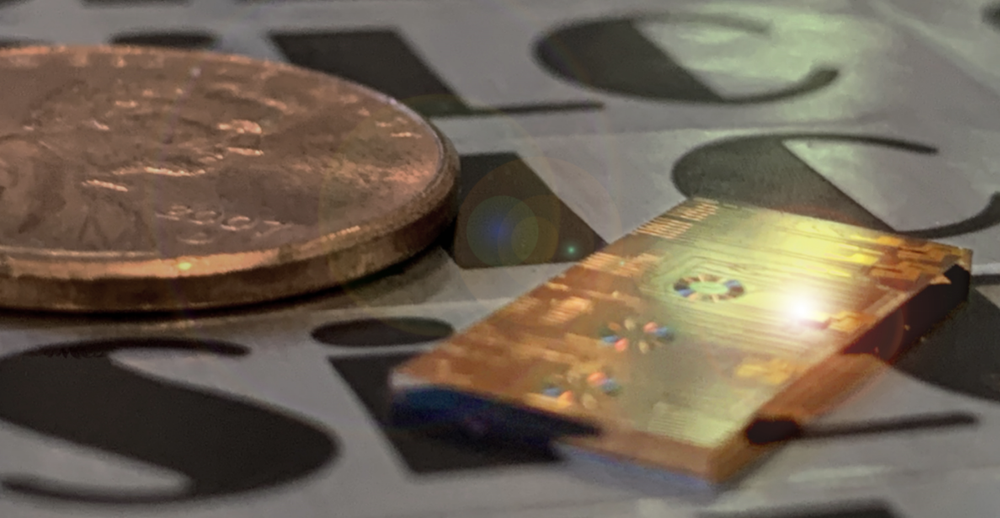
A panel session at the recent PIC Summit Europe event held in Eindhoven, The Netherlands, looked at what would be the markets for photonic integrated circuits by 2030.
The market for PICs is dominated by datacom and telecom. However, emerging applications include medical and wearable devices, optical computing, autonomous vehicles, and sensing applications for the oil, gas, water, and agriculture industries.
Taking part in the PIC Summit Europe panel on behalf of LightCounting Market Research, I shared two forecast charts. One showed LightCounting’s latest Ethernet module forecast, highlighting the rapid growth expected in the next five years, including the adoption of 1.6-terabit and 3.2-terabit pluggables. Also shown was how silicon photonics is gaining market share and will account for nearly half of all optical transceivers by 2029.
No surprise then that LightCounting’s view is that datacom and telecom will remain the dominant markets for PICs in 2030. Moreover, the challenges AI is posing the optical industry means the photonics developments will continue to drive the PIC market overall.


Before the PIC Summit Europe panel, Gazettabyte sought some industry views. What would help the PIC landscape, and what should the PIC industry be addressing? Also, what were the views regarding the PIC marketplace in 2030?
Those approached focus mainly on datacom and telecom. But Julie Eng, the CTO of Coherent, has a broader remit that includes emerging photonics markets, while Mehdi Asghari is CEO of SiLC Technologies, a silicon photonics start-up focused on the Lidar marketplace.
Emerging PIC markets
Dave Welch, founder of Infinera and now founder and CEO of stealth start-up AttoTude, says PICs for datacom and telecom are alive and thriving, while PICs for Lidar and sensing are burgeoning applications with real volume.


“Datacom and telecom will dominate for the foreseeable future,” says Welch. “I do not see where any other application of comparable size can come from.”
Maxim Kuschnerov, director of R&D, points out that 2030 is not as far out as it used to be: “That is like two bigger product cycles at most.” He, too, says datacom and telecom will remain the main markets for PICs.
Coherent’s Eng agrees: “The primary driver of PICs will be datacom and telecom, but if you’re looking for additional drivers, health monitoring is a possible one.”
Coherent experienced an uptick for optical components for medical equipment during the COVID-19 pandemic. “The pandemic increased demand for PCR [polymerase chain reaction] testing, which grew the business for products we sell, such as optical filters and thermoelectric coolers,” says Eng. “The pandemic focused people more on health monitoring, and that, combined with advanced health-monitoring featured in smart-watches, has grown interested in personal health monitoring.”
Eng notes that component sales into PCR testing declined post-COVID although interest remains high in personal health monitoring.
Companies are also addressing biosensing using silicon photonics and semiconductor lasers. “In some cases, a silicon photonics PIC for this application could be fairly large as it is often helpful to monitor many wavelengths,” says Eng. She also highlights potential volumes. “If biosensing in the watch takes off, that could be a higher volume than datacom transceivers, and the PICs may be large. So that is an application to watch.”


“The pandemic experience has pushed the point-of-care testing market, which include biosensors, exponentially,” says Professor Laura Lechuga, a leading biosensor researcher. “This is an increasing market every year with an intensive research and development at academic and industrial level. Point-of-care will be for sure the future of diagnostics.”
Kuschnerov also highlights the health-monitoring market. “There has been a lot of work on non-invasive glucose monitoring using optical sensing, but it is not clear if this could pass FDA [U.S. Food and Drug Agency] approval,” says Kuschnerov. “It could be a life changer for people with diabetes.”
Rafik Ward is a consultant working with companies on PIC developments including the point-of-care medical device marketplace. One start-up developing PIC technology realised it was competing with low-cost point-of-care diagnostics devices. Another challenge the start-up faced is the long development cycles and difficulty entering the medical marketplace. The start-up decided to refocus on communications.
“One thing that did come from COVID was the realisation of how fragile our distribution and logistics ecosystem was and how dependent it was on low-cost labour,” says SiLC’s Asghari. The labour shortage persisted after COVID-19 and has driven a push for warehouse and logistic automation. “For our business in Lidar, this has created a significant demand in robotics and automation,” says Asghari.
Another driver is the drop in the working-age population—about 1 per cent a year—caused by the drop in population growth in industrial countries over the past 20 years.
“This is a major issue and is becoming even more critical over time,” says Asghari. “If robots need to do the kind of work that people do, then they need to see the way we do, and cameras and even 3D imagers don’t cut it.”
Kuschnerov says gas, oil, water quality, and agriculture will eventually use optical sensing variants, but he does not expect high volumes.
Another wearable market is augmented reality/ virtual reality (AR/VR) glasses. This volume market has been predicted for years, but work is taking place, such as the development of diffractive waveguides for such glasses. “Research is happening here, which can’t be ignored, but it’s a non-existent market today,” says Kuschnerov.
Infra-red sensors are set to grow for autonomous drone warfare. Military drones being used in Ukraine and the Middle East are changing modern warfare, he says, a development noted by the leading militaries.
VCSELs for a 3D vision of robots will continue to stay relevant. “The future is full of these (Tesla-like) robots. I’m sure they will need VCSEL arrays,” says Kuschnerov.
Challenges facing the PIC industry
Ward says the highest priority regarding PICs is for the fabrication plants [fabs] to reduce cycle times from tape-out to returned chips.


Indium phosphide fabs regularly turn around chips in six to eight weeks, whereas several of the big silicon photonics fabs take five months. Moreover, chip designs can often take two to three iterations to get to production. “We shouldn’t be surprised that indium phosphide has consistently been six or more months ahead of silicon photonics at each generation,” says Ward. “It’s simple maths.” Silicon photonics needs to be developed to launch new generations of communication devices at the same time as indium phosphide products.
Ward also highlights the need for improved process design kits (PDKs). “While this is improving, there is still too much redundant work by PIC customers because PDKs are immature,” he says.
AttoTude’s Welch notes that, in years past, the value of PICs has been in integrating optics, specifically lasers. The issue with lasers, however, is their environmental compatibility with silicon circuits. “This problem needs to be improved if we expect greater integration into the system needs,” says Welch.
Prof. Lechuga says that one of the main obstacles for biosensors is mass-fabrication at low cost. “It will be interested to see if Europe could offer such fabrication,” she says.
Another issue is the benefits a PIC brings. For Eng, PICs must solve a problem and offer value at a lower cost than existing solutions. “That is a big ask,” says Eng. “Optical technologists must understand new markets with many established technologies.”
Getting help
Asghari suggests several ways the optics industry and governments can help, and not just for PICs. The industry and governments must be measured to avoid boom-and-bust cycles, or at least not feed them.
“I see the AI hype now, and it brings back bitter memories of the 2000 era,” says Asghari. “That did not help anyone and set back the industry in a major way.”
He also calls for fairer trade but not through tariffs. We need fairness, he says: “Our gates are wide open, and we hold ourselves to rules that do not allow governments to support industry.”
But China does whatever it likes, he says. “Our reaction is to add tariffs on imports on things that our industry needs to manufacture, and unfortunately, a lot of these are still from China.” It is, therefore, important to make it easier for companies to manufacture in the West and help bring back basic key capabilities. “We should enable investments and not tax them, and we should stimulate the venture capital communities to invest in hardware, which no one does anymore,” says Asghari.
The issue of population shrinkage and the need for automation is the photonics industry’s chance to lead. “But we are losing again due to lack of investment in the same way that we are losing the electrical vehicle market,” he warns.
For Asghari, what is needed is a long-term vision, stability, and fairness.