
Optical supply chain set to withstand the COVID-19 crisis

The optical supply chain will not experience any lasting damage as a result of the COVID-19 pandemic. So argues LightCounting in a research note.
The market research company notes how the experience of the Coronavirus pandemic has highlighted the many benefits of the digital economy.
And the jolt the world is experiencing will if anything, strengthen it.
“All kind of things are happening as a result of the pandemic,” says John Lively, principal analyst at LightCounting and author of the research note. “Telecommuting, telelearning and telemedicine have all been used before, but never on a scale like this.”
Pandemic toll
Given how governments have shut down activities to contain the spread of the virus, it comes as no surprise the severity with which the world’s economy has been hit during the first quarter of 2020.
LightCounting cites startling figures concerning the world’s two largest economies.
Some 6.6 million Americans filed unemployment claims in the week ending April 1st, double the previous record that was set just a week earlier. And up to 47 million jobs could be lost, a third of the total US workforce, according to the US Federal Reserve Bank.
Meanwhile, in China, the gross domestic product (GDP) in the first quarter is expected to plummet 9 per cent, the first decline in three decades.
Looking more closely at the telecom and datacom industries, LightCounting highlights four developments that overall give cause for optimism.

Returning to work
First, China is returning to work. LightCounting cites figures from China that claim that factories are now staffed at 80-90 per cent of their full production levels. However, figures published by the American Chamber of Commerce in China are less rosy. Of the 120 member companies it surveyed, a quarter said all their staff continued to work from home (as of March 13th).
Talking to Chinese optical component companies, LightCounting says each firm has gone through a process with their local governments to reopen such as meeting the various hygiene protocols and ensuring a suitable distance between staff.
The second development is notable growth in network traffic as a result of people working from home and families being in lockdown.
The growth in the use of the videoconferencing tool, Zoom, is well documented, but strong growth has been witnessed elsewhere. Microsoft’s Teams collaboration application reached 44 million daily users, up 12 million in a week, while the use of its Windows Virtual Desktop has tripled.
In turn, AT&T and Verizon have reported double-digit growth in viewers of their TV and streaming demand content, while Netflix, YouTube and Disney have cut by a quarter their streaming video quality in Europe to lessen the network burden.
Spending on infrastructure by the operators, the third pointer highlighted by LightCounting, promises encouraging growth. The main three Chinese operators plan to increase their 5G spending in 2020. China Mobile, for example, is spending 100 billion yuan on 5G infrastructure, 4x what it spent on 5G in 2019.
Lastly, telecom equipment and component sales are expected to be down in the first quarter, with five companies – Ciena, Infinera, Lumentum, II-VI and NeoPhotonics – issuing guidance warnings.
These range from Ciena which lowered its previous guidance by 3 per cent to NeoPhotonics which expects a 10 per cent drop in the first quarter.
The responses of Chinese optical component players range from not expecting sales to be hit at all to a 15 per cent decline in 2020. LightCounting also noted that companies with sales predominantly outside China were more worried about demand in the coming two quarters.
Punctuated Equilibrium
LightCounting cites a concept coined by Stephen J. Gould, the late evolutionary biologist, of punctuated equilibrium which argues that species do not evolve at a constant rate. Rather, they experience long periods of stability followed by rapid bursts of change due to significant disturbances in their environment.
“The same applies to societies and economies,” says Lively.
This explains why LightCounting believes the coronavirus of 2020-21 will accelerate trends that promote the digital economy.
Lively cites the tens of millions of US students and adult workers now operating from home. “Once the genie is out of the bottle it may prove difficult to put back,” says Lively who, as an analyst, has worked from home for over two decades.
In turn, the need for social hygiene and new habits such as touch-free shopping will boost adoption of digital wallet technology.
Current events also highlight the importance of broadband and the disparity in the quality of service being delivered, especially in rural areas. This too will cause change.
The hyperscalers – Alphabet (Google), Amazon, Apple, Facebook and Microsoft – are well-positioned to weather the storm, being providers of the hubs of the digital economy and having deep pockets. Malls and other brick-and-mortar retailers, in contrast, will suffer greatly.
Lively stresses that it is early days and that the analysis is speculative. It also assumes that massive damage won’t be done to huge swathes of the global economy.
But he is confident that the optical industry will not be badly damaged, and nowhere near the scale of the bursting of the dotcom bubble in 2000 that then crashed the optical industry.
“The oversupply of bandwidth [which developed during the dotcom boom] resulted in a drastic cutback in demand, and that hit our industry directly,” he says. Revenues shrank 30 per cent in 2001 and 30 per cent again in 2002.
“It took years to recover and many companies went out of business including hundreds of start-ups,” says Lively. “But the big players remain, even if some have changed their names.”
Current events will not be as severe as two decades ago since the epic oversupply of bandwidth directly impacted the optical industry, says Lively.
He also ends on a positive note: “It is difficult to think of another industry we would rather be in as we ride this storm.”


Infinera’s ICE6 sends 800 gigabits over a 950km link

Infinera has demonstrated the coherent transmission of an 800-gigabit signal across a 950km span of an operational network.
Infinera used its Infinite Capacity Engine 6 (ICE6), comprising an indium-phosphide photonic integrated circuit (PIC) and its FlexCoherent 6 coherent digital signal processor (DSP).
The ICE6 supports 1.6 terabits of traffic: two channels, each supporting up to 800-gigabit of data.
The trial, conducted over an unnamed operator’s network in North America, sent the 800-gigabit signal as an alien wavelength over a third-party line-system carrying live traffic.
“We have proved not only the state of our 800-gigabit with ICE6 but also the distances it can achieve,” says Robert Shore, senior vice president of marketing at Infinera.
800G trials
Several systems vendors have undertaken 800-gigabit optical trials.
Ciena detailed two demonstrations using its WaveLogic 5 Extreme (WL5e). One was an interoperability trial involving Verizon and Juniper Networks while the second connected two data centres belonging to the operator, Southern Cross Cable, to confirm the deployment of the WL5e cards in a live network environment.
Neither Ciena trial was designed to demonstrated WL5e’s limit of optical performance. Accordingly, no distances were quoted although both links were sub-100km, according to Ciena.
Meanwhile, Huawei has trialled its 800-gigabit technology in the networks of operators Turkcell and China Mobile.
The motivation for vendors to increase the speed of line-side optical transceivers is to reduce the cost of data transport. “One laser generating more data,” says Shore. “But it is not just high-speed transmissions, it is high-speed transmissions over distance.”
Infinera’s first 800-gigabit demonstration involved the ICE6 sending the signal over 800km of Corning’s TXF low-loss fibre.
“We did the demo on that fibre and we realised we had a ton of margin left over after completing the 800-gigabit circuit,” says Shore. The company then looked for a suitable network trial using standard optical fibre.
Infinera used a third-party’s optical line system to highlight that the 950km reach wasn’t due to a combination of the ICE6 module and the company’s own line system.
“What we have shown is that you can take any link anywhere, use anyone’s line system, carrying any kind of traffic, drop in the ICE6 and get 800-gigabit connections over 950km,” says Shore.
ICE 6
Infinera attributes the ICE6’s optical performance to its advanced coherent toolkit and the fact that the company has both photonics and coherent DSP technology, enabling their co-design to optimise the system’s performance.
One toolkit technique is Nyquist sub-carriers. Here, data is sent using several Nyquist sub-carriers across the channel instead of modulating the data onto a single carrier. The ICE6 is Infinera’s second-generation design to use sub-carriers, the first being ICE4, that doubles the number from four to eight.
The benefit of using sub-carriers is that high data rates can be achieved while the baud rate used for each one is much lower. And a lower baud rate is more tolerant to non-linear channel impairments during optical transmission.
Sub-carriers also improve spectral efficiency as the channels have sharper edges and can be packed tightly.
Infinera applies probabilistic constellation shaping to each sub-carrier, allowing fine-tuning of the data each carries. As a result, more data can be sent on the inner sub-carriers and less on the outer two outer sub-carrier where signal recovering is harder.
The sweet spot for sub-carriers is a symbol rate of 8-11 gigabaud (GBd). For the Infinera trial, eight sub-carriers were used, each at 12GBd, for an overall symbol rate of 96GBd.
“While it is best to stay as close to 8-11GBd, the coding gain you get as you go from 11GBd to 12GBd per sub-carrier is greater than the increased non-linear penalties,” says Shore.
Another feature of the coherent DSP is its use of soft-decision forward-error correction (SD-FEC) gain sharing. By sharing the FEC codes, processing resources can be shifted to one of the PIC’s two optical channels that needs it the most.
The result is that some of the strength of the stronger signal can be traded to bolster the weaker one, extending its reach or potentially allowing a higher modulation scheme to be used.
Applications
Linking data centres is one application where the ICE6 will be used. Another is sub-sea optical transmission involving spans that can be thousands of kilometres long, requiring lower modulation schemes and lower data rates.
“It’s not just cost-per-bit and power-per-bit, it is also spectral efficiency,” says Shore. “And a higher-performing optical signal can maintain a higher modulation rate over longer distances as well.”
Infinera says that at 600 gigabits-per-second (Gbps), link distances will be “significantly better” than 1,600km. The company is exploring suitable links to quantify ICE6’s reach at 600Gbps.
The ICE6 is packaged in a 5×7-inch optical module. Infinera’s Groove series will first adopt the ICE6 followed by the XTC platforms, part of the DTN-X series. First network deployments will occur in the second half of this year.
Infinera is also selling the ICE6 5×7-inch module to interested parties.
XR Optics
Infinera is not addressing the 400ZR coherent pluggable module market. The 400ZR is the OIF-defined 400-gigabit coherent standard developed to connect equipment in data centres up to 120km apart.
Infinera is, however, eyeing the emerging ZR+ opportunity using XR Optics. ZR+ is not a standard but it extends the features of 400ZR.
XR Optics is the brainchild of Infinera that is based on coherent sub-carriers. All the sub-carriers can be sent to the same destination for point-to-point links, but they can also be sent to different locations to allow for point-to-multipoint communications. Such an arrangement allows for traffic aggregation.
“You can steer all the sub-carriers coming out of an XR transceiver to the same destination to get a 400-gigabit point-to-point link to compete with ZR+,” says Shore. “And because we are using sub-carriers instead of a single carrier, we expect to get significantly better performance.”
Infinera is developing the coherent DSPs for XR Optics and has teamed up with optical module makers, Lumentum and II-VI.
Other unnamed partners have joined Infinera to bring the technology to market. Shore says that the partners include network operators that have contributed to the technology’s development.
Infinera planned to showcase XR Optics at the OFC conference and exhibition held recently in San Diego.
Shore says to expect XR Optics announcements in late summer, from Infinera and perhaps others. These will detail the XR Optics form factors and how they function as well as the products’ schedules.

Intel combines optics to its Tofino 2 switch chip
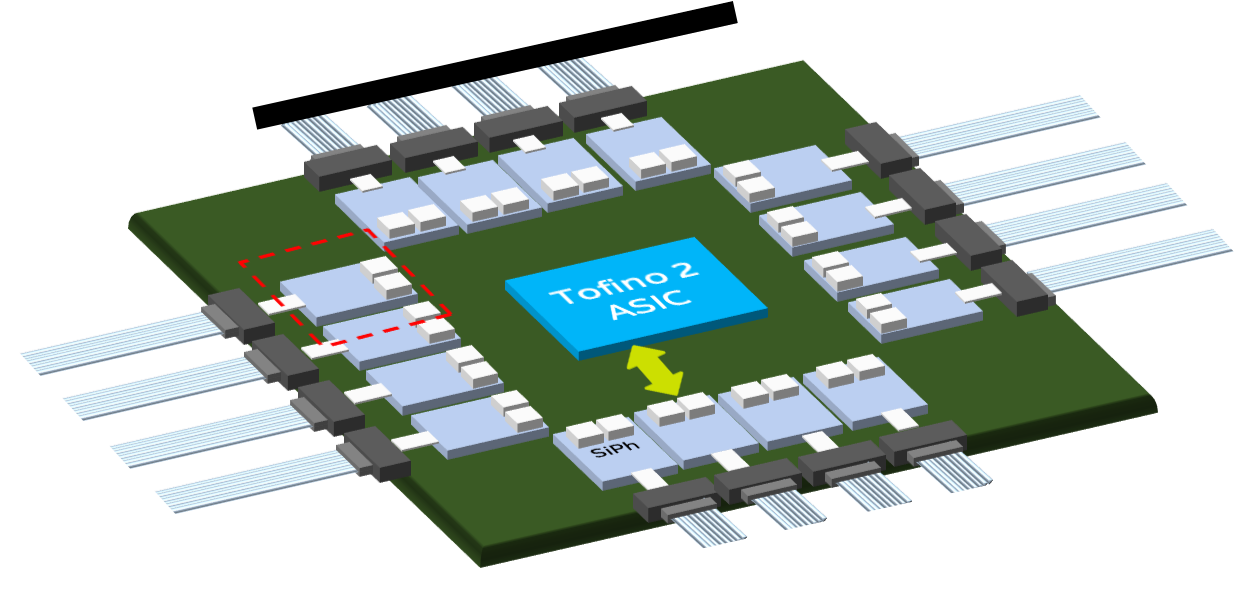
Part 1: Co-packaged Ethernet switch
The advent of co-packaged optics has moved a step closer with Intel’s demonstration of a 12.8-terabit Ethernet switch chip with optical input-output (I/O).
The design couples a Barefoot Tofino 2 switch chip to up to 16 optical ‘tiles’ – each tile, a 1.6-terabit silicon photonics die – for a total I/O of 25.6 terabits.
“It’s an easy upgrade to add our next-generation 25.6-terabit [switch chip] which is coming shortly,” says Ed Doe, Intel’s vice president, connectivity group, general manager, Barefoot division.
Intel acquired switch-chip maker, Barefoot, seven months ago after which it started the co-packaging optics project.
Intel also revealed that it is in the process of qualifying four new optical transceivers – a 400Gbase-DR4, a 200-gigabit FR4, a 100-gigabit FR1 and a 100Gbase-LR4 – to add to its portfolio of 100-gigabit PSM4 and CWDM4 modules.
Urgency
Intel had planned to showcase the working co-packaged switch at the OFC conference and exhibition, held last week in San Diego. But after withdrawing from the show due to the Coronavirus outbreak, Intel has continued to demonstrate the working co-packaged switch at its offices in Santa Clara.

“We have some visionaries of the industry coming through and being very excited, making comments like: ‘This is an important milestone’,” says Hong Hou, corporate vice president, general manager, silicon photonics product division at Intel.
“There are a lot of doubts still [about co-packaged optics], in the reliability, the serviceability, time-to-market, and the right intercept point [when it will be needed]: is it 25-, 51- or 102-terabit switch chips?” says Hou. “But no one says this is not going to happen.”
If the timing for co-packaged optics remains uncertain, why the urgency?
“There has been a lot of doubters as to whether it is possible,” says Doe. “We had to show that this was feasible and more than just a demo.”
Intel has also been accumulating IP from its co-packaging work. Topics include the development of a silicon-photonics ring modulator, ensuring optical stability and signal integrity, 3D packaging, and passive optical alignment. Intel has also developed a fault-tolerant design that adds a spare laser to each tile to ensure continued working should the first laser fail.
“We can diagnose which laser is the source of the problem, and we have a redundant laser for each channel,” says Hou. “So instead of 16 lasers we have 32 functional lasers but, at any one time, only half are used.”
Co-packaged optics
Ethernet switches connected in the data centre currently use pluggable optics. The switch chip resides on a printed circuit board (PCB) and is interfaced to the pluggable modules via electrical traces.
But given that the capacity of the Ethernet switch ICs is doubling every two years, the power consumption of the I/O continues to rise yet the power delivered to a data centre is limited. Accordingly, solutions that ensure a doubling of switch speed but do not increase the power consumed are required.
One option is embedded optics such as the COBO initiative. Here, optics are moved from the switch’s faceplate onto the PCB, closer to the switch chip. This shortens the electrical traces while overcoming the capacity limitations of the number of pluggable modules that can be fitted onto the switch’s faceplate. Freeing up the faceplate by removing pluggables also improves airflow to cool the switch.
The second, more ambitious approach is co-packaged optics where optics are combined with the switch ASIC in the one package.
Co-packaged optics can increase the overall I/O on and off the switch chip, something that embedded optics doesn’t address. And placing the optics next to the ASIC, the drive requirements of the high-speed serialiser-deserialisers (serdes) is simplified.
Meanwhile, pluggable optics continue to advance in the form factors used and their speeds as well as developments such as fly-over cables that lower the loss connecting the switch IC to the front-panel pluggables.
In turn, certain hyperscalers are not convinced about co-packaged optics.
Microsoft and Facebook announced last year the formation of the Co-Packaged Optics (CPO) Collaboration to help guide the industry to develop the elements needed for packaging optics. But Google and Alibaba said at OFC that they prefer the flexibility and ease of maintenance of pluggables.
Data centre trends
The data centre is a key market for Intel which sells high-end server microprocessors, switch ICs, FPGAs and optical transceivers.
Large-scale data centres deploy 100,000 servers, 50,000 switches and over one million optical modules. And a million pluggable modules equate to $150M to $250M of potential revenue, says Intel.

“One item that is understated is the [2:1] ratio of servers to switches,” says Doe. “We have seen a trend in recent years where the layers of switching in data centres have increased significantly.”
One reason for more switching layers is that traffic over-subscription is no longer used. With top-of-rack switches, a 3:1 over-subscription was common which limited the switch’s uplink bandwidth needed.
However, the changing nature of the computational workloads now requires that any server can talk to any other server.
“You can’t afford to have any over-subscription at any layer in the network,” says Doe. “As a result, you need to have a lot more bandwidth: an equal amount of downlink bandwidth to uplink bandwidth.”
Another factor that has increased the data centre’s switch layer count is the replacement of chassis switches with disaggregated pizza boxes. Typically, a chassis switch encompasses three layers of switching.
“Disaggregation is a factor but the big one is the 1:1 [uplink-downlink bandwidth] ratio, not just at the top-of-rack switch but all the way through,” says Doe. “They [the hyperscalers] want to have uniform bandwidth throughout the entire data centre.”
Tofino switch IC
Barefoot has two families of Tofino chips. The first-generation Tofino devices have a switching capacity ranging from 1.2 to 6.4 terabits and are implemented using a 16nm CMOS process. The Tofino 2 devices, implemented using a 7nm CMOS IC, range from 4 terabits to 12.8 terabits.
“What we having coming soon is the Tofino next-generation which will go to both 25 terabits and 51 terabits,” says Doe.
Intel is not discussing future products but Doe hints that both switch ICs will be announced jointly rather than the typical two-year delay between successive generations of switch IC. This also explains the urgency of the company’s co-packaging work.
The 12.8-terabit Tofino 2 chip comprises the switch core dies and four electrical I/O tiles that house the device’s serdes.
“The benefit of the tile design is that it allows us to easily swap the tiles for higher-speed serdes – 112 gigabit-per-second (Gbps) – once they become available,” says Doe. And switching the tiles to optical was already envisaged by Barefoot.
Optical tile
Intel’s 1.6-terabit silicon-photonics tile includes two integrated lasers (active and spare), a ring modulator, an integrated modulator driver, and receiver circuitry. “We also have on-chip a v-groove which allows for passive optical alignment,” says Hou.
Each tile implements the equivalent of four 400GBASE-DR4s. The 500m-reach DR4 comprises four 100-gigabit channels, each sent over single-mode fibre.
“This is a standards-based interface,” says Robert Blum, Intel’s director of strategic marketing and business development, as the switch chip must interact with standard-based optics.
The switch chip and the tiles sit on an interposer. Having an interposer will enable different tiles and different system-on-chips to be used in future.
Hou says that having the laser integrated with the tile saves power. This contrasts with designs where the laser is external to the co-packaged design.
The argument for using an external laser is that it is remote from the switch chip which runs hot. But Hou says that the switch chip itself has efficient thermal management which the tile and its laser(s) can exploit. Each tile consumes 35W, he says.
As for laser reliability, Intel points to its optical modules that it has been selling since 2016 when it started selling the PSM4.
Hou claims Intel’s hybrid laser design, where the gain chip is separated from the cavity, is far more reliable than a III-V facet cavity.
“We have shipped over three million 100-gigabit transceivers, primarily the PSM4. The DPM [defects per million] is 28-30, about two orders of magnitude less than our closest competitor,” says Hou. “Eight out of ten times the cause of the failure of a transceiver is the laser, and nine out of ten times, the laser failure is due to a cavity problem.”
The module’s higher reliability reduces the maintenance needed, and enables data centre operators to offer more stringent service-level agreements, says Hou.
Intel says it will adopt wavelength-division multiplexing (WDM) to enable a 3.2-terabit tile which will be needed with the 51.2-terabit Tofino.
Switch platform
Intel’s 2-rack-unit (2RU) switch platform is a hybrid design: interfaced to the Tofino 2 are four tiles as well as fly-over cables to connect the chip to the front-panel pluggables.
“The hyperscalers are most interested in co-packaging but when you talk to enterprise equipment manufacturers, their customers may not have a fabric as complicated as that of the hyperscalers,” says Hou. “Bringing pluggables in there allows for a transition.”
The interposer design uses vertical plug-in connectors enabling a mix of optical and electrical interfaces “It is pretty easy, at the last minute, to [decide to] bring in 10 optical [interfaces] and six fly-over cables [to connect] to the pluggables,” says Hou.
“This is not like on-board optics,” adds Blum. “This [connector arrangement] is part of the multi-chip package, it doesn’t go through the PCB. It allows us to have [OIF-specified] XSR serdes and get the power savings.”
Intel expects its co-packaged design to deliver a 30 per cent power saving as well as a 25 to 30 per cent cost-saving. And now that it has a working platform, Hou expects more engagements with customers that seeking these benefits and its higher-bandwidth density.
“This can stimulate more discussions and drive an ecosystem formation around this technology,” concludes Hou.
See Part 2: Ranovus outlines its co-packaged optics plans.

Acacia unveils its 400G coherent module portfolio

Acacia Communications has unveiled a full portfolio of 400-gigabit coherent optics and has provided test samples to customers, one being Arista Networks.
Delivering a complete set of modules offers a comprehensive approach to address the next phase of coherent optics, the company says.
The 400-gigabit coherent designs detailed by Acacia are implemented using the QSFP-DD, OSFP and CFP2 pluggable form factors.
Collectively, the pluggables support three performance categories: the 400ZR standard, OpenZR+ that is backed by several companies, and the coherent optics specification used for the Open ROADM multi-source agreement (MSA).
OIF-defined 400ZR standard designed for hyperscalers
“These are challenging specifications,” says Tom Williams, vice president of marketing at Acacia. “Even the 400ZR, where the objective has been to simplify the requirements.”
400ZR and OpenZR+
The OIF-defined 400ZR standard is designed for hyperscalers to enable the connection of switches or routers in data centres up to 120km apart.
The 400ZR standard takes in a 400 Gigabit Ethernet (GbE) client signal and outputs a 400-gigabit coherent signal for optical transmission.
“Hyperscaler customers want a limited subset of performance [with the ZR] because they don’t want to introduce operational complexity,” says Williams.
Acacia is implementing the 400ZR standard with two module offerings: the QSFP-DD and the OSFP.
Acacia is also a founding member of OpenZR+, the industry initiative that supports both 400ZR and extended optical performance modes. The other OpenZR+ members are NEL, Fujitsu Optical Components, Lumentum, Juniper Networks and Cisco Systems which is in the process of acquiring Acacia.
OpenZR+ supports 100GbE and its multiples (200GbE and 300GbE) input signals, not just 400GbE as used for ZR. To transmit the 200- 300- and 400GbE client signals, OpenZR+ uses quadrature phase-shift keying (QPSK), 8-ary quadrature amplitude modulation (8-QAM), and 16-QAM, respectively.
OpenZR+ also employs an enhanced forward-error correction (oFEC) used for the Open ROADM specification and delivers improved dispersion compensation performance.
“OpenZR+ is not just about going further but also being able to offer more functionality than 400ZR,” says Williams.
Acacia is implementing OpenZR+ using the QSFP-DD and OSFP form factors.
Open ROADM
The Open ROADM specification is the most demanding of the three modes and is targeted for use by the telecom operators. Here, a CFP2-DCO module is used due to its greater power envelope. And while the Open ROADM optics is aimed at telcos, the CFP2-DCO also supports OpenZR+ and 400ZR modes.
“The telcos are not as focussed on [face plate] density,” says Williams. “The CFP2-DCO has a higher output and is not limited to just Ethernet but also multiplexed client signals and OTN.”
Since line cards already use CFP2-DCO modules, the Open ROADM module enables a system upgrade. Existing line cards using the 200-gigabit CFP2-DCO may not support 400GbE client signals but with the Open ROADM CFP2’s higher symbol rate, it offers enhanced reach performance.
This is because the Open ROADM CFP2-DCO uses a 64 gigabaud (GBd) symbol rate enabling a 200-gigabit signal to be transmitted using QPSK modulation. In contrast, 32GBd is used for the existing 200-gigabit CFP2-DCOs requiring 16-QAM. Using QPSK rather than 16-QAM enables better signal recovery.
There is also an interoperability advantage to the new CFP2-DCO in that its 200-gigabit mode is compliant with the CableLabs specification.
All three designs – 400ZR, OpenZR+ and Open ROADM – use Acacia’s latest 7nm CMOS Greylock low-power coherent digital signal processor (DSP).
This is the company’s third-generation low-power DSP following on from its Sky and Meru DSPs. The Meru DSP is used in existing 32GBd 100/ 200-gigabit CFP2-DCOs.
3D stacking
Acacia has spent the last year and a half focusing on packaging, using techniques from the semiconductor industry to ensure the pluggable form factors can be made in volume.
The higher baud rate used for the 400-gigabit coherent modules means that the electronic ICs and the optics need to be closely coupled. “Moving up the baud rate means that the interconnection between the [modulator] driver [chip] and the modulator can become a limiting factor,” says Williams.
Acacia is not detailing the 3D design except to say that the Greylock DSP, its silicon-photonics photonic integrated circuit (PIC), and the modulator driver and trans-impedance amplifier (TIA) are all assembled into one package using chip-stacking techniques. The chip is then mounted onto a printed circuit board much like a BGA chip, resulting in a more scalable process, says Acacia.
“We have taken the DSP and optics and turned that into an electronic component,” says Williams. “Ultimately, we believe it will lead to improvements in reliability using this volume-repeatable process.”
Acacia says its modules will undergo qualification during most of this year after which production will ramp.
No one module design will be prioritised, says Williams: “There are a lot of benefits of doing all three, leveraging a lot of common elements.”
Nokia buys Elenion for its expertise and partnerships

Nokia will become the latest systems vendor to bolster its silicon photonics expertise with the acquisition of Elenion Technologies.
The deal for Elenion, a privately-held company, is expected to be completed this quarter, subject to regulatory approval. No fee has been disclosed.
“If you look at the vertically-integrated [systems] vendors, they captured the lion’s share of the optical coherent marketplace,” says Kyle Hollasch, director of optical networking product marketing at Nokia. “But the coherent marketplace is shifting to pluggables and it is shifting to more integration; we can’t afford to be left behind.”
Elenion Technologies
Elenion started in mid-2014, with a focus of using silicon as a platform for photonics. “We consider ourselves more of a semiconductor company than an optics company,” says Larry Schwerin, CEO of Elenion.
Elenion makes photonic engines and chipsets and is not an optical module company. “We then use the embedded ecosystem to offer up solutions,” says Schwerin. “That is how we approach the marketplace.”
The company has developed a process design kit (PDK) for photonics and has built a library of circuits that it uses for its designs and custom solutions for customers.
A PDK is a semiconductor industry concept that allows circuit designers to develop complex integrated circuits without worrying about the underlying transistor physics. Adhering to the PDK ensures the circuit design is manufacturable at a chip fabrication plant (fab).
But developing a PDK for optics is tricky. How the PDK is designed and developed must be carefully thought through, as has the manufacturing process, says Elenion.

“We got started on a process and developed a library,” says Larry Schwerin, CEO of Elenion. “And we modelled ourselves on the hyperscale innovation cycle, priding ourselves that we could get down to less than three years for new products to come out.”
The “embedded ecosystem” Elenion refers to involves close relationships with companies such as Jabil to benefit from semiconductor assembly test and packaging techniques. Other partnerships include Molex and webscale player, Alibaba.
Elenion initially focussed on coherent optics, providing its CSTAR coherent device that supports 100- and 200-gigabit transmissions to Jabil for a CFP2-DCO pluggable module. Other customers also use the design, mostly for CFP2-DCO modules.
The company has now developed a third-generation coherent design, dubbed CSTAR ZR, for 400ZR optics. The optical engine can operate up to 600 gigabits-per-second (Gbps), says Elenion.
Elenion’s work with the cloud arm of Alibaba covers 400-gigabit DR4 client-side optics as well as an 800-gigabit design.
Alibaba Cloud has said the joint technology development with Elenion and Hisense Broadband covers all the production stages: the design, packaging and testing of the silicon photonics chip followed by the design, packaging, assembly and testing of the resulting optical module.
Bringing optics in-house
With the acquisition of Elenion, Nokia becomes the latest systems vendors to buy a silicon photonics specialist.
Cisco Systems acquired Lightwire in 2012 that enabled it to launch the CPAK, a 100-gigabit optical module, a year ahead of its rivals. Cisco went on another silicon photonics shopping spree more recently with the acquisition of Luxtera in 2019, and it is the process of acquiring leading merchant coherent player, Acacia Communications.
In 2013 Huawei bought the Belgium silicon photonics start-up, Caliopa, while Mellanox Technologies acquired silicon photonics firm, Kotura, although subsequently, it disbanded its silicon photonics arm.
Ciena bought the silicon-photonics arm of Teraxion in 2016 and, in the same year, Juniper bought silicon photonics start-up, Aurrion Technologies.
Markets
Nokia highlights several markets – 5G, cloud and data centres – where optics is undergoing rapid change and where the system vendor’s designs will benefit from Elenion’s expertise.
“5G is a pretty obvious one; a significant portion of our optical business over the last two years has been mobile front-haul,” says Nokia’s Hollasch. “And that is only going to become more significant with 5G.”
Front-haul is optics-dependent and requires new pluggable form factors supporting lower data rates such as 25Gbps and 100Gbps. “This is the new frontier for coherent,” says Hollasch.
Nokia is not looking to be an optical module provider, at least for now. “That one we are treading cautiously,” says Hollasch. “We, ourselves, are quite a massive customer [of optics] which gives us some built-in scale straight away but our go-to-market [strategy] is still to be determined.”
Not being a module provider, adds Schwerin, means that Nokia doesn’t have to come out with modules to capitalise on what Elenion has been doing.
Nokia says both silicon photonics and indium phosphide will play a role for its coherent optical designs. Nokia also has its own coherent digital signal processors (DSPs).
“There is an increasingly widening application space for silicon photonics,” says Hollasch. “Initially, silicon photonics was looked at for the data centre and then strictly for metro [networks]; I don’t think that is the case anymore.”
Why sell?
Schwerin says the company was pragmatic when it came to being sold. Elenion wasn’t looking to be acquired and the idea of a deal came from Nokia. But once the dialogue started, the deal took shape.
“The industry is in a tumultuous state and from a standpoint of scenario planning, there are multiple dynamics afoot,” says Schwerin.
As the company has grown and started working with larger players including webscales, their requirements have become more demanding.
“As you get more into bigs, they require big,” says Schwerin. “They want supply assurance, and network indemnification clauses come into play.” The need to innovate is also constant and that means continual investment.
“When you weigh it all up, this deal makes sense,” he says.
Schwerin laughs when asked what he plans to do next: “I know what my wife wants me to do.
“I will be going with this organisation for a short while at least,” he says. “You have to make sure things go well in the absorption process involving big companies and little companies.”

The 50th anniversary of light-speed connections at OFC

The 50th anniversary of two key optical developments will be celebrated at the upcoming OFC show to take place in San Diego starting March 8th.
Back in 1970 the first low-loss fibre and the first room-temperature semiconductor laser were demonstrated.
“The low-loss fibre had a loss of 16 decibels-per-kilometre,” says Jun Shan Wey of ZTE and the OFC programme co-chair. “Without such optical fibre, there would be no chance of any long-distance communication.”
The advent of a semiconductor laser operating at room temperature was another development of key importance, she adds.
The Fiber 50 celebrations and recognition of the invention of the first EDFA
Fiber 50 Keynote
The Fiber 50 celebrations include a series of events assessing the impact of the two optical-communication enablers as well as looking to the future.
Dave Welch, founder and chief innovation officer at Infinera, will open the event with a keynote talk (Tuesday, 10 March 2020, 18:15 – 19:00 Ballroom 20BCD) addressing the impact of optical communications on society over the last half-century and discussing what to expect in the coming years.
According to Welch, advances witnessed in the technology are the result of game-changing innovations such as the erbium-doped fibre amplifier (EDFA), “a critical enabler” for dense wavelength-division multiplexing (DWDM).
Professor Sir David Payne, that led the team that invented the EDFA, is one of this year’s OFC Plenary Session speakers.
“What is so striking is how the world has changed as a consequence of the fibre network,” says Welch. “I do not believe that there has been anything more globally impactful than the fibre-optic network because, without it, the internet could not exist.“

Fibre-optic communication has also transformed the business world.
“If we look at the top ten companies as defined by market valuation and compare the list from 1997 to the list today, it is stunning,” says Welch.
Back then it was energy firms and bricks-and-mortar companies whereas today the list is dominated by companies built on data and the communication of that data.
Welch will also highlight in his keynote what to expect going forward.
“What is highly predictable is the continued expansion of bandwidth consumption and the cost of bandwidth continuing to drop,” says Welch.
The technologies that enable the network will also be highly innovative. “For example, optical communication will draw even more from radio network designs, and from the functional convergence of physical layers of the network to achieve continued expansion,” says Welch.
The networks will also be built with machines in mind, not just humans. “This is where most of the traffic expansion is coming from today and in the future,” concludes Welch.
Vision 2030
Welch’s Fiber 50 keynote talk will be followed by a conference reception (Tuesday 10 March 2020, 19:00 – 20:30 Sails Pavilion) where key individuals in the development of optical communications will be present.
The OFC also has a Special Chair’s Session entitled: Vision 2030: Taking Optical Communications through the Next Decade (Wednesday, 11 March 2020, 14:00-18:30 Room: 6F) where industry luminaries will discuss key topic directions over the next decade.
These include data centres; optical devices such as terabit transmitters, indium phosphide photonic integrated circuits (PICs) and silicon/ nanophotonics; undersea communications; optical access, and 5G optical transport.
Wey highlights how new technologies such as machine learning and quantum techniques for optical communications feature widely across this year’s OFC conference sessions.
“My view is that we are seeing a ‘hockey-stick’ of ideas coming in as we enter the next decade,” says Wey.
She cites access networks as an example. In the past decade, the main driver has been increasing access bit rates. This remains important, she says, but other considerations are also driving access.
5G is changing the architectural requirements, not just the increase in bandwidth but in the use cases it will support. Multi-access edge computing is another aspect.
“Cloud and virtualisation are coming into access, and then there is the challenge of how vendors stay in business,” says Wey.
Exhibits
The OFC has also organised a timeline-of-innovation exhibition on the show floor with items being loaned by companies for the event.
The exhibits will include a 1970 lithium niobate modulator, a 1977 fibre prototype from Corning that carried the first commercial traffic, an early fibre-to-the-home BPON optical transceiver and the first coherent optical transmission system from Ciena (Nortel).
Lastly, there will be an interactive exhibit honouring the recipients of The John Tyndall Award. The award is presented by the IEEE and the OSA to 33 individuals that have made outstanding contributions in optical fibre technology.
“We are very excited and proud in what we have put together,” says Wey. The other OFC programme co-chairs are Professor David Plant of McGill University and Shinji Matsuo of NTT.

Deutsche Telekom's Access 4.0 transforms the network edge

Deutsche Telekom has a working software platform for its Access 4.0 architecture that will start delivering passive optical network (PON) services to German customers later this year. The architecture will also serve as a blueprint for future edge services.
Access 4.0 is a disaggregated design comprising open-source software and platforms that use merchant chips – ‘white-boxes’ – to deliver fibre-to-the-home (FTTH) and fibre-to-the-building (FTTB) services.
“One year ago we had it all as prototypes plugged together to see if it works,” says Hans-Jörg Kolbe, chief engineer and head of SuperSquad Access 4.0. “Since the end of 2019, our target software platform – a first end-to-end system – is up and running.”
Deutsche Telekom has about 1,000 central office sites in Germany, several of which will be upgraded this year to the Access 4.0 architecture.
“Once you have a handful of sites up and running and you have proven the principle, building another 995 is rather easy,” says Robert Soukup, senior program manager at Deutsche Telekom, and another of the co-founders of the Access 4.0 programme.
Origins
The Access 4.0 programme emerged with the confluence of two developments: a detailed internal study of the costs involved in building networks and the advent of the Central Office Re-architected as a Datacentre (CORD) industry initiative.
Deutsche Telekom was scrutinising the costs involved in building its networks. “Not like removing screws here and there but looking at the end-to-end costs,” says Kolbe.
Separately, the operator took an interest in CORD that was, at the time, being overseen by ON.Labs.
At first, Kolbe thought CORD was an academic exercise but, on closer examination, he and his colleague, Thomas Haag, the chief architect and the final co-founder of Access 4.0, decided the activity needed to be investigated internally. In particular, to assess the feasibility of CORD, how bringing together cloud technologies with access hardware would work, and quantify the cost benefits.
“The first goal was to drive down cost in our future network,” says Kolbe. “And that was proven in the first month by a decent cost model. Then, building a prototype and looking into it, we found more [cost savings].”
Given the cost focus, the operator hadn’t considered the far-reaching changes involve with adopting white boxes and the disaggregation of software and hardware, nor the consequences of moving to a mainly software-based architecture in how it could shorten the introduction of new services.
“I knew both these arguments were used when people started to build up Network Functions Virtualisation (NFV) but we didn’t have this in mind; it was a plain cost calculation,” says Kolbe. “Once we starting doing it, however, we found both these things.”
Cost engineering
Deutsche Telekom says it has learnt a lot from the German automotive industry when it comes to cost engineering. For some companies, cost is part of the engineering process and in others, it is part of procurement.

“The issue is not talking to a vendor and asking for a five percent discount on what we want it to deliver,” says Soukup, adding that what the operator seeks is fair prices for everybody.
“Everyone needs to make a margin to stay in business but the margin needs to be fair,” says Soukup. “If we make with our customers a margin of ’X’, it is totally out of the blue that our vendors get a margin of ‘10X’.”
The operator’s goal with Access 4.0 has been to determine how best to deploy broadband internet access on a large scale and with carrier-grade quality. Access is an application suited to cost reduction since “the closer you come to the customer, the more capex [capital expenditure] you have to spend,” says Soukup, adding that since capex is always less than what you’d like, creativity is required.
“When you eat soup, you always grasp a spoon,” says Soukup. “But we asked ourselves: ‘Is a spoon the right thing to use?’”
Software and White Boxes
Access 4.0 uses two components from the Open Networking Foundation (ONF): Voltha and the Software Defined Networking (SDN) Enabled Broadband Access (SEBA) reference design.
Voltha provides a common control and management system for PON white boxes while making the PON network appear to the SDN controller that resides above as a programmable switch. “It abstracts away the [PON] optical line terminal (OLT) so we can treat it as a switch,” says Soukup
SEBA supports a range of fixed broadband technologies that include GPON and XGS-PON. “SEBA 2.0 is a design we are using and are compliant,” says Soukup.
“We are bringing our technology to geographically-distributed locations – central offices – very close to the customer,” says Kolbe. Some aspects are common with the cloud technology used in large data centres but there are also differences.
For example, virtualisation technologies such as Kubernetes are shared while large data centres use OpenStack which is not needed for Access 4.0. In turn, a leaf-spine switching architecture is common as is the use of SDN technology.
“One thing we have learned is that you can’t just take the big data centre technology and put it in distributed locations and try to run heavy-throughput access networks on them,” says Kolbe. “This is not going to work and it led us to the white box approach.”
The issue is that certain workloads cannot be tackled efficiently using x86-based server processors. An example is the Broadband Network Gateway (BNG). “You need to do significant enhancements to either run on the x86 or you offload it to a different type of hardware,” says Kolbe.
Deutsche Telekom started by running a commercial vendor’s BNG on servers. “In parallel, we did the cost calculation and it was horrible because of the throughput-per-Euro and the power-per-Euro,” says Kolbe. And this is where cost engineering comes in: looking at the system, the biggest cost driver was the servers.
“We looked at the design and in the data path there are three programmable ASICs,” says Kolbe. “And this is what we did; it is not a product yet but it is working in our lab and we have done trials.” The result is that the operator has created an opportunity for a white-box design.
There are also differences in the use of switching between large data centres and access. In large data centres, the switching supports the huge east-west traffic flows while in carrier networks, especially close to the edge, this is not required.
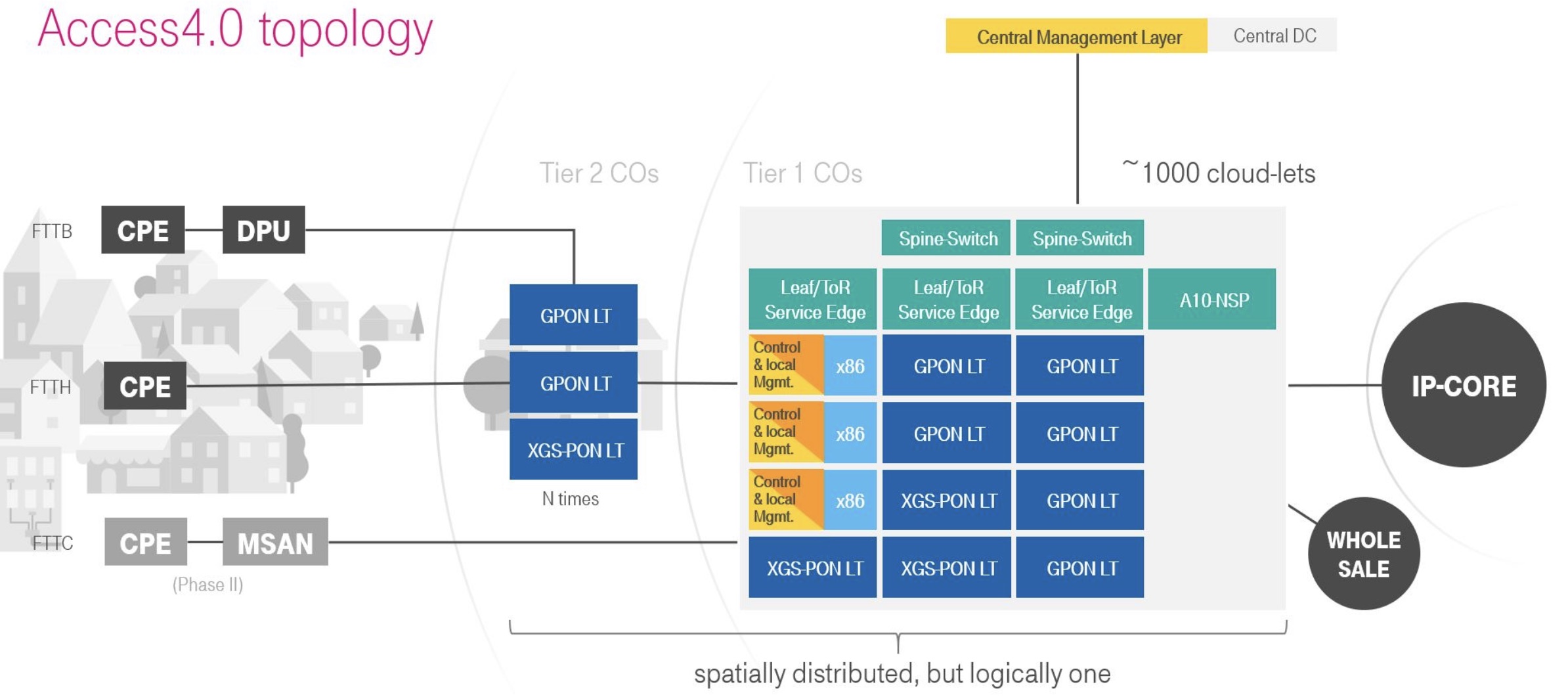
Instead, for Access 4.0, traffic from PON trees arrives at the OLT where it is aggregated by a chipset before being passed on to a top-of-rack switch where aggregation and packet processing occur.
The leaf-and-spine architecture can also be used to provide a ‘breakout’ to support edge-cloud services such as gaming and local services. “There is a traffic capability there but we currently don’t use it,” says Kolbe. “But we are thinking that in the future we will.”
Deutsche Telekom has been public about working with such companies as Reply, RtBrick and Broadcom. Reply is a key partner while RtBrick contributes a major element of the speciality domain BNG software.
Kolbe points out that there is no standard for using network processor chips: “They are all specific which is why we need a strong partnership with Broadcom and others and build a common abstraction layer.”
Deutsche Telekom also works closely with Intel, incumbent network vendors such as ADTRAN and original design manufacturers (ODMs) including EdgeCore Networks.
Challenges
About 80 percent of the design effort for Access 4.0 is software and this has been a major undertaking for Deutsche Telekom.
“The challenge is to get up to speed with software; that is not a thing that you just do,” says Kolbe. “We can’t just pretend we are all software engineers.”
Deutsche Telekom also says the new players it works with – the software specialists – also have to better understand telecom. “We need to meet in the middle,” says Kolbe.
Soukup adds that mastering software takes time – years rather than weeks or months – and this is only to be expected given the network transformation operators are undertaking.
But once achieved, operators can expect all the benefits of software – the ability to work in an agile manner, continuous integration/ continuous delivery (CI/DC), and the more rapid introduction of services and ideas.
“This is what we have discovered besides cost-savings: becoming more agile and transforming an organisation which can have an idea and realise it in days or weeks,” says Soukup. The means are there, he says: “We have just copied them from the large-scale web-service providers.”
Status
The first Access 4.0 services will be FTTH delivered from a handful of central offices in Germany later this year. FTTB services will then follow in early 2021.
“Once we are out there and we have proven that it works and it is carrier-grade, then I think we are very fast in onboarding other things,” says Soukup. “But they are [for now] not part of our case.”

Scintil Photonics looks to add light to silicon
It’s the second day of Christmastide and Sylvie Menezo is working: “I enjoyed the last two days and now I’m back at work.”
But then it should not be surprising given how Menezo is both the CEO and CTO of Scintil Photonics, the French start-up that secured €4.4 million in first-round funding last year.
Origins
Scintil Photonics’ expertise is in the design of silicon photonics circuits and the addition of active III-V materials – for lasing, gain and modulation – to a silicon substrate.
The start-up is using its funding to move its technology from the lab to production, working with an unnamed commercial foundry. The firm is also growing its staff, from eight to a dozen by the year-end.
Menezo worked previously at CEA-Leti, a French technology research institute, where her roles included heading the silicon photonics lab and business development.
In her business role, there was interest from customers in Leti’s silicon photonics technology but, at the time, its III-V technology on silicon was not ready.
“There was an opportunity of putting III-V on silicon but quite a bit of investment was needed to make the technology more mature,” she says. “This is where you need quick money and a 100 per cent dedicated team.”
Menezo discussed the idea of a start-up with CEA-Leti and once the organisation was satisfied that the proposed venture could succeed, it enabled her to step down to focus solely on developing the technology.
In return, the organisation that oversees Leti, CEA Tech, took a share in the start-up before it sought funding. This is one of CEA Tech’s duties, says Menezo, to create jobs.
“Once the patent technology was strengthened, we went outside and looked for funding,” she says.
Technology
Scintil Photonics has both indium phosphide and silicon photonics expertise. The start-up’s plans to develop and sell fully photonic integrated circuits (PICs). The start-up’s optical component library includes lasers, modulators, waveguides, wavelength filters, and photodetectors.
“We have a fabrication process which is CMOS-friendly and which relies on existing silicon-photonics technology,” says Menezo. “We want to have silicon and III-V fabricated and we want to commercialise photonic ICs.”
Scintil’s work with a commercial foundry will take its technology to production using a standard silicon photonics process.
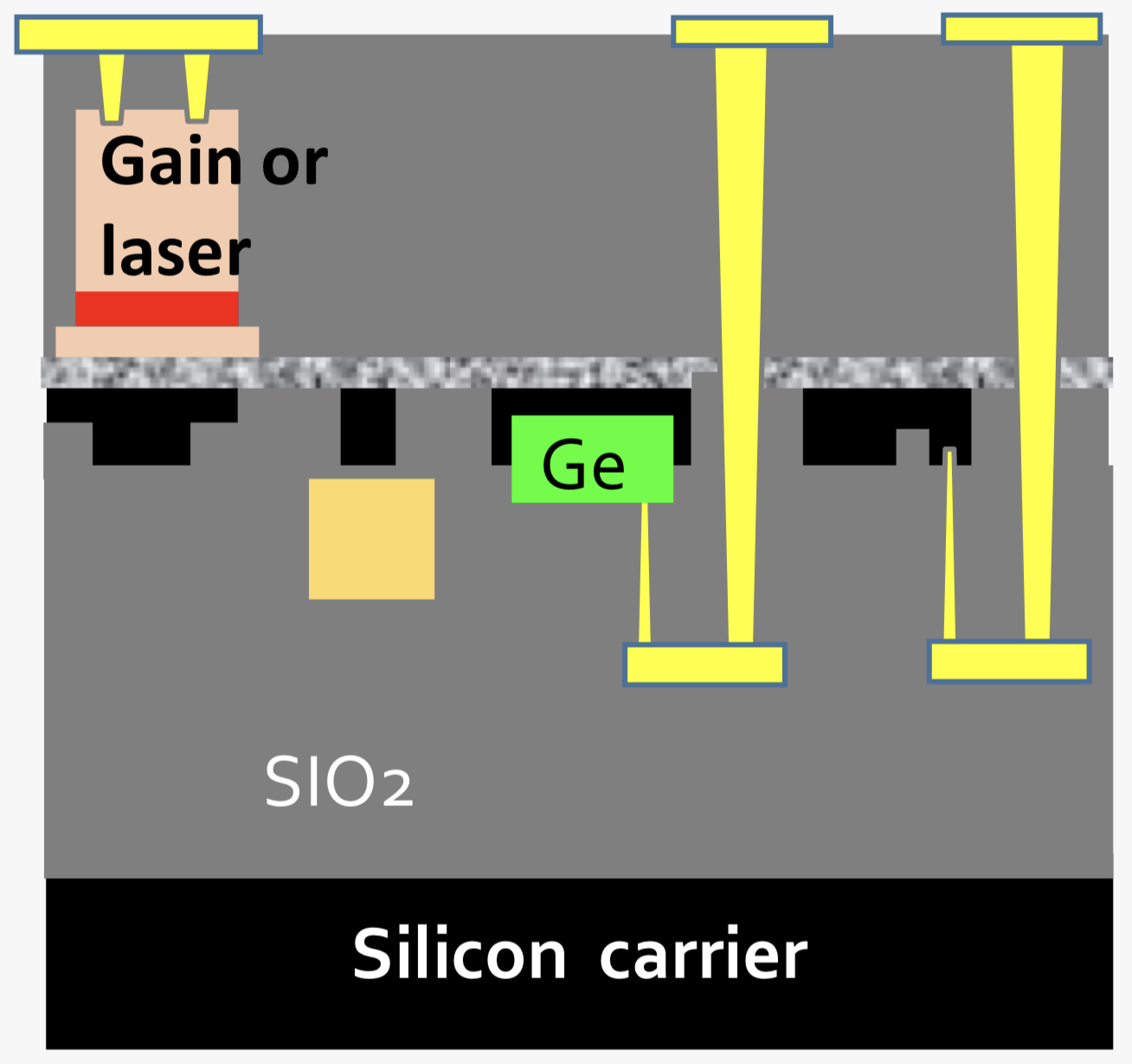
Once the silicon photonics chips are fabricated on a wafer, Scintil’s process bonds the wafer onto a silicon carrier, flips it and etches off the silicon-on-insulator (SOI) substrate.
Indium phosphide is bonded onto the exposed silicon layer before being processed to fabricate such active components as lasers, semiconductor optical amplifiers and hybrid modulators using CMOS fabrication techniques (see image).
Menezo describes the fabrication as CMOS-friendly: standard off-the-shelf processes are used while the processing of III-V is CMOS-compatible in terms of etching and electrical contacts.
Scintil’s process is also scalable, she says: new materials and functions will be added over time to the silicon photonics processes without impacting the integration of III-V materials onto the silicon.
“The more you design these devices and circuits, the more you see the design opportunities you have,” says Menezo. “This is the future if people manage to make it as a friendly as CMOS technology.”
Applications
Scintil Photonics is already working on circuit prototypes with the foundry.
The prototypes include coherent components for optical transmission and designs for 800-gigabit and 1.6-terabyte client-side interfaces. These are based on parallelising existing 400-gigabit DR4 and FR4 designs.
“For an 800-gigabit, the use of eight lanes [each lane being 100 gigabits] is indeed a good target because of [the need for] more integration,” says Menezo. “We can also scale to higher-speed lanes with our hybrid indium phosphide/ silicon photonics modulator.”
Eight-hundred gigabit modules are only needed from 2022 at the earliest.
Another application area for the technology is co-packaged optics, using optical interfaces to move data on- and off-chip.
Menezo says that the company is already thinking about the next round of funding but that it is at least two years away.

NeoPhotonics’ growing 400G coherent pluggable portfolio
NeoPhotonics has unveiled its first two 400-gigabit coherent pluggable modules that support the OIF’s 400ZR coherent standard and extended ZR+ modes.
The company has delivered samples of its ClearLight CFP2-DCO module for trials. The CFP2-DCO supports 400ZR, metro, and long-haul optional transmissions.
NeoPhotonics has also delivered to a hyperscaler the first samples of a 400-gigabit OSFP pluggable that supports 400ZR and 400ZR+.
Both modules use Inphi’s latest Canopus 7nm CMOS coherent digital signal processor (DSP) chip.
Module types
The OIF has developed the 400ZR standard to enable 400-gigabit signals to be sent between switches or routers in data centres up to 120km apart.
The main three pluggable modules earmarked for 400ZR are the QSFP-DD, OSFP and CFP2-DCO.
These modules differ in size and power envelope, ranging from the QSFP-DD, which is the most compact and has the smallest power envelope, to the CFP2-DCO module which supports the highest power and size.
It is the two client-side module form factors – the QSFP-DD and the OSFP – that will be mainly used for 400ZR.
“The CFP2 has more of a power envelope available so it tends to be used for longer reach applications,” says Ferris Lipscomb, vice president of marketing at NeoPhotonics.
These applications include specialist data-centre-interconnect applications and the metro and long-haul needs of the telecom operators.
400G CFP2-DCO
NeoPhotonics’ ClearLight CFP2-DCO uses an extension of a fibre’s C-band spectrum, what Huawei calls the Super C-band while NeoPhotonics refers to its implementation as C++.
The Super C-band covers 6THz of the spectrum compared to the standard C-band’s 4THz. The extended band can fit 120, 50GHz-wide channels or 80, 75GHz-wide channels.
NeoPhotonics can send 64-gigabaud (GBd), 400-gigabit signals over a 75GHz channel such that using ClearLight CFP2-DCO modules, 32 terabits can be sent overall.
The CFP2-DCO module uses NeoPhotonics’s ultra narrow-band line-width tunable laser that has had its tuning range extended to span the Super C-band. NeoPhotonics also uses its 64GBd intradyne coherent receiver (ICR) and coherent driver modulator.
The ClearLight CFP2-DCO can also send 400-gigabit signals over distances greater than 400ZR’s 120km. In addition, the module supports 200-gigabit transmissions over greater distances.
Sending a 200-gigabit at 64GBd using a 75GHz channel and quadrature phase-shift keying (QPSK) modulation, an optical signal-to-noise ratio (OSNR) of under 14dB is needed. Alternatively, using a 50GHz channel at 32GBd and 16-ary quadrature amplitude modulation (16-QAM), the OSNR is 16dB.
“With these [decibel] numbers, lower is better,” says Lipscomb. “You can go further with 64 gigabaud and QPSK; it’s 2dB better.”
Lipscomb says one use case for the 400-gigabit CFP2-DCO promises significant volumes: “The Super C-band has been used for deployments particularly by the Chinese carriers where they want to get more channels down a fibre.”
OSFP
NeoPhotonics has also unveiled its ClearLight OSFP module that enables the 400ZR standard and 400-gigabit transmissions for metro.
The module incorporates NeoPhotonics’s nano integrated tunable laser assembly (Nano-ITLA) and its silicon photonics-based coherent optical sub-assembly (COSA) that integrates the coherent receiver and modulator driver functions.
The OSFP tunes over 75GHz- or 100GHz-spaced channels, enabling 85 and 64 channels, respectively, as specified by the OIF. The OSFP also supports longer metro reaches at 400 gigabits.
NeoPhotonics also makes arrayed waveguide gratings (AWG) suited for 64GBd and 75GHz channel spacings that both modules support. “You need broader passbands and different channel spacings for 64 gigabaud,” says Lipscomb.
ZR+ interop?
Lipscomb is not a proponent of enforcing standardisation for the ZR+ extended modes, as has been done with 400ZR, despite the resulting lack of interoperability between optical modules from different vendors.
“There will always be the temptation in cases where you need it, to give up interoperability for increased [optical] performance,” he says.

Books in 2019 - Final Part

Gazettabyte asks industry figures each year to cite the memorable books they have read. These include fiction, non-fiction and work-related titles.
In the second and final part, the recommendations during 2019 of Analysys Mason’s Dana Cooperson and Tom Williams from Acacia Communications are included.
Dana Cooperson, Research Director, Analysys Mason
I’ll cheat somewhat and go back several years when picking favourite books and then I’ll focus on titles read in 2019.
I’ve spent a lot of time over the past five years thinking about, helping my kids apply for, and paying for university education, so education-related books have been a focus.
My first recommendation is Excellent Sheep: The Miseducation of the American Elite and the Way to a Meaningful Life, by William Deresiewicz, an ex-professor and admissions counsellor at Yale.
I recommend it for its insight into the college admissions process, the business of US higher education, and how far some parents, prospective students, and colleges stray from what should be the goal: a good education. The recent “Varsity Blues” admissions scandal is a case in point.
The book, read after my first daughter’s run through the admissions obstacle course, validated my cynicism, but also left me and my younger daughter, who read it, empowered for our second attempt.
Three other education-related books offer different accounts of disadvantaged yet determined individuals who overcome challenging circumstances to become well-educated. And how friends and relatives can work to undermine those who strive for more. They also recount how difficult navigating the system can be for the disadvantaged and the crucial role of mentors.
Educated: A Memoir, by Tara Westover and Hillbilly Elegy: A Memoir of a Family and Culture in Crisis, by J. D. Vance, are well-known. These memoirs are insightful about the ‘anti-elite’, anti-education subcultures in the US (in Appalachia and survivalist Idaho, respectively).
Less well-known is A Hope in the Unseen: an American Odyssey from the Inner City to the Ivy League, by journalist Ron Suskind; by far my favourite of the three.
It traces the path of Cedric Jennings, a bright and determined African American boy from a poor, dangerous section of Washington, D.C., in the 1990s as he faces setback after setback in his quest for an education and a better life. It is a wonderfully written and deep book.
Other books gave me engrossing peeks into other eras, cultures, and species.
My 2019 reading started with Homegoing, by Yaa Gyasi, a story of two 18th century Ghanaian half-sisters, one of whom ends up enslaved in Mississippi. This epic novel spans eight generations of the sisters’ families and sheds light on the dark corners of the international slave trade and its legacy.
The central character of Eleanor Oliphant is Completely Fine, by Gail Honeyman, is smart, funny, and cringingly, endearingly quirky. The novel, set in present-day Scotland, has elements of a mystery as we slowly learn the roots of Eleanor’s trauma and just how twisted her psyche has become in her effort to outrun childhood tragedy.
I ended 2019 with A Gentleman in Moscow: A Novel, by Amor Towles. This novel’s plot spans Russian/ Soviet history from the Bolshevik revolution to the Cold War, and yet it unfolds almost entirely in a hotel.
Count Alexander Rostov, the titular protagonist, is an aristocrat whom the Bolsheviks deem a “former person” and sentenced to house arrest in Moscow’s Metropol Hotel. The Count, abetted by various friends and dogged by his chief antagonist, creates a life well-lived despite being a prisoner of the state. Here’s looking at you, Count!
Lastly, the book you didn’t know you needed to read about the species you didn’t know was so fascinating: The Soul of an Octopus: A Surprising Exploration into the Wonder of Consciousness, by journalist Sy Montgomery.
I’m never going to eat octopus again but that is a small price to pay for such an illuminating exposé on the physiology, lifecycle, and intelligence of the octopus; their personalities; and what we can learn about consciousness from a species alien to us.
Tom Williams, Vice President of marketing at Acacia Communications.
It may be a depressing story but the book that most impacted me in 2019 is entitled: What Made Maddy Run, by Kate Fagan.
It is a tragic story about a freshman, Madison Hollaran, at the University of Pennsylvania, who struggled with the pressures of freshman year as a scholarship athlete at an Ivy League school and committed suicide in her second semester.
Maddy seemed to have a perfect life as a star high-school athlete in soccer and track. She had a strong network of high-school friends and a supportive family, but she found herself lost at Penn and couldn’t find her way back to peace in her life.
Her family and close friends knew she was struggling but I don’t think anyone ever imagines events taking such a turn.
Maddy’s family provided the author with full access to her phone, computer and accounts. Stories from family and friends are interspersed with email and text discussions to provide a real sense of the pain she was struggling to communicate. Stitching these different strands together and the benefit of hindsight provide a fuller perspective.
As she approached her final act of desperation, several interactions presented themselves to offer her a different path out of the valley that she found herself in, but somehow she couldn’t recognise these opportunities. She had lost hope.
The book explores the pressures of freshman year, especially at an Ivy League school where students face a level of academic competitiveness never experienced before. Everyone there was at the top of their class in high-school.
In addition, athletes often feel the burden of living up to expectations to “earn” their scholarship. Their sport can become a responsibility or burden and no longer a source of enjoyment.
The book also explores how social media posts can disguise what someone like Maddie is feeling, making it even harder to recognise when a concerning situation has become a crisis.
As a parent of teenage daughters, I felt for her parents who knew she was struggling but didn’t know how to help. As parents, we want to fix our children’s problems, but as they approach adulthood, it is more difficult to have all the answers.
You know from the start how the book will end, but the chapter where she takes her life is as powerful as anything I’ve read. I can’t imagine how difficult it was for her family to provide the access to enable this book to be written, but I respect their strength and I hope it helps others in similar situations.
The book made a lasting impression on me.
Roy Rubenstein, Editor of Gazettabyte
I read some terrific titles in 2019 but none came close to the book What Dementia Teaches Us about Love, by Nicci Gerrard. (In the US, the title is The Last Ocean: A Journey Through Memory and Forgetting)
Gerrard is a journalist and novelist. She is also a co-founder of a campaign in the UK, named after her father, John, to allow carers to accompany dementia patients in hospitals. This follows her experience with her father who was left alone for days without visitors due to a virus outbreak.
Gerrard describes how, “… away from the home he loved, stripped of familiar routines and surrounded by strangers and machines, he swiftly lost his bearings and his fragile hold on himself. There is a great chasm between care and ‘care’, and my father fell into it.”
The book explores the disease – the gradual fragmentation of a person as they lose memory, language, recognition of their surroundings and, inevitability, their health.
But the book is more than that: it is a treatise on what it is to be human. What makes you, you? The grounding of memory and what it means to start forgetting. What is home? And the conflicting demands of caring: preserving the self while being endlessly drawn to caring for a loved one that is slowly losing and being lost.
The book is part memoir and part study. It is also sprinkled with moving human-interest stories. It may be hard to read at times but the book is uplifting.
Gerrard has written an original work on a topic that is not short of literature. Her writing also causes you to pause and reflect on what you’ve read.
For example, she starts the book with a story of how her father, after a decade of dementia, joins the family on a holiday in Sweden and visits a lake.
“My father, old and frail, swam out a few yards and then he started to sing. It is a song I’d never heard before, and never heard since …
“His self – bashed about by the years, picked apart by his dementia – was, in this moment of kindness, beyond language, consciousness and fear, lost and contained in the multiplicity of things and at home in the vast wonder of life.”