

BT's IP-over-DWDM move
- BT will roll out next year IP-over-DWDM using pluggable coherent optics in its network
- At ECOC 2022, BT detailed network trials that involved the use of ZR+ and XR optics coherent pluggable modules
Telecom operators have been reassessing IP-over-DWDM with the advent of 400-gigabit coherent optics that plug directly into IP routers.
According to BT, using pluggables for IP-over-DWDM means a separate transponder box and associated ‘grey’ (short-reach) optics are no longer needed.
Until now, the transponder has linked the IP router to the dense wavelength-division multiplexing (DWDM) optical line system.
“Here is an opportunity to eliminate unnecessary equipment by putting coloured optics straight onto the router,” says Professor Andrew Lord, BT’s head of optical networking.
Removing equipment saves power and floor space too.
DWDM trends
Operators need to reduce the cost of sending traffic, the cost-per-bit, given the continual growth of IP traffic in their networks.
BT says its network traffic is growing at 30 per cent a year. As a result, the operator is starting to see the limits of its 100-gigabit deployments and says 400-gigabit wavelengths will be the next capacity hike.
Spectral efficiency is another DWDM issue. In the last 20 years, BT has increased capacity by lighting a new fibre pair using upgraded optical transport equipment.
Wavelength speeds have gone from 2.5 to 10, then to 40, 100, and soon 400 gigabits, each time increasing the total traffic sent over a fibre pair. But that is coming to an end, says BT.
“If you go to 1.2 terabits, it won’t go as far, so something has to give,” says Lord. ”So that is a new question we haven’t had to answer before, and we are looking into it.”
Fibre capacity is no longer increasing because coherent optical systems are already approaching the Shannon limit; send more data on a wavelength and it occupies a wider channel bandwidth.
Optical engineers have improved transmission speeds by using higher symbol rates. Effectively, this enables more data to be sent using the same modulation scheme. And keeping the same modulation scheme means existing reaches can still be met. However, upping the symbol rate is increasingly challenging.
Other ways of boosting capacity include making use of more spectral bands of a fibre: the C-band and the L-band, for example. BT is also researching spatial division multiplexing (SDM) schemes.
IP-over-DWDM
IP-over-DWDM is not a new topic, says BT. To date, IP-over-DWDM has required bespoke router coherent cards that take an entire chassis slot, or the use of coherent pluggable modules that are larger than standard QSFP-DD client-side optics ports.
“That would affect the port density of the router to the point where it’s not making the best use of your router chassis,“ says Paul Wright, optical research manager at BT Labs.
The advent of OIF-defined 400ZR optics has catalysed operators to reassess IP-over-DWDM.
The 400ZR standard was developed to link equipment housed in separate data centres up to 120km apart. The 120km reach is limiting for operators but BT’s interest in ZR optics stems from the promise of low-cost, high-volume 400-gigabit coherent optics.
“It [400ZR optics] doesn’t go very far, so it completely changes our architecture,” says Lord. “But then there’s a balance between the numbers of [router] hops and the cost reduction of these components.”
BT modelled different network architectures to understand the cost savings using coherent ZR and ZR+ optics; ZR+ pluggables have superior optical performance compared to 400ZR.
The networks modelled included IP routers in a hop-by-hop architecture where the optical layer is used for point-to-point links between the routers.
This worked well for traffic coming into a hub site but wasn’t effective when traffic growth occurred across the network, says Wright, since traffic cascaded through every hop.
BT also modelled ZR+ optics in a reconfigurable optical add-drop multiplexer (ROADM) network architecture, as well as a hybrid arrangement using both ZR+ and traditional coherent optics. Traditional coherent optics, with its superior optical performance, can pass through a string of ROADM stages where ZR+ optics falls short.
BT compared the cost of the architectures assuming certain reaches for the various coherent optics and published the results in a paper presented at ECOC 2020. The study concluded that ZR and ZR+ optics offer significant cost savings compared to coherent transponders.
ZR+ pluggables have since improved, using higher output powers to better traverse a network’s ROADM stages. “The [latest] ZR+ optics should be able to go further than we predicted,” says Wright.
It means BT is now bought into IP-over-DWDM using pluggable optics.
BT is doing integration tests and plans to roll out the technology sometime next year, says Lord.
XR optics
BT is a member of the Open XR Forum, promoting coherent optics technology that uses optical sub-carriers.
Dubbed XR optics, if all the subs-carriers originate at the same point and are sent to a common destination, the technology implements a point-to-point communication scheme.
Sub-carrier technology also enables traffic aggregation. Each sub-carrier, or a group of sub-carriers, can be sent from separate edge-network locations to a hub where they are aggregated. For example, 16 endpoints, each using a 25-gigabit sub-carrier, can be aggregated at a hub using a 400-gigabit XR optics pluggable module. Here, XR optics is implementing point-to-multipoint communication.
Lord views XR optics as innovative. “If only we could find a way to use it, it could be very powerful,” he says. “But that is not a given; for some applications, XR optics might be too big and for others it may be slightly too small.”
ECOC 2022
BT’s Wright shared the results of recent trial work using ZR+ and XR optics at the recent ECOC 2022 conference, held in Basel in September.
The 400ZR+ were plugged into Nokia 7750 SR-s routers for an IP-over-DWDM trial that included the traffic being carried over a third-party ROADM system in BT’s network. BT showed the -10dBm launch-power ZR+ optics working over the ROADM link.
For Wright, the work confirms that 0dBm launch-power ZR+ optics will be important for network operators when used with ROADM infrastructures.
BT also trialled XR optics where traffic flows were aggregated.
“These emerging technologies [ZR+ and XR optics] open up for the first time the ability to deploy a full IP-over-DWDM solution,” concluded Wright.


ECOC '22 Reflections - Final Part
Gazettabyte has been asking industry and academic figures for their thoughts after attending ECOC 2022, held last month in Basel, Switzerland. In particular, what developments and trends they noted, what they learned, and what, if anything, surprised them.
In the final part, Dr. Sanjai Parthasarathi of Coherent, Acacia’s Tom Williams, ADVA’s Jörg-Peter Elbers and Fabio Pittalà of Keysight Technologies share their thoughts.
Dr. Sanjai Parthasarathi, Chief Marketing Officer, Coherent
The ECOC event represents an excellent opportunity for us – a vertically-integrated manufacturer selling at all levels of the value chain – to meet with customers, end-customers and partners/ suppliers.
There was a refreshing sense of optimism and excitement for optical communications, driven by relentless bandwidth growth, despite the macroeconomic backdrop.
The roadmap for optical transceivers is dictated by the electrical interface used for Ethernet switch chips. We have seen that play out yet again for 100-gigabit electrical lanes used for 25-terabit and 50-terabit Ethernet switches.
Several transceiver suppliers demonstrated products with 100 gigabit-per-lane electrical interfaces in quad and octal form factors. The optical lane of a transceiver typically begins at the same speed as the electrical lane and then progresses to a faster rate. This transition should be expected for 800-gigabit transceivers as well.
While 100 gigabit-per-lane transceivers, such as the 800G-DR8 and the 2x400G-FR4 devices, there were devices demonstrated that enable the transition to optical 200-gigabit lanes. It was satisfying to see a warm response for the demonstration of Coherent’s 200-gigabit electro-absorption modulated laser (EML) and Semtech’s 200-gigabit EML driver. I am confident that direct detection will play a predominant role in 800-gigabit and 1.6-terabit data centre links.
Despite the great interest in co-packaged optics, nearly all the working demonstrations at the show used pluggable transceiver modules. Industry colleagues are preparing for pluggable transceiver modules using the next 200-gigabit electrical interface. Indeed, at ECOC, there was an OIF-CEI 224G demo by Keysight and Synopsys.
One key topic at the show concerned whether ‘coherent lite’ or direct detect is the preferred solution for data centres and edge aggregation. The debate remains open and no one solution fits all. It will depend on the specific application and architecture. A broad portfolio supported by different technology platforms frees you to select the best approach to serve the customer’s needs.
I saw the industry responding to the need for disaggregation and innovative solutions for access and telecom. Coherent’s 100G ZR announcement is one such example, as well as the extra performance of high-power 400ZR+ coherent transceivers.
We started this trend and we now see others announcing similar solutions.
Arista’s demo, which featured 400ZR connections over a 120km data centre interconnect (DCI) link, enabled by our pluggable optical line system in a QSFP form factor, received much attention and interest.
Tom Williams, Senior Director of Marketing for Acacia, now part of Cisco.
Many of us are still of a mindset where any opportunity to get together and see industry friends and colleagues is a great show.
My focus is very much on the success of 400-gigabit pluggable coherent solutions.
We’ve been talking about these products for a long time, back to the initial OIF 400ZR project starting in late 2016. Since then, 400ZR/ZR+ has been a hot topic at every conference.
The commercial success of these solutions, and the impact that they’re having on network architectures, has been gratifying. These products have ramped in volumes not seen by any previous coherent technology.
The industry has done a great job at 400 gigabits, striking the right balance of power and performance. Now, we’re looking at 800 gigabits and working through some of the same questions. Discussions around 1.6 terabits have even started.
Much work is still required but what we heard from customers at ECOC is that the trend toward pluggable coherent will likely continue.
Jörg-Peter Elbers, Senior Vice President, Advanced Technology, Standards and IPR at ADVA
‘Never say never’ captures well ECOC’s content. There was no one groundbreaking idea but topics discussed in the past are back on the agenda, either because of a need or the technology has progressed.
Here are several of my ECOC takeaways:
- The 130 gigabaud (GBd) class of coherent optics is coming, and the generation after that – 240GBd – is on the horizon.
- Coherent optics continue to push towards the edge. Will there be a Very-High Speed Coherent PON after 50G High-Speed PON?
- Whether co-packaged optics or front-pluggable modules, electro-photonic integration is rapidly advancing with some interesting industry insights shared at the conference.
- Quantum-safe communication is becoming part of the regular conference program.
- Optical Satcom is gaining traction. Optical ground-to-space links are promising yet challenging.
Fabio Pittalà, Product Planner, Broadband and Photonics – Center of Excellence, Keysight Technologies
This was my first ECOC as an employee of Keysight. I spent most of my time at the exhibition introducing the new high-speed Keysight M8199B Arbitrary Waveform Generator.
There were a lot of discussions focusing on technologies enabling the next Ethernet rates. There is a debate about intensity-modulation direct detection (IMDD) versus coherent but also what modulation format, symbol rate or degree of parallelisation.
While the industry is figuring out the best solution, researchers achieved important milestones by transmitting the highest symbol rate and the highest net bitrate.
Nokia Bell-Labs demonstrated record-breaking transmission of 260-gigabaud dual-polarisation quadrature phase-shift keying (DP-QPSK) over 100km single-mode fibre.
Meanwhile, NTT broke the net bitrate record by transmitting more than 2 terabit-per-second using a probabilistic-constellation-shaped dual-polarisation quadrature amplitude modulation (DP-QAM) over different data centre links.

Data centre photonics - an ECOC report

- ECOC 2022 included talks on optical switching and co-packaged optics.
- Speakers discussed optical switching trends and Google’s revelation that it has been using optical circuit switching in its data centres.
- Nvidia discussed its latest chips, how they are used to build high-performance computing systems, and why optical input-output will play a critical role.
Co-packaged optics and optical switching within the data centre were prominent topics at the recent ECOC 2022 conference and exhibition in Basel, Switzerland.
There were also two notable data centre announcements before ECOC.
Tencent announced it would adopt Broadcom’s Humboldt design, a hybrid co-packaged optics version of the Tomahawk 4 switch chip, in its data centres. Tencent is the first hyperscaler to announce it is adopting co-packaged optics.
Google also revealed its adoption of optical circuit switching in its data centres. Google made the revelation in a paper presented at the Sigcomm 2022 conference held in Amsterdam in August.
Optical circuit switching
Google rarely details its data centre architecture, but when it does, it is usually at Sigcomm.
Google first discussed a decade of evolution of its ‘Jupiter’ data centre architecture in a paper at Sigcomm in 2015.
This year, Google gave an update revealing that it has been using optical circuit switching in its data centres for the past five years. As a result, Google can scale its data centre more efficiently using a reconfigurable optical layer.
Upgrading a data centre’s network is much more complex than upgrading servers and storage. Moreover, a data centre is operational far longer than each generation of equipment. It is thus hard for a data centre operator to foresee how equipment and workloads will evolve over the data centre’s lifetime, says Google.
Google would pre-deploy the spine layer when it started operating a data centre. For Google’s Jupiter architecture, 64 spine blocks, each using 40 gigabit-per-second (Gbps) links, would be deployed. Then, Google added newer aggregation blocks with 100Gbps links. But the hyperscaler could not fully benefit due to the pre-existing 40Gbps spine links.
Google wanted to avoid touching the spine switches. A partial upgrade would have limited benefits, while fully upgrading the spine would take months and be hugely disruptive and costly.
Google’s first solution introduced a MEMS-based optical circuit switching layer between the aggregation and spine blocks.
The MEMS-based switch is data rate agnostic and can support multiple generations of optical modules. The switch’s introduction also allowed Google to add new spine blocks alongside new aggregation blocks; the hyperscaler no longer had to pre-deploy the spine.
At some point, Google decided that for new data centre builds, it would use optical circuit switching only and remove the spine layer of electrical switches.
Adopting optical circuit switch-based interconnect changes Google’s data centres from a clos to a direct-connect architecture. However, not all paths are direct; some take two hops to link aggregation blocks.
Google has developed sophisticated control software to best exploit the direct connectivity for traffic flows.
The software also adapts the network topology – the optical links between the aggregation blocks and their capacities. Such topology changes occur every few weeks, with the system first learning the nature of the traffic and workloads.
Removing the spine layer and replacing it with optical circuit switches has reduced Google’s data centre networking costs by 30 per cent and power consumption by 41 per cent.
ECOC reflections about Google’s optical switch adoption
There was much discussion at ECOC of Google’s use of optical circuit switching in its data centres.
S.J. Ben Yoo, a distinguished professor at the University of California, Davis, gave an ECOC talk about new trends in optical switching. “These are expected future trends,” he said. “I don’t have a crystal ball.”
Prof. Ben Yoo stressed the difficulty of scaling up and scaling out data centre networking architectures in the era of artificial intelligence workloads.
He described co-packaged optics as ‘Trend 0’ because it only delivers bandwidth (input-output capacity).
In contrast, introducing a reconfigurable optical switching layer on top of electrical aggregation switches is the first trend in optical switching. This is what Google has done with its optical circuit switch.
The next development in the data centre, says Ben Yoo, will be the introduction of photonic integrated circuit-based optical switching.
Huawei’s Maxim Kuschnerov, in his ECOC talk, said optical switching in the data centre would only grow in importance.
“Are there use cases where we can use optical switching and what are they?” he said. “I like to take a use-case perspective and find a technology that fulfils that use case.”
His view is that with the classical clos architecture, you can’t just rip out a single layer of electrical switches and replace it with optical ones. “There is a reason why you need all these switches and aggregation functionality,” says Kuschnerov.
Kuschnerov views Google’s optical circuit switching as nothing more than an automated patch panel.
“This is not the optical switch which is the saviour of future data centres,” he says.
Mark Filer, optical network architect, systems and services infrastructure at Google, in an ECOC tutorial detailing how Google uses and benefits from standards, multi-source agreements and open-source developments, was asked about Google’s custom optical switch.

How could Google explain such a custom design if the hyperscaler is such a proponent of open standards? And would Google consider contributing its optical circuit switch and software design to an open community framework?
“My guess is over time, we may see that it finds its way into some kind of open framework,” said Filer, adding that right now, Google sees its optical circuit switch as delivering a competitive advantage.
Co-packaged optics
Benjamin Lee, a senior research scientist at Nvidia, in his ECOC address, discussed the high-performance computing market and the role graphics processing units (GPUs) play in accelerating artificial intelligence and machine learning tasks.
Nvidia not only develops processors, GPUs and data processing unit ICs but also networking silicon and systems that the company uses to make high-performance computing systems.
Lee’s talk addressed the role optical interconnect will play in ensuring continuing scaling of high-performance GPU-based computing systems.
Scaled systems
Nvidia’s latest GPU, announced earlier this year, is the 80-billion-transistor Hopper H100. The H100 deliver a six-fold improvement in throughput compared to Nvidia’s existing A100 GPU announced in 2020.
The Hopper is Nvidia’s first GPU that uses the latest generation of stacked DRAM memory, known as high bandwidth memory 3 (HBM3). In addition, Hopper also uses Nvidia’s fourth-generation NVlink interface.
Eight H100 GPUs fit within Nvidia’s DGX box, as do four Nvidia NVSwitches used to interconnect the GPUs. In addition, an Nvidia Superpod connects 32 DGX nodes – 256 GPUs – using an external tier of NVSwitches.
“A paradigm shift we’re seeing is that switched interconnect is becoming important for scale-up,” said Lee. “So when we want to make the node more computationally powerful, those switches are being put inside the box to connect the GPUs.”
Switch ASIC bandwidths are consistently improving, with 51.2-terabit switch silicon being state-of-the-art. But despite such progress, the scaling is insufficient to keep up with bandwidth requirements, said Lee.
Switch ASIC power consumption is also rising, with advanced CMOS scaling having less impact on designs. Lee foresees switch ASICs consuming 2kW if current trends continue.
In turn, ASIC input-output (I/O) accounts for an increasing portion of the chip’s overall power consumption.
This is true for Nvidia’s GPUs and switch chips, so any I/O technology developed for switching will also benefit its GPUs.
Thus, Nvidia sees optical I/O as the key to scaling the processing performance of its ASICs and computing systems.

I/O metrics
Lee outlined various metrics when discussing optical I/O:
- the electrical interfaces used between the ASIC and optics, and their reach
- the power consumption of the module (the chip, and the chip and optics)
- the system power (of the line card or platform)
- interface density: the capacity exiting a millimetre of surface in terabits-per-second-per-mm (Tbps/mm)
For a system using a 102.4-terabit switch IC, half the power is consumed by the ASIC and half by the edge-board pluggable optics. Here the OIF’s long reach (LR) interface links the two.
The chip’s electrical interfaces consume 4.5 to 6.5 picojoule-per-bit (pJ/b) such that the total switch IC I/O power consumed is 450W.
The next step is co-packaged optics. Here, optical chiplets are placed closer to the ASIC (100mm away) such that the OIF’s lower power XSR (extra short reach) interface can be used that consumes 1.24-1.7pJ/s, says Lee.
Again taking a module view, Nvidia views the co-packaged design as comprising two electrical interfaces (the XSR interface between the chip and optical chiplets either side) and one optical interface.
This equates to 250W per chip module, a modest power saving at the chip module level but a significant power saving at the system level, given the optics is now part of the module.
However, bandwidth density is 475-870Gbps/mm, and for beyond 100-terabit switches, a further fourfold improvement is needed: 2Tbps/mm and, ultimately, 10Tbps/mm.
Just achieving a 2Tb/s/mm interface density will be challenging, says Lee.
For that, 2.5D co-packaged optics will be needed with the ASIC and chiplets sharing a silicon interposer that enables higher wire densities.
2.5D integration is already an established technology in the semiconductor industry; Nvidia has been using the technology for its GPUs since 2016.
The technology enables much closer coupling between the ASIC and optics (some 1mm), resulting in sub 1pJ/bit. Nvidia cites research showing a 0.3pJ/b has already been achieved.
Scaling I/O
Lee outlined all the ways I/O can be scaled.
Baud rate is one approach, but the energy efficiency diminishes as the symbol rate increases, from 50 to 100 to 200 gigabaud.
Modulation is another approach, moving from non-return-to-zero to 4-level pulse amplitude modulation (PAM-4) and even higher PAM schemes. The challenge is that the signal-to-noise ratio diminishes the higher the PAM scheme, requiring additional digital signal processing which, in turn, consumes more power.
Another technique, polarization, can be used to double the data rate. Then there is the spatial domain. Here, tighter pitches can be used, says Lee, moving from 250, 127 and even 80 microns before other approaches are needed. These include multi-core fibre, waveguide fan-outs and even bidirectional optics (what Google uses for its optical circuit switch ports, to save on fibre and port count).
All these spatial approaches require considerable development and operational costs, says Lee.
The most promising way to boost throughput and increase interface density is using wavelength division multiplexing (WDM).
Nvidia has produced several generations of test chips that use wavelength parallelism in the O-band based on micro-ring resonators.
Nvidia’s steer
Micro-ring resonator technology already supports 100Gbps modulation rates. The optical circuit is also compact, energy-efficient and supports wavelength scaling.
Lee also outlined other key technologies that will be needed, each bringing their own challenges. One is the external laser source, another is advanced packaging.
Nvidia believes that for future generations of ASICs, dense WDM mirror-ring modulated links offer the most promising approach to meeting both low power and the massive interface density improvements that will be needed.
This will require low-cost lasers while packaging remains a severe challenge.
2.5D integration is going to be an important step in the evolution of switch interconnect, concluded Lee.

ECOC '22 Reflections - Part 3

Gazettabyte is asking industry and academic figures for their thoughts after attending ECOC 2022, held in Basel, Switzerland. In particular, what developments and trends they noted, what they learned, and what, if anything, surprised them.
In Part 3, BT’s Professor Andrew Lord, Scintil Photonics’ Sylvie Menezo, Intel’s Scott Schube, and Quintessent’s Alan Liu share their thoughts.
Professor Andrew Lord, Senior Manager of Optical Networks Research, BT
There was strong attendance and a real buzz about this year’s show. It was great to meet face-to-face with fellow researchers and learn about the exciting innovations across the optical communications industry.
The clear standouts of the conference were photonic integrated circuits (PICs) and ZR+ optics.
PICs are an exciting piece of technology; they need a killer use case. There was a lot of progress and discussion on the topic, including an energetic Rump session hosted by Jose Pozo, CTO at Optica.
However, there is still an open question about what use cases will command volumes approaching 100,000 units, a critical milestone for mass adoption. PICs will be a key area to watch for me.
We’re also getting more clarity on the benefits of ZR+ for carriers, with transport through existing reconfigurable optical add-drop multiplexer (ROADM) infrastructures. Well done to the industry for getting to this point.
All in all, ECOC 2022 was a great success. As one of the Technical Programme Committee (TPC) Chairs for ECOC 2023 in Glasgow, we are already building on the great show in Basel. I look forward to seeing everyone again in Glasgow next year.
Sylvie Menezo, CEO of Scintil Photonics
What developments and trends did I note at ECOC? There is a lot of development work on emergent hybrid modulators.
Scott Schube, Senior Director of Strategic Marketing and Business Development, Silicon Photonics Products Division at Intel.
There were not a huge amount of disruptive announcements at the show. I expect the OFC 2023 event will have more, particularly around 200 gigabit-per-lane direct-detect optics.
Several optics vendors showed progress on 800 gigabit/ 2×400 gigabit optical transceiver development. There are now more vendors, more flavours and more components.
Generalising a bit, 800 gigabit seems to be one case where the optics are ready ahead of time, certainly ahead of the market volume ramp.
There may be common-sense lessons from this, such as the benefits of technology reuse, that the industry can take into discussions about the next generation of optics.
Alan Liu, CEO of Quintessent
Several talks focused on the need for high wavelength count dense wavelength division multiplexing (DWDM) optics in emerging use cases such as artificial intelligence/ machine learning interconnects.
Intel and Nvidia shared their vision for DWDM silicon photonics-based optical I/O. Chris Cole discussed the CW-WDM MSA on the show floor, looking past the current Ethernet roadmap at finer DWDM wavelength grids for such applications. Ayar Labs/Sivers had a DFB array DWDM light source demo, and we saw impressive research from Professor Keren Bergman’s group.
An ecosystem is coalescing around this area, with a healthy portfolio and pipeline of solutions being innovated on by multiple parties, including Quintessent.
The heterogeneous integration workshop was standing room only despite being the first session on a Sunday morning.
In particular, heterogeneously integrated silicon photonics at the foundry level was an emergent theme as we heard updates from Tower, Intel, imec, and X-Celeprint, among other great talks. DARPA has played – and plays – a key role in seeding the technology development and was also present to review such efforts.
Fibre-attach solutions are an area to watch, in particular for dense applications requiring a high number of fibres per chip. There is some interesting innovation in this area, such as from Teramount and Suss Micro-Optics among others.
Shortly after ECOC, Intel also showcased a pluggable fibre attach solution for co-packaged optics.
Reducing the fibre packaging challenge is another reason to employ higher wavelength count architectures and DWDM to reduce the number of fibres needed for a given aggregate bandwidth.

ADVA targets access with its latest pluggable module
- The 25 gigabit-per-second (Gbps) SFP28 is self-tuning and has a reach of 40km
- ADVA’s CEO, Christoph Glingener, in his plenary talk at ECOC 2022 addressed the unpredictable nature of technology adoption.
ADVA has expanded its portfolio of optical modules with an SFP28 for the access market.
The AccessWave25 is a self-tuning dense wavelength division multiplexing (DWDM) pluggable.
The SFP28 is designed to enable communications service providers to straightforwardly upgrade their access networks from 10Gbps to 25Gbps.
ADVA made the announcement just before ECOC 2022.
Features
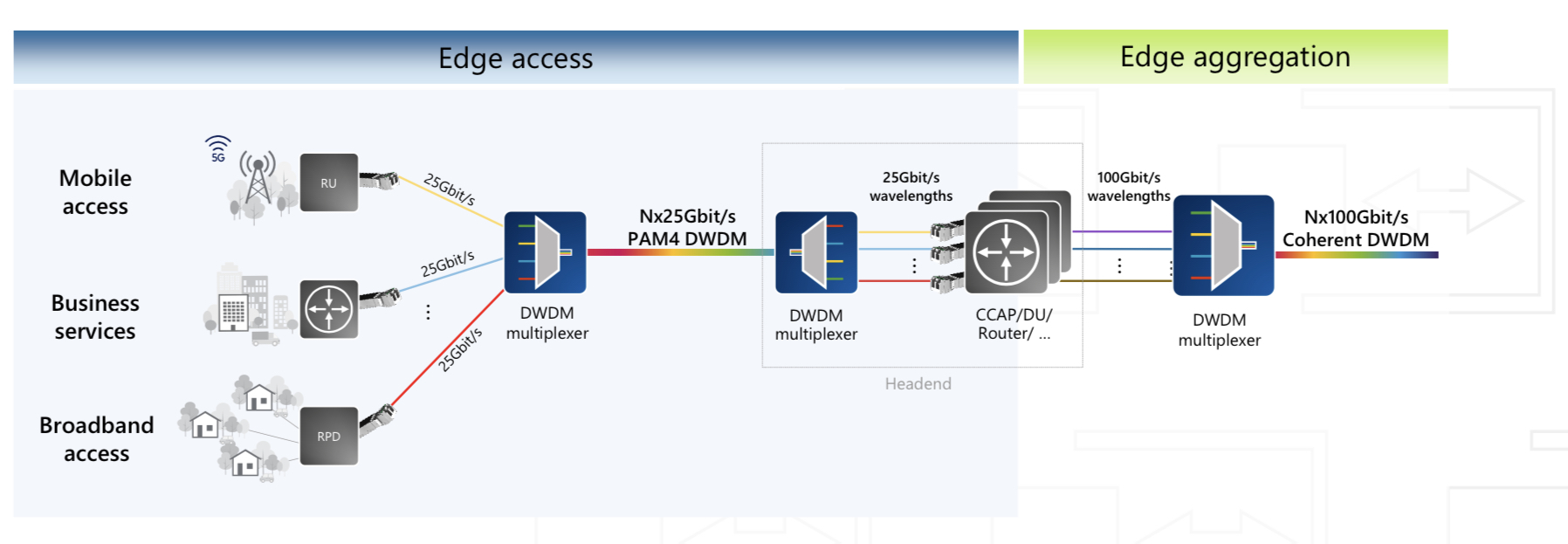
The SFP28 module links switches and routers to DWDM open-line systems (see diagram below).
The 40km-reach pluggable uses 4-level pulse amplitude modulation (PAM-4) and supports 25 gigabit Ethernet and eCPRI traffic.
The module uses the G.metro self-tuning standard to coordinate with the remote-end transceiver a chosen channel in the C-band, simplifying configuration and removing human error.
The G.metro communication channel also enables remote monitoring of the module.
The SFP28 consumes 3W and works over the extended temperature of -40 to 85oC.
Strategy
ADVA says vertical integration is a critical part of its Optical Engine unit’s strategy.
Saeid Aramideh, ADVA’s Optical Engine’s vice president of business development, says the unit focusses on such technology disciplines as silicon photonics, laser technology and digital signal processing.
The digital signal processing includes aggregation as with ADVA‘s MicroMux module products, PAM-4 used by the AccessWave25, and coherent as with its 100ZR module announced in June.
Advanced packaging is another technology area of interest.
“These are the fundamental innovation areas we focus on,” says Aramideh. “We build our product portfolio based on these platforms.”
ADVA also looks at the market to identify product gaps.
“Not so much every MSA module, but what is happening on the aggregation side,” says Aramideh. “What is it that other people are not paying attention to?”
This is what motivated ADVA’s MicroMux products. The MicroMux module family includes a 10-by-10 gigabit going into 100 gigabits, a 10-by-one gigabit into 10 gigabits, and a four-by-100 gigabit going into 400 gigabits.
“The reality is over 10,000 MicroMux modules are carrying traffic with a top tier-one network provider in Europe,“ says Aramideh. “Not on ADVA equipment but on other network equipment maker, which we haven’t made public.”
For access aggregation, ADVA unveiled at OFC its four-by-10 gigabit MicroMux Edge BiDi with a 40km reach.
“This is for Ethernet, backhaul, and services where fibre is limited and symmetric latency is important,” says Aramideh.
ADVA’s 100ZR module uses a coherent digital signal processor (DSP) developed with Coherent. The 100ZR is a QSFP28 module that dissipates 5W and reaches 300km.
Now, ADVA has added the AccessWave25, a tunable SFP28 that uses direct-detect technology and PAM-4, including ADVA’s IP for distance optimisation.
“The AccessWave25 works on legacy, so if you have a 10-gigabit network, you don’t have to change anything on the physical layer,” he says.
ADVA also looks at metro applications and says it will announce lower-power, smaller form factor coherent designs.
ECOC plenary talk
The CEO of ADVA, Christoph Glingener, gave a plenary talk at ECOC.
Entitled Never say never, Glingener reflected on technology adoption and its timing.
He pointed out how technologies that, at first, seem impractical or too difficult to adopt can subsequently become mainstream. He cited coherent optical communication as one example.
Glingener also discussed how such unpredictability impacts business, citing supply-chain issues, the global pandemic, and sovereignty.
Sovereignty and the influx of government capital for fibre rollout and semiconductors confirm that the optical communications industry is in a good place. But Glingener worries how the industry’s practitioners are ageing and stresses more needs to be done to attract graduates.
Tracing optical communications’ progress, he talked about the 15-year cycles of first direct detect and then fibre amplification. Coherent then followed in 2010.
The industry is thus ripe for breakthrough technology.

Reaching limits
Shannon’s limit means spectral efficiency no longer improves while Moore’s law’s demise continues. Near-term trends are clear, he says, parallelism, whether it is multiple spectrum bands, multiple fibres, or multiple fibre cores. This, in turn, will drive new optical amplifier and wavelength-selective switch designs.
Further optimisation will be needed, integration at the device level and the creation of denser systems. Network automation is also essential and that requires much work.
Glingener also argues for optical bypass rather than electrical packet processing. Large core routers overseeing routing at the IP and optical layer will not aid the greening of the internet.
Next wave
So what is the next technology wave?
Possibilities he cited include hollow-core fibre, photonic computing, and quantum entanglement for communications and the quantum internet.
Will they reach a large scale? Glingener is doubtful.
Whatever the technology proves to be, he said, it is likely already being discussed at ECOC 2022.
If he has a message for the audience, it is to apply their own filter whenever they hear people say, ‘it will never come,’ or ‘it is too difficult.’ Never say never, says Glingener.

ECOC '22 Reflections - Part 2

Gazettabyte is asking industry and academic figures for their thoughts after attending ECOC 2022, held in Basel, Switzerland. In particular, what developments and trends they noted, what they learned, and what, if anything, surprised them.
In Part 2, Broadcom‘s Rajiv Pancholy, optical communications advisor, Chris Cole, LightCouting’s Vladimir Kozlov, Ciena’s Helen Xenos, and Synopsys’ Twan Korthorst share their thoughts.
Rajiv Pancholy, Director of Hyperscale Strategy and Products Optical Systems Division, Broadcom*
The buzz at the show reminded me of 2017 when we were in Gothenburg pre-pandemic, and that felt nice.
Back then, COBO (Consortium for On-Board Optics) was in full swing, the CWDM8 multi-source agreement (MSA) was just announced, and 400-gigabit optical module developments were the priority.
This year, I was pleased to see the show focused on lower power and see co-packaged optics filter into all things ECOC.
Broadcom has been working on integrating a trans-impedance amplifier (TIA) into our CMOS digital signal processor (DSP), and the 400-gigabit module demonstration on the show floor confirmed the power savings integration can offer.
Integration impacts power and cost but it does not stop there. It’s also about what comes after 2nm [CMOS], what happens when you run out of beach-front area, and what happens when the maximum power in your rack is not enough to get all of its bandwidth out.
It is the idea of fewer things and more efficient things that draws everyone to co-packaged optics.
The OIF booth showcased some of the excitement behind this technology that is no longer a proof-of-concept.
Moving away from networking and quoting some of the ideas presented this year at the AI Hardware Summit by Alexis Bjorlin, our industry needs to understand how we will use AI, how we will develop AI, and how we will enable AI.
These were in the deeper levels of discussions at ECOC, where we as an industry need to continue to innovate, disagree, and collaborate.
Chris Cole, Optical Communications Advisor
I don’t have many substantive comments because my ECOC was filled with presentations and meetings, and I missed most of the technical talks and market focus presentations.
It was great to see a full ECOC conference. This is a good sign for OFC.
Here is an observation of what I didn’t see. There were no great new silicon photonics products, despite continued talk about how great it is and the many impressive research and development results.
Silicon photonics remains a technology of the future. Meanwhile, other material systems continue to dominate in their use in products.
Vladimir Kozlov, CEO of LightCounting
I am surprised by the progress made by thin-film lithium niobate technology. There are five suppliers of these devices now: AFR, Fujitsu, Hyperlight, Liobate, and Ori-chip.
Many vendors also showed transceivers with thin-film lithium niobate modulators inside.
Helen Xenos, senior director of portfolio marketing at Ciena
One key area to watch right now is what technology will win for the next Ethernet rates inside the data centre: intensity-modulation direct detection (IMDD) or coherent.
There is a lot of debate and discussion happening, and several sessions were devoted to this topic during the ECOC Market Focus.
Twan Korthorst, Group Director Photonic Solutions at Synopsys.
My main observations are from the exhibition floor; I didn’t attend the technical conference.
ECOC was well attended, better than previous shows in Dublin and Valencia and, of course, much better than Bordeaux (the first in-person ECOC in the Covid era).
I spent three days talking with partners, customers and potential customers, and I am pleased about that.
I didn’t see the same vibe around co-packaged optics as at OFC; not a lot of new things there.
There is a feeling of what will happen with the semiconductor/ datacom industry. Will we get a downturn? How will it look? In other words, I noticed some concerns.
On the other hand, foundries are excited about the prospects for photonic ICs and continue to invest and set ambitious goals.

ECOC 2022 Reflections - Part 1

Gazettabyte is asking industry and academic figures for their thoughts after attending ECOC 2022, held in Basel, Switzerland. In particular, what developments and trends they noted, what they learned, and what, if anything, surprised them.
In Part 1, Infinera’s David Welch, Cignal AI’s Scott Wilkinson, University of Cambridge’s Professor Seb Savory, and Huawei’s Maxim Kuschnerov share their thoughts.
David Welch, Chief Innovation Officer and Founder of Infinera
First, we had great meetings. It was exciting to be back to a live, face-to-face industry event. It was also great to see strong attendance from so many European carriers.
Point-to-multipoint developments were a hot topic in our engagements with service providers and component suppliers. It was also evident in the attendance and excitement at the Open XR Forum Symposium, as well as the vendor demos.
We’re seeing that QSFP-DD ZR+ is a book-ended solution for carriers; interoperability requirements are centred on the CFEC (concatenated or cascaded FEC) market; oFEC (Open FEC) is not being deployed.
Management of pluggables in the optical layer is critical to their network deployment, while network efficiency and power reduction are top of mind.
The definition of ZR and ZR+ needs to be subdivided further into ZR – CFEC, ZR+ – oFEC, and ZR+-HP (high performance), which is a book-ended solution.
Scott T. Wilkinson, Lead Analyst, Optical Components, Cignal AI.
The show was invaluable, given this was our first ECOC since Cignal AI launched its optical components coverage.
Coherent optics announcements from the show did not follow the usual bigger-faster-stronger pattern, as the success of 400ZR has convinced operators and vendors to look at coherent at the edge and inside the data centre.
100ZR for access, the upcoming 800ZR specifications from the OIF, and coherent LR (coherent designed for 2km-10km) will revolutionise how coherent optics are used in networks.
Alongside the coherent announcements were developments from the direct-detect vendors demonstrating or previewing key technologies for 800 Gigabit Ethernet (GbE) and 1.6 Terabit Ethernet (TbE) modules.
800GbE is nearly ready for prime time, awaiting completion of systems based on the newest 112 gigabit-per-second (Gbps) serialiser-deserialiser (serdes) switches. The technology for 224Gbps serdes is just starting to emerge and looks promising for products in late 2024 or 2025.
While there were no unexpected developments at the show, it was great to compare developments across the industry and understand the impact of supply chain issues, operator deployment plans, and any hints of oversupply.
We came away optimistic about continued growth in optical components shipments and revenue into 2023.
Seb Savory, Professor of Optical Fibre Communication, University of Cambridge
My overwhelming sense from ECOC was it was great to be meeting in person again. I must confess I was looking at logistics as much as content with a view to ECOC 2023 in Glasgow where I will be a technical programme committee chair.
Maxim Kuschnerov, Director of the Optical and Quantum Communications Laboratory at Huawei
In the last 12 months, the industry has got more technical clarification regarding next-generation 800ZR and 800LR coherent pluggables.
While 800ZR’s use case seems to be definitely in the ZR+ regime, including 400 gigabit covering metro and long-haul, the case for 800LR is less clear.
Some proponents argue that this is a building block toward 1.6TbE and the path of coherence inside the data centre.
Although intensity-modulation direct detection (IMDD) faces technical barriers to scaling wavelength division multiplexing to 8×200 gigabit, the technological options for beyond 800-gigabit coherent aren’t converging either.
In the mix are 4×400 gigabit, 2×800 gigabit and 1×1.6 terabit, making the question of how low-cost and low-power coherent can scale into data centre applications one of the most interesting technical challenges for the coming years.
Arista continues making a case for a pluggable roadmap through the decade based on 200-gigabit serdes.
With module power envelopes of around 40W at the faceplate, it shows the challenge that the industry is facing and the case co-packaged optics is trying to make.
However, putting all the power into, or next to, the switching chip doesn’t make the cooling problem any less problematic. Here, I wonder if Avicena’s microLED technology could benefit next-generation chip-to-chip or die-to-die interconnects by dropping the high-speed serdes altogether and thus avoiding the huge overhead current input-output (I/O) is placing on data centre networking.
It was great to see the demo of the 200-gigabit PAM-4 externally modulated laser (EML) at Coherent’s booth delivering high-quality eye diagrams. The technology is getting more mature, and next year will receive much exposure in the broader ecosystem.
As for every conference, we have seen the usual presentations on Infinera’s XR Optics. Point-to-multipoint coherent is a great technology looking for a use case, but it is several years too early.
At ECOC’s Market Focus, Dave Welch put up a slide on the XR ecosystem, showing several end users, several system OEMs and a single component vendor – Infinera. I think one can leave it at this for now without further comment.
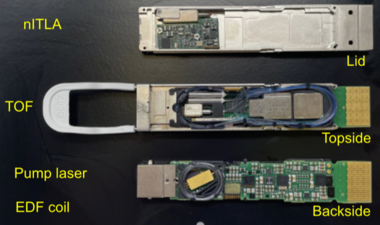
Ciena's multi-format 400G coherent QSFP-DD pluggable
Ciena showcased a working 400-gigabit Universal coherent pluggable module at the ECOC 2022 conference and exhibition in Basel, Switzerland.
Ciena is using its WaveLogic 5 Nano coherent digital signal processor (DSP) for the Universal QSFP-DD coherent pluggable module.
“We call it universal because it supports many transmission modes – interoperable and high performance; the most in the industry,” says Helen Xenos, senior director of portfolio marketing at Ciena.
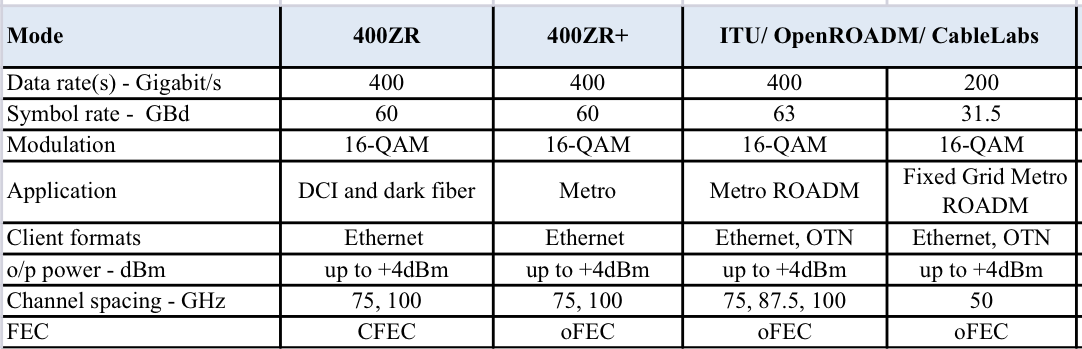
The pluggable has custom extended-performance modes and supports three industry formats: the 400ZR interoperable standard, the 400ZR+ multi-source agreement (MSA), and the OpenROADM MSA. (See tables below).
IP over DWDM
Communications service providers (CSPs) want to add pluggable coherent modules to their IP routers, removing the need for a separate transponder card or box linking the router to the optical line system.
The advent of coherent QSFP-DD pluggables has meant the same form factor can be used for client-side and line-side optics, ensuring efficient use of the router ports.
The CSPs want the coherent QSFP-DD module to have sufficient optical performance to meet their demanding networking requirements. For example, the module’s output signal can pass through the filtering stages of reconfigurable optical add-drop multiplexers (ROADMs) along the optical link.
Optical amplification and filtering
Ciena’s coherent QSFP-DD adds a fibre-based optical amplifier and a tunable optical filter to the coherent photonics and electronic ICs.
The optical amplification enables the high-performance mode and the launching of a 4dBm output signal. In contrast, 400ZR and 400ZR+ have a launch power of -10dBm.
“This is the industry’s highest [QSDP-DD] transmit power,” says Xenos.
The tunable optical filter improves the optical performance of the coherent receiver.
In an optical line system with colourless ROADMs, the Erbium-doped fibre amplifiers (EDFAs) generate out-of-band transmission noise – amplified spontaneous emission (ASE). The noise sources superimpose and become significant, impairing wavelength and system performance dramatically.
The tunable optical filter eliminates this effect and simplifies deployment over any photonics line system. In addition, Ciena says the pluggables can now work alongside high-baud rate transponders in existing ROADM applications.
The QSFP-DD’s tunable optical filter means its optical performance closely matches that of the CFP2-DCO, aiding the two classes of pluggables working together.
Modes of operation
400ZR defines the module’s baseline coherent performance. The OIF developed the 400ZR standard so hyperscalers can link their equipment in two separate data centres up to 120km apart.
The 400ZR specification delivers just enough optical performance to meet the optical link budget. The OIF produced a low-cost, interoperable, pluggable coherent specification.
400ZR supports a single baud rate – 60 gigabaud (GBd), and modulation scheme – dual-polarisation 16-QAM, and carries Ethernet frames.
Google, Meta, Microsoft and Alibaba were all involved in the OIF development, with the 400ZR Implementation Agreement published in early 2020.
400ZR supports two-channel widths: 75GHz and 100GHz, while the forward error correction scheme used is CFEC.
The 400ZR+ MSA enhances the performance by supporting other data rates – 100, 200 and 300 gigabits-per-second (Gbps) – as well as 400Gbps. In addition, it uses several modulation schemes and the enhanced O-FEC error correction scheme that extends reach.
Ciena’s module also meets the OpenROADM MSA, supporting Ethernet and OTN and an enhanced reach at 400Gbps.

Ciena’s Universal module’s extended performance modes up the symbol rate to 65 and 70 gigabaud (GBd) and uses probabilistic constellation shaping (PCS).
PCS maps the bitstream onto the constellation to maximise the data recovery at the coherent receiver, thereby improving overall optical performance. The scheme also allows the fine-tuning of the data rate sent.
At ECOC, Ciena showed the module implementing the high-performance mode at 70GBd and PCS.
ECOC innovation award
The ECOC Exhibition Market Focus Advisory Committee awarded the most innovative product award to Ciena’s WaveLogic 5 Nano 400G Universal QSFP-DD.

Tencent makes its co-packaged optics move

- Tencent is the first hyperscaler to announce it is deploying a co-packaged optics switch chip
- Tencent will use Broadcom’s Humboldt that combines its 25.6-terabit Tomahawk 4 switch chip with four optical engines, each 3.2 terabit-per-second (Tbps)
Part 2: Broadcom’s co-packaged optics
Tencent will use Broadcom’s Tomahawk 4 switch chip co-packaged with optics for its data centres.
“We are now partnered with the hyperscaler to deploy this in a network,” says Manish Mehta, vice president of marketing and operations optical systems division, Broadcom. “This is a huge step for co-packaged optics overall.”
Broadcom demonstrated a working version of a Humboldt switch at OFC earlier this year.
The Chinese hyperscaler will use Broadcom’s 25.6Tbps Tomahawk 4 Humboldt, a hybrid design where half of the chip’s input-output (I/O) is optical and half is the chip’s serialisers-deserialisers (serdes) that connect to pluggable modules on the switch’s front panel.
Four Broadcom 3.2-terabit silicon photonics-based optical engines are co-packaged alongside the Tomahawk 4 chip to implement 12.8Tbps of optical I/O.
Broadcom demonstrated a working version of a Humboldt switch at OFC earlier this year.
Co-packaged optics
Broadcom started its co-packaged optics development work in 2019.
“One of the reasons for our investment in co-packaged optics was that we did see firsthand the ongoing limits of copper interconnect being approached,” says Mehta.
The transmission reach of copper links continues to shrink as the signalling speed has increased from 25 gigabits-per-second (Gbps) non-return to zero (NRZ) to PAM-4 (4-level pulse amplitude modulation) based signalling at 56Gbps, 112Gbps and, in the coming years, 224Gbps. Power consumption is also rising with each speed hike.
Broadcom says data centres now use 1 million optical interconnects, but that much of the connectivity is still copper-based, linking adjacent racks and equipment within the rack.
“Hyperscalers spend ten times more on interconnects than switching silicon,” says Mehta. Given these trends, there needs to be a continual improvement in the power profile, cost and scaled manufacturing of optical interconnect, he says.
In the short term, what is driving interest in co-packaged optics is overcoming the limitations of copper, says Broadcom.
In early 2021, Broadcom detailed at a JP Morgan event its co-packaged optics roadmap. Outlined was the 25.6-terabit Humboldt to be followed by Bailly, a 51.2-terabit all co-packaged optics design using Broadcom’s Tomahawk 5 switch chip which is now sampling.
Humboldt uses DR4 (4×100-gigabit using 4 fibres) whereas the 51.2-terabit Bailly will add multiplexing-demultiplexing and use the FR4 specification (4×100-gigabit wavelengths per fibre).
Technology and partners
Broadcom’s in-house technology includes lasers (VCSELs and EMLs), mixed-signal expertise (trans-impedance amplifiers and drivers), and silicon photonics, as well as its switch chips.
Broadcom uses a remote laser source for its co-packaged optics design. Placing the laser away from the package (the switch chip and optics) means no cooling is needed.
Broadcom is working with 15 partners to enable its co-packaged optics, highlighting the breadth of expertise required and the design complexity.
There are two prominent use cases for the hybrid I/O Humboldt.
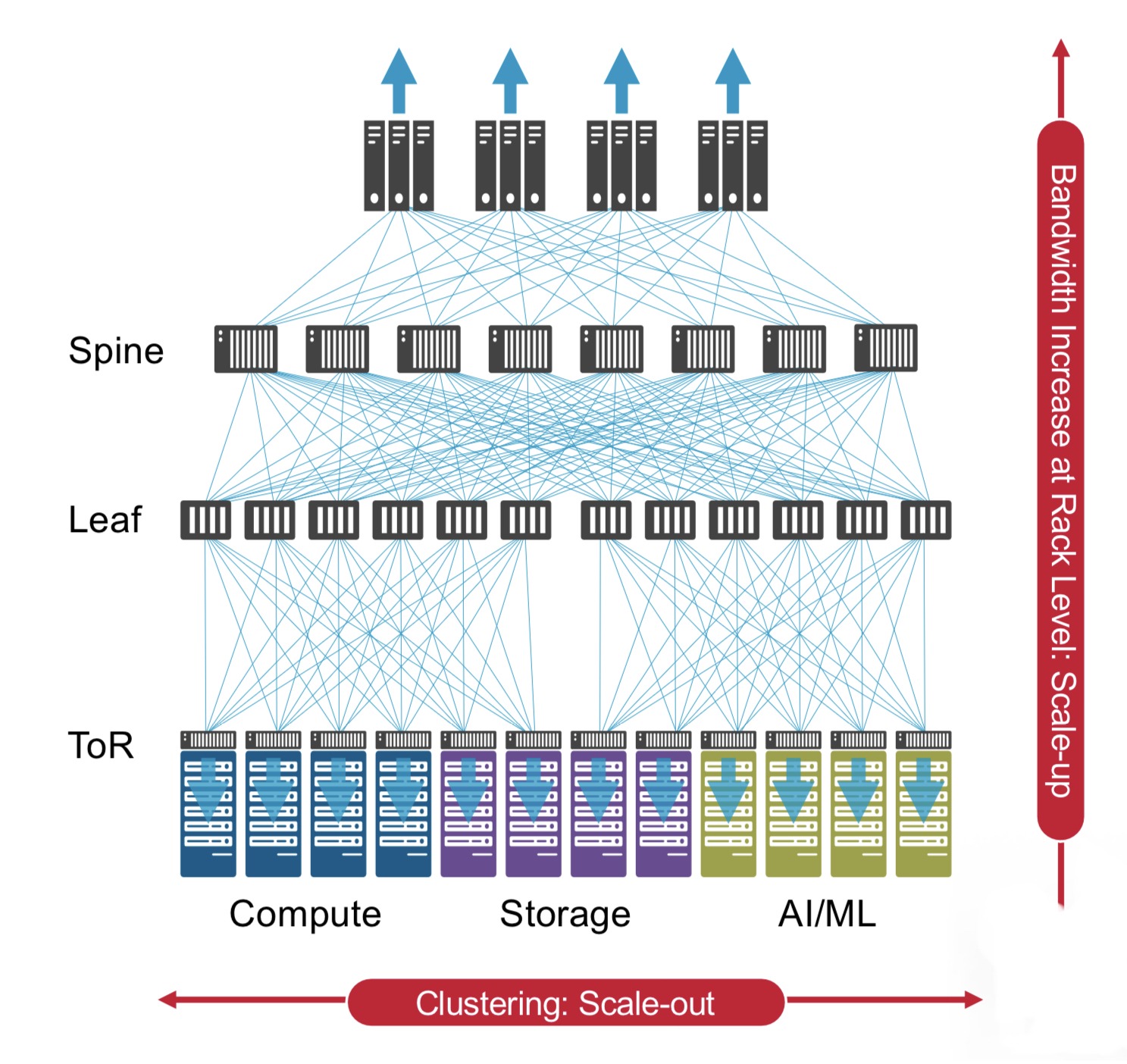
One is for top-of-rack switches, where the electrical interfaces support short-reach copper links connecting the servers in a rack, while the optical links connect the top-of-rack box to the next layer of aggregation switching.
The second use is at the aggregation layer, where the electrical I/O connects other switches in the rack while the optical links connect to switch layers above or below the aggregation layer.
“There is a use case for having pluggable ports where you can deploy low-cost direct-attached copper,” says Mehta.
Broadcom says each data centre operator will have their own experience with their manufacturing partners as they deploy co-packaged optics. Tencent has decided to enter the fray with 25.6-terabit switches.
“It is not just Broadcom developing the optical solution; it is also ensuring that our manufacturing partner is ready to scale,” says Mehta.
Ruijie Networks is making the two-rack-unit (2RU) switch platform for Tencent based on Broadcom’s co-packaged optics solution. The co-packaged optics interfaces are routed to 16 MPO connectors while the switch supports 32, 400-gigabit QSFP112 modules.
“It’s always important to have your lead partner [Tencent] for any deployment like this, someone you’re working closely with to get it to market,” says Mehta. “But there is interest from other customers as well.”
Cost and power benefits
Broadcom says co-packaged optics will lower the optical cost-per-bit by 40 per cent while the system (switch platform) power savings will be 30 per cent.
Humboldt more than halves the power compared to using pluggables. Broadcom’s co-packaged optics consumes 7W for each 800-gigabits of bandwidth, whereas an equivalent 800-gigabit optical module consumes 16-18W.
Its second-generation design will embrace 5nm CMOS rather than 7nm and still more than halve the power: an 800-gigabit pluggable will consume 14-15W, whereas it will be 5.5W for the same co-packaged optics bandwidth.
Broadcom will move to CMOS for its second-generation electrical IC; it uses silicon germanium at present.
Power and operational cost savings are a longer-term benefit for data centre operators, says Broadcom. A more immediate concern is the growing challenge of managing the thermal profile when designing switching systems. “The amount of localised heat generation of these components is making systems quite challenging,” says Mehta.
A co-packaged design eliminates pluggables, making system design easier by improving airflow via the front panel and reducing the power required for optical interconnect.
“They’ve been telling us this directly,” says Mehta. “It’s been a pretty good testimonial to the benefits they can see for system design and co-packaged optics.”
Roadmap
At OFC 2022, Broadcom also showed a mock-up of Bailly, a 51.2 terabit switch chip co-packaged with eight 6.4Tbps optical engines.
Broadcom will offer customers a fully co-packaged optics Tomahawk 5 design but has not given a date.
Since Broadcom has consistently delivered a doubling of switch silicon capacity every 24 months, a 102.4-terabit Tomahawk 6 is scheduled to sample in the second half of 2024.
That timescale suggests it will be too early to use 224Gbps serdes being specified by the OIF. Indeed, Mehta believes 112Gbps serdes will have “a very long life”.
That would require the next-generation 102.2Tbps to integrate 1024, 100Gbps serdes on a die. Or, if that proves too technically challenging, then, for the first time, Broadcom’s switching ASIC may no longer be a monolithic die.
Broadcom’s networking group is focused on high-speed serial electrical interfaces. But the company is encouraged by developments such as the open standard UCIe for package interconnect, which looks at slower, wider parallel electrical interfaces to support chiplets. UCIe promises to benefit co-packaged optics.
Broadcom’s view is that it is still early with many of these design challenges.
“Our goal is to understand when we need to be ready and when we need to be launching our silicon on the optical side,” says Mehta. “That’s something we are working towards; it’s still not clear yet.”

The significance of 6G
Henning Schulzrinne is known for speaking his mind.
A professor at the Department of Computer Science and the Department of Electrical Engineering at Columbia University, he previously expressed concern regarding what he saw as excessive hype surrounding 5G.
More recently, he has written about 6G, placing the emerging wireless standard in the broader context of societal needs.
“Research, particularly academic research, should be driven by the urgent needs of society, not just supplying patent-protected ‘moats’ against the competition, whether between companies or nations,” he wrote in an introduction to the book, Shaping Future 6G Networks.
Schulzrinne stresses he is not working on 6G standards but has taken part in an early 6G flagship project at the University of Oulu, Finland.
“My expertise is not on the radio; it is system architecture,” he says. “We have a lot of interest in my research group on issues such as automation and authentication, not specifically to 6G but to networks.”
Wireless generations
Every decade, work starts on a new-generation cellular wireless standard.
In the past, each generation represented a significant change. “You started with a clean slate, the [2G] digital system had very little in common with the analogue system that preceded it, and 3G was a different beast to 2G,” says Schulzrinne. “It made sense to call each a generational change.”
Now, release cycles are shorter, and there are what Schulzrinne calls ‘arbitrary markers’, such as when the 3GPP standards body issues a new Release or when the standard is suddenly called 4G.
Now, the notion of a new generation has become forced.
There is no solely-5G handset since it also supports earlier-generation standards. Supporting multiple generations is common in wireless; Wi-Fi devices may fall back to earlier standards for a connection.
He views 6G as more of an exercise for stakeholders such as consumers, policymakers and investors. “Putting a label on it helps to crystallise efforts, primarily outside the industry,” he says.
5G wireless
Schulzrinne notes how each 5G deployment still generates a press release: “You don’t see that for other things where people buy stuff.”
He also has doubts about some of the stated promises of 5G, such as its use to transform other industries.
“The question I don’t get a good answer to is, with the digitisation of industry, does it involve a plant that had no network at all, or a minimal networking capability and they wanted to create a network?” says Schulzrinne. “Why do they choose 5G; what value creation does it give?”
In US factories, robotics is usually fixed rather than mobile. Beating Ethernet on cost is also hard, he says, and factories can be hostile environments for radio.
In China, the three main operators are showing growth in service revenues from new ‘industrial digitalisation’ services. But then China is an advanced, large-scale manufacturer.
“I’m trying to have an open mind,” says Schulzrinne. “But where is that coming from, and what revenue is there outside of China?”
What 5G does bring is the opening up of radio spectrum, not just millimetre wave but also between 2GHz and 6GHz. 5G has also moved away from classical software to virtual network functions and cloud-based building blocks.
“This architectural transformation behind the scenes, which is hard to write flashy stories about, seems much more interesting,” says Schulzrinne.
Smaller carriers, and those outside the leading industrial countries, can now outsource parts of their operation to other parties; all that is needed is a cloud provider and software.

6G: uses and metrics
It is too early to summarise 6G.
5G’s main story is its three performance pillars: supporting many more devices, a tenfold hike in data speeds, and ultra-low latency.
For 6G, two stories are emerging.
One is consumer, involving the Metaverse, although Schulzrinne remains sceptical about the degree that is a motivating factor for 6G.
The second is technology related, and there are two parts here. One is AI and machine learning, although it is not clear as yet what role the technology will play with 6G.
The second, potentially transformational, is using 6G networks for sensing. For example, the position, movement and actions of entities in the field of view, adding sensing alongside the network’s communication capabilities.
“It’s almost like building a radar; it’s not the same technology, but it’s similar,” says Schulzrinne. Such sensing could be used outdoors and at home as a game controller or for motion detection.
6G will improve the critical performance metrics of 5G, but Schulzrinne believes the more meaningful metrics are cost-per-bit delivered and cost-per-base station-month.
Cost-per-bit is a crucial metric if cellular wireless is to replace Wi-Fi or Ethernet networks in the home and enterprise.
The average household data usage in the US is 400 gigabytes a month, 10x more than the heaviest mobile user.
It is also why Wi-Fi is used for data offload, given that fixed-line offers a cheaper solution than cellular with its base station and mobile backhaul costs. And this is before new data-intensive applications emerge, such as augmented and virtual reality headsets.
6G’s focus should be to reduce base station and backhaul costs.
“If you want to scale up the bits-per-dollar, its going to be a big challenge making that work,” he says.
Calibrating expectations
There will be a mismatch between 6G’s ambition and the likely outcome, he says.
A story told by the telcos is that they want to be the providers of higher-level services, not big data pipes. But this is misguided, says Schulzrinne. Instead, the telcos should aspire to be utilities.
“Many electric utilities, water utilities, don’t grow in double-digit percentages every year, and nobody expects them to, and that’s fine,” says Schulzrinne. “They have an expertise and a set of skills that are necessary and helpful from a societal perspective.”
Their metrics are reliability and cost-effectiveness.
He views 6G as a promising technology upgrade for the operators.
“What I want is fast and cheap, and I rely on the carrier to use modern technology to do that, “he says.
Comparing telcos to electric and water utilities can be taken too far, he says, but what the best of them share is that they provide vital input with changing technology to decrease prices and increase reliability.
They also share facing new challenges like cybersecurity.
“That is their job; it’s not other things,” says Schulzrinne.
Professor Schulzrinne and his research team developed the Session Initiation Protocol (SIP), the Real-Time Transport Protocol (RTP), and other multimedia signalling and support protocols.
Schulzrinne has been an advisor to the US Federal Communications Commission (FCC) and served as FCC Chief Technologist on public safety. He also served as a Technology Fellow in the office of Senator Ron Wyden, addressing data protection.