

OFC 2014 product round-up - Final part

The industry is moving at a clip to fill the void in 100 Gig IEEE standards for 100m to 2km links. Until now, the IEEE 10km 100GBASE-LR4 and the 10x10 MSA have been the interfaces used to address such spans.
But responding to data centre operators, optical players are busy developing less costly, mid-reach MSAs, as was evident at the OFC exhibition and conference, held in San Francisco in March.
Meanwhile, existing IEEE 100 Gigabit standards are skipping to the most compact CFP4 and QSFP28 form factors. The -LR4 standard was first announced in a CFP in 2010, and moved to the CFP2, half the size of the CFP, in 2013. Now, several companies have detailed CFP4 -LR4 products, while Source Photonics has gone one better, announcing the standard in a QSFP28.
The CFP4 is half the size of the CFP2, while the QSFP28 is marginally smaller than the CFP4 but has a lower power consumption: 3.5W compared to the CFP4's 6W.
 Timeline of some pluggable announcements at recent OFCs. Source: Gazettabyte
The mid-reach landscape
Several interfaces for mid-reach interconnect were detailed at OFC. And since the show, two MSAs have been detailed: the CWDM4 and the CLR4 Alliance.
At OFC, the OpenOptics MSA backed by Mellanox Technologies and Ranovus, was announced. Skorpios Technologies demoed its CLR4 module that has since become the CLR4 Alliance. And vendors discussed the Parallel Single Mode (PSM4) initiative that was first detailed in January.
Switch vendor Mellanox Technologies and module start-up Ranovus announced the OpenOptics MSA at OFC. The QSFP-based MSA uses a single-mode fibre and WDM transmission around 1550nm to address data centre links up to 2km.
Saeid Aramideh of Ranovus says that the MSA using its laser and silicon photonics technologies will deliver significant cost, power and size advantages {add link}. "But the 1550nm WDM connection is open to any technology," says Aramideh, chief marketing and sales officer at Ranovus. "It does not have to be silicon photonics."
The first MSA product, a 100 Gig QSFP28, uses 4x25 Gig channels. "The channel spacing for the MSA is flexible to be 50GHz or more," says Aramideh. The MSA is scalable to 400 Gig and greater rates. The 100 Gig QSFP28 technology is several months away from sampling.
Skorpios Technologies demonstrated its QSFP28-CLR4 transceiver although the details of the MSA have yet to be detailed. Skorpios is a silicon photonics player and uses heterogenous integration where the lasers, modulators, detectors and optical multiplexer and de-multiplexer are monolithically integrated on one chip.
The PSM4 MSA is another initiative designed to tackle the gap between IEEE short and long reach standards. Backed by players such as Avago Technologies, Brocade, JDSU, Luxtera, Oclaro, and Panduit, the 100 Gig standard is defined to operate in the 1295-1325nm spectral window and will have a reach of at least 500m.
ColorChip demonstrated a 100 Gig (4x25 Gig) QSFP28 with a 2km reach at the show. The design uses uncooled directly modulated lasers to achieve the 3.5W power consumption. Since the show Colorchip is one of the member companies backing the CLR4 Alliance and the demoed QSFP matches the first details of the new MSA's spec.
100GBASE-LR4 moves to CFP4 and QSFP28
The IEEE 100GBASE-LR4 standard is transitioning to the smallest modules. At OFC, vendors detailed the first CFP4s while Source Photonics announced the -LR4 in a QSFP28.
Source Photonics says its transceiver consumes 3.5W. The QSFP28 form factor achieves up to a fourfold increase in face plate density compared to the CFP2: up to 48 modules compared to a dozen CFP2 modules, says the company, which expects first QSFP28 -LR4 samples in mid-2014.
Meanwhile, Avago Technologies, Finisar, Fujitsu Optical Components and JDSU all detailed their first CFP4 -LR4 modules.
JDSU says that when it developed the optics for its CFP2 -LR4, it was already eyeing the transition to the CFP4 and QSFP28 form factors. To achieve the -LR4 spec in the 6W CFP4, a key focus are the clock data recover (CDR), driver and trans-impedance amplifier chips. "A decent amount of the power consumption is wrapped up in the ICs that do the CDR and a variety of the digital functions behind the photonics," says Brandon Collings, JDSU's CTO for communications and commercial optical products. JDSU expects general availability of its CFP4 -LR4 later this year.
Finisar's -LR4 is its second CFP4 product; at ECOC 2013 it showcased a 100m, 100GBASE-SR4 CFP4. Finisar says its -LR4 uses distributed feedback (DFB) lasers and consumes 4.5W, well within the CFP4's 6W power profile. At OFC, the CFP4 was demonstrated working with CFP2 and CFP -LR4 modules. Finisar's CFP4 will sample later this year.
Avago announced availability of its -LR4 transmit optical subassembly (TOSA) and receive optical subassembly (ROSA) products for the CFP4, along with its CFP4 module which it says will be available next year. Fujitsu Optical Components also used OFC to demo its CFP4 -LR4.
40km Extended Reach Lite
Oclaro and Finisar detailed a tweak to the 100 Gig Extended Reach standard: the 40km, 100GBASE-ER4.
The IEEE standard uses a power-hungry semiconductor optical amplifier (SOA) prior to the PIN photodetector to achieve 40km. The module vendors have proposed replacing the SOA and PIN with an avalanche photo diode (APD) and external forward error correction to reduce the power consumption while maintaining the optical link budget. The changed spec is dubbed 100GBASE-ER4 Lite.
"Trying to achieve the power envelopes required for the CFP4 and QSFP28 using SOAs is going to be too hard," says Kevin Granucci, vice president of strategy and marketing at Oclaro.
Oclaro demonstrated a ER4-Lite in a CFP2. The module supports 100 Gigabit Ethernet and the Optical Transport Network (OTN) OTU-4 rates, and consumes less than 9W. "We are using the CFP2 as the first proof-of-concept," says Granucci. "For the 6W CFP4 and the 3.5W QSFP28, we think this is the only solution available."
At OFC Finisar demonstrated the link's feasibility, which it refers to as ER4f, using four 28 Gig lasers and four 28 Gig APDs.
Oclaro says it is seeing customer interest in the ER4 Lite, and points out that there are many 10 Gig 40km links deployed, especially in China. "The ER4 Lite will provide an update path to 100 Gig," says Granucci.
VCSELs: serial 40 Gig and the 400 Gig CDFP
Finisar showcased a VCSEL operating at 40 Gig at OFC. State-of-the-art VCSEL interfaces run up to 28 Gig. Finisar's VCSEL demonstration was to show the commercial viability of higher-speed VCSELs for single channel or parallel-array applications. "We believe that VCSELs have not run out of steam," says Rafik Ward, vice president of marketing at Finisar. The 40 Gig VCSEL demonstration used non-return-to-zero (NRZ) signalling, "no higher-order modulation is being used", says Ward.
IBM T.J.Watson Research Center has published an IEEE paper with Finisar involving a 56Gbps optical link based on an 850nm VCSEL.
Finisar also demonstrated an CDFP-based active optical cable. The CDFP is a 400 Gig MSA that uses 16 x 25 Gig VCSEL channels in each direction. Such an interface will address routing, high-performance computing and proprietary interface requirements, says Finisar. The demonstration showcased the technology; Finisar has yet to announce interface products or reaches.
Short reach 100G and 4x16 Gig Fibre QSFPs
Avago Technologies announced a 100GBASE-SR4 implemented using the QSFP28. Avago's I Hsing Tan, segment marketing manager for Ethernet and storage optical transceivers, says there has been a significant ramp in data centre demand for the 40GBASE-SR4 QSFP+ in the last year. "Moving to the next generation, the data centre operator would like to keep the same [switch] density as the QSFP+, and the QSFP28 MSA offers the same form factor," he says.
The QSFP28 differs from the QSFP+ is that its electrical connector is upgraded to handle 28 Gigabit-per-lane data rates. Avago says the -SR4 module will be generally available next year.
Avago also announced a 4x16 Gigabit Fibre Channel QSFP+ transceiver. The industry is transitioning from 8 to 16 Gig Fibre Channel, says Avago, and this will be followed by 32 Gig serial and 4x32 Gig Fibre Channel modules.
The company has announced a 4x16 Gig QSFP+ to continue the increase in platform channel density while the industry transitions from 16 to 32 Gig Fibre Channel. "This solution is going to provide the switch vendor a 3x increase in density at half the power dissipation per channel for 16 Gig Fibre Channel, before the 32 bit Fibre Channel come to maturity in three to five years," says Tan.
Avago has just announced that it has shipped over half a million QSFP+ modules.
Optical engines
TE Connectivity announced its 25 Gig-per-channel optical engine technology. The Coolbit optical engine will be included in four TE Connectivity products planned for this year: 100 Gig QSFP28 active optical cables (AOCs), 100 Gig QSFP28 transceivers, 300 Gig mid-board optical modules, and 400 Gig CDFP AOCs.
Meanwhile, Avago's MiniPod and MicroPod optical engine products now have a reach of 550m when coupled with Corning's ClearCurve OM4 fibre.
"This allows customers in the data centre to go a little bit further and not have to go to single-mode fibre," says Sharon Hall, product line manager for embedded optics at Avago.
For Part 1, click here
Further reading:-
TE Connectivity White Paper: End-to-end Communications with Fiber Optic Technologies, click here
LightCounting: Reflections on OFC 2014: The industry is approaching a critical junction, click here
Ovum at OFC 2014, click here
LightWave OFC 2014 Podcast, click here
Ethernet Alliance Blog: OFC 2014 show and best in class, click here

Industry in a flurry of mid-reach MSA announcements
Another day, another multi-source agreement.
The CLR4 Alliance is the latest 100 Gig multi-source agreement (MSA) to address up-to-2km links in the data centre. The 100 Gig CLR4 Alliance is backed by around 20 companies including data centre operators, equipment vendors, optical module and component players and chip makers.
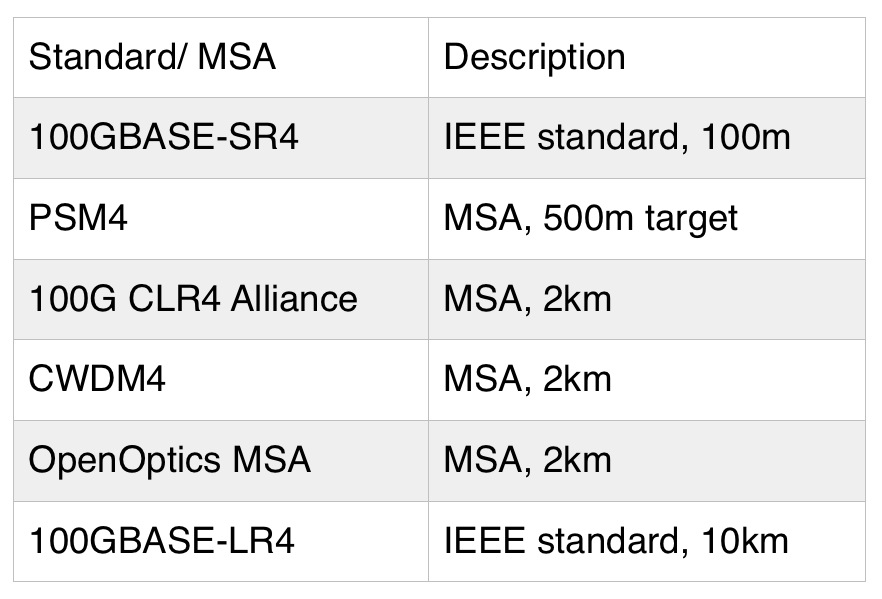 The table provides a summary of the latest MSAs and how they relate to the IEEE 100 Gigabit client interface standards. Source: Gazettabyte.
The announcement follows in the footsteps of the CWDM4 MSA, announced at the start of the week. The CWDM4 is another 100 Gig single-mode fibre MSA backed by optical module makers, Avago Technologies, Finisar, JDSU and Oclaro.
The two MSAs are the latest of several announced interfaces - three in the last three weeks - to tackle mid-reach distances from 100m-plus to 2km. The MSAs reflect an industry need to fill the void in the IEEE standards: the -SR4 multimode standard, with its 100m reach, and the 10km -LR4 that is seen as over-specified for data centre requirements.
Below is a discussion of the recent data centre MSAs
The PSM4 MSA
The PSM4 MSA is a four-channel parallel single mode interface that uses eight- or 12-fibre cabling based on the MTP/MPO optical connectors. The PSM4 uses simpler optics than the 10km IEEE 100GBASE-LR4 and the shorter-reach 2km offshoot, the CWDM4 MSA, and thus promises lower cost. But this is at the expense of using eight fibres and more expensive connectors compared to the single-mode CWDM4.
The PSM4 is expected to have a reach of at least 500m; above that the cost of the fibre becomes the dominant factor. "Note that a 500m PMD [physical medium dependent layer] at 100 Gig was an objective of the IEEE 802.3bm group but it did not happen, so the industry is defining products that fill the gap," says Dale Murray, principal analyst at LightCounting Market Research.
The PSM4 MSA was first detailed in January and includes such members as Avago Technologies, Brocade, JDSU, Luxtera, Oclaro and Panduit.
The 100 Gig CLR4 Alliance
The 100 Gig CLR4 MSA is backed by companies including ebay; equipment vendors Arista Networks, Brocade, Dell, Fujitsu, HP, and Oracle; silicon photonics players Aurrion, Intel, Skorpios Technologies (Oracle is also a proponent of silicon photonics); optical module and component players ColorChip, Kaiam, Oclaro, Oplink, NeoPhotonics; and chip vendors, Netronome and Semtech.
The 100 Gig standard is based on a QSFP form factor module and uses two single mode fibres - 1 send and 1 receive - for duplex communications. The MSA has a 2km reach and uses coarse wavelength-division multiplexing (CWDM). The 8.5mm x18mm x 72mm QSFP has a maximum power consumption of 3.5W and enables a port density of 36 modules on a face plate of a 1 rack unit card, or 3.6 Terabits overall.
At the recent OFC show, Skorpios Technologies demonstrated a QSFP28-CLR4. The silicon photonics player said its module was based on a single-chip that integrates the lasers, modulators, detectors and optical multiplexer and de-multiplexer, to deliver significant size, cost and power benefits. It also said the transceiver achieved a reach of 10km, putting its CLR4 on a par with the IEEE -LR4
At OFC ColorChip announced its iLR4 which is a QSFP28 with a 2km although, like with Skorpios, this was before the 100G CLR4 Alliance launch.
The CWDM4 MSA
The CWDM4 MSA also uses 4-channel CWDM optics and two-fibre cabling. The CWDM4 is being promoted as a complement to the PSM4. "It is MSA-based and has a 2km target," says Murray. "This is an LR4 with relaxed specs; it has no thermal electric cooler but uses the same wavelengths."
"From the link solution point of view, the PSM4 may be more cost effective than the CWDM4 up to 200m-300m," says I-Hsing Tan, segment marketing manager for Ethernet and storage optical transceivers at Avago. "But CWDM4 is for sure the winner beyond 200m and can be more cost effective than the 100GBASE-LR4 solution up to 2km."
Companies backing the CWDM4 MSA include Avago Technologies, Finisar, JDSU and Oclaro.
The OpenOptics MSA
The OpenOptics MSA was launched at OFC by Mellanox Technologies and Ranovus. The MSA uses 1550nm optics and DWDM. The first implementation will be a 100G QSFP28 module and the distance it will address is up to 2km. The MSA will also support future 400 Gig and greater interface speeds.
The degree of acceptance of the OpenOptics MSA is still to be determined compared to the more broadly backed CWDM4.
Other developments
The CLR4 Alliance may not be the final word regarding MSA announcements for the data centre.
Work is ongoing to use advanced modulation for data centre links, such as PAM-8 and carrier multi-tone.
Both Ciena's Joe Berthold and Ovum's Daryl Inniss address the importance of client-side interfaces and whether the rush to announce new MSAs is beneficial overall.
The story was first published on April 1st and has been updated to include the CLR4 Alliance MSA.
OFC 2014 industry reflections - Part 2

The high cost of 100 Gigabit Ethernet client modules has been a major disappointment to me as it has slowed adoption
Joe Berthold, Ciena
Joe Berthold, vice president of network architecture at Ciena.
OFC 2014 was another great event, with interesting programmes, demonstrations and papers presented. A few topics that really grabbed my interest were discussions around silicon photonics, software-defined networking (SDN) and 400 Gigabit Ethernet (GbE).
The intense interest we saw at last year’s OFC around silicon photonics grew this year with lots of good papers and standing-room-only sessions. I look forward to future product announcements that deliver on the potential of this technology to significantly reduce cost of interconnecting systems over modest distances. The high cost of 100GbE client modules has been a major disappointment to me as it has slowed adoption.
Another area of interest at this year’s show was the great deal of experimental work around SDN, some more practical than others.
I particularly liked the reviews of the latest work under the DARPA-sponsored CORONET programme, whose Phase 3 focused on SDN control of multi-layer, multi-vendor, multi-data centre cloud networking across wide area networks.
In particular, there were talks from three companies I noted: Anne Von Lehman of Applied Communication Sciences, the prime contractor, provided a good program overview; Bob Doverspike of AT&T described a very extensive testbed using equipment of the type currently deployed in AT&T’s network, as well as two different processing and storage virtualisation platforms; and Doug Freimuth of IBM described its contributions to CORONET including an OpenStack virtualisation environment, as well as other IBM distributed cloud networking research.
All the action on rates above 100 Gig lies with the selection of client signals. 400 Gig seems to have the major mindshare but there are still calls for flexible rate clients and Terabit clients.
One thing I enjoyed about these talks was that they described an approach to SDN for distributed data centre networking that is pragmatic and could be realised soon.
I also really liked a workshop held on the Sunday on the question whether SDN will kill GMPLS. While there was broad consensus that GMPLS has failed in delivering on its original turn-of-the-century vision of IP routers control of multi-layer, multi-domain networks, most speakers recognised the value distributed control planes have in simplifying and speeding the control of single layer, single domain networks.
What I took away was that single layer distributed control planes are here to stay as important network control functions, but instead will work under the direction of an SDN network controller.
As we all know, 400 Gigabit dense wavelength division multiplexing (DWDM) is here from the technology perspective, but awaiting standardisation of the 400 Gig Ethernet signal from the IEEE, and follow-on work by the ITU-T on signal mapping to OTN. In fact, from the perspective of DWDM transmission systems, 1 Terabit-per-second systems can be had for the asking.
All the action on rates above 100 Gig lies with the selection of client signals. 400 Gig seems to have the major mindshare but there are still calls for flexible rate clients and Terabit clients.
One area that received a lot of attention, with many differing points of view, was the question of the 400GbE client. As the 400GbE project begins soon in the IEEE, it is time to take a lesson from the history of the 100 Gig client modules and do better.
Let us all agree that we don’t need 400 Gig clients until they can do better in cost, face plate density, and power dissipation than the best 100 Gig modules that will exist then.
The first 100 Gig DWDM transceivers were introduced in 2009. It is now 2014 and 100 Gig is the transmission rate of choice for virtually all high capacity DWDM network applications, with a strong economic value proposition versus 10 Gig. Yet the industry has not yet managed to achieve cost/bit parity between 100 Gig and 10 Gig clients - far from it!
Last year's OFC, we saw many show floor demonstrations of CFP2 modules. They promise lower costs, but evidence of their presence in shipping products is still lacking. At the exhibit this year we saw 100 Gig QSFP28 modules. While progress is slow, the cost of the 100 Gig client module continues to result in many operators favouring 10 Gig handoffs to their 100 Gig optical networking systems.
Let us all agree that we don’t need 400 Gig clients until they can do better in cost, face plate density, and power dissipation than the best 100 Gig modules that will exist then. At this juncture the 100 Gig benchmark we should be comparing 400 Gig to is a QSFP28 package.
Lastly, last year we heard about the launch of an OIF project to create a pluggable analogue coherent optical module. There were several talks that referenced this project, and discussed its implications for shrinking size and supporting higher transceiver card density.
Broad adoption of this component will help drive down costs of coherent transceivers, so I look forward to its hearing about its progress at OFC 2015.
Daryl Inniss, vice president and practice leader, Ovum.
There was no shortage of client-side announcements at OFC and I’ve spent time since the conference trying to organise them and understand what it all means.
I’m tempted to say that the market is once again developing too many options and not quickly agreeing on a common solution. But I’m reminded that this market works collaboratively and the client-side uncertainty we’re seeing today is a reflection of a lack of market clarity.
Let me describe three forces affecting suppliers:
The IEEE 100GBASE-xxx standards represent the best collective information that suppliers have. Not surprisingly, most vendors brought solutions to OFC supporting these standards. Vendors sharpened their products and focused on delivering solutions with smaller form factors and lower power consumption. Advances in optical components (lasers, TOSAs and ROSAs), integrated circuits (CDRs, TIAs, drivers), transceivers, active optical cables, and optical engines were all presented. A promising and robust supply base is emerging that should serve the market well.
A second driver is that hyperscale service providers want a cost-effective solution today that supports 500m to 2km. This is non-standard and suppliers have not agreed on the best approach. This is where the market becomes fragmented. The same vendors supporting the IEEE standard are also pushing non-standard solutions. There are at least four different approaches to support the hyperscale request:
- Parallel single mode (PSM4) where an MSA was established in January 2014
- Coarse wavelength division multiplexing—using uncooled directly modulated lasers and single mode fibre
- Dense wavelength division multiplexing—this one just emerged on the scene at OFC with Ranovus and Mellanox introducing the OpenOptics MSA
- Complex modulation—PAM-8 for example and carrier multi-tone.
Admittedly, the presence of this demand disrupts the traditional process. But I believe the suppliers’ behavior reflects their unhappiness with the standardisation solution.
The good news is these approaches are using established form factors like the QSFP. And silicon photonic products are starting to emerge. Suppliers will continue to innovate.
Ambiguity will persist but we believe that clarity will ultimately prevail.
The third issue lurking in the background is knowledge that 400 Gig and one Terabit will soon be needed. The best-case scenario is to use 100 Gig as a platform to support the next generation. Some argue for complex modulation as you reduce the number of optical components thereby lowering cost. That’s good but part of the price is higher power consumption, an issue that is to be determined.
Part of today’s uncertainty is whether the standard solution is suitable to support the market to the next generation. Sixteen channels at 25 Gig is doable but feels more like a stopgap measure than a long-term solution.
These forces leave suppliers innovating in search of the best path forward. The approaches and solutions differ for each vendor. Timing is an issue too with hyperscale looking for solutions today while the mass market may be years away.
We believe that servers with 25 Gig and/ or 40 Gig ports will be one of the catalysts to drive the mass market and this will not start until about 2016. Meanwhile, each vendor and the market will battle for the apparent best solution to meet the varying demands. Ambiguity will persist but we believe that clarity will ultimately prevail.
OFC 2014 industry reflections - Part 1
T.J. Xia, distinguished member of technical staff at Verizon
The CFP2 form factor pluggable - analogue coherent optics (CFP2-ACO) at 100 and 200 Gig will become the main choice for metro core networks in the near future.

I learnt that the discrete multitone (DMT) modulation format seems the right choice for a low-cost, single-wavelength direct-detection 100 Gigabit Ethernet (GbE) interface for data ports, and a 4xDMT for 400GbE ports.
As for developments to watch, photonic switches will play a much more important role for intra-data centre connections. As the port capacity of top-of-rack switches gets larger, photonic switches have more cost advantages over middle stage electrical switches.
Don McCullough, Ericsson's director of strategic communications at group function technology
The biggest trend in networking right now is software-defined networking (SDN) and Network Function Virtualisation (NFV), and both were on display at OFC. We see that the combination of SDN and NFV in the control and software domains will directly impact optical networks. The Ericsson-Ciena partnership embodies this trend with its agreement to develop joint transport solutions for IP-optical convergence and service provider SDN.
 We learnt that network transformation, both at the control layer (SDN and NFV) and at the data plane layer, including optical, is happening at the network operators. Related to that, we also saw interest at OFC in the announcement that AT&T made at Mobile World Congress about their User-Defined Network Cloud and Domain 2.0 strategy where AT&T has selected to work with Ericsson on integration and transformation services.
We will continue to watch the on-going deployment of SDN and NFV to control wide area networks including optical. We expect more joint developments agreements to connect SDN and NFV with optical networking, like the Ericsson-Ciena one.
One new thing for 2014 is that we expect to see open source projects like OpenStack and Open DayLight play increasingly important roles in the transformation of networks.
Brandon Collings, JDSU's CTO for communications and commercial optical products
The announcements of integrated photonics for coherent CFP2s was an important development in the 100 Gig progression. While JDSU did not make an announcement at OFC, we are similarly engaged with our customers on pluggable approaches for coherent 100 Gig.
I would like to see convergence around 400 Gig client interface standards
There is a lack of appreciation of the data centre operators who aren’t big household names. While the mega data centre operators have significant influence and visibility, the needs of the numerous, smaller-sized operators are largely under-represented.
I would like to see convergence around 400 Gig client interface standards. Lots of complex technology here, challenges to solve and options to do so. But ambiguity in these areas is typically detrimental to the overall industry.
Mike Freiberger, principal member of technical staff, Verizon
The emergence of 100 Gig for metro, access, and data centre reach optics generated a lot of contentious debate. Maybe the best way forward as an industry isn’t really solidified just yet.
 What did I learn? Verizon is a leader in wireless backhaul and is growing its options at a rate faster than the industry.
The two developments that caught my attention are 100 Gig short-reach and above-100-Gig research. 100 Gig short-reach because this will set the trigger point for the timing of 100 Gig interfaces really starting to sell in volume. Research on data rates faster than 100 Gig because price-per-bit always has to come downward.
OFC 2014 product round-up - Part 1
Part 1: Line-side technologies
Technologies for 100 Gigabit were prominent at this year's OFC conference and exhibition held in San Francisco earlier this month.
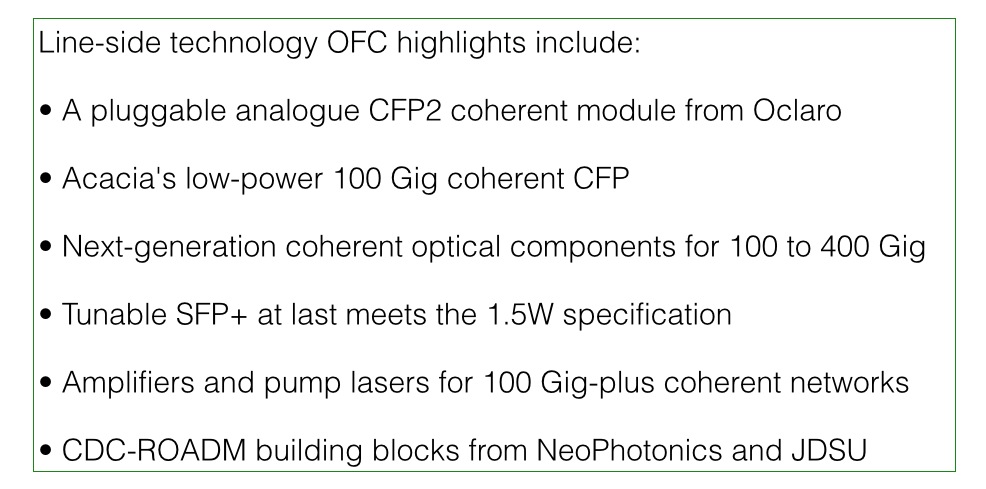
The transition to smaller pluggable modules – client-side CFP2, CFP4 and QSFP28 interfaces - was one 100 Gig trend, another was the first 100 Gig pluggable modules for metro and metro-regional networks. Acacia Communications detailed its low-power AC-100 CFP, while Oclaro demonstrated coherent optics in the smaller CFP2 pluggable module.
To fit within the CFP2, Oclaro has developed a transmitter that combines two tunable lasers (one being for the coherent receiver) and an indium phosphide modulator, and a micro intradyne coherent receiver (micro ICR).
Having 100 Gig coherent optics in a CFP2 will enable equipment makers to double the 100 Gig line ports on their platforms. The optics will also support polarisation multiplexed, 16-quadrature amplitude modulation (PM-16-QAM) and hence 200 Gig transmission. However, given the CFP2's limited power profile, the coherent DSP-ASIC will need to reside on the line card, external to the module. Oclaro says samples of its 'analogue CFP2' will be with customers from the second quarter of the year.
The same coherent optics will also be used for Oclaro's 100 Gig coherent CFP module. "If you combine the [transmitter and micro ICR] optics, you get the CFP2, and the power target is 12W," says Robert Blum, director, product management, 40 and 100 Gig line-side modules at Oclaro. "Combining the optics with a [coherent] DSP in the CFP, the power target is 32W, the highest CFP [power] class."
Oclaro's 100 Gig CFP will be available by year-end, coinciding with a new generation of merchant coherent DSP-ASIC designs. ClariPhy Communications is sampling its LightSpeed-II devices, implemented using a 28nm CMOS process, while NTT Electronics (NEL) is developing its next-generation DSP-ASIC, expected to use an even more advanced CMOS process.
Integrating the DSP chip and optics in a CFP simplifies a line card design and adds flexibility: the same CFP port can be used for line-side or client-side modules. But given that the coherent optics consumes 12W, the next-generation DSP-ASIC must consume no more than 18W typically, with the remaining 2W to accommodate the physical layer ICs, if the CFP's maximum power profile is not to be exceeded.
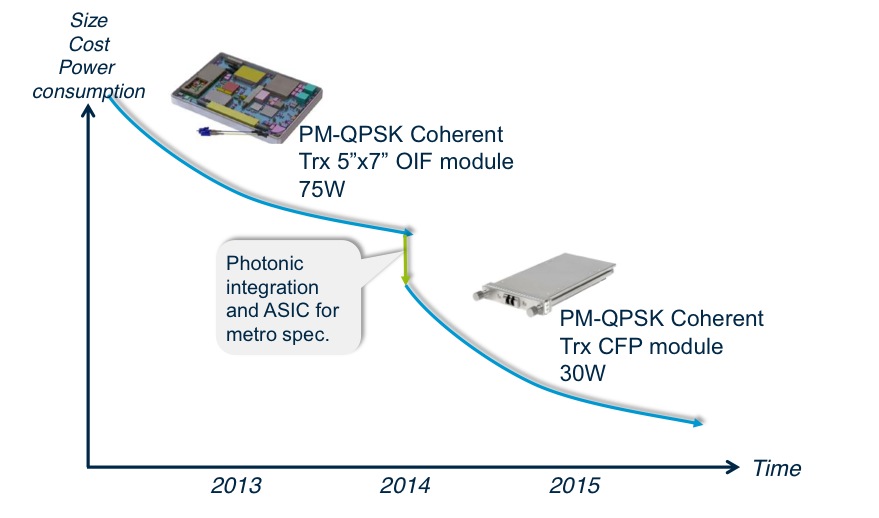
Acacia Communications' AC-100 coherent CFP module uses the company's DSP-ASIC and photonic integrated circuit (PIC) implemented using silicon photonics. The resulting 100 Gig CFP consumes 24-26W, well within the CFP's maximum 32W.
Meanwhile, Fujitsu Optical Components demonstrated all the components needed to make a 100 Gig coherent CFP, using its indium phosphide modulator to generate a 100 Gig polarisation multiplexed, quadrature phase-shift keying (PM-QPSK) signal, and a micro ICR.
Considering that the 5x7-inch Optical Internetworking Forum (OIF) multi-source agreement (MSA) 100 Gig transponder for long-haul consumes some 80W, with the DSP-ASIC alone consuming over half that, the advent of the coherent CFP and analogue CFP2 highlights the industry’s recent progress in shrinking the size and power consumption of coherent optics.
"Our focus long term is the CFP2. It is where we think the market is going to go in the next two years."
Ferris Lipscomb, NeoPhotonics
Coherent components
NeoPhotonics detailed an integrated coherent transmitter that combines a narrow-linewidth tunable laser and a PM-QPSK modulator in one package. The device joins NeoPhotonics' micro Integrable Tunable Laser Assembly (ITLA) and micro ICR that have already been announced. "These are the next generation, smaller form factor coherent optical components," says Ferris Lipscomb, vice president of marketing at NeoPhotonics. The transmitter supports PM-QPSK and PM-16-QAM such that it can be used for 100, 200 and even as an element to enable 400 Gig transmission.
The device is suited for line card, OIF MSA modules, and pluggable CFP and CFP2 designs. "Our focus long term is the CFP2," says Lipscomb. "It is where we think the market is going to go in the next two years." NeoPhotonics says its coherent devices has been sampling to customers and will be generally available in the second half of the year.
Oclaro announced that its micro ITLA, first detailed at ECOC 2013, now supports a flexible grid; the tunable laser's wavelength can be set independent of the ITU Grid spanning the C-band. Such a capability is required for advanced optical networks based on flexible-grid ROADMs and spectrally-efficient super-channels. "The flexible-grid micro ITLA gives peace of mind [to operators] even if it is not widely used yet," says Oclaro's Blum. The technology used for the micro ITLA is also used for Oclaro's CFP and CFP2 line side modules.
Fujitsu Optical Components announced a lithium niobate modulator that supports 100 Gig PM-QPSK and 400 Gig PM-xQAM signals. The new modulator has the same drive voltage as its existing 100 Gig lithium niobate modulator but is half the size. The company also announced an accompanying ICR that also supports 100 and 400 Gig transmissions in core networks. The company says both devices will be available from July.
Sumitomo Electric Industries detailed its micro ITLA at OFC. The micro ITLA uses a narrower line width laser and reduces power consumption by a fifth. The company also showcased a micro ICR that supports 100 and 200 Gig transmissions, and an indium phosphide based Mach-Zehnder modulator that is smaller and has lower power than a lithium niobate-based version.
Avago Technologies announced its micro ICR at OFC, a demonstration of Avago's broad component portfolio following its acquisition of CyOptics. Finisar was another company that showcased a new portfolio of high-speed optical components following its acquisition of u2t Photonics. These include indium phosphide-based Mach-Zehnder modulators and 100 Gig receivers and photodetectors.
Tunable SFP+
Both JDSU and Oclaro detailed their latest 10 Gigabit tunable SFP+ optical modules. Moving the tunable laser design from an XFP to the SFP+ has been a challenge, meeting the SFP+'s smaller dimensions and 1.5W power consumption.
Oclaro's latest tunable SFP+ now meets the 1.5W SFP+ specification. Oclaro says that to achieve the specification, it produced a more compact integrated laser Mach-Zehnder chip. Oclaro demonstrated the tunable SFP+ operating at 85oC. Beta samples of the tunable SFP+ are being shipped and the module will soon undergo qualification.
JDSU has had a tunable SFP+ product for over a year but its power consumption is 2W. The SFP+ length is also elongated by 4mm to fit the tunable laser. Now, JDSU has announced a revised design that no longer needs the extra 4mm and achieves a power consumption of 1.6W. "We will achieve the 1.5W specification in the near future," says Brandon Collings, JDSU's CTO for communications and commercial optical products.
"The reason why there is a lot of talk about hybrid EDFA-Raman in the industry is that it works very well with coherent."
Rafik Ward, Finisar
Pump lasers and hybrid amplifiers
JDSU also announced pump laser designs. The motivation for these latest pump products is the more demanding link budgets required for 100 Gig-and-greater transmission speeds while still achieving long-distance reaches.
JDSU announced Raman pump lasers for hybrid EDFA-Raman amplifiers. These are more power-efficient and cover the Raman pump wavelengths required, says JDSU: a 600mW output between 1425-1470nm and 550mW at 1470-1495nm. The company has also detailed higher-power 980nm pumps for EDFAs. "More power is almost always a good thing as it allows you a lot more design freedom and performance in your amp," says Collings.
Finisar demonstrated a hybrid EDFA-Raman amplifier for the first time. The hybrid amp is capable of spanning 220km and has a 44dB link loss. "The reason why there is a lot of talk about hybrid EDFA-Raman in the industry is that it works very well with coherent," says Rafik Ward, vice president of marketing at Finisar. Amplifier span distances of 80km are commonly used but the purpose of the demonstration was to showcase the product's capability, says Ward.
WSSes and multicast switches
NeoPhotonics has announced a modular multicast switch that allows an operator to grow a ROADM's node according to demand. The multicast switch is used to add colourless, directionless and contentionless (CDC) attributes to the ROADM. "You can have any wavelength [colourless] from any direction come out at any port [directionless]," says Lipscomb. "And if you have two identical wavelengths coming from different directions, you can drop them through the same switch [contentionless]."
Lipscomb cites as an example an 8-degree ROADM node, with each direction fibre carrying 100 dense WDM channels. Even if only a quarter of the channels are dropped, that is 200 channels, he says: "What we are announcing is a modular multicast switch; you can start with 4 channels and 4 drops and keep adding modular line cards as needed to add more drop ports and more directions."
NeoPhotonics modular multicast switches include such dimensions as 4x4, 4x16 and 8x16. "Carriers don't want to limit their future deployment but they also don't want to spend a lot of money now because they might want to drop 100 channels later," says Lipscomb.
JDSU announced its second-generation twin 1x20 wavelength-selective switch (WSS) that fits on a single-slot card. The twin WSS is used for advanced flexible-grid CDC-ROADM nodes.
The latest twin 1x20 WSS has the same functionality as JDSU's current twin 1x20 WSS that has been available for a year but which occupies two chassis slots. "It has the same capability but is considerably smaller," says Collings.
Indeed, the twin WSS is sufficiently compact that other functions can be added to the card such as amplification, optical power monitoring and optical service channels, communication channels between nodes used for such tasks as provisioning, power management and firmware updates.
For the OFC 2014 product round-up - Part 2, click here
Ciena uses software to dip into the photonic layer
Ciena has enhanced its control plane and line elements to enable software to control the optical networking layer. The additions are part of Ciena's OPn network architecture evolution to enable greater visibility and automation. "It is about putting software into a system to allow you to program the photonic line," says Michael Adams, vice president of product & technology marketing at Ciena.

"For an SDN controller to control a photonic line, we need to present it as a programmable layer. The infrastructure is now there to be programmed."
Michael Adams, Ciena
Dubbed WaveLogic Photonics, the enhancements address the optical line system, made up of Ciena's WaveLogic coherent module, amplifier and reconfigurable optical add/ drop multiplexer (ROADM) elements. Ciena's ROADM is colourless and directionless and supports flexible-grid lightpaths, while the contentionless attribute will be added in the second half of the year.
Making the optical layer programmable is tricky. The OTN, Ethernet and IP networking layers above the line system are digital, lending themselves to software control. The optical layer, however, is not. Its performance is determined by linear and non-linear fibre transmission effects and parameters such as the optical signal-to-noise ratio.
"We believe the photonic line is equally important to be programmed, but the challenge has been that it is an analogue domain," says Adams.
To this aim, Ciena's WaveLogic Photonics introduces three changes:
- The OneConnect Intelligent Control Plane has been extended to include the photonic layer.
- Software-based line monitoring has been added to Raman to simplify amplifier deployment.
- Network analytics has been introduced to identify faults and optical signal loss.
By extending the OneConnect Control Plane to the photonic level, service providers can offer customers more tailored service-level agreements (SLAs). Customers that want protection against double fibre cuts can add automated optical restoration. After the first cut, the 50-millisecond OTN layer restoration kicks in. If a second cut occurs, OneConnect will restore the network in tens of seconds. At present, a truck roll and manual repair is needed after the second cut and that can take hours to repair. "The combination of the two [OTN and optical restoration] gives you a much more flexible system of SLAs that can be offered," says Adams.
The second line system enhancement, dubbed Smart Raman, adds a software-based optical time-domain reflectometer (OTDR) to Ciena's hybrid Raman/ EDFA amplifiers to simplify their deployment. The OTDR enables the amp to monitor and characterise the line.
"The Raman provides simple and controlled turn-up and will not turn on until it has checked that the surrounding fibre does not have any high losses," says Adams. Such automation replaces the careful manual configuration otherwise required when deploying high-powered Raman amps.
Ciena is also using the line data collected by the OTDR to provide network analytics. The line's condition can be plotted over time, helping identify any degradation in line elements. The analytics will also locate faults across fibre spans without requiring a truck roll. "Now from the NOC [network operations centre], that [fault] visibility is within 3m," says Adams.
Comcast has already used Smart Raman and the analytics as part of a Terabit trial conducted with Ciena. The cable operator located signal loss points on the line. "Comcast was able to recover several dBs of margin on that fibre," says Adams. "With 16-QAM used for the Terabit trial, they were able to go much farther; they achieved 1,000km even on marginal fibre." Ciena will also introduce advanced 16-QAM signaling in the second half of the year.
Ciena says WaveLogic Photonics should be viewed as enhancing the OneConnect control plane at the OTN and optical levels, while paving the way for software-defined networking (SDN) and applications-driven automation.
"For an SDN controller to control a photonic line, we need to present it as a programmable layer," says Adams. "The infrastructure is now there to be programmed."
The Smart Raman and analytics software is available and shipping in volume, says Ciena, while the photonic additions to the control plane are being trialled by customers and will be available in several weeks as part of the Release 10.0 software for Ciena's 6500 platform.
See also:
Ovum: Ciena launches WaveLogic Photonics, click here
Acacia uses silicon photonics for its 100G coherent CFP
Acacia Communications has revealed the innards of its 100 Gig coherent pluggable module for metro networks. The AC-100 CFP combines a low-power DSP-ASIC with a silicon-photonics-based optics chip. The CFP's reach is 80km to 1,200km, and its power consumption is 24-26W, well within the pluggable's maximum power profile of 32W.
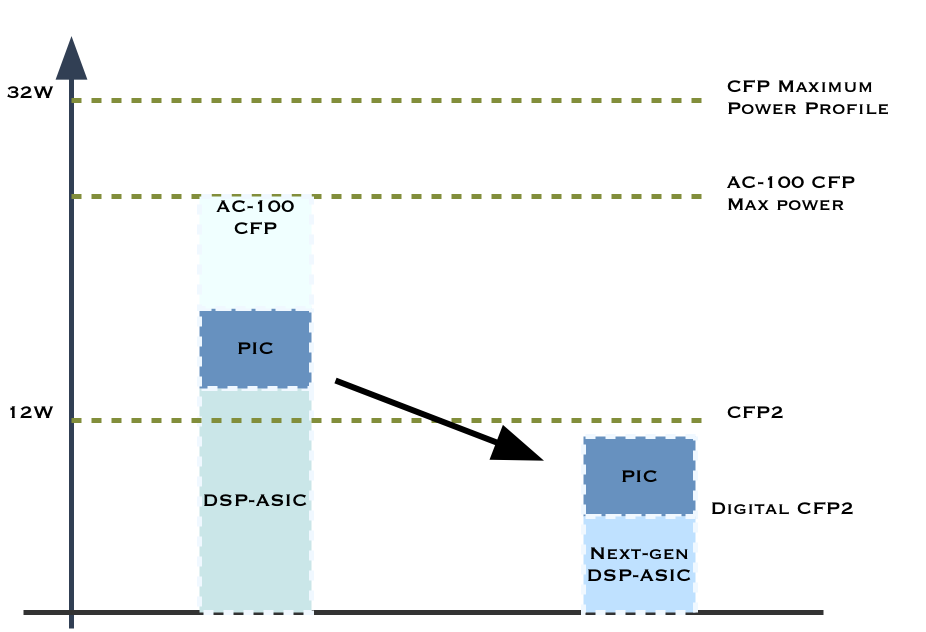 The power consumption of the AC-100 CFP, and its main components, and the target power consumptions of the components needed for a digital CFP2. Source: Gazettabyte
The start-up says it is shipping samples of the AC-100 CFP and already has 15 customers. "That includes some of the bigger [systems] players that have their own internal DSP," says Raj Shanmugaraj, CEO of Acacia. "The coherent CFP is not their focus; they are going after long-haul."
The start-up is shipping samples of the AC-100 CFP and already has 15 customers
Acacia chose to develop it own DSP chips as it sees the technology as core for coherent-based optical transmission. "That is where we see the big market," says Shanmugaraj. "We have a 100 Gig [MSA] that has been shipping, and a 200-400 Gig product that is in development."
DSP-ASIC and silicon photonics
The DSP-ASIC for the AC-100 CFP is Acacia's second chip design. Its first, a DSP-ASIC for its long-haul 5x7-inch OIF MSA transponder, is implemented using a 40nm CMOS process. The latest metro DSP-ASIC uses 28nm CMOS.
The DSP-ASIC includes analogue-to-digital (A/D) and digital-to-analogue (D/A) converters and a serialiser/ deserialiser (Serdes). Also on-chip is the digital signal processor (DSP) that implements soft-decision, forward error correction (SD-FEC) and compensation algorithms for chromatic and polarisation-mode dispersion.
Other DSP-ASIC features include spectral shaping for flexible grid transmission. "The signal processing on the transmit side fits in the one ASIC," says Benny Mikkelsen, CTO at Acacia. Also on-chip are a 100 Gig OTN (Optical Transport Network) framer and a microprocessor to manage the DSP-ASIC and the overall CFP.
The DSP-ASIC consumes 12-14W: the A/D, D/A converters and Serdes consume 5W, while the DSP consumes 7W for an 80km link - the 100 Gig equivalent of the -ZR spec - and 9W for 1,200km transmission due to the more powerful SD-FEC needed.
Mikkelsen says achieving a low-power ASIC requires several approaches. The SD-FEC is designed to be extremely low power, he says, as is the dispersion compensation: "Not just the algorithms but how we code the algorithms." Also, how the ASIC's circuitry is laid out impacts power consumption.
Acacia's engineers have also developed a silicon-photonics chip that combines the coherent transmitter and receiver optics. "The PIC [photonic integrated circuit] is the first silicon-photonics chip targeted at metro/ metro-regional," says Shanmugaraj. "It is an IC that has all the components except the laser, and is co-packaged in a gold box with the drivers and trans-impedance amplifiers."
Acacia's PIC is monolithic; all the functional blocks are implemented in silicon rather than combined silicon and III-V materials, a technique known as heterogeneous integration.
Using silicon photonics rather than indium phosphide has advantages, says Shanmugaraj. Silicon photonics benefits from mature CMOS processes developed for the semiconductor industry: "With the large silicon wafers, you can have thousands of these silicon PICs on them," he says.
Acacia tests the PICs directly on the wafer. This avoids having to dice the wafer and package each die before testing. "We also don't need thermal control [of the chip] or hermetic packaging," says Shanmugaraj. With indium phosphide, the modulators do require thermal cooling, adding to the design complexity and the power consumption. The PIC is 10mm long and consumes less than 5W.

The AC-100 CFP is expected to cost less than half the 5x7-inch 100 Gig coherent MSA which sells for $20,000. "One of the biggest pain points in metro is cost, if you ask most of the service providers," says Shanmugaraj. At below $10,000, the coherent CFP will be cost-competitive with the 100 Gig direct-detection CFP that uses 4x25 Gig wavelengths. However, the 100 Gig direct-detection CFP continues to come down in price as more products come to market.
Roadmap
Acacia will continue to address long-haul and metro, each requiring its own ASIC. "We don't believe that you can have one ASIC that serves both submarine and the metro," says Mikkelsen. In turn, silicon photonics will be used for pluggables while discrete optics will be used for the more demanding submarine.
The company says it is developing a multi-core ASIC to support super-channels and 16-QAM modulation for 200 Gig and 400 Gig transmission. The company says it will provide more details of its flexible, adaptive-rate ASIC at ECOC, to be held in September this year.
The company's product roadmap also features a co-packaged DSP-ASIC and PIC that will fit within a CFP2. Achieving such a pluggable, dubbed a digital CFP2, require a further halving of the DSP-ASIC's power consumption. This, says Acacia, is achievable using the next CMOS process node after 28nm.
The advantages of a digital CFP2 compared to a CFP2 with optics only, with the DSP-ASIC on the line card, include using the DSP-ASIC only when it is needed. When a fault occurs, the relevant pluggable can be replaced rather than having to remove the complete line card. Lastly, new functionality in the DSP-ASIC can be introduced by plugging in the new CFP2 pluggable compared with having to redesign the line card.
See also:
Transmode adopts 100 Gigabit coherent CFPs, click here
ClariPhy samples a 200 Gigabit coherent DSP-ASIC, click here
Amplifiers come to the fore to tackle agile network challenges
The growing sophistication of high-speed optical transmission based on 100 Gigabit-plus lightpaths and advanced ROADMs is rekindling interest in amplifier design.

Raman is a signature of the spread of 100 Gig but also the desire of being upgradable to higher bit rates
Per Hansen, II-VI
For the last decade, amplifier designers have been tasked with reducing the cost of Erbium-doped fibre amplifiers (EDFAs). "Now there is a need for new solutions that are more expensive," says Daryl Inniss, vice president and practice leader, components at market research firm, Ovum. "It is no longer just cost-cutting."
Higher output power amplifiers are needed to boost 100 Gig-plus signals that have less energy. Such amplifiers must also counter greater losses incurred by sophisticated colourless, directionless and contentionless (CDC) ROADM nodes. System vendors also require more power-efficient and compact amplifiers to maximise the chassis slots available for revenue-generating 100 Gig transponders.
Such requirements have created interest in all amplifier types, not just EDFAs but hybrid EDFA-Raman and Raman amplifiers.
"Improving the optical signal-to-noise ratio (OSNR) is of paramount consideration to enable higher capacity and reach for 100 Gig-plus lambdas," says Madhu Krishnaswamy, director, product line management at JDSU. "Raman amplification is becoming increasingly critical to delivering this OSNR improvement, largely in long haul."
Other developments include micro-amplifiers that boost single channels, and arrayed amplifiers used with ROADM nodes. These developments are also driving optical components: power-efficient, integrated pump lasers are needed for such higher-power amplifiers.
Operators' requirements span all three amplifier classes: EDFA, hybrid EDFA-Raman and all-Raman, says Anuj Malik, manager, solutions marketing at Infinera: "Some networks require a high OSNR and use hybrid amplifiers but some networks are prone to fibre cuts and hence avoid hybrid as fibre splices can cause more problems with Raman."
Raman differs from EDFA in several ways. Raman has a lower power efficiency, the optical pump power needed to pump an amplifier to achieve a certain gain and output power. This requires higher power to be launched into a Raman amplifier, raising safety issues for staff and equipment. The high launch power requires a sound connection between the Raman pump source and the fibre to avoid equipment being damaged, hence Infinera's reference to fibre splices.
Yet if Raman has a lower power efficiency, it has notable benefits when compared to an EDFA.
An EDFA performs lumped amplification, boosting the signal at distinct points in the network, every 80km commonly. Raman amplifies the signal as it travels down the fibre.
"With Raman amplification the gain is out in the fibre span, and Raman delivers a lower equivalent noise figure - a big advantage," says Per Hansen, head of product marketing, amplifier business unit at II-VI." The company II-VI acquired Oclaro's amplifier business in November 2013.
An amplifier's noise figure is a measure of performance in the network. All amplifiers introduce noise so that the input signal-to-noise ratio divided by the output signal-to-noise ratio is always greater than one. "Raman gives you a significantly better noise figure, an improvement in the range of 3 to 5dB," says Hansen.
EDFA designs continue to progress alongside the growing interest in hybrid and all-Raman. JDSU says that higher output power EDFAs, greater than 24dBm, are increasingly relevant for 96-plus channel systems that support super-channels and flexible grid ROADMs in the metro and long haul.
"Switchable-gain EDFAs to optimise the noise figure over a wider dynamic range of operation is another element enhancing overall system OSNR," says Krishnaswamy. "This is also common for metro and long haul."
Hybrid amplification combines the best characteristics of EDFA and Raman. In a hybrid, Raman is the first amplification stage where noise figure performance is most important, while the EDFA, with its power efficiency, is used as the second stage, boosting the signal to a higher level.
According to Finisar, 100 Gig uses the same receiver OSNR as 10 Gig transmissions. However, the transmission power per channel at 100 Gig is reduced, from 0 to 1dBm at 10 Gig to -2 to -3dBm at 100 Gig, due to non-linearity transmission issues. "Immediately you lose a few dBs in the OSNR," says Uri Ghera, CTO of the optical amplifier products at Finisar.
An overwhelming portion of WANs worldwide have adopted hybrid EDFA-Raman and this trend is expected to continue for the foreseeable future.
For 400 Gigabit transmission, the weaker signal sent requires the OSNR at the receiver to be 4-10dBm higher, says Ghera: "This is why you need hybrid Raman-EDFA."
Moving to a narrower channel spacing using a flexible grid also places greater demands on amplifiers. "Because of super-channels, if before we were talking about 100 channels [in the C-band], for a channel spacing of 37.5GHz it is more like 130 channels," says Ghera. "If you want the same power per channel, it means higher-output amplifiers."
The spectrum amplified by an EDFA is determined by the fibre. EDFAs amplify the 35nm-wide C-band spanning 1530 to 1565nm, and also the separate L-band at 1570 to 1605nm, if that is used. In contrast, the spectrum amplified by Raman is determined by the pump laser's wavelength. This leads to another benefit of all-Raman: far broader spectrum amplification, 100nm and wider.
Xtera is a proponent of all-Raman amplification. The system vendor has demonstrated 60nm- and even 100nm-wide spectrum amplification, broader than the C and L bands combined.
Xtera conducted trials with Verizon in 2013 using its Nu-Wave Optima platform and Raman operating over a 61nm window. The trials are detailed in Table 1.
Between 15 and 40 Terabits were sent over 4,500km and 1,500km, respectively, using several modulation schemes and super-channel arrangements. In comparison, state-of-the-art 100 Gig-plus systems achieve 16 Terabit typically across the C-band, and are being extended to 20-24 Terabit using closer-spaced channels. Using 16-QAM modulation, the reach achieved is 600km and more.
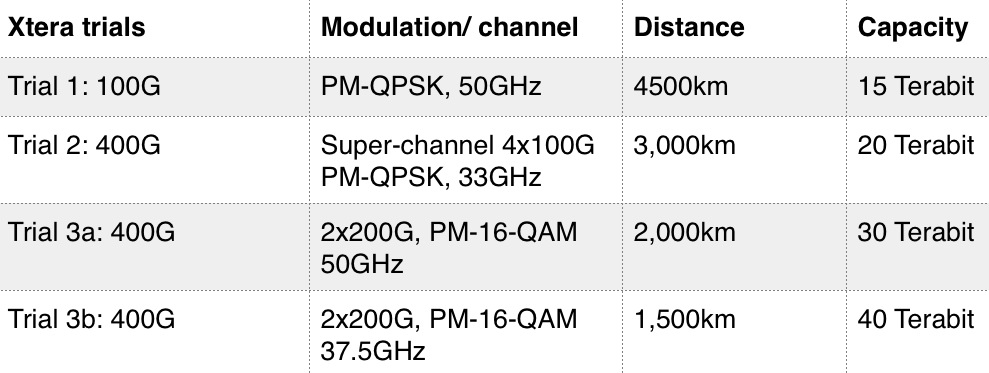 Table 1: Xtera's Verizon trial results using a 61nm spectrum and all-Raman amplification.
JDSU says hybrid amplification remains the most cost-competitive way to deliver the required OSNR and system capacity, while all-Raman can potentially increase system capacity.
Overall, it is network capacity and reach requirements that drive amplifier choice, says Krishnaswamy: "An overwhelming portion of WANs worldwide have adopted hybrid EDFA-Raman and this trend is expected to continue for the foreseeable future."
Meanwhile, the single channel micro-amp, sits alongside or is integrated within the transmitter. Operators want a transponder that meets various requirements for their reconfigurable networks. "If you look into the numbers, you want to boost the signal early on before it is attenuated," says II-VI's Hansen. "That gives you the best OSNR performance."
"This [single-channel amp] is a type that was rare in old systems," adds Finisar's Ghera. "It is also a market that is growing the fastest for us."
The micro-amp needs to be compact and low power, being alongside the power-hungry 100 Gig coherent transmitter. This is driving uncooled pump laser development and system integration.
Similar design goals apply to arrayed amplifiers that counter losses in ROADM add/ drop cards. "If you have some of the features of colourless, directionless and contentionless, you incur bigger losses in the node but you can make it up with other amps, one of these being arrayed amps," says Hansen.
Arrayed designs can have eight or more amps to support multiple-degree nodes so that achieving a power-efficient, compact design is paramount. Hence II-VI's development of an uncooled dual-chip pump laser integrated in a package. "Having four packages to pump eight amps in a small space that do not require cooling is a huge advantage," says Hansen.
The amplifier design challenges are set to continue.
One, highlighted by Infinera, is expanding amplification to the L-band to double overall capacity. JDSU highlights second-order and third-order Raman designs that use a more complex pump laser arrangement to improve system OSNR. Lowering the noise figure of EDFAs will be another continuing design goal, says JDSU.
II-VI expects further challenges in miniaturising single-channel and arrayed amplifier designs. Finisar also cites the need for more compact designs, citing putting an EDFA in an XFP package as an example.
Another challenge is producing high-power Raman amplifiers that can bridge extremely long spans, 300 to 400km. Such an amplifier must be able to read lots of physical parameters associated with the span and set the line accordingly, said Gheri.
II-VI's Hansen says the adoption of Raman and arrayed amplifiers is a good indicator of the wider deployment of next-generation network architectures. "Raman is a signature of the spread of 100 Gig but also the desire of being upgradable to higher bit rates," he says.
The article first appeared as an OFC 2014 show preview piece
ClariPhy samples a 200 Gigabit coherent DSP-ASIC
The CL20010 is the first of ClariPhy's LightSpeed-II family of coherent digital signal processing ASICs (DSP-ASICs), manufactured using a 28nm CMOS process. "We believe it is the first 28nm standard product, and leaps ahead of the current generation [DSP-ASIC] devices," says Paul Voois, co-founder and chief strategy officer at ClariPhy.
 Paul Voois
ClariPhy has been shipping its 40 Gigabit coherent CL4010 LightSpeed chip since September 2011. Customers using the device include optical module makers Oclaro, NEC and JDSU. "We continue to go into new deployments but it is true that the 40 Gig market is not growing like the 100 Gig market," says Voois.
With the CL20010, Clariphy now joins NTT Electronics (NEL) as a merchant supplier of high-speed coherent silicon. Clariphy has said that the LightSpeed-II devices will address metro, long-haul and submarine.
No longer do the integrators need to buy a separate transmit multiplexer chip
Using an advanced 28nm CMOS process enables greater on-chip integration. The CL20010 includes the transmit and receive DSPs, soft-decision forward error correction, and mixed signal analogue-to-digital and digital-to-analogue converters. "No longer do the integrators need to buy a separate transmit multiplexer chip," says Voois.
The LightSpeed-II silicon also features an on-chip Optical Transport Network (OTN) framer/ mapper and a general-purpose processor. The general purpose processor enables the chip to be more network aware - for example, the state of a link - and support software-defined networking (SDN) in the WAN.
The LightSpeed-II ICs support three modulation schemes - polarisation-multiplexed, bipolar phase-shift keying (PM-BPSK), quadrature phase-shift keying (PM-QPSK) and 16-quadrature amplitude modulation (PM-16-QAM). Using PM-16-QAM, the CL20010 can support 200 Gigabit traffic. "I believe that is also a first for merchant silicon," says Voois.
Having an on-chip framer enables the transmission of two 100 Gigabit clients signals as a 200 Gigabit OTN signal. In turn, combining two CL20010 devices enables a 400 Gig flexible-grid super-channel to be transmitted. The on-chip transmit DSP enables the CL20010 to support flexible grid, with the dual carrier 400 Gigabit super-channel occupying 75GHz rather than 100GHz. The CL20010 can achieve a reach of 3,500km at 100 Gig, and over 600km at 200 and 400 Gig.
ClariPhy has not announced the power consumption of its chips but says that it is also targeting the metro pluggable market. Given that a CFP coherent module consumes up to 32W and that the optics alone consume 12W, a LightSpeed-II metro DSP-ASIC will likely consume 18-20W.
Merchant market
Many of the leading optical transport equipment makers, such as Alcatel-Lucent, Ciena, Cisco Systems, Huawei and Infinera, use their own coherent DSP-ASICs. More recently, Acacia Communications announced a CFP 100 Gig coherent pluggable module that uses its internally developed DSP-ASIC.
Some of the OEMs will continue to develop internal technology but even they can't cover all possible applications
ClariPhy says that despite the bulk of the 100 Gigabit coherent ports shipped use internally developed designs, there are signs that the market is moving towards adopting merchant silicon. "It doesn't happen all at once," says Voois. "Some of the OEMs will continue to develop internal technology but even they can't cover all possible applications."
He cites coherent silicon for metro networks as an example. Equipment makers are focussed on DSP-ASIC designs that satisfy the most demanding, ultra-long-haul network applications. But such high-performance, high-power chips are not suited for the more cost-conscious, low-power and compact metro requirements.
"Our committed customer base includes a nice spectrum of applications and integration types: OEMs and module vendors; metro, long haul and submarine," says Voois.
General availability of the CL20010 is expected later this year. The company will also be demonstrating the device at OFC 2014.
Transmode adopts 100 Gigabit coherent CFPs
Transmode has detailed line cards that bring 100 Gigabit coherent CFP optical modules to its packet optical transport platforms.

We can be quicker to market when newer DSP-based CFPs appear
Jon Baldry
"We believe we are the first to market with line-side coherent CFPs, bringing pluggable line-side optics to a WDM portfolio," says Jon Baldry, technical marketing director at Transmode. Baldry says that other system vendors already support non-coherent CFP modules on their line cards and that further vendor announcements using coherent CFPs are to be expected.
The Swedish system vendor announced three line cards: a 100 Gig transponder, a 100 Gig muxponder and what it calls its Ethernet muxponder (EMXP) card. The first two cards support wavelength division multiplexing (WDM) Layer 1 transport: the 100 Gig transponder card supports two 100 Gig CFP modules while the 100 Gig muxponder supports 10x10 Gig ports and a CFP.
The third card, the EMXP220/IIe, has a capacity of 220 Gig: 12x10 Gigabit Ethernet ports and the CFP, with all 13 ports supporting optional Optical Transport Network (OTN) framing. "You can think of it as a Layer 2 switch on a card with 13 embedded transponders," says Baldry. The three cards each take up two line card slots.
Transmode's platforms are used for metro and metro regional networks. Metro has more demanding cost, space and power efficiency requirements than long distance core networks. "The move that the whole industry is taking to CFP or pluggable-based optics is a big step forward [in meeting metro's requirements]," says Baldry.
The line cards will be used with Transmode's metro edge TM-Series packet optical family that is suited for applications such as mobile backhaul and business services. "Within packet-optical networks, we can do customer premise Gigabit Ethernet all the way through to 100 Gig handover to the core on the same family of cards running the same Layer 2 software," says Baldry. Transmode believes this capability is unique in the industry.
The TM-3000 chassis is 11 rack units (RU) high and can hold eight double-slot cards, for a total of 800 Gig CFP line side capacity.
 Source: Transmode
100 Gig coherent modules
Transmode is talking to several 100 Gig coherent CFP module makers. The company will use multiple suppliers but says it is currently working with one manufacturer whose product is closer to market.
Acacia Communications announced the first CFP module late last year and other module makers are expected to follow at the upcoming OFC show in March 2014.
The roadmap of the CFP modules envisages the CFP to be followed by the smaller CFP2 and smaller still CFP4. For the CFP2 and CFP4, the coherent digital signal processor (DSP) ASIC is expected to be external to the module's optics, residing on the line card instead. The 100 Gig CFP, however, integrates the DSP-ASIC within the module and this approach is favoured by Transmode.
"We can be quicker to market when newer DSP-based CFPs appear; today we can do 800km and in the future that will go to a longer reach or lower power consumption," says Baldry. "Also, the same port can take a coherent CFP or a 100BASE-SR4 or -LR4 CFP without having the cost burden of a DSP on the card whether it is needed or not."
The company also points out that by using the integrated CFP it can choose from all the coherent designs available whereas modules that separate the optics and DSP-ASIC will inevitably offer a more limited choice.
There are also 100 Gigabit direct detection CFPs from the likes of Finisar and Oplink Communications and Transmode's cards would support such a CFP module. But for now the company says its main interest is in coherent.
"One key requirement for anything we deploy is that it works with the existing optical infrastructure," says Baldry. "One difference between 100 Gig metro and long haul is that a lot of the long distance 100 Gig is new build, whereas the metro will require 100 Gig over existing infrastructure and coherent works very nicely with the existing design rules and existing 10 Gig networks."
The 100 Gig transponder card consumes 75W, with the coherent CFP accounting for 30W of the total. The card can be used for signal regeneration, hosting two 100 Gig coherent CFPs rather than the more typical arrangement of a client-side and a line-side CFP. The card's power consumption exceeds 75W, however, when two coherent CFPs are used.
The 100 Gig transponder and Ethernet muxponder will be available in the second quarter of 2014, says Transmode, while the 100 Gig muxponder card will follow early in the third quarter of the year.