

Reflections and predictions: 2011 & 2012 - Part 1

"For 2012, the macroeconomy is likely to dominate any other developments"
Martin Geddes, telecom consultant @martingeddes
Sometimes the important stuff is slow-burning: we're seeing a continued decline in the traditional network equipment providers, and the rise in Genband, Acme, Sonus and Metaswitch in their place. Smaller, leaner, and more used to serving Tier 2 and Tier 3 operators and enterprise players and their lower cost structures.
The recognition of the decline of SMS and telephony became mainstream in 2011 -- maybe I can close down my Telepocalypse blog as what I foresaw is reality.
We've seen absolute declines in revenue and usage of telco voice and messaging in leading markets like Norway and Netherlands. The creation of Telefonica Digital is a landmark reorganisation around new markets. No longer are those initiatives endlessly parked in business development whilst marketing dream up a new price plan for minutes, messages and megabytes.
If I had to pick one thing to characterise 2011, it was the year of the App.
For 2012, the macroeconomy is likely to dominate any other developments. The scenarios are "distress", "meltdown" and "collapse".
Telecoms is well-placed to weather the storm. Even £600 smartphones may remain in vogue as people defer purchases like cars and holidays, and hide their fiscal distress with status symbols hewn out of pure blocks of profit.
Voice will be much more prominent, after decades of languishing, as LTE sets up a complex dynamic of service innovation driven by over-the-top applications - which will increasingly come from telcos as well as telecoms outsiders. Microsoft's purchase of Skype is the one to watch - if they get it right, it joins Windows and Office in the hall of fame; get it wrong, and Microsoft is probably out of the smartphone game due to a lack of competitive differentiation and advantage.
So 2012 is the year when (mobile) voice gets vocal again - because we're going to have a lot to talk about, and want to do it much cheaper and better.
Brandon Collings, CTO for communications and commercial optical products at JDS Uniphase
For the course of 2011, the tunable XFP shipped in volume and it rather quickly supplanted the 300-pin transceiver. On the service/ market trend, over-the-top consumer video (Netflix) grew rapidly to be the dominant traffic on the internet.
"Solutions for the next generation ROADM networks - self aware networks - are now firm"
I expect the maturation of 100 Gigabit to continue through 2012 with the introduction of a number of new 100 Gigabit solutions, both network equipment makers and at the transceiver level.
Also, as the adoption percentage of consumers using over-the-top video usage still seems to be relatively small, yet is growing strongly and is already the dominant traffic on the internet, it will be interesting to see how this trend continues as it strongly drives bandwidth yet with potentially unfavorable revenue models for the network operators who need to deliver it.
Lastly, I expect that as the solutions for the next generation ROADM networks - self aware networks - are now firm, the practical assessment of the value and advantages of these networks can quantitatively take place.
Eve Griliches, managing partner, ACG Research @EveGr
The Juniper PTX announcement really caught the market by surprise. I'm not so much sure why but clearly it rocked some folks back on their heels. Momentum for the product has been good as well. I think you can count this as a success story.
Another one is the Infinera 500Gbps release with super-channels. A pretty impressive technology and service providers are waiting for final product to test.
The death of Steve Jobs rattled us all. I think it struck a note for everyone in how different he was and how he touched us all.
"Content providers ask for simple, scalable and low-featured products. Those who deliver will be rewarded for listening."
I continue to be amazed at how much optical equipment content providers [the Googles, Facebooks, MSNs of this world] are deploying and how few folks at the vendor level are doing anything about getting into their networks. Maybe that is a 2012 thing, I don't know.
As for 2012, we'll definitely see some mergers and acquisitions - expect low acquisition prices too - and some companies exiting this market. I love optics and it really pains me to say that, but there are just more companies out there who can't support the declining margins. I think margin erosion will be key to who survives.
Cisco and Infinera should be bringing some cool products to market in the next six months. We hope the products are good because it will generate debate for the final vendor choices for operators such as AT&T and Verizon.
Again, content providers ask for simple, scalable and low-featured products. Those who deliver will be rewarded for listening. Some don't listen, and will wonder what happened.
Peter Jarich, service director, service provider infrastructure, mobile ecosystem, Current Analysis @pnjarich
2012 is going to be the year for LTE-Advanced (LTE-A). Why? One, vendors always like to talk up what’s next, and LTE-A is what follows LTE (Long Term Evolution).
At the same time, operators who haven’t yet deployed LTE will want to look to start with the latest and greatest. Of course, LTE-A brings real advances for operators: carrier aggregation for dealing with fragmented spectrum assets; heterogeneous networks for dealing with the interaction of small cell and macrocell networks; relaying for improved cell edge performance.
Avi Shabtai, CEO of MultiPhy
The most significant development of 2011 was the availability of CMOS technology that allows next-generation optical transport solutions for 100 Gigabit. And specifically, metro-focused solutions that hit the cost and power numbers required by this industry.
On top of that, optical communication has entered the era of digital signal processing receivers. We have also seen the potential segmentation in 100 Gigabit of metro versus long-haul, each with its specific set of solutions.
"We will see a huge growth in video consumption. This has already started but it is just the tip of the iceberg."
The transition of the telecom and datacom market to 100 Gigabit has also begun - from the transport optical network all the way to copper backplanes - it's all a 4x25Gbps architecture. This year has also seen consolidation in the ecosystem, especially among module companies.
This consolidation will continue at all industry levels in 2012: semiconductors, subsystems, systems and the carriers. The consolidation will coincide with an across-the-board price reduction in emerging technologies like 100 Gigabit transport.
The increase in capacity demand will also force an increase in requirements for various solutions supporting 100 Gigabit. I expect to see more CMOS-based devices introduced.
From a services point or view, we will see a huge growth in video consumption. This has already started but it is just the tip of the iceberg. Video will have a tremendous influence on network evolution.
Gilles Garcia, director, wired communication at Xilinx @gllsgarcia
The CFP2 and CFP4 optical modules are arriving a lot faster than it took for the CFP to follow the XFP optical module.
The CFP standard took 3-4 years to complete while the standard for the CFP2 just closed after two years. Now the CFP4 standard has been launched and is expected to take 18 months only. The new form factors are being driving by the cost-per-port of 100 Gigabit and how to reduce it. The CFP2 doubles the density when compared to the CFP while the CFP4 doubles it again.

"Programmability is becoming the key trend among telecom system vendors as operators look to react faster to standards, new feature requests and deployment of new services."
Telecom application-specific standard product (ASSP) players have been relatively quiet in 2011. Word from customers is that such vendors are pushing out their roadmap/ product availability because of too much flux in the various IEEE and ITU-T telecom standards and difficulties to justify the return-on-investment. This is proving a perfect opportunity for FPGAs.
Large system vendors are growing their network services as operators continue to outsource their network management and maintenance. As reported in their financial reports, this is an important source of business for the likes of Ericsson, Huawei and Alcatel-Lucent.
It is leading the vendors to push more of their own hardware, as they look to add value-add services and integrate the services using their own platforms. Some equipment vendors realise they do not have a full portfolio and have established partnerships for the missing platforms. They are also starting to develop platforms to generate more revenue.
In 2012, I’m not expecting a telecom revolution but I do expect accelerated evolution. And I foresee big disruptions in the ASSP market as it continues to consolidate: I expect several mergers and acquisitions among the top 20 ASSP suppliers.
Programmability is becoming the key trend among telecom system vendors as operators look to react faster to standards, new feature requests and deployment of new services. Programmability also improves time-to-market to deliver these services and reduce time-to-revenue.
Mobile backhaul will be a market driver in 2012. The growth in mobile data terminals will lead to a new generation of mobile backhaul networks. This will drive the move from 1 to 10 Gigabit Ethernet, higher-feature packet processing, and traffic management integration into mobile infrastructure to better control and bill bandwidth usage i.e. pay for what you use.
The 'God box' - packet optical transport systems and the like - are back, but really it is network needs that is driving this.
And one topic to watch that will become clearer in 2012 is how cloud computing impacts the networking market with regard such issues as security, cacheing and higher speed links.
Google is becoming an important internal - for its own usage -networking equipment player. And Google will be joined by others - Facebook, Amazon etc. What impact will this have on the traditional system networking vendors? Such new players are defining and building networks platforms tailored for their needs. This is competition to the traditional system vendors who are not getting this piece of the business. Semiconductors, including FPGAs, could serve those companies directly.
Other issues to note: What will Intel do in the networking space? Intel acquired Fulcrum in 2011 and has invested in several networking companies.
There are also technology issues.
What will happen to ternary content addressable memory (TCAM)? Broadcom's acquisition of NetLogic Microsystems has created a hole in the TCAM market. Will Broadcom continue with TCAM? Will customers want to give their TCAM business to Broadcom?
Xilinx FPGAs have added network search engines IP in the solution portfolio as multi-core ‘search engine’ face increasing difficulty in sustaining the performance required.
And of course there is the continual issue of power optimisation.
For Part 2, click here
For Part 3, click here

Boosting the 100 Gigabit addressable market
Alcatel-Lucent has enhanced the optical performance of its 100 Gigabit technology with the launch of its extended reach (100G XR) line card. Extending the reach of 100 Gigabit systems helps makes the technology more attractive when compared to existing 40 Gigabit optical transport.
 "We have built some rather large [data centre to data centre] networks with spans larger that 1,000km in totality"
Sam Bucci, Alcatel-Lucent
Used with the Alcatel-Lucent 1830 Photonic Service Switch, the line card improves optical transmission performance by 30% by fine-tuning the algorithm that runs on its coherent receiver ASIC. The system vendor says the typical optical reach extends to 2,000km.
When Alcatel-Lucent first announced its 100 Gigabit technology in June 2010, it claimed a reach of 1,500-2,000km. Now this upper reach limit is met for most networking scenarios with the extended reach performance.
"By announcing the extended reach, Alcatel-Lucent is able to highlight the 2,000km reach as well as draw attention to the fact that it has many deployments already, and that some of those customers are using 100 Gig in 1,000km+ applications," says Sterling Perrin, senior analyst at Heavy Reading.
Market research firm Ovum views the 100G XR announcement as a specific evolutionary improvement.
"But it is significant in that it makes the case for 100 Gig versus 40 Gig more attractive for terrestrial longer-reach applications," says Dana Cooperson, network infrastructure practice leader at Ovum. “The higher the performance vendors can make 100 Gig for more demanding applications - bad fiber, ultra long-haul and ultimately submarine - the quicker it will eclipse 40 Gig.” That said, Ovum does not expect 40 Gig to be eclipsed anytime soon.
100G XR
The line card's improved optical performance equates to transmission across longer fibre spans before optical regeneration is required. This, says the vendor, saves on equipment cost, power and space.
More complex network topologies can also be implemented such as mesh networks where the signal can encounter varying-length paths based on differing fibre types as well as multiple ROADM stages. Alcatel-Lucent says it has implemented a 1,700km link with 20 amplifiers and seven ROADM stages without the need for signal regeneration.
The improved optical performance of the 100G XR has been achieved without changing the line card's hardware. The card uses the same analogue-to-digital converter, digital signal processor (DSP) ASIC and the same forward error correction scheme used for its existing 100 Gigabit line card.
What has changed is the dispersion compensation algorithm that runs on the DSP, making use of the experience Alcatel-Lucent has gained from existing 100 Gigabit deployments.
"We can tune various parameters, such as power and the way it [the algorithm] deals with impairments," says Sam Bucci, vice president, terrestrial portfolio management at Alcatel-Lucent. In particular the 100G XR has increased tolerance to polarisation mode dispersion and non-linear impairments.
Cooperson says Alcatel-Lucent has adjusted the receiver ASIC performance after 'mining' data from coherent deployments, something the company is used to doing with its wireless networks. She says Alcatel-Lucent has also worked closely with component vendors to achieve the improved performance.
Perrin points out that Alcatel-Lucent's 100 Gig design uses a single laser while Ciena's system is dual laser. "Alcatel-Lucent is saying that over an identical plant the two-laser approach has no distance advantages over the one laser approach," he says. However, other system vendors have announced distances at and beyond 2,000km. "So Alcatel-Lucent's enhanced system is not record-setting," says Perrin.
100 Gigabit Market
Alcatel-Lucent says it has more than 45 deployments comprising over 1,200 100 Gig lines since the launch of its 100 Gigabit system in 2010.
"It appears that Alcatel-Lucent has shipped more 100G line cards than anyone," says Cooperson. "Alcatel-Lucent has a good opportunity to make some serious 100 Gig inroads here, along with Ciena, while everyone else gears up to get their solutions to market in 2012."
Cooperson also says the 100G XR announcement dovetails nicely with Alcatel-Lucent’s recent CloudBand announcement. Indeed Bucci says that its deployments of 100 Gig include connecting data centres: "We have built some rather large [data centre to data centre] networks with spans larger that 1,000km in totality."
The 100G XR card is being tested by customers and will be generally available starting December 2011.
2012: The year of 100 Gigabit transponders
 “The world is moving to coherent, there is no question about that”
Per Hansen, Oclaro
The 100Gbps module expands the company's coherent offerings. Oclaro is already shipping a 40Gbps coherent module. “The world is moving to coherent, there is no question about that,” says Per Hansen, vice president of product marketing, optical networks solutions at Oclaro.
Why is this significant?
Having a selection of 100Gbps long-haul optical modules will aid the uptake of high-capacity links in the network core. Opnext announced in September its OTM-100 100Gbps coherent optical module, in production from April 2012. And at least one other module maker has worked with ADVA Optical Networking to make its 100Gbps module, a non-coherent design.
The 100Gbps coherent optical modules will enable system vendors without their own technology to enter the marketplace. It also presents those system vendors with their own 100Gbps technology - the likes of Alcatel-Lucent, Ciena, Cisco and Huawei - with a dilemma: do they continue to evolve their products or embrace optical modules?
“These system vendors have developed [100Gbps] in-house to have a strategic differentiator," says Hansen. "But with lower volumes you have a higher cost.” The advent of 100Gbps modules diminishes the strategic advantage of in-house technology while enabling system vendors to benefit from cheaper, more broadly available modules, he says.
What has been done
Oclaro is still developing the MI 8000XM module and has yet to reveal the reach performance of the module: “We want to do many more tests before we share,” says Hansen. The module will meet the Optical Internetworking Forum's (OIF) 100Gbps module maximum power consumption limit of 80W, he says.
 The OIF 100 Gigabit module architecture
The NEL DSP chip is the same device that Opnext is using for its 100Gbps module. “A partnership agreement and sourcing arrangement with NEL allows us to come to market with what we think is a very good product at the right time,” says Hansen.
The DSP uses soft-decision forward error correction. Opnext has said this adds 2-3dB to the optical performance to achieve a reach of 1500-1600km before regeneration.
In 2010 Oclaro announced it had invested US $7.5 million in Clariphy Communications as part of the chip company's development of its 100Gbps coherent receiver chip, the CL10010. As part of the agreement, Oclaro will get a degree of exclusivity as a module supplier (at least one other module maker will also benefit).
ClariPhy has said that while it will not be first to market with a 100Gbps ASIC, the CL10010 will be a 28nm CMOS second-generation chip design. To be able to enter the market with a 100Gbps module next year, Oclaro adopted NEL's design which exists now.
Next
Hansen says that the MI 8000XM, which uses a lithium niobate modulator, is designed to achieve maximum reach and optical performance. But future 100Gbps modules will be developed that may use other modulator technologies and be optimised in terms of power or size.
Hansen is also in no doubt that the next speed hike after 100Gbps will be 400Gbps. Like 100Gbps, there will be some early-adopter operators that embrace the technology one or two years before the consensus.
Such a development is still several years away, however, since an industry standard for 400Gbps must be developed which is only expected in 2014 only.
Alcatel-Lucent adds networking to enhance the cloud
Alcatel-Lucent has developed an architecture that addresses the networking aspects of cloud computing. Dubbed CloudBand, the system will enable operators to deliver network-enhanced cloud services to enterprise customers. Operators can also use CloudBand to deliver their own telecom services.

“As far as we know there is no other system that bridges the gap between the network and the cloud"
Dor Skuler, Alcatel-Lucent
Alcatel-Lucent estimates that moving an operator's services to the cloud will reduce networking costs by 10% while speeding up new service introductions.
“As far as we know there is no other system that bridges the gap between the network and the cloud," says Dor Skuler, vice president of cloud solutions at Alcatel-Lucent.
In an Alcatel-Lucent survey of 3,500 IT decision makers, the biggest issue stopping their adoption of cloud computing was performance. Their issues of concern include service level agreements, customer experience, and ensuring low latency and guaranteed bandwidth.
Using CloudBand, a customer uses a portal to set such cloud parameters as the virtual machine to be used, the hypervisor and the operating system. Users can also set networking parameters such as latency, jitter, guaranteed bandwidth and whether a layer two or layer three VPN is used, for example. The user can even define where data is stored if regulation dictates that the data must reside within the country of origin.
Architecture
CloudBand uses an optimisation algorithm developed at Alcatel-Lucent's Bell Labs. The algorithm takes the requested cloud and networking settings and, knowing the underlying topology, works out the best configuration.
“This is a complex equation to optimise,” says Skuler. “All these resources - all different and in different locations - need to be optimised; the network needs to be optimised, I also have the requirements of the applications and I want to optimise it on price.” Moreover, these parameters change over time.

"We recommend service providers have tiny clouds that look like one logical cloud yet have different attributes"
According to Alcatel-Lucent, operators have an advantage over traditional cloud service providers in owning and being able to optimise their networks for cloud. Operators also have lots of locations - central offices and exchanges - distributed across the network where they can site cloud nodes.
Having such distributed IT resources benefits the end user by having more localised resources even though it makes the optimisation task of the CloudBand algorithm more complicated. “We recommend service providers have tiny clouds that look like one logical cloud yet have different attributes,” says Skuler.
At the heart of the architecture is the management and orchestration system (See diagram). The system takes the output of the optimisation algorithm, and provisions the cloud resources - moving the virtual machine to a particular site, turning it on, assuring its performance, checking the service level agreement and creating the required billing record.

Once assigned a service is fixed, but in future CloudBand will adapt existing services as new services are set up to ensure continual cloud optimisation.
Benefits
"Not every [telecom] service can be virtualised but overall we believe we can shave 10% out of the cost of the network,” says Skuler.
Alcatel-Lucent has already implemented its application store software, content management applications and digital media for use in the cloud. Skuler says video, IP Multimedia Subsystem (IMS) and the applications that run on the IMS architecture can also be moved to the cloud, while Alcatel-Lucent's lightRadio wireless architecture, announced earlier this year, can pool and virtualise cellular base station resources.
But Skuler says that the real benefit for operators moving services to the cloud is agility: operators will be able to introduce new cloud-based services in days rather than months. This will reduce time-to-revenue and costs while allowing operators to experiment with new services.
CloudBand will be ready for trialling in operators’ labs come January. The system will be available commercially in the first half of 2012.
Next-gen 100 Gigabit short reach optics starts to take shape
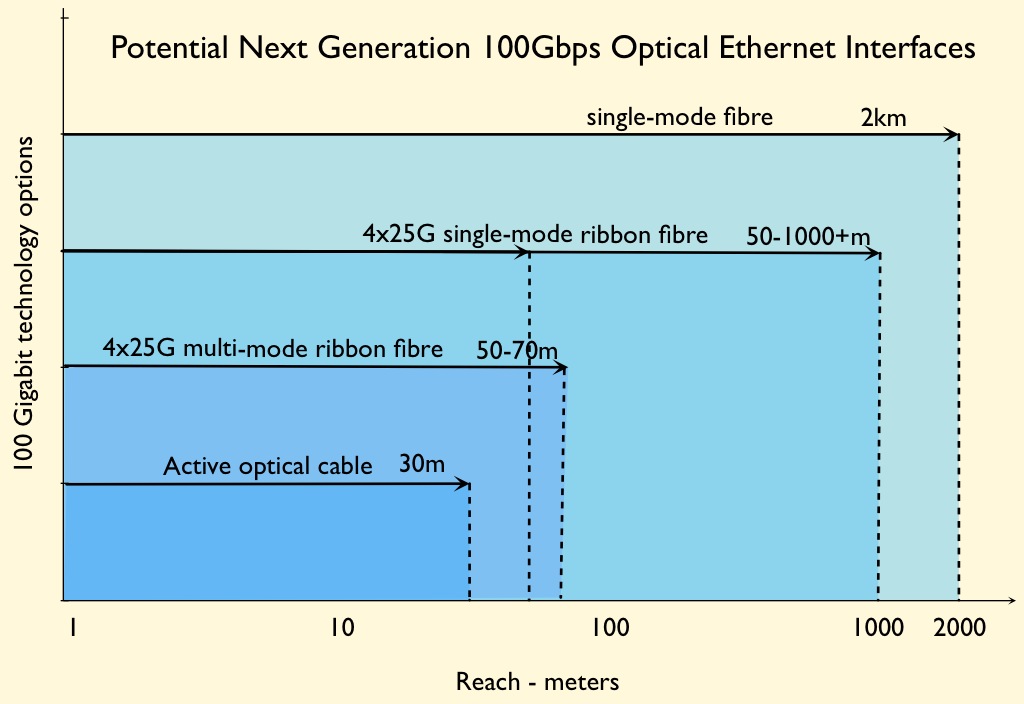
The latest options for 100 Gigabit-per-second (Gbps) interfaces are beginning to take shape following a meeting of the IEEE 802.3 Next Generation 100Gb/s Optical Ethernet Study Group in November.
The interface options being discussed include:
- A parallel multi-mode fibre using a VCSEL with a reach of 50m to 70m. An active optical cable version with a 30m reach, limited by the desired cable length rather than the technology, using silicon photonics or a VCSEL has also been proposed.
- A parallel single-mode fibre using a 1310nm electro-absorption modulated laser (EML) or silicon photonics with a range of 50m to 1000m+.
- A duplex single-mode fiber, using wavelength division multiplexing (WDM) or pulse-width modulation (PAM), an EML or silicon photonics for a 2km reach.
“I think in the end all will be adopted,” says Marek Tlalka, director of marketing at Luxtera. "Users will be able to choose what is most economical."
Jon Anderson, director of technology programme at Opnext, stresses however that these are proposals.
"No decisions were reached by the Study Group on any of these proposals," he says. “The Study Group is only working towards defining objectives for a next-gen 100 Gigabit Ethernet Optics project.” Agreement on technical solutions is outside the scope of the Study Group.
Anderson says there is a general agreement to define a 4x25Gbps multi-mode fibre optical interface. But the issues of reach and multi-mode fibre type (OM3, OM4) are still being studied.
“The Study Group has not reached any agreement on whether a 100GE short reach single-mode objective should be pursued," says Anderson. “Discussion at this point are on reach, power consumption and relative cost of possible solutions with respect to (the 10km) 100GBASE-LR4."
Best blogs, books and apps of 2011?
Also is there a journal or blog site that you have started to read that you have come to value? Apps can also be included.
In the last year I have started to read Ericsson Business Review which I really like. It has impressive forward-looking articles and great infographics. I also like the Telecom Ramblings blog, a valuable resource.
As for apps, I have discovered Zite, an iPad news aggregator app which is excellent. I also now use two fantastic drawing app packages - OmniGraphSketcher for graphs and TouchDraw for diagrams. I have used both for reports and for Gazettabyte. Lastly Book Creator, an ebook-making app.
Please comment and share your thoughts.
ECI Telecom's Apollo mission
The privately-owned system vendor has launched Apollo, a family of what it calls optimised multi-layer transport platforms.
Event
ECI Telecom has launched a family of platforms that combines optical transmission, Ethernet and optical transport network (OTN) switching and IP routing.
The 9600 series platforms, dubbed Apollo, combines the functionality of what until now has required a packet-optical transport system (P-OTS) and a carrier Ethernet switch router (CESR).
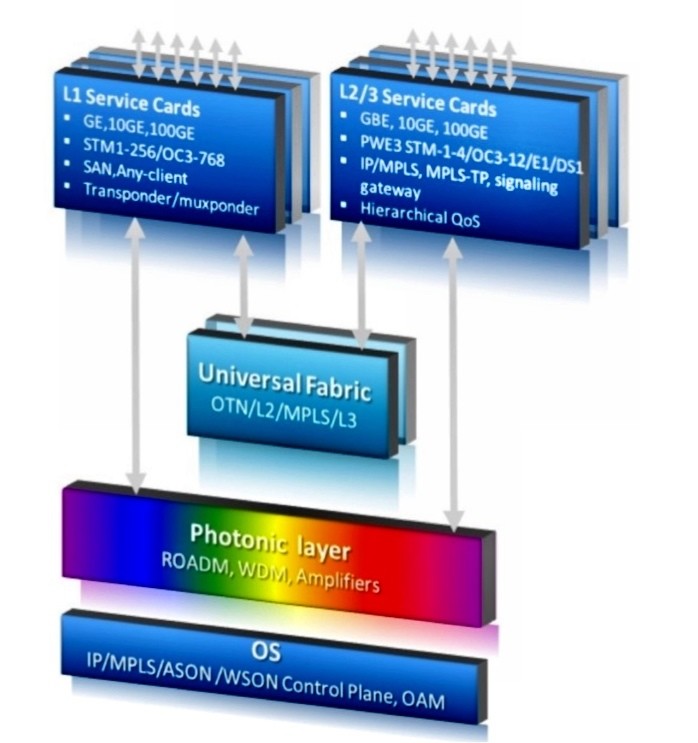 The Apollo 9600 series architecture. Source: ECI Telecom
ECI refers to the capabilities of such a combined platform as optimised multi-layer transport (OMLT). Analysts view the platform as a natural evolution of P-OTS rather than a new category of system.
Why is it important?
ECI's Apollo 9600 series is the first to combine dense wavelength-division multiplexing (DWDM) with carrier Ethernet switch routing. It is also one of the first platforms that bring OTN switching to the metro; until now OTN switching has been confined to the network core.
Apollo addresses a shortfall of packet optical transport, namely its limited layer 2 capabilities, says ECI. This is addressed with Apollo that also adds layer 3 routing, another first.
“In the buying cycle, operators start with optical networking and add carrier Ethernet switch routing,” says Oren Marmur, head of optical networking & CESR lines of Business at ECI Telecom. Now with Apollo, operators can simplify their networks: they don't have to provision, or maintain, two separate platforms.
ECI claims the Apollo platform, with 100 Gigabit-per-second (Gbps) transport and hybrid Ethernet and OTN cards, more than halves the equipment cost compared to using separate ROADM and CESR platforms. The company also says such an Apollo configuration reduces rack space by 38% and power consumption by some 60%.
What has been done
ECI has announced six Apollo platforms that span the access, metro and core networks. The platforms include the SR 9601 and OPT 9603 for metro access and the metro edge SR 9604 and OPT 9608 with four and eight input-output (I/O) cards respectively that support WDM or 100Gbps Ethernet MPLS packet switching. The final two platforms are the OPT 9624 for metro core and the OPT 9648 for regional and long haul, and both can accommodate a terabit universal switch.
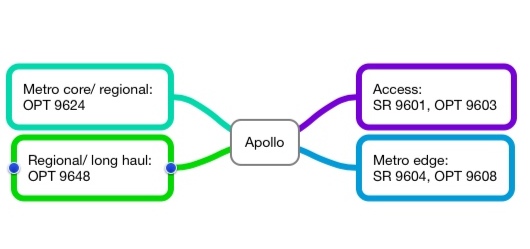
Overall Apollo can support 44 or 88 light paths at 10, 40 and 100Gbps, 2-degree and multi-degree colourless, directionless and contentionless ROADMs, OTN and Ethernet switching, and IP/ MPLS and MPLS-TP. "MPLS-TP versus IP/ MPLS is almost a religious issue yet both are valid," says Marmur, who adds that at 40 Gig, ECI will use coherent and direct detection technologies but at 100 Gig it will use only coherent.
The universal fabric of the OPT 9624 and 9648 is cell based - ODUs and packets, not lower-order SONET/SDH traffic. If an operator has any significant amount of SONET/SDH traffic, ECI’s XDM platform or another aggregation box is needed.
The platforms can be configured as CESR platforms, OTN switches, optical transport platforms or combinations of the three.
Analysis
Gazettabyte asked Sterling Perrin, senior analyst at Heavy Reading; Rick Talbot, senior analyst, optical infrastructure at Current Analysis and Dana Cooperson, vice president of the network infrastructure practice at Ovum for their views about the ECI announcement.
Sterling Perrin, Heavy Reading
Apollo has several noteworthy aspects, according to Heavy Reading.
“It is a big announcement for ECI and a big announcement for the industry," says Perrin. “They are doing with the technology some fundamental things that are new.” That said, it remains to be seen how quickly operators will embrace an OMLT-style platform, he says.
Apollo confirms one networking trend - moving the OTN switching fabric into the metro network. So far OTN has been confined largely to the core network. “I know operators are interested but they are still evaluating it,” says Perrin. “But OTN will migrate down from the core to the metro.” Others that have announced such a capability include Ciena and Huawei.
ECI has also put the DWDM transport with the CESR platform. “This is another trend we figured would happen,” he says. “This puts ECI very early, if not first, in doing that function.”
Perrin has his doubts about how quickly the layer 3 functionality added to the platform will be embraced by operators: “What I've seen from the industry is that MPLS-TP will give you that functionality over time as it matures, so this sort of platform may not need the full layer 3 functions.”
The modular nature of the design that allows operators to add the functionality they need helps avoid one issue associated with integrated platforms, paying for functionality that is not needed. And there are cost savings by having a single integrated platform. “You do want to save capex and opex and this is definitely a way to get that done,” says Perrin.
In the network core, the question remains whether packet needs to be combined with the optics. “Metro lends itself more to the integration than the core does,” he says.
ECI’s biggest competitor is probably Huawei and over time also ZTE, says Perrin. ECI has done well in India and other emerging markets that many of the system vendors were ignoring. “Now they have Huawei in the mix, it is definitely tougher,” he says. “This [Apollo] announcement will definitely help them.”
Rick Talbot, Current Analysis
Current Analysis categorises the smaller members of the Apollo family as a packet-optical access (POA) portfolio, playing the same role as Ericsson’s SPO 1400 family and Cisco’s CPT series. The market research firm views the largest two Apollo platforms - the OPT 9624 and 48 - as packet-optical transport systems.
The Apollo POAs bring protocol-agnostic packet switching to the aggregation network, says Talbot, a rarity in this part of the network. Several vendors offer P-OTS with universal switching fabrics but most do not extend that architecture into the aggregation network, Tellabs with the 7100 Nano OTS being the exception. Also the 9600 series IP/ MPLS and MPLS-TP options are very strong, providing what Cisco and Ericsson call unified MPLS, he says.
For Current Analysis, the significance of the portfolio is that the Apollo family delivers converged packet and time-division multiplexing (TDM) switching in a single switch fabric, and provides an infrastructure that extends from the network core to the access network edge.
The switching fabric provides the greatest efficiency for the ultimate traffic type - packets - while simplifying the network architecture and minimising equipment cost. In turn, the breadth of the portfolio provides a common set of capabilities across an operator’s network, minimising training costs and spares inventory.
As for the specification, the wide range of MPLS features integrated into this product family, its terabit universal switch and its 100Gbps DWDM transport capabilities are impressive, says Talbot.
“The primary gap in the portfolio, and it is hard to fault ECI for this, is that the highest capacity member of the family supports ’only’ 1 Terabit-per-second of switching capacity,” he says. “This is not large enough for a Tier 1 core optical switch.”
ECI must first execute on the production of the Apollo family, but if it does, Talbot believe that ECI will capture the interest of larger and more end-to-end operators in markets they already serve.
ECI will also have positioned itself to capture the attention of many European operators and, if it makes a push there, the North American market. However Talbot believes ECI will still be challenged to capture the attention of Tier 1 operators because of the family’s limited maximum scale.
Dana Cooperson, Ovum
Size and scale breeds specialisation, says Cooperson. “Large service providers, including the Tier 1s, won’t be so interested in the OMLT, but they aren’t the target anyway,” she says. Large service providers need plenty of scale when it comes to WDM and CESR functionality, while they also tend to have compartmentalised operations groups. “So an all-in-one product like the OMLT isn’t targeted at them,” she says.
ECI has always done well selling to the Tier 2 and Tier 3 carriers as well as enterprises such as utilities that have carrier-like networks. That is because ECI's modular, packet-based platforms are sized and priced to match such operators' and enterprises’ requirements. “I see the OMLT as a continuation of ECI's positioning of its XDM platform,” she says.
Cooperson says that it can be difficult to position vendors’ switch announcements and that they should do more to explain where they sit. But she stresses that the Apollo 9600 series is very different from Juniper's PTX, for example.
“The PTX is positioned in the core as a lower-cost alternative to core routers, while the OMLT as a CESR or even an OTN switch is meant more for smaller sites,” she says. Also the switch capacities of the smaller Apollo platforms fit with ECI's focus and positioning on smaller customers and smaller sites.
Cooperson also highlights the need for the XDM platform if an operator requires SONET/SDH support but says ECI has alluded to add/drop multiplexer blades as well as packet blades. "The [Apollo] focus is on the packet and photonic bits,” says Cooperson. “ECI did emphasize that the XDM isn’t going anywhere, but we’ll see what happens over time and how much SONET/SDH ECI builds in [if any to the Apollo].”
Further Reading
For accompanying White Papers, click here
Calient brings optical switching to the data centre
 Source: Calient
The Californian-based start-up has as been selling its FC 320, a 320-port 3D MEMS-based switch, since 2006. The optical switch is used by Verizon and AT&T at submarine cable landing sites, and by Government agencies.
Now Calient has raised US $19.4 million (€13.77M) in its latest funding round to complete the development and manufacturing of a more compact, power efficient version of its optical switch.
The company has upgraded the electronics and software of its MEMS-based optical switch module. This, says Gregory Koss, Calient's senior vice president for products and partners, reduces the power consumption to 20W, a 90% reduction compared to its existing design.
The new switch module is also more compact. Using the module in a new 320-port switch platform more than halves the size: from 17 to 7 rack units.
The 3D MEMS optics has not been changed. The MEMS design uses mirrors to form a free-space connection between an fibre input port and any of the 320 output ports. A control system then adjusts the mirrors to maximise the output signal. In all the years Calient has been selling its systems, there has not been a single MEMS failure, says the company.
Calient is also changing its strategy by selling the switch as a module to system vendors. The switch module can be incorporated on a line card, while Calient will work with system vendor partners that want to integrate the module within their own platform designs.

"[Data centre] operators want a future-proofed network. They don't want to rebuild when links are upgraded from 10 to 40 and then 100 Gig."
Gregory Koss, Calient Technologies
Data centre and cloud
Calient's MEMS-based switch will be used to connect large server clusters in content service providers' 'mega' data centres.
According to Koss, content service providers are interested in using an optical switch to link their server clusters. In a typical configuration, 48 servers are connected to a top-of-rack switch. This top-of-rack switch, via a 10 Gigabit Ethernet link, would be one input to the 320-port optical switch.
"[Data centre] operators want a future-proofed network," says Koss. "They don't want to rebuild when links are upgraded from 10 to 40 and then 100 Gig."
Common cabling used in the data centre include copper and multi-mode fibre while Calient's design uses single-mode fibre. According to Koss, data centre managers are installing more single-mode fibre: "It is it not so much for reach but for bandwidth and for scaling.”
The switch can also be used for what Calient calls cloud networking, to monitor and manage an enterprise's fibres as it enters the data centre.
ROADMs
The switch will also address agile optical networking, to enable colourless, directionless and contentionless ROADMs.
The optical module will be used for the add/ drop, alongside rather than replacing 1x9 or 1x20 WSSs which are used for the pass-through lambdas.
Koss says that the company's main focus in 2012 is addressing the data centre market opportunity but that the switch is of interest to ROADM system vendors. Such a 3D MEMS-based ROADM design will take longer to bring to market.
Further reading:
CALIENT's 3D MEMS Technology Enables Exploding Bandwidth Demands (log-in required to download the White Paper)
Webcasts and White Papers
First webcast is LightCounting's “State-of-The-High-Speed Interconnect Industry – Optical and Copper” on Nov 1st, 2011.
To see upcoming webcasts, click here.
ECOC 2011: Products and market trends
There were several noteworthy announcements at the European Conference on Optical Communications (ECOC) held in Geneva in September. Gazettabyte spoke to Finisar, Oclaro and Opnext about their ECOC announcements and the associated market trends.
100 Gig module
Opnext announced the first 100 Gigabit-per-second (Gbps) transponder at ECOC, a much anticipated industry development.
 "Quite a few system vendors .... are looking at 'make-versus-buy' for the next-generation [of 100 Gig]."
Ross Saunders, Opnext
The OTM-100 is a dual-polarisation, quadrature phase-shift keying (DP-QPSK) coherent design that fits into a 5x7-inch module and meets the Optical Internetworking Forum's (OIF) multi-source agreement (MSA). The module's coherent receiver uses a digital signal processor (DSP) developed by NTT Electronics.
"At the moment we are going through the bring-up in the lab," says Ross Saunders, general manager, next-gen transport for Opnext Subsystems.
According to Opnext, system vendors that have their own 100Gbps coherent designs are also interested in the 100Gbps module.
"There are a few developing in-house [100Gbps designs] that are not interested in going for the module solution," says Saunders. "But there is another camp - quite a few system vendors - who have their first-generation solution that are looking at 'make-versus-buy' for the next-generation."
System vendors' first-generation 100Gbps designs use hard-decision forward error correction (FEC). But customers want a 100Gbps design with a reach that gets close to matching that of 10Gbps, 40Gbps DPSK and 40Gbps coherent designs, says Opnext.
"There is demand to go to the next-generation with its higher overhead and soft-decision FEC," says Saunders. "That [soft-decision FEC] buys another 2-3dB of performance so you don't need as many regeneration stages." Translated into distances, the reach using soft-decision FEC is 1500-1600km rather than 800-900km, says Saunders.
Opnext expects to deliver samples to lead customers before the year end.
Meanwhile, Oclaro is also developing a 100Gbps coherent module. "It is on track and we expect to ship in early 2012," says Per Hansen, vice president of product marketing, optical networks solutions at Oclaro.
100 Gig receiver
Oclaro announced an integrated 100Gbps coherent receiver at ECOC.
The company claims the device takes less than half the board area as defined by the OIF. "Board space is at a premium on line cards," says Robert Blum, director of product marketing for Oclaro's photonic components. "If you can increase functionality, that translates to lower cost."
 100 Gig indium phosphide integrated receiver Source: OclaroThe device has two inputs and four outputs. The inputs are the received 100Gbps optical signal and the local oscillator and the outputs are from the four balanced detectors.
"The entire 90-degree hybrid mixing and the photo detection are all done in an indium phosphide single chip," says Blum.
40 Gig modules
Oclaro also announced it is shipping in volume its 40Gbps coherent transponder.
"There is a lot of interest from equipment vendors and service providers to use coherent in their networks," says Hansen "Coherent has advantages in the way it can overcome impairments."
Hansen says coherent will be used in the majority of new network deployments in future: "If you are deploying a network that is geared to 40Gbps and above, people will most likely deploy an all-coherent solution."
One reason why coherent is favoured is that the same technology can be scaled to 100Gbps, 400Gbps and even a Terabit.
Coherent technology, whose DSP is used for dispersion compensation, is also suited for mesh networks where switching wavelengths occurs. The coherent technology can compensate when it encounters new dispersion conditions following the switching.
In contrast 40Gbps direct-detection modules interest vendors for use in existing networks alongside 2.5Gbps and 10Gbps wavelengths, says Oclaro.
For networks geared to 40Gbps and above, people will most likely deploy an all-coherent solution
Per Hansen, Oclaro
"They can have very high power which can make it difficult for a new [high-speed] channel to live next to them but direct-detection modules are robust for those types of applications," says Hansen. "Where you will see people upgrading their existing networks, they will use DPSK or DQPSK transponders."
But Oclaro says that the split is not that clear-cut: 40Gbps coherent for new builds and direct-detection schemes when used alongside existing 10Gbps wavelengths. "There is a lot of variability in both of these approaches such that you can tailor them to different applications," says Hansen. "In the end, what it will come down to is what the customer is happy with and the price points, more than fundamental technology capabilities."
40G client-side interfaces
Finisar demonstrated at ECOC a serial 40Gbps CFP module that meets the 2km 40GBASE-FR standard.
"This will be the first 40 Gig serial module that is in a pluggable form factor," says Rafik Ward, vice president of marketing at Finisar. Indeed Finisar's CFP is a tri-rate design that also supports the ITU-T OC-768 SONET/SDH very short reach (VSR) and OTU3 standards.
The FR interface is the IEEE's 40 Gigabit Ethernet equivalent of the existing OC-768 VSR interface. The original 300pin VSR interface has a 16-channel electrical interface, each operating at 2.5Gbps, while the CFP module uses 10Gbps electrical channels.
IP routers can now be connected to DWDM platforms using the pluggable module, says Finisar. The pluggable will also enable system vendors to design denser line cards with two or even four CFP interfaces, as well as the option of changing the CFP to support other standards as required.
The tri-rate FR pluggable module's power consumption will be below 8W, says Finisar, which is shipping samples to customers.
Meanwhile, Opnext has announced it is sampling its 40GBASE-LR4, the 10km 40 Gigabit Ethernet interface, in a QSFP module. "It will be readily available by the end of the year," says Jon Anderson, director of technology programme at Opnext.
 "The 40GBASE-LR4 [QSFP] will be readily available by the end of the year"
Jon Anderson, Opnext
Tunable laser XFP
Opnext and Oclaro have both announced 10Gbps tunable XFPs at ECOC. Having two new suppliers of tunable XFPs joining JDS Uniphase will increase market competition and reduce the price of the tunable pluggable.
"It really is a replacement for 300-pin transponders," says Blum. "You can now migrate 10Gbps links to a pluggable form factor."
Oclaro's tunable XFP is released for production. Opnext says its tunable XFP will be in volume production by early 2012.
ROADMs get 1x20 WSS
Finisar announced a 1x20 high-port count wavelength selective switch (WSS). The WSS supports a flexible spectrum grid that allows the channel width to be varied in increments of 12.5GHz, enabling future line rates above 100Gbps to be supported.
"This [1x20 WSS] has the possibility to enable some pretty interesting applications for next generation - colourless, directionless, contentionless networks," says Ward.

"This [40GBASE-FR] will be the first 40 Gig serial module that is in a pluggable form factor"
Rafik Ward, Finisar.
One common application of the 1x20 WSS is implementing a multi-degree node. The degree refers to the number of points that node branches out to in a mesh network, says Finisar. "The fundamental question is how many ports do you have in that node?" explains Ward.
For example, an 8-degree node communicates with eight other points in the mesh. With a 1x20 WSS, the architecture uses eight of the 20 as express ports - those 8 ports interfacing with other WSSs in the node - while the remaining 12 ports on that 1x20 WSS are used as add and drop ports.
"The advantage of a 1x20 WSS in this case is enabling a large number of express ports and a large number of add ports," says Ward.
A second application is for colourless or tunable multiplexing.
"One of the problems today enabling colourless ROADM operation is that typically the muxes and demuxes used are AWGs," says Ward. Having a tunable laser is all well and good but it becomes hardwired to a specific port because of the arrayed waveguide grating (AWG). "That specific port is configured for that particular wavelength," he says.
To make an 80-channel colourless design, that does not require manual intervention, four 1x20 WSSs are placed side-by-side with a 1x4 WSS connecting the four. This is a more elegant and compact than using existing 1x9 WSSs, which requires more than twice as many WSS units.
Pump lasers
Oclaro announced two 980nm pump laser products that enable more compact, lower-power amplifier designs.
 "Board space is at a premium on line cards"
Robert Blum, Oclaro
One is an uncooled 980nm 500mW pump laser and the second is two 600mW pump lasers in a single package. The dual-pump laser product halves the footprint and requires a single thermo-electric cooler only.
"The power consumption is significantly lower than what it would be for two discrete pump lasers," says Blum. "The 300mW uncooled pump laser doesn't go away but for dual-stage or mid-stage optical amplifiers instead of using multiple [300mW] lasers, you can use a single package," says Blum.
GPON-on a-stick
Finisar announced a 'GPON-on-a-stick' SFP module. The result of its acquisition of Broadway Networks in 2010, the SFP-based GPON optical network unit (ONU) enables an Ethernet switch to be connected to a PON. The product is aimed at enterprises as well as large residential premises. The GPON stick complements the company's existing EPON stick.
Further information:
ECOC 2011 Market focus presentations, click here
Rapid progress in optical transport seen at ECOC 2011, Ovum's Karen Liu, click here
Finisar and Capella enter 1×20 WSS market; signals shift, Ovum's Daryl Inniss, click here