

ECOC reflections: final part
Gazettabyte asked several attendees at the recent ECOC show, held in Cannes, to comment on key developments and trends they noted, as well as the issues they will track in the coming year.
Dr. Ioannis Tomkos, Fellow of OSA & Fellow of IET, Athens Information Technology Center (AIT)
With ECOC 2014 celebrating its 40th anniversary, the technical programme committee did its best to mark the occasion. For example, at the anniversary symposium, notable speakers presented the history of optical communications. Actual breakthroughs discussed during the conference sessions were limited, however.
 Ioannis Tomkos
It appears that after 2008 to 2012, a period of significant advancements, the industry is now more mainstream, and significant shifts in technologies are limited. It is clear that the original focus four decades ago on novel photonics technologies is long gone. Instead, there is more and more of a focus on high-speed electronics, signal processing algorithms, and networking. These have little to do with photonics even if they greatly improve the overall efficient operation of optical communication systems and networks.
Coherent detection technology is making its way in metro with commercial offerings becoming available, while in academia it is also discussed as a possible solution for future access network applications where long-reach, very-high power budgets and high-bit rates per customer are required. However, this will only happen if someone can come up with cost-effective implementations.
Advanced modulation formats and the associated digital signal processing are now well established for ultra-high capacity spectral-efficient transmission. The focus in now on forward-error-correction codes and their efficient implementations to deliver the required differentiation and competitive advantage of one offering versus another. This explains why so many of the relevant sessions and talks were so well attended.
There were several dedicated sessions covering flexible/ elastic optical networking. It was also mentioned in the plenary session by operator Orange. It looks like a field that started only fives years ago is maturing and people are now convinced about the significant short-term commercial potential of related solutions. Regarding latest research efforts in this field, people have realised that flexible networking using spectral super-channels will offer the most benefit if it becomes possible to access the contents of the super-channels at intermediate network locations/ nodes. To achieve that, besides traditional traffic grooming approaches such as those based on OTN, there were also several ground-breaking presentations proposing all-optical techniques to add/ drop sub-channels out of the super-channel.
Progress made so far on long-haul high-capacity space-division-multiplexed systems, as reported in a tutorial, invited talks and some contributed presentations, is amazing, yet the potential for wide-scale deployment of such technology was discussed by many as being at least a decade away. Certainly, this research generates a lot of interesting know-how but the impact in the industry might come with a long delay, after flexible networking and terabit transmission becomes mainstream.
Much attention was also given at ECOC to the application of optical communications in data centre networks, from data-centre interconnection to chip-to-chip links. There were many dedicated sessions and all were well attended.
Besides short-term work on high-bit-rate transceivers, there is also much effort towards novel silicon photonic integration approaches for realising optical interconnects, space-division-multiplexing approaches that for sure will first find their way in data centres, and even efforts related with the application of optical switching in data centres.
At the networking sessions, the buzz was around software-defined networking (SDN) and network functions virtualisation (NFV) now at the top of the “hype-cycle”. Both technologies have great potential to disrupt the industry structure, but scientific breakthroughs are obviously limited.
As for my interests going forward, I intend to look for more developments in the field of mobile traffic front-haul/ back-haul for the emerging 5G networks, as well as optical networking solutions for data centres since I feel that both markets present significant growth opportunities for the optical communications/ networking industry and the ECOC scientific community.
Dr. Jörg-Peter Elbers, vice president advanced technology, CTO Office, ADVA Optical Networking
The top topics at ECOC 2014 for me were elastic networks covering flexible grid, super-channels and selectable higher-order modulation; transport SDN; 100-Gigabit-plus data centre interconnects; mobile back- and front-hauling; and next-generation access networks.
For elastic networks, an optical layer with a flexible wavelength grid has become the de-facto standard. Investigations on the transceiver side are not just focussed on increasing the spectral efficiency, but also at increasing the symbol rate as a prospect for lowering the number of carriers for 400-Gigabit-plus super-channels and cost while maintaining the reach.
 Jörg-Peter Elbers
As we approach the Shannon limit, spectral efficiency gains are becoming limited. More papers were focussed on multi-core and/or few-mode fibres as a way to increase fibre capacity.
Transport SDN work is focussing on multi-tenancy network operation and multi-layer/ multi-domain network optimisation as the main use cases. Due to a lack of a standard for north-bound interfaces and a commonly agreed information model, many published papers are relying on vendor-specific implementations and proprietary protocol extensions.
Direct detect technologies for 400 Gigabit data centre interconnects are a hot topic in the IEEE and the industry. Consequently, there were a multitude of presentations, discussions and demonstrations on this topic with non-return-to-zero (NRZ), pulse amplitude modulation (PAM) and discrete multi-tone (DMT) being considered as the main modulation options. 100 Gigabit per wavelength is a desirable target for 400 Gig interconnects, to limit the overall number of parallel wavelengths. The obtainable optical performance on long links, specifically between geographically-dispersed data centres, though, may require staying at 50 Gig wavelengths.
In mobile back- and front-hauling, people increasingly recognise the timing challenges associated with LTE-Advanced networks and are looking for WDM-based networks as solutions. In the next-generation access space, components and solutions around NG-PON2 and its evolution gained most interest. Low-cost tunable lasers are a prerequisite and several companies are working on such solutions with some of them presenting results at the conference.
Questions around the use of SDN and NFV in optical networks beyond transport SDN point to the access and aggregation networks as a primary application area. The capability to programme the forwarding behaviour of the networks, and place and chain software network functions where they best fit, is seen as a way of lowering operational costs, increasing network efficiency and providing service agility and elasticity.
What did I learn at the show/ conference? There is a lot of development in optical components, leading to innovation cycles not always compatible with those of routers and switches. In turn, the cost, density and power consumption of short-reach interconnects is continually improving and these performance metrics are all lower than what can be achieved with line interfaces. This raises the question whether separating the photonic layer equipment from the electronic switching and routing equipment is not a better approach than building integrated multi-layer god-boxes.
There were no notable new trends or surprises at ECOC this year. Most of the presented work continued and elaborated on topics already identified.
As for what we will track closely in the coming year, all of the above developments are of interesting. Inter-data centre connectivity, WDM-PON and open programmable optical core networks are three to mention in particular.
For the first ECOC reflections, click here

ECOC 2014: Industry reflections on the show
Gazettabyte asked several attendees at the recent ECOC show, held in Cannes, to comment on key developments and trends they noted, as well as the issues they will track in the coming year.
Daryl Inniss, practice leader, components at market research firm, Ovum
 It took a while to unwrap what happened at ECOC 2014. There was no one defining event or moment that was the highlight of the conference.
The location was certainly beautiful and the weather lovely. Yet I felt the participants were engaged with critical technical and business issues, given how competitive the market has become.
Kaiam’s raising US $35 million, Ranovus raising $24 million, InnoLight Technology raising $38 million and being funded by Google Capital, and JDSU and Emcore each splitting into two companies, all are examples of the shifting industry structure.
On the technology and product development front, advances in 100 Gig metro coherent solutions were reported although products are coming to market later than first estimated. The client-side 100 Gig is transitioning to CFP2. Datacom participants agree that QSFP28 is the module but what goes inside will include both parallel single mode solutions and wavelength multiplexed ones.
Finisar’s 50 Gig transmission demonstration that used silicon photonics as the material choice surprised the market. Compared to last year, there were few multi-mode announcements. ECOC 2014 had little excitement and no one defining show event but there were many announcements showing the market’s direction.
There is one observation from the show, which while not particularly exciting or sexy, is important, and it seems to have gone unnoticed in my opinion. Source Photonics demonstrated the 100GBASE-LR4, the 10km 100 Gigabit Ethernet standard, in the QSFP28 form factor. This is not new as Source Photonics also demonstrated this module at OFC. What’s interesting is that no one else has duplicated this result.
There will be demand for a denser -LR4 solution that’s backward compatible with the CFP, CFP2, and CFP4 form factors. It is unlikely that the PSM4, CWDM4, or CLR4 will go 10km and they are not optically compatible with the -LR4. The market is on track to use the QSFP28 for all 100 Gig distances so it needs the supporting optics. The Source Photonics demonstration shows a path for 10km. We expect to see other solutions for longer distances over time.
One surprise at the show was Finisar's and STMicroelectronics's demonstration of 50 Gig non-return-to-zero transmission over 2.2km on standard single mode fiber. The transceiver was in the CFP4 form factor and uses heterogeneous silicon technologies inside. The results were presented in a post-deadline paper (PD.2.4). The work is exciting because it demonstrates a directly modulated laser operating above 28 Gig, the current state-of-the-art.
The use of silicon photonics is surprising because Finisar has been forced to defend its legacy technology against the threat of transceivers based on silicon photonics. These results point to one path forward for next-generation 100 Gig and 400 Gig solutions.
In the coming year, I’m looking for the dominant metro 100G solution to emerge. When will the CFP2 analogue coherent optical module become generally available? Multiple suppliers with this module will help unleash the 100 Gig line-side transmission market, drive revenue growth and the development for the next-generation solution.
Slow product development gives competing approaches like the digital CFP a chance to become the dominant solution. At present, there is one digital CFP vendor with a generally available product, Acacia Communications, with a second, Fujitsu Optical Components, having announced general availability in the first half of 2015.
Neal Neslusan, vice president of sales and marketing at fabless chip company, MultiPhy.
It was impressive to see Oclaro's analogue CFP2 for coherent applications on the show floor, albeit only in loopback mode. Equally impressive was seeing ClariPhy's DSP on the evaluation board behind the CFP2.
 I saw a few of the motherboard-based optics solutions at the show. They looked very interesting and in questioning various folks in the business I learned that for certain data centre applications these optics are considered acceptable. Indeed, they represent an ability to extract much higher bandwidth from a given motherboard as compared to edge-of-the-board based optics, but they are not pluggable.
Traditionally, pluggable optics has been the mainstay of the datacom and enterprise segments and these motherboard-based optics have been relegated to supercomputing. This is just another example, in my opinion, of how the data centre market is becoming distinct from the datacom market.
Where there any surprises at the show? I was surprised and alarmed at the cost of the Martini drinks at the hotel across the street from the show, and they weren't even that good!
Regarding developments in the coming year, the 8x50 Gig versus 4x100 Gig fight in the IEEE is clearly a struggle I will follow. I think it will have a great impact on product development in our industry. If 8x50 Gig wins, it may be one of the few times in the history of our industry that a less advanced solution is chosen over a more advanced and future-proofed one.
The physical size of the next-generation Terabit Ethernet switch chips will have a much larger impact on the optics they connect to in the coming years, compared to the past. This work combined with the motherboard-based optics may create a significant change in the solutions brought to bear for high-performance communications.
John Lively, principal analyst at market research firm, LightCounting.
 There were several developments that I noted at the show. ECOC helped cement the view that 100 Gig coherent is mainstream for metro networks. Also more and more system vendors are incorporating Raman/ remote optically pumped amplifier (ROPA) into their toolkit. ROPA is a Raman-based amplifier where the pump is located at one end of the link, not in some intermediate node. Another trend evident at ECOC is how the network boundary between terrestrial and submarine is blurring.
As for developments to watch, I intend to follow mobile fronthaul/ backhaul, higher speed transceiver developments, of course, and how the mega-data-centre operators are disrupting networks, equipment, and components.
For the ECOC reflections, final part, click here
Finisar adds silicon photonics to its technology toolkit
- Finisar revealed its in-house silicon photonics design capability at ECOC
- The company also showed its latest ROADM technologies: a dual wavelength-selective switch and a high-resolution optical channel monitor.
- Also shown was an optical amplifier that spans 400km fibre links

These two complementary technologies [VCSELs and silicon photonics] work well together as we think about the next-generation Ethernet applications.
Rafik Ward
Finisar demonstrated at ECOC its first optical design implemented using silicon photonics. The photonic integrated circuit (PIC) uses a silicon photonics modulator and receiver and was shown operating at 50 Gigabit-per-second.
The light source used with the PIC was a continuous wave distributed feedback (DFB) laser. One Finisar ECOC demonstration showed the eye diagram of the 50 Gig transmitter using non-return-to-zero (NRZ) signalling. Separately, a 40 Gig link using this technology was shown operating error-free over 12km of single mode fibre.
"Finisar, and its fab partner STMicroelectronics, surprised the market with the 50 Gig silicon photonics demonstration,” says Daryl Inniss, practice leader of components at Ovum.
"This, to our knowledge, was the first public demonstration of silicon photonics running at such a high speed," says Rafik Ward, vice president of marketing at Finisar. However, the demonstrations were solely to show the technology's potential. "We are not announcing any new products," he says.
Potential applications for the PIC include the future 50 Gig IEEE Ethernet standard, as well as a possible 40 Gig serial Ethernet standard. "Also next-generation 400 Gig Ethernet and 100 Gig Ethernet using 50 Gig lanes," says Ward. "All these things are being discussed within the IEEE."
Jerry Rawls, co-founder and chairman of Finisar, said in an interview a year ago that the company had not developed any silicon photonics-based products as the technology had not shown any compelling advantage compared to its existing optical technologies.
Now Finisar has decided to reveal its in-house design capability as the technology is at a suitable stage of development to show to the industry. It is also timely, says Ward, given the many topics and applications being discussed in the standards work.
The company sees silicon photonics as part of its technology toolkit available to its engineers as they tackle next-generation module designs.
Finisar unveiled a vertical-cavity surface-emitting laser (VCSEL) operating at 40 Gig at the OFC show held in March. The 40 Gig VCSEL demonstration also used NRZ signalling. IBM has also published a technical paper that used Finisar's VCSEL technology operating at 50 Gbps.
"What we are trying to do is come up with solutions where we can enable a common architecture between the short wave and the long wave optical modules," says Ward. "These two complementary technologies [VCSELs and silicon photonics] work well together as we think about the next-generation Ethernet applications."
Cisco Systems, also a silicon photonics proponent, was quoted in the accompanying Finisar ECOC press release as being 'excited' to see Finisar advancing the development of silicon photonics technology. "Cisco is our biggest customer," says Ward. "We see this as a significant endorsement from a very large user of optical modules." Cisco acquired silicon photonics start-up Lightwire for $271 million in March 2012.
ROADM technologies
Finisar also demonstrated two products for reconfigurable optical add/ drop multiplexers (ROADM): a dual configuration wavelength-selective switch (WSS) and an optical channel monitor (OCM).
The dual-configuration WSS is suited to route-and-select ROADM architectures.
Two architectures are used for ROADMs: broadcast-and-select and route-and-select. With broadcast-and-select, incoming channels are routed in the various directions using a passive splitter that in effect makes copies of the incoming signal. To route signals in the outgoing direction, a 1xN WSS is used. However, due to the optical losses of the splitters, such an architecture is used for low node-degree applications. For higher-degree nodes, the optical loss becomes a barrier, such that a WSS is also used for the incoming signals, resulting in the route-and-select architecture. A dual-configuration WSS thus benefits a route-and-select ROADM design.
Finisar's WSS module is sufficiently slim that it occupies a single-chassis slot, unlike existing designs that require two. "It enables system designers to free up slots for other applications such as transponder line cards inside their chassis," says Ward.
The dual WSS modules support flexible grid and come in 2x1x20, 2x1x9 and 2x8x12 configurations. "There are some architectures being discussed for add/ drop that would utilise the WSS in that [2x8x12] configuration," says Ward.
The ECOC demonstrations included different traffic patterns passing through the WSS, as well as attenuation control and the management of super-channels.
Finisar also showed an accompanying high-resolution OCM that also occupies a single-chassis slot. The OCM can resolve the spectral power of channels as narrow as 6.25GHz. The OCM, a single-channel device, can scan a fibre's C-band in 200ms.
A rule of thumb is that an OCM is used for each WSS. A customer often monitors channels on a single fibre, says Ward, and must pick which fibres to monitor. The OCM is typically connected to each fibre or to an optical switch to scan multiple fibres.
"People are looking to use the spectrum in a fibre in a much more optimised way," says Ward. The advent of flexible grid and super-channels requires a much tighter packing of channels. "So, being able to see and identify all of the key elements of these channels and manage them is going to become more and more difficult," he says, with the issue growing in importance as operators move to line speeds greater than 100 Gig.
Finisar also used the ECOC show to demonstrate repeater-less transmission using an amplifier that can span 400km of fibre. Such an amplifier is used in harsh environments where it is difficult to build amplifier huts. The amplifier can also be used for certain submarine applications known as 'festooning' where the cable follows a coastline and returns to land each time amplification is required. Using such a long-span amplifier reduces the overall hops back to the coast.
Oclaro demonstrates flexible rate coherent pluggable module
- The CFP2 coherent optical module operates at 100 and 200 Gig
- Samples are already with customers, with general availability in the first half of 2015
- Oclaro to also make more CFP2 100GBASE-LR4 products

The CFP2 is not just used in metro/ regional networks but also in long-haul applications
Robert Blum
The advent of a pluggable CFP2, capable of multi-rate long-distance optical transmission, has moved a step closer with a demonstration by Oclaro. The optical transmission specialist showed a CFP2 transmitting data at 200 Gigabits-per-second.
The coherent analogue module demonstration, where the DSP-ASIC resides alongside rather than within the CFP2, took place at ECOC 2014 held in September at Cannes. Oclaro showcased the CFP2 to potential customers in March, at OFC 2014, but then the line side module supported 100 Gig only.
"What has been somewhat surprising to us is that the CFP2 is not just used in metro/ regional networks but also in long-haul applications," says Robert Blum, director of strategic marketing at Oclaro. "We are also seeing quite significant interest in data centre interconnect, where you want to get 400 Gig between sites using two CFP2s and two DSPs." Oclaro says that the typical distances are from 200km to 1,000km.
The CFP2 achieves 200 Gig using polarisation multiplexing, 16-quadrature amplitude modulation (PM-16-QAM) while working alongside ClariPhy's merchant DSP-ASIC. ClariPhy announced at ECOC that it is now shipping its 200 Gig LightSpeed-II CL20010 coherent system-on-chip, implemented using a 28nm CMOS process.
"One of the beauties of an analogue CFP2 is that it works with a variety of DSPs," says Blum. Other merchant coherent DSPs are becoming available, while leading long-haul optical equipment vendors have their own custom coherent DSPs.
Oclaro's CFP2, even when operating at 200 Gig, falls within the 12W module's power rating. "One of the things you need to have for 200 Gig is a linear modulator driver, and such drivers consume slightly more power [200mW] than limiting modulator drivers [used for 100 Gig only]," says Blum.
Oclaro will offer two CFP2 line-side variants, one with linear drivers and one using limiting ones. The limiting driver CFP2 will be used for 100 Gig only whereas the linear driver CFP2 supports 100 Gig PM-QPSK and 200 Gig PM-16-QAM schemes. "Some customers prefer the simplicity of a limiting interface; for the linear interface you have to do more calibration or set-up," says Blum. "Linear also allows you to do pre-emphasis of the signal path, from the DSP all the way to the modulator." Pre-emphasis is used to compensate for signal path impairments.
By consuming under 12W, up to eight line-side CFP2 interfaces can fit on a line card, says Blum, who also stresses the CFP2 has a 0dBm output power at 200 Gig. Achieving such an output power level means the 200 Gig signal is on a par with 100 Gig wavelengths. "When you launch a 200 Gig signal, you want to make sure that there is not a big difference between signals," says Blum.
To achieve the higher output power, the micro integrable tunable laser assembly (micro-iTLA) includes a semiconductor optical amplifier (SOA) with the laser, while SOAs are also added to the Mach–Zehnder modulator chip. "That allows us to compensate for some of the [optical] losses," says Blum.
Customers received first CFP2 samples in May, with the module currently at the design validation stage. Oclaro expects volume shipments to begin in the first half of 2015.
100 Gig and the data centre
Oclaro also announced at ECOC that it has expanded manufacturing capacity for its CFP2-based 100GBASE-LR4 10km-reach module.
One reason for the flurry of activity around 100 Gig mid-reach interfaces that span 500m-2km in the data centre is that the 100GBASE-LR4 module is relatively expensive. Oclaro itself has said it will support the PSM-4, CWDM4 and CLR4 Alliance mid-reach 100 Gig interfaces. So why is Oclaro expanding manufacturing of its CFP2-based 100GBASE-LR4?
It is about being pragmatic and finding the most cost-effective solution for a given problem
"There is no clear good solution to get 100 Gig over 500m or 2km right now," says Blum. "CFP2 is here, it is a mature technology and we have made improvements both in performance and cost."
Oclaro has improved its EML design such that the laser needs less cooling, reducing overall power dissipation. The accompanying electronic functions such as clock data recovery have also been redesigned using one IC instead of two such that the CFP2 -LR4's overall power consumption is below 8W.
Demand has been so significant, says Blum, that the company has been unable to meet customer demand. Oclaro expects that towards year-end, it will have increased its CFP2 100GBASE-LR4 manufacturing capacity by 50 percent compared to six months earlier.
"It is about being pragmatic and finding the most cost-effective solution for a given problem," says Blum. "There are other [module] variants that are of interest [to us], such as the CWDM4 MSA that offers a cost-effective way to get to 2km."
Module makers rush to fill the 100 Gig mid-reach void
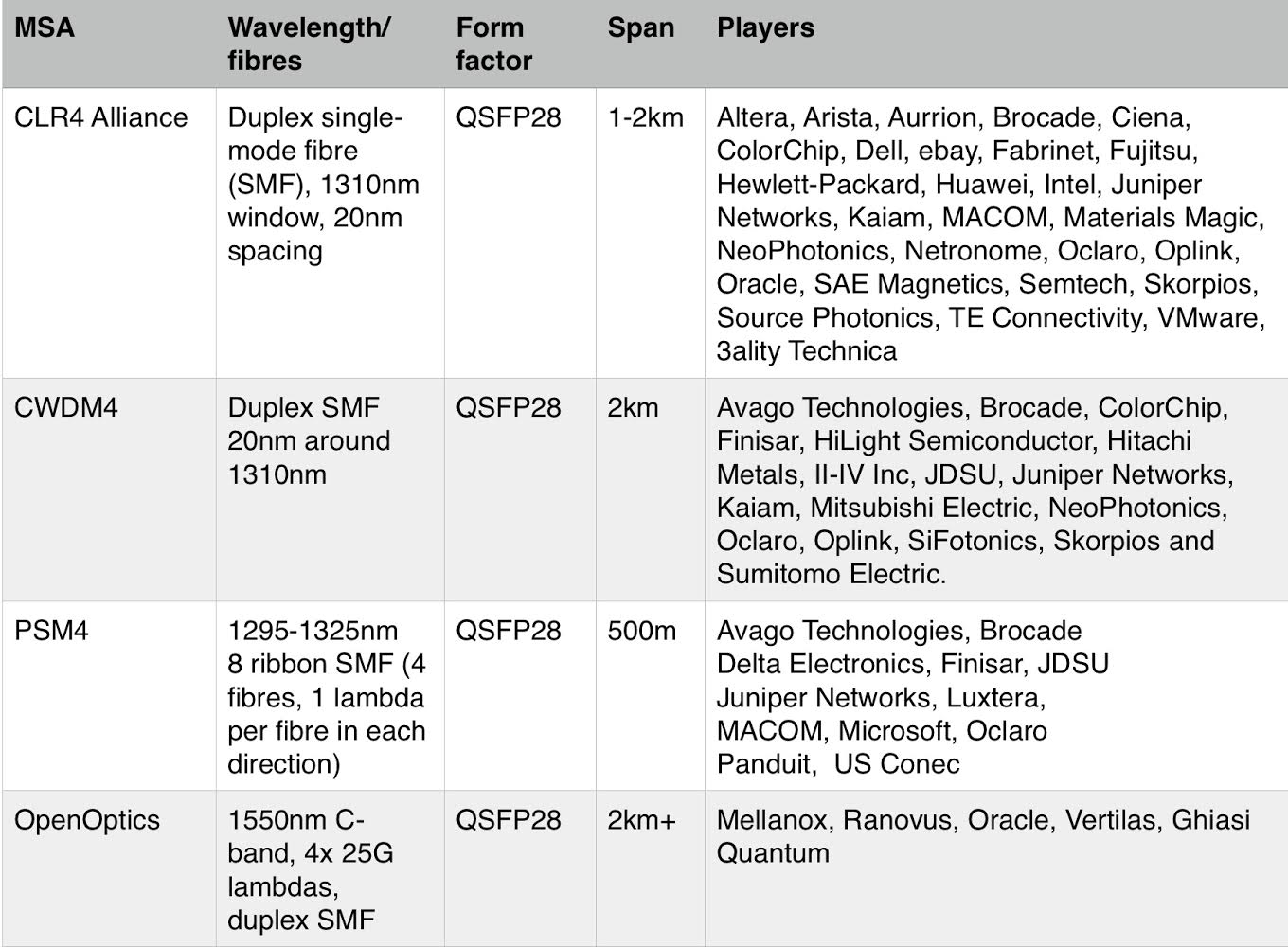
You may give little thought as to how your Facebook page is constructed each time you log in, or the data centre ramifications when you access Gmail. But for the internet giants, what is clear is that they need cheaper, higher-speed optical links to connect their equipment that match the growing size of their hyper-scale data centres.
The challenge for the web players is that existing 100 Gig links are either too short or too expensive. Ten and 40 Gig multimode interfaces span 300m, but at 100 Gig the reach plummets; the existing IEEE 802.3 Ethernet 100GBASE-SR10 and 100GBASE-SR4 multi-mode standards are 100m only. Meanwhile, the 10km reach of the next IEEE interface option, the 100 Gig single-mode 100GBASE-LR4, is overkill and expensive; the LR4 being sevenfold the cost of the 100GBASE-SR10, according to market research firm, LightCounting.
"The largest data centre operators will tell you less than 1km, less than 500m, is their sweet spot," says Martin Hull, director of product management at switch vendor, Arista Networks. Hyperscale data centres use a flatter switching architecture known as leaf and spine. "The flatter switching architectures require larger quantities of economical links between the leaf and spine switches," says Dale Murray, principal analyst at LightCounting.
A 'leaf' can be a top-of-rack switch connecting the servers to the larger-capacity 'spine' of the switch architecture. Operators want 100GbE interfaces with sufficient optical link budget to span 500m and greater distances, to interconnect the leaf and spine, or the spine to the data centre's edge router.
The optical industry has been heeding the web companies' request.
One reason the IEEE 802.3 Ethernet Working Group created the 802.3bm Task Force is to address mid-reach demand by creating a specification for a cheaper 500m interface. Four proposals emerged: parallel single mode (PSM4), coarse WDM (CWDM), pulse amplitude modulation, and discrete multi-tone. But none of the proposals passed the 75% voting threshold to become a standard.
The optical industry has since pursued a multi-source agreement (MSA) strategy to bring the much-needed solutions to market. In the last year, no fewer than four single-mode interfaces have emerged: the CLR4 Alliance, and the CWDM4, PSM4 and OpenOptics MSAs.
"The MSA-based solutions will have two important advantages," says Murray. "All will be much less expensive than a 10km 100Gig LR4 module and all can be accommodated by a QSFP28 form factor."
The 100 GbE PSM4, backed by the leading optical module makers (see table above), differs from the other three designs in using parallel ribbon fibre and having a 500m rather than a 2km reach. The PSM4 uses four 25 Gig channels, each sent over a fibre, such that four fibres are used in each direction. The PSM4 is technically straightforward and is likely to be the most economical for links up to 500m. In contrast, the CLR4, CWDM4 and OpenOptical all use 4x25 Gig WDM over duplex fibre. Thus, while the PSM4 will likely be the cheapest of the four modules, the link's cost advantage is eroded with distance due to the ribbon fibre cost.
The PSM4 is also attractive for secondary applications; the 25 Gig channels could be used as individual 'breakout' links. Already there is industry interest in 25GbE, while the module could be used in future for 32 Gig Fibre Channel and high-density 128 Gig Fibre Channel.
The OpenOptics MSA, backed by Mellanox and start-up Ranovus, operates in the 1550nm C-band and uses dense WDM, whereas the CLR4 Alliance and CWDM4 operate around 1310nm and use CWDM. The 100 GbE OpenOptics is also 4x25 Gig, such that the wavelengths can be spaced far apart but DWDM promises a roadmap for even higher speed interfaces.
The CLR4 Alliance is an Intel-Arista initiative that has garnered wide industry backing, but it is not an MSA. The specification is very similar to the CWDM4. Both the CLR4 and the CWDM4 include forward error correction (FEC) but whereas FEC is fundamental to the CWDM4, it is an option with the CLR4.
"We have focussed on the FEC-enabled [CWDM4] version so that optical manufacturers can develop the lowest possible cost components to support the interface," says Mitchell Fields, senior director, product marketing and strategy, fiber-optics product division at Avago. FEC adds flexibility, he says, not just in relaxing the components' specification but also simplifying module testing.
The backers of CWDM4 and CLR4 are working to align their specifications and while it is likely the two will interoperate, it remains unclear whether the two will merge.
The CWDM4 specification is likely to be completed in September with first products appearing as early as one or two quarters later. Arista points out that it already has a switch that could use CWDM4/ CLR4 modules now if they were available.
John D'Ambrosia, chairman of the Ethernet Alliance, regrets that four specifications have emerged. "My own personal belief is that it would be better for the industry overall if we didn't have so many choices," he says. "But the reality is there are a lot of different applications out there."
LightCounting expects the PSM4 and a merged CWDM offering will find strong market traction. "Avago, Finisar, JDSU and Oclaro are participating in both categories, demonstrating that each has its own value proposition," says Murray.
This article first appeared in the Optical Connections ECOC '14 magazine issue.
For a more detailed article on mid-reach optics, see p28 of the Autumn issue of Fibre Systems, click here
Article Revision: 30/10/2014: Updated members list of the OpenOptics MSA