

China Mobile plots 400 Gigabit trials in 2017
China Mobile is preparing to trial 400-gigabit transmission in the backbone of its optical network in 2017. The planned trials were detailed during a keynote talk given by Jiajin Gao, deputy general manager at China Mobile Technology, at the OIDA Executive Forum, an OSA event hosted at OFC, held in Los Angeles last week.
The world's largest operator will trial two 400-gigabit variants: polarisation-multiplexed, quadrature phase-shift keying (PM-QPSK) and 16-ary quadrature amplitude modulation (PM-16QAM).
The 400-gigabit 16-QAM will achieve a total transmission capacity of 22 terabits and a reach of 1,500km using ultra-low-loss fibre and Raman amplification, while with Nyquist PM-QPSK, the capacity will be 13.6 terabits and a 2000km reach. China Mobile started to deploy 100 gigabits in its backbone in 2013. It expects to deploy 400 gigabits in its metro and provisional networks from 2018.
Gao also detailed the growth in the different parts of China Mobile's network. Packet transport networking ports grew by 200,000 in 2016 to 1.2 million. The operator also grew its fixed broadband market share, adding over 20 million GPON subscribers to reach 80 million in 2016 while its optical line terminals (OLTs) grew from 89,000 in 2015 to 113,000 in 2016. Indeed, China Mobile has now overtaken China Unicom as China's second largest fixed broadband provider. Meanwhile, the fibre in its metro networks grew from 1.26 million kilometres in 2015 to 1.41 million in 2016.
The Chinese operator is also planning to adopt a hybrid OTN-reconfigurable optical add-drop multiplexer (OTN-ROADM) architecture which it trialled in the second half of 2016, linking several cities. The operator currently uses electrical cross-connect switches which were first deployed in 2011.
The ROADM is a colourless, directionless and contentionless design that also supports a flexible grid, and the operator is interested in using the hybrid OTN-ROADM in its provisional backbone and metro networks. Using the OTN-ROADM architecture is expected to deliver a power savings of between 13% and 50%, says Gao.
XG-PON was also first deployed in 2016. China Mobile says 95% of its GPON optical network units deployed connect single families. The operator detailed an advanced home gateway that it has designed which six vendors are now developing. The home gateway features application programming interfaces to enable applications to be run on the platform.
For the XG-PON OLTs, China Mobile is using four vendors - Fiberhome, Huawei, ZTE and Nokia Shanghai Bell. The OLTs support 8 ports per card with three of the designs using an ASIC and one an FPGA. "Our conclusion is that 10-gigabit PON is mature for commercialisation," says Gao.
Gao also talked about China Mobile's NovoNet 2020, the vision for its network which was first outlined in a White Paper in 2015. NovaNet will be based on such cloud technologies as software-defined networking (SDN) and network function virtualisation (NFV) and is a hierarchical arrangement of Telecom Integrated Clouds (TICs) that span the core through to access. He outlined how for private cloud services, a data centre will have 3,000 servers typically while for public cloud 4,000 servers per node will be used.
China Mobile has said the first applications on NovoNet will be for residential services, with LTE, 5G enhanced packet core and multi-access edge computing also added to the TICs.
The operator said that it will trial SDN and NFV in its network this year and also mentioned how it had developed its own main SDN controller that oversees the network.
China Mobile reported 854 million mobile subscribers at the end of February, of which 559 million are LTE users, while its wireline broadband users now exceed 83 million.

Telefónica tackles video growth with IP-MPLS network
- Telefónica’s video growth in one year has matched nine years of IP traffic growth
- Optical mesh network in Barcelona will use CDC-ROADMs and 200-gigabit coherent line cards
Telefónica has started testing an optical mesh network in Barcelona, adding to its existing optical mesh deployment across Madrid. Both mesh networks are based on 200-gigabit optical channels and high-degree reconfigurable add-drop multiplexers (ROADMs) that are part of the optical infrastructure that underpins the operator’s nationwide IP-MPLS network that is now under construction.
 Maria Antonia CrespoThe operator decided to become a video telco company in late 2014 to support video-on-demand and over-the-top streaming video services.
Telefónica realised its existing IP and aggregation networks would not be able to accommodate the video traffic growth and started developing its IP-MPLS network.
“What we are seeing is that the traffic is growing very quickly,” says Maria Antonia Crespo, IP and optical networking director at Telefónica. “In one year we are getting the same
figures as we got from internet traffic in the last nine years.”
The operator is rolling out the IP-MPLS network across Spain. Juniper Networks and Nokia are the suppliers of the IP router equipment, while Huawei and Nokia were chosen to supply the optical networking equipment.
IP-MPLS
Telefónica set about reducing the number of layers and number of hops when designing its IP-MPLS network. “At each hop, we have to invest money if we want to increase capacity,” says Crespo.
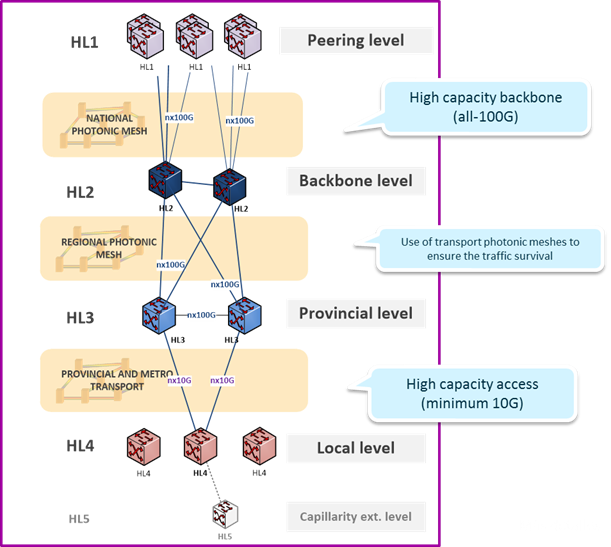
The result is an IP-MPLS network comprising four layers (see diagram). The uppermost Layer 1, dubbed HL1, connects the network to the internet world, while HL2 is a backbone transit layer. The HL3 layer is also a transit layer but at the provincial level. Spain is made up of 52 provinces. HL4 is where the services will reside, where Telefonica will deliver such services as Layer 2 and Layer 3 virtual private networks.
Between HL1 and HL2 is a national GMPLS-based photonic mesh, says Crespo, and between HL3 and HL4 there are the metro mesh networks. “Now we are deploying two GMPLS-based mesh networks, in Madrid and Barcelona,” she says. “Then, in the rest of the country, we are deploying [optical] rings.”
Systems requirements
Telefónica says it had several requirements when choosing the optical transport equipment, requirements common to both its backbone and regional networks.
One is the need to scale capacity at 10 gigabits and 100 gigabits, while network availability and robustness are also key. Telefónica says its network is designed to withstand two or more simultaneous fibre failures. “We have long experience with the GMPLS control plane to support different fibre impairments in the network,” says Alberto Colomer, optical technology manager at Telefónica.
The operator also wants its equipment to support high-speed interfaces and more granular rates to allow it to transition away from legacy traffic such as SDH and 1GbE. Operational improvements are another requirement: Telefónica wants to reduce the manual intervention its network needs. Optical time-domain reflectometers (OTDR) are being integrated into the network to monitor the fibre, as is the ability to automatically equalise the different optical channels.
 Alberto ColomerLastly, Telefónica is looking to reduce its capital expenditure and operational expense. It is deploying flexible rate 200-gigabit transponders in its Barcelona and Madrid networks and the same line cards will support 400-gigabit and even 1 terabit channels in future, as well as flexible grid to support the most efficient use of a fibre’s spectrum.
The 200-gigabit transponders use 16-quadrature amplitude modulation (16-QAM). Such transponders have enough reach to span each of the two cities but Colomer says Telefónica is still studying how many ROADM stages the 16-QAM transponders can cross.
It is like a pilot changing the engines while flying a plane
The ROADMs Telefónica is deploying in Madrid are directionless and are able to support up to 20 degrees. “You need some connectivity inside the mesh but also the mesh has to be connected to rings that cover all the counties around Madrid,” says Colomer.
Barcelona will be the first location where the ROADMs will also be colourless and contentionless (CDC-ROADMs). “We need to understand in a better way what are the advantages that come with that functionality,” says Colomer.
Telefónica has deployed Huawei’s Optix OSN 9800 platform in Madrid while in Barcelona Nokia’s 1830 Photonic Service Switch with the latest PSE-2 Coherent DSP-ASIC technology is being deployed.
Nokia’s PSS-1830 is designed to support the L-band as well as the C-band but Telefonica does not see the need for the L-band in the near future. “We are going in the direction of increasing capacity per channel: 400-gigabit channels and one terabit channels,” says Colomer. By deploying a photonic mesh and high-degree ROADMs, it will also be possible to increase capacity on a specific link by adding a fibre pair.
Status
The mesh in Madrid is already completed while Telefónica is deploying optical rings around Barcelona while it tests the contentionless ROADMs. These deployments are aligned with the IP-MPLS deployment, says Crespo, which is expected to be completed by 2018.
Crespo says the nationwide IP-MPLS rollout is a challenge. The deployment involves learning new technology that needs to be deployed alongside its existing network. "My boss likens it to a pilot changing the engines while flying a plane," says Crespo. "We are testing in the labs, duplicating it [the network], and migrating the traffic without impacting the customer."