

PMC-Sierra delivers silicon for 10 Gigabit EPON
PMC-Sierra has announced the availability of symmetric 10 Gigabit EPON chips. The devices complete the company's 10 Gigabit PON portfolio which also includes XGPON designs.
The 10G-EPON devices comprise two PAS9000 optical networking unit (ONU) and four PAS8000 optical line terminal (OLT) chips that support asymmetrical and symmetrical 10G-EPON: 10Gbps downstream (to the user) and 1Gbps upstream, and 10Gbps downstream and upstream, respectively. PMC-Sierra claims it is the first to market with a dual-mode 10G-EPON ONU device.
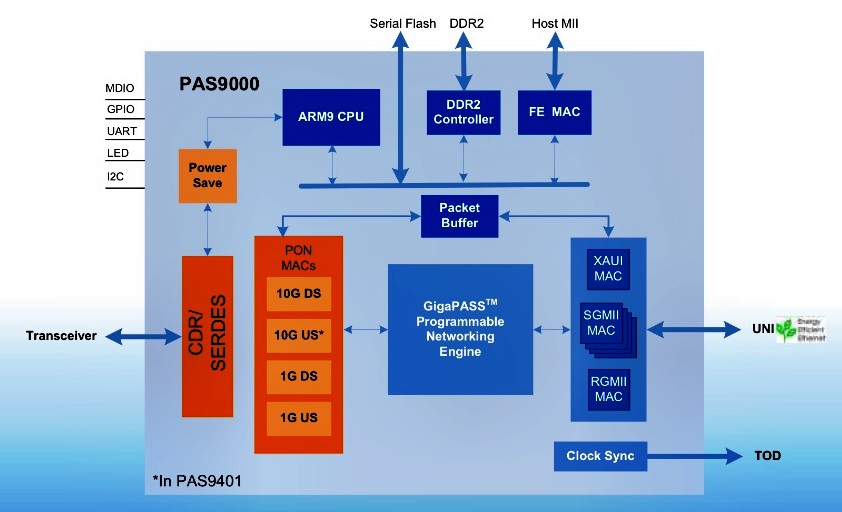 The PAS9000 optical network unit chip architecture. There are two devices in the family. One, the PAS9401, also supports 10G-EPON symmetric mode. Source: PMC-Sierra.
PON Market
PMC-Sierra says that the total market for PON is set for strong growth through 2015.
Using market data from Gartner and IDC, PMC says the 2010 market for EPON silicon was US $120M, growing to $180M for EPON and 10G-EPON speeds in 2015. In contrast, the GPON market was $35M in 2010 but will total $175M for both GPON and XGPON by 2015.
"China is going to be a very large market [for PON] compared to elsewhere," says Rammy Bahalul, senior marketing manager, FTTH division at PMC-Sierra.
Field trials of 10G-EPON have already been conducted in South Korea, Japan and China, says Bahalul: "We see Japan being the first to move to 10G-EPON, followed by Korea and China."
PMC expects 10G-EPON deployments to start in 2013, with the first application being multi-dwelling units. Meanwhile, the company expects first deployments of XGPON in 2014, with field trials starting in 2013. China is expected to deploy XGPON first, followed by North America.
10G-EPON ICs
The 40nm CMOS PAS8000 OLT family comprises four devices.
The PAS8301 and PAS8311 support asymmetric (1Gbps upstream) 10G-EPON. The two chips differ in that the PAS8311 has an on-chip traffic manager/ packet processor which inspects and classifies packets as well as rate-limits particular service flows.
The remaining two devices, the PAS8401 and PAS8411, support symmetric and asymmetric modes. However, the PAS8401 does not include the traffic manager/ packet processor.
All four have the Power Save mode which PMC claims halves the power consumption compared to existing ONUs. For example, it allows the ONU to be shut down when appropriate. The OLT devices also support synchronisation protocols required for mobile backhaul.
Another feature of the PAS8000 family is an on-chip optical time-domain reflectometer (OTDR). The OTDR function enables operators to locate fibre faults without using standalone test equipment, and can diagnose the nature and location of a fault to within a 2m accuracy, says Bahalul.
The PAS9000 ONU family comprises two devices: the asymmetric PAS9301 and the asymmetric/ symmetric PAS9401. The devices support the power save mode and mobile backhaul. And by delivering 10G-EPON symmetric and asymmetric modes, the PAS9401 ONU IC enables operators to plan five years ahead using silicon available now, says Bahalul.
Meanwhile, the company's XGPON OLT and ONU are asymmetric designs - 10Gbps downstream and 2.5Gbps upstream. The system-on-chip XGPON versions have still to be taped out with the designs currently implemented as FPGAs. The XGPON design was part of a recent successful interoperability test, conducted by industry body FSAN (Full Service Access Network), says PMC.
PMC-Sierra says it has a single software development kit that allows software developed on one platform to be reused across all its products.

Photonic integration specialist OneChip tackles PON
Briefing: PON
Part 1: Monolithic integrated transceivers
OneChip Photonics is moving to volume production of PON transceivers based on its photonic integrated circuit (PIC) design. The company believes that its transceivers can achieve a 20% price advantage.

"We will be able to sell [our integrated PON transceivers] at a 20% price differential when we reach high volumes"
Andy Weirich, OneChip Photonics
OneChip Photonics has already provided transceiver engineering samples to prospective customers and will start the qualification process with some customers this month. It expects to start delivering limited quantities of its optical transceivers in the next quarter.
The company's primary products are Ethernet PON (EPON) and Gigabit PON (GPON) transceivers. But it is also considering selling a bi-directional optical sub-assembly (BOSA), a component of its transceivers, to those system providers that want to attach the BOSA directly to the printed circuit board (PCB) in their optical network units (ONUs).
"The BOSA is the sub-assembly that contains all the optics, usually the TIA [trans-impedance amplifier] and sometimes the laser driver," says Andy Weirich, OneChip Photonics' vice president of product line management.
The company will roll out its Ethernet PON (EPON) ONU transceivers in the second quarter of 2012, followed by GPON ONU transceivers in the third quarter.
PON Technologies
EPON operates at 1.25 Gigabit-per-second (Gbps) upstream and downstream. OneChip had planned to develop a 2.5Gbps EPON variant which, says OneChip, has been standardised by the China Communications Standards Association (CCSA). But the company has abandoned the design since volumes have been extremely small and there have been no deployments in China.
GPON is a 2.5Gbps downstream/ 1.25Gbps upstream technology. The main differences between GPON and EPON transceiver optical components are the requirement of the ONU's receiver optics and circuitry, and the laser type, says Weirich. GPON's Class B+ specification, used for nearly all the GPON deployments, calls for a 28-29dB sensitivity. This is a more demanding specification requirement to meet than EPON's. GPON also calls for a Distributed Feedback (DFB) laser, whereas an EPON ONU may use either a Fabry-Perot laser or a DFB laser.
OneChip uses the same DFB for GPON and EPON ONUs. Where the PIC designs differ is the receiver assembly where GPON requires amplification. This, says Weirich, is achieved using either an avalanche photodiode (APD) or a semiconductor optical amplifier (SOA).
OneChip will start with an APD but will progress to an SOA. Once it integrates an SOA as part of the PIC, a simpler, cheaper photo-detector can be used.
Weirich admits that it has taken OneChip longer than it expected to develop its monolithically-integrated design.
Part of the challenge has been the issue of packaging the PIC. "Because of our integrated approach and non-alignment-requiring assembly, we have had to solve a few more technology problems," he says. "Our suppliers have had a challenge with some of those issues, and it has taken a couple of iterations to solve."
OneChip says that the good news is that the price erosion of EPON transceivers has slowed down in the last two years. So while Weirich admits the market is more competitive now, what is promising is that volumes have continued to grow.
"There is no sign of saturation happening either in the EPON or GPON markets," he says. And OneChip believes it can compete on price. "What we are saying is that we will be able to sell [our monolithically integrated PON transceivers) at a 20% price differential when we reach high volumes." That is because the monolithic design is simpler and the optical components that make up the design are cheaper, says the company.
10G EPON and XGPON
OneChip believes the end of 2012 will be when 10G EPON volumes start to ramp. "10G EPON is a significantly larger market than 10G GPON [XGPON]," says Weirich, pointing out that some of the largest operators such as China Telecom have backed 10G EPON.
With 10G EPON there are two flavours: the asymmetric (10Gbps downstream and 1.25Gbps upstream) and the symmetric (10Gbps bidirectional) versions.
For an asymmetric 10Gbps ONU transceiver, the laser does not need to change but the optics and electronics at the receiver do, because of the 10Gbps receive signal and because operators want 28-29dB optical link budgets so that 10G EPON can run on the same fibre plant as EPON. "This is an order of magnitude more difficult from a sensitivity perspective than for EPON," says Weirich.
There is demand for the 10G symmetric EPON but it is much lower than the asymmetric version primarily due to cost. "The ONU transceiver with its 10 Gbps laser and photo-detector is quite a bit more costly," says Weirich, complicating the PON's business case.
OneChip says it has a 10G EPON in its product roadmap, but it has not yet made any announcements or made any demonstrations to customers.
Challenges
OneChip is not aware of any other company developing a monolithic integrated design for PON transceivers, in part due to the challenge. It has to be made cheaply enough to compete with the traditional TO-can design. The key is to develop low-cost integration techniques and processes right at the start of the PIC design, he says.
The company says that it is also exploring using its PIC technology to address data centre connectivity.
OneChip Photonics at a glance
OneChip employs some 80 staff and is headquartered in Ottawa, Canada, where it has a 4,000 sq. ft. cleanroom. The start-up also has a regional office in Shenzhen, China which includes a test lab to serve regional customers.
The company is primarily a transceiver supplier and its main target customers are the tier-one system vendors that supply OLT and ONU equipment. "When you think of the big three players in China, Huawei, ZTE and Fiberhome would be among those we are targeting," says Steve Bauer, vice president of marketing and communications, as well as players such as Alcatel-Lucent and Motorola. As mentioned, the company is also considering selling its BOSA design to ONU makers.
In May 2011 the company received $18M in its latest round of funding. "We are transitioning from product development to becoming operationally ready to manufacture in volume," says Bauer.
Fabrinet and Sanmina-SCI are two contract manufacturers that the company is using for transceiver testing and assembly while it has partnerships with several other fabs for supply of wafers, wafer fabrication and silicon optical benches.