

Edgecore exploits telecom’s open-networking opportunity
Edgecore Networks is expanding its open networking portfolio with cell-site gateways and passive optical networking (PON) platforms.
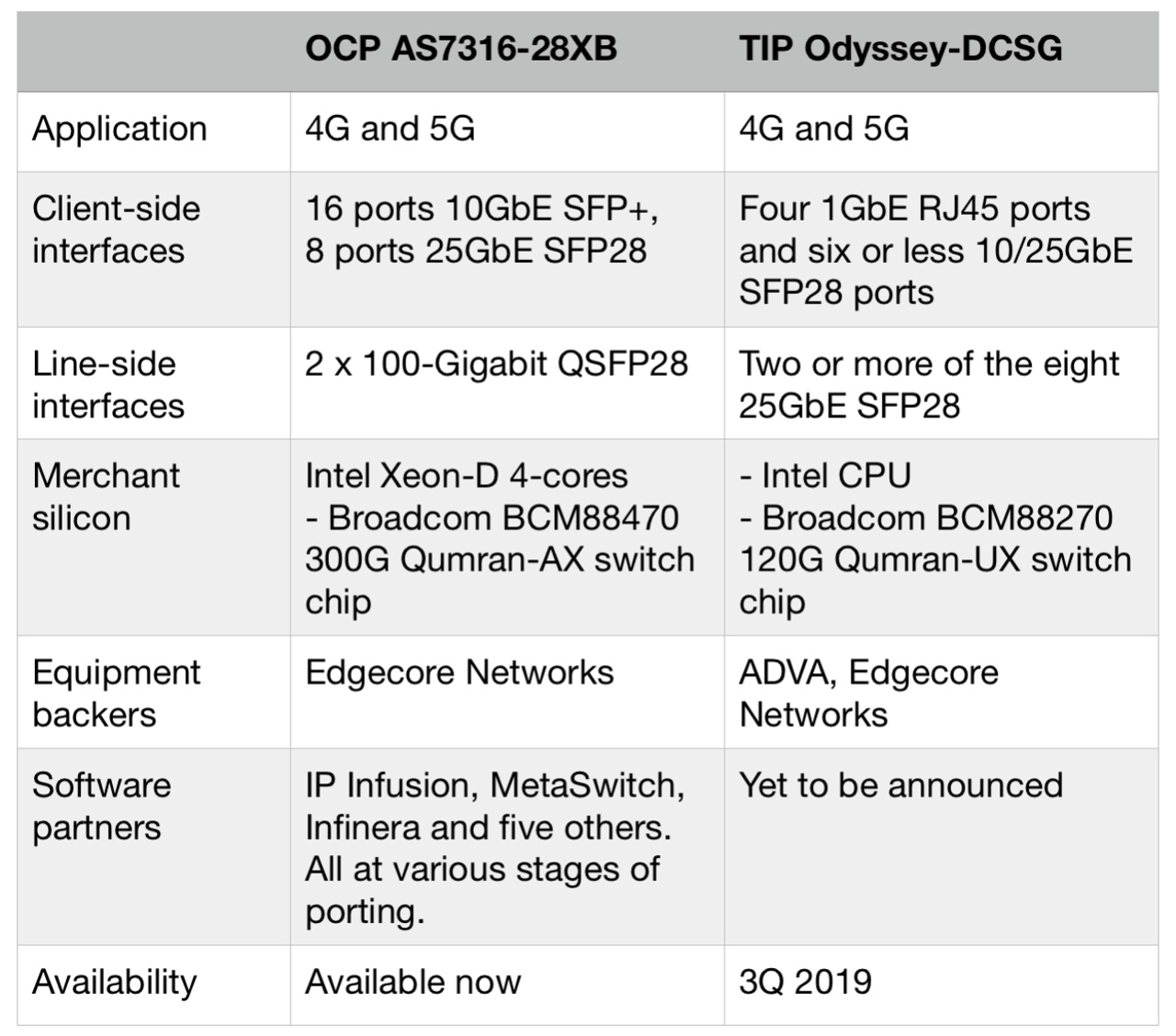
The company is backing two cell-site gateway designs that aggregate traffic from baseband units for 4G and 5G mobile networks. One design is from the Open Compute Project (OCP) that is available now and the second is from the Telecom Infra Project (TIP) that is planned for 2019 (see table).
Edgecore has also announced PON optical line terminal (OLT) platforms addressing 10-gigabit XGS-PON and GPON.
 Source: ADVA, Edgecore Networks
Edgecore is a wholly-ownedsubsidiary of Accton Technology, a Taiwanese original design manufacturer (ODM) employing over 700 networking engineers that reported revenues exceeding $1.2 billion in 2017.
Open networking
Edgecore is a leading proponent of open networking that first data centre operators and now telecom operators are adopting.
Open networking refers to disaggregated designs where the hardware and software comes from separate companies. The hardware is a standardised white box developed in an open framework, while the accompanying software can be commercial code from a company or open-sourced.
Our focus is on all those attributes of open networking: disaggregation, the hardware and software design of standard platforms, and making those designs open
Telecom networks have traditionally been built using proprietary equipment from systems vendors that includes the complete software stack. But the leading telcos have moved away from this approach to avoid being locked into a systems vendor's roadmap. Instead, they are active in open frameworks and are embracing disaggregated open designs, having seen the benefits achieved by the internet content providers that pioneered the approach.
“The IT industry for years have been buying servers and purposing them for whatever application they are designated for, adding an operating system and application software on top,” says Mark Basham, vice president business development and marketing, EMEA at Edgecore. “Now we are seeing the telecom industry shift to that model; they see where the value should be.”
White-box platforms built using merchant silicon promise to reduce the number of specialised platforms in an operator’s network, reducing costs by simplifying platform qualification and support.
“Our focus is on all those attributes of open networking: disaggregation, the hardware and software design of standard platforms, and making those designs open,” says Bill Burger, vice president, business development and marketing for North America at Edgecore.
OCP, TIP and ONF
Edgecore is active in three leading open framework initiatives whose memberships include large-scale data centre operators, telcos, equipment makers, systems integrators, software partners and chip players.
Edgecore is a member of OCP that was founded to address the data centre but now plays an important role in telecoms. The company is also part of TIP that was established in 2016 and includes internet giants Facebook and Microsoft as well as leading telecom operators, systems vendors, components players and others. Edgecore is also a key white-box partner as part of the Open Networking Foundation’s (ONF) reference-design initiative.
 Edgecore Networks' involvement in the ONF's reference design projects. Diagram first published in July 2018. Source: ONF.
Cell-site gateways
Edgecore has announced the availability of its AS7316-26XB, the industry’s first open cell-site gateway white-box design from the OCP that originated as an AT&T specification.
The company is also active in TIP’s cell-site gateway initiative. Edgecore will make and market the Odyssey Disaggregated Cell Site Gateway (Odyssey-DCSG) design that is backed by TIP’s operator members Telefonica, Orange, TIM Brazil and Vodafone. BT is also believed to be backing the TIP gateway.
The gateway aggregates the radio baseband unit (BBU) at a cell site back into the transport network.
The OCP cell-site gateway has a more advanced specification compared to the Odyssey. The AS7316-26XB uses a more powerful Intel processor and employs a 300-gigabit Broadcom Qumran-AX switch chip that aggregates the baseband traffic for transmission into the network.
The platform’s client-side interfaces include 16 SFP+ ports that supports either 1 Gigabit Ethernet (GbE) SFP or 10GbE SFP+ pluggable modules, eight 25GbE ports that accommodate either 10GbE SFP+ or 25GbE SFP28 modules, and two 100GbE QSFP28 uplinks. Some of the 25GbE ports could be used to expand the uplink capacity, if needed.
In contrast, the TIP Odyssey-DCSG platform uses a 120-gigabit Qumran switch chip while its interfaces include provide four 1GbE RJ45 ports and eight 10GbE or 25GbE SFP28 ports. Accordingly, the platform’s uplinks are at 25GbE.
“They [the OCP and TIP gateways] are very different boxes in terms of their performance,” says Basham.
Current deployed mobile platforms don't have sufficient capacity to support LTE Advanced Pro, never mind 5G, says Basham: “All the operators are looking at what is the right time to insert these boxes in the network.”
Telcos need to decide how much they are willing to spend up front. They could deploy a larger capacity but costlier cell-site gateway to future-proof their mobile backhaul for up to a decade. Or they could install the smaller-capacity Odyssey-DCSG that will suffice for five years before requiring an upgrade.
Given that the largest operators will deploy the gateways in units of hundreds of thousands, the capital expenditure outlay will be significant.
Basham says there will be a family of cell-site gateways and points out that the TIP specification originally had three ‘service configurations’. The latest TIP specification document now has a fourth service configuration that differs significantly from the other three in its port count and capabilities. “It shows that there is no one-size-fits-all,” says Basham.
The company also has announced two open disaggregated PON products, part of the OCP.
The ASXvOLT16 is a 10-gigabit OLT platform that supports XGS-PON and NG-PON2. The open OLT platform uses Broadcom’s 800-gigabit Qumran-MX switch chip and its BCM68620 Maple OLT device.
The platform’s interfaces includes 16 XFP ports supporting 10-gigabit optics while for the uplink traffic, four 100GbE ports are used. Each 10-gigabit interface will support 32 or 64 PON optical network units (ONU) typically.
“To support NG-PON2 will require the virtual OLT hardware abstraction layer to be adapted slightly, and also firmware to be put on the Broadcom chips,” says Basham. “The big difference between XGS-PON and NG-PON2 is in the plug-in optics.” More costly tunable optics will be required for NG-PON2. The 1 rack unit (1RU) PON OLT design is available now.
Edgecore has also contributed GPON OLT designs that conform with Deutsche Telecom’s Open GPON OLT design. The Edgecore ASGvOLT32 and ASGvOLT64 GPON OLTs support 32- and 64-GPON ports, respectively, while there are two 100GbE and eight 25GbE uplink ports.
The two GPON OLTs will sample in the first quarter of 2019, moving to volume production one quarter later.
We are at the cusp of bringing together all the parts to make Cassini a deployable solution
Cassini
Edgecore is also bringing its Cassini packet-optical transport white-box platform to market.
Like TIP’s Voyager box, Cassini uses the Broadcom StrataXGS Tomahawk 3.2-terabit switch chip. But while the Voyager comes with built-in coherent interfaces based on Acacia’s AC-400 module, Cassini is a modular design that has eight card slots. Each slot can accommodate one of three module options: a coherent CFP2-ACO, a coherent CFP2-DCO or two QSFP28 100-gigabit pluggables. The Cassini platform also has 16 fixed QSFP28 ports.
Accordingly, the 1.5RU Cassini box can be configured using only the coherent interfaces required. The box could be set up as a 3.2-terabit switch using QSFP28 modules only or as a transport box with up to 1.6 terabits of client-side interfaces and 1.6 terabits of line-side coherent interfaces. This contrasts with the 1RU Voyager that offers 2 terabits of switch capacity with its dozen 100-gigabit client-side interfaces and 800 gigabits of coherent line-side capacity.
“We are at the cusp of bringing together all the parts to make Cassini a deployable solution,” says Basham. “The focus is to get it deployed in the market.”
Edgecore sees Cassini as a baseline for future products. One obvious direction is to increase the platform’s capacity using Broadcom’s 12.8-terabit Tomahawk 3 switch chip. Edgecore already offers a Tomahawk 3-based switch for the data centre.
Such a higher-capacity Cassini platform would support 400GbE client-side interfaces and 400- or 800-gigabit coherent line-side interfaces. “We think that there is a future need for such a platform but we are not actively developing it right now,” says Burger.
A second direction for Cassini’s development is as a platform suited to routeing using larger look-up tables and deep buffering. Such a platform would use merchant silicon such as Broadcom’s Jericho chip. “We think there is a need for that as service providers deploy packet transport platforms in their networks,” says Burger.
Business model
The Cassini platform arose as part of Edgecore’s detailed technology planning discussions with its leading internet content provider customers.
“We recognised a need for more modularity in an open-packet transponder, the ability to mix-and-match the number of packet switching interfaces with the coherent optical interfaces,” says Burger.
Edgecore then approached TIP before contributing the Cassini platform to the organisation’s Open Optical and Packet Transport group.
When Edgecore contributes a design to an open framework such as the OCP or TIP, the design undergoes a review resulting in valuable feedback from member companies.
“We end up making modifications to improve the design in some cases and it then goes through an approval process,” says Burger. “After that, we contribute the design package and its available to anyone without any royalty obligation.”
At first glance, it is not obvious how contributing a platform design that other firms can build benefits Edgecore. But Burger says Edgecore benefits is several ways.
The organisation members’ feedback improves the product’s design. Edgecore also raises industry awareness of its platforms including among the OCP’s and TIP’s large service provider members.
Making the design available to members also offers the operators a potential second source for Edcore’s white box designs, strengthening confidence and their appeal.
And once a design is open sourced, software partners including start-ups will investigate the design as a platform for their code which can result in partnerships. “This benefits us and benefits the software companies,” says Burger.
Edgecore stresses that open-networking platforms are going to take time before they become widely adopted across service providers’ networks.
“It is going to be an evolution, starting with high-volume, more standardised use cases,” concludes Burger.
Part 1: TIP white-box designs, click here

Pilot Photonics makes a one terabit coherent comb source
Pilot Photonics has produced a four-wavelength laser chip for one-terabit coherent transmissions.
It is one of several applications the Irish start-up is pursuing using its optical comb source that produces multiple tunable outputs, the equivalent of a laser array.
The company is using its laser technology and photonic integration expertise to address Next Generation Passive Optical Network 2 (NG-PON2), coherent long-haul transmission, and non-telecom applications such as Light Detection and Ranging (LiDAR) and sensing.
 Frank Smyth (right)
“We have a number of chips reaching maturity and we are transitioning from an R&D-focussed company to early commercial activity,” says Frank Smyth, CEO of Pilot Photonics.
Start-up
Pilot Photonics was founded in 2011 and developed a lab instrumentation product. But its limited market resulted in the company changing tack, adding photonic integration expertise to its optical comb source intellectual property.
The company secured two grants that furthered its photonic integration know-how. One - Big Pipes - was a European Commission Seventh Framework Programme (FP7) project addressing optical transport and data centre applications using combs. The second, an Irish government grant, helped the start-up to commercialise its comb technology.
But this was also a challenging period for the company which could only employ two full-time staff. “I wasn't even full time for a few years,” says Smyth, who worked evenings and weekends. “We went into a lean period out of necessity.”
But building a photonic integration capability gained the company a market presence and led to it raising nearly €1million in funding.
Pilot Photonics now has 11 staff and two products being evaluated by customers. One is a directly-modulated laser for NG-PON2 while the second is a fibre-sensing product. The coherent four-channel source chip will soon be its third evaluation product.
The company is also working on a further funding round of several million Euro that it hopes to close by the year-end.
Optical comb source
There are several ways to implement an optical comb source. These include solid-state and fibre-based comb sources commonly used for scientific instrumentation but they are unsuited for high-volume applications, says Smyth.
Pilot Photonics’ approach, dubbed gain switching, is suited to high-volume applications and involves the direct modulation of a laser chip. “A close competitor of our technology is mode-locked laser diodes,” he says. This is the technology used by Ranovus for its module designs.
The start-up claims its technology has distinct advantages. “Our approach gives you better optical properties such as a narrow line-width," he says. The source also offers tunable wavelength spacing, in contrast to most optical combs that use a fixed-cavity design. Pilot Photonics says it can tune the spacing of the sources with sub-kilohertz precision.
The advantage of the comb source for coherent transmission is that a single chip can replace four or eight distinct lasers, saving packaging, size and cost
Pilot Photonics’ comb sources exploit injection locking between two lasers. Injection locking refers to an effect when two closely matched oscillating systems - in this case, lasers - interact to become synchronised.
The start-up’s comb source comprises a short-cavity ‘slave’ laser and a long-cavity ‘master’ one. The slave laser is modulated with a sine wave, turning the laser on briefly each cycle, to create a train of optical light pulses.
Linking the two lasers, injection locking occurs which increases the coherence between the output pulses. As Smyth explains, this reduces the jitter of the slave laser’s output in that the laser is turned on and off at the same exact points each cycle. This turns the slave’s output, when viewed on a spectrum analyser, into equally-spaced narrow line-width light sources.
The dimensions of the master laser’s cavity set the sources’ line widths while their spacing is dictated by the modulating sine wave. The master laser also determines the central wavelength of the comb sources while the sine wave’s frequency sets the spacings either side. “The master laser gives you a locked centre point and then the tones emanating from the centre can be tuned quite precisely,” says Smyth.
Pilot Photonics’ core intellectual property is making the indium-phosphide optical comb source using its patented gain-switching approach.
Photonic integration
The start-up has built a library of indium-phosphide optical functions in addition to the lasers used for the comb source. The functions include semiconductor optical amplifiers, waveguides, optical couplers, splitters and an active optical filter.
The splitters are used to place the comb source output on waveguides while an active optical filter on each selects the wanted source.
“This [active optical filter] is what we use to separate out individual comb lines so we can do fancy things with them,” says Smyth. For example, modulating the source with data, or beating two sources together for frequency multiplication to create sources in the millimetre wave or sub-terahertz ranges.
Pilot Photonics’ optical circuits are built in an indium-phosphide foundry where the comb source fabrication in done without using regrowth stages. This equates to fewer mask stages to process the indium-phosphide wafer. “There is no regrowth of material back over etched areas,” says Smyth. Fewer steps equates to a less-costly manufacturing process and improved yields.
The start-up sees NG-PON2, the 10-gigabit four-wavelength PON standard, as the largest and closest market opportunity for the company. Coherent optical transport is another telecom market the company is pursuing.
“The next closest opportunity is optical fibre sensing,” says Smyth, pointing out that there are several optical fibre sensoring techniques that can be made using their laser as a pulse source.
The company is also developing LiDAR technology and is involved with the European Space Agency to develop a light source for high-frequency metrology applications including atomic clocks and gravity meters.
“It is a very broad range of applications that we can apply the technology to,” says Smyth.
NG-PON2
Pilot Photonics is not using its source technology as a comb for an NG-PON2 optical line terminal (OLT) but rather as a directly modulated laser for the customer premises equipment’ optical network unit (ONU).
“What we have done is develop a wavelength-tunable directly-modulated laser for NG-PON2,” says Smyth. The benefit of its design is that the laser chip meets the stringent specification of the ONU by being tunable, meeting a reach of 40km and enabling sub-$100 designs.
The start-up is engaged with several potential NG-PON2 customers including manufacturers, systems vendors and module makers, and has delivered an evaluation board with the chip to its lead customer.
Two or three network equipment manufacturers are eager to evaluate the chip
Coherent source
The advantage of the comb source for coherent transmission is that a single chip can replace four or eight distinct lasers, saving packaging, size and cost.
Smyth estimates that a four-channel comb source is a third of the cost of a design using four single-mode lasers. The power consumption is also less; only one thermo-electric cooler is required instead of four.
Pilot Photonics says that it has demonstrated its four-channel comb-source transmitting over hundreds of kilometres.
The comb source can be used to send 400-gigabit (100 gigabit/wavelength) and 1-terabit (250 gigabit/wavelength) super-channels. “We’ve done two terabits using 16-QAM on most of the channels and QPSK on the outer ones,” says Smyth.
There are also other system performance benefits using a comb source. There is no need for guard bands to separate between the tones. “You are packing them as tight as can be allowed, the ultimate in spectral efficiency,” he says.
Smyth also points out that non-linear compensation techniques can be used because the frequency spacings are known precisely. Using non-linear compensation methods benefits reach; the laser source can be launched at higher power and the non-linear effects that result can be compensated for.
Pilot Photonics has shown its sources spaced as close as 6.25GHz to 87.5GHz apart. The start-up also says the tones do not need to be evenly spaced.
The start-up now has its four-channel comb-source chip on an evaluation board that it is about to deliver to interested systems vendors and large-scale data centre operators.
“Two or three network equipment manufacturers are eager to evaluate the chip,” says Smyth. “They are less forthcoming as to what they are applying it to.”
Finisar's 10 Gig bi-directional DWDM architecture
Finisar has developed a bi-directional 10-gigabit SFP+ module for the metro-access market. The dense wavelength-division multiplexing (DWDM) module is designed to expand capacity at locations where fibre is scarce. And being tunable, the SFP+ also simplifies network planning for the operators.
Finisar demonstrated the module working at the recent ECOC 2017 show held in Gothenburg.
Market applications
Interest is growing in using WDM optics for wireless, metro-access and cable networks that are undergoing upgrades. The interest in WDM at the network edge is due to a need to use fibre resources more efficiently. “We are seeing that globally, more and more dark fibre is being used up,” says Leo Lin, director of product line management at Finisar.
 Leo LinGiven the cost of leasing and installing fibre, operators are keen to make the best use of their existing fibre and are willing to pay more for WDM optics.
According to Finisar, leasing a fibre can cost $250-$2,000 per fibre annually while the cost of installing fibre can be $500,000 per 10km. “Using WDM optics, you can get payback in less than a year,” says Lin.
LightCounting Market Research's latest forecast estimates that the global wireless transceiver market for 10 gigabit WDM will be approximately $400 million in 2022.
Finisar’s bi-directional 10-gigabit SFP+ product is also being aimed at two emerging ITU Telecom standards: G.metro and NG-PON2.
G.Metro and NG-PON2
The G.metro standard supports up to 40 DWDM wavelengths on a 100GHz wavelength grid. Tuneable transponders each at 10 gigabits-per-second (Gbps) are used and have a reach of up to 20km without amplification.
NG-PON2 is a time and wavelength division multiplexing, passive optical network (TWDM-PON) standard. “In addition to TWDM-PON, they want to have a few dedicated point-to-point WDM links, an overlay on top of the PON,” says Lin.
G.metro uses both the C-band and the L-band: one band is used for the sent wavelengths and the other band for the received wavelengths. In contrast, Finisar’s bi-directional approach sends and receives wavelengths using the C-band only.
“The G.metro standard calls out bi-directional and tuneable optics, and our bi-directional module product can be directly used here,” says Lin. “Since ECOC, we have had quite some support from operators and OEMs that will add our architecture as one of the channel options in both G.metro and NG-PON2.”
Bidi design
Finisar describes its design as a dual-band bi-directional DWDM approach. To understand the design, it helps to compare it to existing DWDM duplex and single fibre schemes.
 Standard DWDM (A), a hybrid bi-directional scheme that uses 50GHz AWGs (B), and the bi-directional approach (C) using the C- and L-bands being proposed for G.metro and NG-PON2. Finisar's approach is shown in the diagram below. Source Finisar.
With standard DWDM, two fibres are used, each having a multiplexer and demultiplexer pair. The C-band is used with wavelengths sent down one fibre and received on the other (see diagram A).
The hybrid bi-directional DWDM design (diagram B) sends wavelengths in both directions on one fibre. The hybrid approach is growing in popularity, says Finisar, to address fibre scarcity, for example between a central office and a remote node. For the hybrid scheme, only a single multiplexer-demultiplexer pair is needed. But to fit all the wavelengths on one fibre, a 50GHz channel mux-demux is used rather than a cheaper 100GHz one.
Another bi-directional scheme - one that G.metro and NG-PON2 are promoting - uses 100GHz channels but requires both the C-band and the L-band (diagram C). Here, east-to-west traffic is sent across one band while west-to-east traffic is sent on the other.
“This approach requires cyclic arrayed-waveguide gratings,” says Lin. A cyclic or colourless arrayed-waveguide grating (AWG) can separate or combine wavelengths across multiple bands. But unlike the hybrid bi-directional case, one fibre only connects to each bi-directional transceiver hosting a C-band wavelength in one direction and an L-band one travelling in the opposite direction. Using fewer fibres saves cost and space.
Finisar’s bi-directional design is similar but with one important twist: only the C-band is used.
To do this, two carriers are placed into the single 100GHz channel: one an upstream wavelength and one a downstream one. The result is 40, 10Gbps wavelengths - 80 carriers in total - spread across the C-band (see diagram below).
 Finisar's bi-directional architecture uses two carriers per channel spread across the C-band. Source: Finisar
A tuneable filter is used in the module not only to match the channel that the remote module’s tuneable laser will use, but also to select the particular band in a given channel, either the upstream or downstream band. The result is that one bi-directional module can be used for all 40 channels. “One single part number for the far end and the near end,” says Lin.
The technical challenge Finisar faced to make its design work is separating the two closely spaced carriers in a 100GHz channel.
Finisar says that with a 50GHz DWDM system, the wavelength must sit centrally in the channel and that requires a wavelength locker. The two carriers within its 100GHz band are not placed centrally yet Finisar has developed a way to separate the two without needing wavelength-locker technology.
The tuneable bi-directional approach also simplifies network planning. If an operator wants to add a new wavelength and drop it at an existing node, the node’s optical add-drop multiplexer does not need to be upgraded.
“All operators have different channel plans and customised optical add-drop multiplexers in the field,” says Lin. “In our case, we are even simpler than the duplex. In duplex you need a multiplexer-demultiplexer pair; in our case, any AWG or thin-film filter based design can be used.”
Finisar uses an out-of-band communication channel for the central office module to co-ordinate the channel to be used with a newly inserted remote module. “You can plug in a module on any available port and it establishes a link by itself in under 10 seconds,” says Lin.
Roadmap
Finisar is working to extend the reach of its 10-gigabit bi-directional tuneable SFP+ DWDM architecture to beyond the current 40km to 60km with the use of a bi-directional EDFA.
The current 40km reach is determined by the link budget chosen for the expected use cases with the assumption being that multiple add-drop sites will exist between the central office and the remote end. “The tuneable laser used is the same that is used in our tuneable XFP+, so supporting beyond 80km is not a problem,” says Lin.
Finisar says it is working on a 25-gigabit bi-directional module that will be available in 2019.
Meanwhile, select customers are evaluating samples of the 10-gigabit bi-directional SFP+ module. General availability is expected by mid-2018.
FSAN unveils roadmap plans
Part 2: Next-generation passive optical networks
The Full Service Access Network (FSAN) has outlined its vision for fibre access networks for the coming decade.
FSAN is an industry forum that includes over 20 operators and 70 members overall. The group identifies service requirements and develops optical access technologies that are passed to the International Telecommunication Union (ITU) for standardisation.
 Source: FSAN
“One of the messages of the roadmap is that, in the immediate future, what FSAN wants to do is evolve the existing standards,” says Peter Dawes, FSAN NGPON co-chair.
The latest FSAN technologies to become standards are XGS-PON (10 gigabits symmetrical passive optical network) and the multiple wavelength TWDM-PON (time wavelength-division multiplexing passive optical network), also known as NG-PON2 (see chart).
PON status
XGS-PON is a single-wavelength PON standard that supports two rates: a 10-gigabit symmetrical rate and the asymmetrical 10 gigabits downstream (to the user) and 2.5 gigabits upstream originally introduced by XG-PON.
 Peter Dawes
TWDM-PON uses four wavelengths to deliver up to 40 gigabits of symmetrical bandwidth and has an option for eight wavelengths overall. TWDM-PON also uses tuneable lasers enabling operators to move subscribers between wavelengths.
“FSAN operators see continued growth in PON deployment,” says Dawes. “There is still strong deployment of GPON and we are on the verge of needing 10-gigabit symmetrical services.” Other operators may delay and go straight to TWDM-PON, he says.
According to Dawes, operators are seeing a variety of applications that are driving the need for 10-gigabit access rates. One is the growing use of video and video conferencing. Another bandwidth driver for access networks is mobile applications such as connecting mobile antennas and mobile backhaul. In addition, there are digital home trends such as social networking and the moving of content to the cloud.
Mobile fronthaul can eat as much bandwidth as you can supply once you start to aggregate [radio] antennas
Operators are also keen to attach the labels ‘gigabit’ and ‘gigabit services’ to their broadband offerings as a marketing differentiator.
Other drivers for the move to the newer PON technologies include peer-to-peer services and business IP services, says Dawes.
Roadmap
FSAN’s plan to evolve the existing standards in the near term will take the group to 2021.
One obvious way the existing PONs can be evolved is to adopt 25-gigabit wavelengths. This would enable a 25-gigabit symmetrical extension to XGS-PON and a future TWDM-PON variant with up to 200 gigabits of capacity if the full eight wavelengths are used. “It is a case of looking for logical evolutions of these technologies,” says Dawes.
One application that could use such high capacities is mobile fronthaul, says Dawes: “It can eat as much bandwidth as you can supply once you start to aggregate [radio] antennas.”
After 2020, FSAN will investigate disruptive technologies as it defines future optical access schemes. R&D work, new modulation schemes and component developments including silicon photonics will all be assessed as to their suitability for future optical access schemes.
Meanwhile, FSAN says it will review its roadmap on a yearly basis and amend it as required.
See Part 1: XGS and TWDM passive optical networks, click here
Telefonica tests XGS-PON
Part 1: XGS and TWDM passive optical networks
Telefonica is the latest operator to test XGS-PON, the 10-gigabit passive optical networking standard.
“Operators want to show they are taking the maximum from their fibre investment,” says Ana Pesovic, marketing manager for fibre at Nokia, the supplier of the XGS-PON equipment used for the operator’s lab tests. “Telefonica has been really aggressive in their fibre deployments in the last couple of years.”
 Ana Pesovic
XGS-PON
Approved by the ITU-T in 2016, XGS-PON supports two rates: 10-gigabit symmetrical and the asymmetrical rate of 10 gigabits downstream (to the user) and 2.5 gigabits upstream.
XGS-PON has largely superseded the earlier XG-PON standard which supports the 10-gigabit asymmetrical rate only. “It is fair to say there is no traction for XG-PON,” says Pesovic. “Even in China [an early adopter of XG-PON], we see the interest slowly moving to XGS-PON.”
Nokia says it has now been involved in 40 XGS-PON trials and nine customers have deployed the technology. “These have just started and they are not massive deployments,” says Pesovic.
Nokia’s XGS-PON customers include China Telecom and SK Broadband. SK Broadband has deployed XGS-PON alongside the more advanced TWDM-PON (time wavelength division multiplexing, passive optical network), the ITU-T NG-PON2 standard.
XGS-PON uses a fixed wavelength to deliver either the 10-gigabit symmetrical or asymmetrical service. The standard supports a distance of 20km and a split ratio of up to 1:128 - one XGS-PON optical line terminal (OLT) serving up to 128 optical network units (ONUs). In contrast, TWDM-PON supports four wavelengths enabling up to 40-gigabit symmetrical rates. And unlike XGS-PON, TWDM-PON supports flexible wavelengths using tuneable lasers.
The wavelengths used by XGS-PON and TWDM-PON have been specified such that the two standards can operate alongside GPON on the same fibre. Accordingly, with SK Broadband’s deployment, the two PON standards along with GPON support an aggregate capacity of 52.5 gigabits-per-second.
As well as testing XGS-PON's performance, Telefonica has tested that XGS-PON works without disturbing existing broadband services over its GPON networks, says Pesovic.
For the test, Telefonica used an 8-port line card where each port can be configured for XGS-PON or as a wavelength of a TWDM-PON. The line card fits within Nokia’s 7360 Intelligent Services Access Manager (ISAM) FX platform.
5G will require the deployment of many more small cells. With XGS-PON, multiple small cells can be served using a single PON
Applications
XGS-PON with its symmetrical 10-gigabit rate is suited to business services. "Operators can use one network to converge business and residential; today they are two overlay networks,” says Pesovic. Many businesses require 1-gigabit connectivity or less but by having a 10-gigabit link, multiple enterprises can be aggregated on one PON.
Nokia says that in countries such as South Korea as well as in Europe and North America there is also interest in a 10-gigabit PON for residential services. “People are taking the downstream bandwidth for granted and now the upstream is becoming a differentiator, making the quality of experience much better,” says Pesovic.
The bulk of traffic is still predominately downstream but increasingly users want to upload large files and video. Even if these uploads are of shorter duration, the network must deliver, says Pesovic.
Operators are also eyeing XGS-PON for the emerging 5G cellular standard. Nokia points out that 5G will require the deployment of many more small cells. With XGS-PON, multiple small cells can be served using a single PON.
Nokia expects XGS-PON will be deployed for years to come. Broadband is advancing by adding more wavelengths. To GPON, which uses one wavelength, can be added a second wavelength supporting 10-gigabit XGS-PON. Using TWDM-PON adds four and potentially eight more wavelengths - 40 gigabits and 80 gigabits of bandwidth, respectively. “It really doesn’t matter what the technology is called,” says Pesovic.
One North American operator is looking at TWDM-PON as a way to save power. During the night when there is less broadband usage, the operator wants to use wavelength mobility to migrate users onto a single wavelength.
TWDM-PON
Besides wavelength count, TWDM-PON differs from XGS-PON in its use of tuneable lasers.
Having tuneable wavelengths delivers several benefits to the operators. One is load balancing. If users on one wavelength start to exhaust its capacity, several users can be moved to a second wavelength that is less heavily loaded.
TWDM-PON also benefits network sharing and wavelength unbundling. A third-party operator can offer its fibre to interested operators. “Each operator could then operate on a single wavelength,” says Pesovic. If a user changes operator, they can simply be moved from one wavelength to another.
There are also operational benefits. If a fault develops on a board, users can be migrated to a second card without service interruption and the faulty board replaced.
One North American operator is looking at TWDM-PON as a way to save power, says Pesovic. During the night when there is less broadband usage, the operator wants to use wavelength mobility to migrate users onto a single wavelength. This would deliver sufficient bandwidth to those users that are active while allowing the remaining wavelengths to be powered down, saving power.
The issue impeding the uptake of TWDM-PON remains the high cost of tuneable lasers. Nokia expects it to be at least another year before the cost of tuneable lasers becomes more economical for PON. That said, service providers delivering businesses services may still be tempted to adopt TWDM-PON despite the higher cost of tuneable lasers given that the average revenue per user (ARPU) of business users is 5x that of residential users, says Pesovic.
See Part 2: FSAN unveils roadmap plans, click here
100 gigabit the next stop on PON's roadmap
 Source: Huawei
Q. What are the various ways the industry is considering implementing 100 Gigabit?
FE: The work happening now is to do a 25 gigabit-per-second wavelength, and then multiple wavelengths will be combined in some way to create 50-gigabit or 100-gigabit speed offerings.
Q. The IEEE 802.3ca is developing 100 gigabit EPON whereas the ITU-T/FSAN has defined NG-PON2. What does the development of 100 gigabit EPON mean for the future of NG-PON2?
The ITU NG-PON2 was a future PON project that was started in 2011 with the goal of reaching at least 40 Gigabit per PON system. This was achieved in 2015 when the whole series of standards was completed. During this time, the highest economical speed was 10 gigabit.
Now that time has passed, 25 gigabit-per-lambda is becoming more reasonable, and so the ITU plans to study 25 gigabit in both the multi-channel setting - that is NG-PON2, and in a single-channel setting that would be a follow-on to the XGS-PON system. These PON systems should not be seen as a single-point development but part of an evolution.
The IEEE 802.3ca work is complementary to this work, and many of the same people go to both standards groups - certainly Huawei does. It is in everybody’s interest to reuse components and technologies, and I’m confident that this will happen for the 25-gigabit generation just as it has in previous PON generations.
Q. In a press release, Huawei mentioned it is demonstrating a 100-Gigabit PON prototype. What is Huawei demonstrating and how has it been implemented?
The 100 gigabit PON prototype is an early look at the 25 gigabit-per-wavelength technology. Given that the standardisation is only beginning, we had to make many assumptions, but such prototypes give us a chance to find any issues early.
The details of the prototype will be more fully explained at the OFC conference, but in brief, what we have is a system that implements 25 gigabit downstream and 10 gigabit upstream per wavelength pair. A real PON MAC is operating in this system, and full PON operations: activation, ranging, dynamic bandwidth allocation etc. are taking place. The 25-gigabit transmission is done using either conventional non-return-to-zero (NRZ) or optical duobinary line coding.
Q. How is 100 gigabit PON envisaged to work with existing systems?
100 gigabit PON will co-exist with previous PON generations, most likely using a WDM-style of interworking. This is the same method used to allow G-PON, XG-PON, and TWDM-PON to co-exist on a single-fibre network.
Q. What in Huawei’s opinion are the main challenges to be overcome regarding 100 gigabit PON?
 Frank EffenbergerThere are two technical challenges to this system.
First, 25 gigabit-per-wavelength transmission over 20km of standard fibre that meets the approximate 30dB loss budget and the aggressive cost targets of access is difficult. This will take time to solve.
Second, combining multiple PON channels into a single virtual channel is not trivial because it requires some level of coordination between the channels. There are solutions, but they need more study to confirm their operation.
Q. What will the advent of Nx25 gigabit do to reduce the cost of PON?
That is a loaded question, because you presuppose that 25 gigabit will lower the cost. To first order, our hope is to keep the cost-per-endpoint increase to a reasonable level. Obviously, the cost-per-bit will decline significantly, but the access business is not so tied to this factor. The key factor in higher-speed PON is to increase the system and user speed while trying to hold costs steady.
The industrial readiness of TWDM-PON is not really at a mass deployment stage; furthermore, the 'killer app' that just absolutely demands TWDM’s capacity is not immediately at hand
Q. Besides showing operators an extended roadmap beyond 40 gigabit, what applications will require 100 gigabit PON?
In reality, while 100 gigabit PON makes for a nice headline, the story is more complex. There are two separate applications where we see the technology.
The first is a single-channel 25-gigabit system that would be useful for residential applications. This would serve as a follow-on to the XG-PON or 10GEPON deployments, and it could be at a price point that allows that.
The second is the full 100 gigabit PON with four channels. This would be useful for business services, for mobile backhaul and fronthaul, and fibre-deep architectures like G.fast (fibre-to-the-distribution point) and DOCSIS3.1 (D-CMTS).
Q. Huawei has also detailed a 10 and 40 gigabit NG-PON. Is this a combination of time- and wavelength-division multiplexing that in effect supports a traditional time-division multiplexed PON per wavelength i.e. TWDM-PON with rates that include 10 gigabit symmetrical, 10 gigabit downstream and 2.5 gigabit upstream, and 2.5 gigabit symmetrical?
You describe it correctly. The NG-PON2 system’s major solution is the TWDM-PON, which defines 4- or 8-wavelength pairs that can be used simultaneously, with 10 gigabit- or 2.5 gigabit-per-wavelength. So, it can reach a total capacity of 80 gigabit per PON.
In addition, NG-PON2 also defines a WDM overlay component, which supports eight or more channels of 10 gigabit per wavelength (not TDMed). All in all, the system capacity could reach over 160 gigabit.
Q. Is this system commercially deployed?
So far, there have been only small trial deployments. Huawei has deployed its early TWDM systems in many operators' networks in Europe and in Asia, but we are not at liberty to disclose these collaborations other than what has been announced. The industrial readiness of TWDM-PON is not really at a mass deployment stage; furthermore, the 'killer app' that just absolutely demands TWDM’s capacity is not immediately at hand.
When will it be deployed is a hard question.
Keep in mind that 10 gigabit PONs were standardised and prototyped by 2010, and yet it is 2016 and we still don’t see huge deployment; the first small-scale movements are starting to happen in China. That’s a six-year lag!
If NG-PON2 is true to that, then it predicts 2021 as the start of significant deployment. Barring the introduction of some super bandwidth-hungry service, I think it will still be some time before we deploy any next-generation system.
Q. What will be the first applications for 10G-40G NG-PON systems?
The envisioned applications for TWDM-PON was primarily residential and small business, with the simple assumption that bandwidth increase will continue to grow to 1 gigabit-per-second. A 40-gigabit PON, serving 32 customers typically, fits this Gigabit FTTH picture well. But that seems far away for now. Early deployments will likely be business services and wireless backhaul.
Verizon prepares its next-gen PON request for proposal
 Vincent O'Byrne
The NG-PON2 request for proposal (RFP) is being issued after the US operator completed a field test that showed a 40 gigabit NG-PON2 system working alongside Verizon’s existing GPON customer traffic.
The field test involved installing a NG-PON2 optical line terminal (OLT) at a Verizon central office and linking it to a FiOS customer’s home 5 km away. A nearby business location was also included in the trial.
Cisco and PT Inovação, an IT and research company owned by Portugal Telecom, worked with Verizon on the trial and provided the NG-PON2 equipment.
NG-PON2 is the follow-on development to XG-PON1, the 10 gigabit GPON standard. NG-PON2 supports both point-to-point links and a combination of time- and wavelength-division multiplexing that in effect supports a traditional time-division multiplexed PON per wavelength, known as TWDM-PON. The rates TWDM-PON supports include 10 gigabit symmetrical, 10 gigabit downstream and 2.5 gigabit upstream, and 2.5 gigabit symmetrical.
Verizon field-tested the transmission of NG-PON2 signals over a fibre already carrying GPON traffic to show that the two technologies can co-exist without interference, including Verizon’s analogue RF video signal. Another test demonstrated how, in the event of a OLT card fault at the central office, the customer’s optical network terminal (ONT) equipment can detect the fault and retune to a new wavelength, restoring the service within seconds.
Now we know we can deploy this technology on the same fibre without interference and upgrade the customer when the market demands such speed
Verizon is not saying when it will deploy the next-generation access technology. “We have not said as the technology has to become mature and the costs to reduce sufficiently,” says Vincent O'Byrne, director of access technology for Verizon.
It will also be several years before such speeds are needed, he says. “But now we know we can deploy this technology on the same fibre without interference and upgrade the customer when the market demands such speed.”
Verizon expects first NG-PON2 services will be for businesses, while residential customers will be offered the service once the technology is mature and cost-effective, says O’Byrne.
Vodafone is another operator conducting a TWDM-PON field trial based on four 10 gigabit wavelengths, using equipment from Alcatel-Lucent. Overall, Alcatel-Lucent says it has been involved in 16 customer TWDM-PON trials, half in Asia Pacific and the rest split between North America and EMEA.
Further reading
For an update on the NG-PON2 standard, click here
ECOC reflections: final part
Gazettabyte asked several attendees at the recent ECOC show, held in Cannes, to comment on key developments and trends they noted, as well as the issues they will track in the coming year.
Dr. Ioannis Tomkos, Fellow of OSA & Fellow of IET, Athens Information Technology Center (AIT)
With ECOC 2014 celebrating its 40th anniversary, the technical programme committee did its best to mark the occasion. For example, at the anniversary symposium, notable speakers presented the history of optical communications. Actual breakthroughs discussed during the conference sessions were limited, however.
 Ioannis Tomkos
It appears that after 2008 to 2012, a period of significant advancements, the industry is now more mainstream, and significant shifts in technologies are limited. It is clear that the original focus four decades ago on novel photonics technologies is long gone. Instead, there is more and more of a focus on high-speed electronics, signal processing algorithms, and networking. These have little to do with photonics even if they greatly improve the overall efficient operation of optical communication systems and networks.
Coherent detection technology is making its way in metro with commercial offerings becoming available, while in academia it is also discussed as a possible solution for future access network applications where long-reach, very-high power budgets and high-bit rates per customer are required. However, this will only happen if someone can come up with cost-effective implementations.
Advanced modulation formats and the associated digital signal processing are now well established for ultra-high capacity spectral-efficient transmission. The focus in now on forward-error-correction codes and their efficient implementations to deliver the required differentiation and competitive advantage of one offering versus another. This explains why so many of the relevant sessions and talks were so well attended.
There were several dedicated sessions covering flexible/ elastic optical networking. It was also mentioned in the plenary session by operator Orange. It looks like a field that started only fives years ago is maturing and people are now convinced about the significant short-term commercial potential of related solutions. Regarding latest research efforts in this field, people have realised that flexible networking using spectral super-channels will offer the most benefit if it becomes possible to access the contents of the super-channels at intermediate network locations/ nodes. To achieve that, besides traditional traffic grooming approaches such as those based on OTN, there were also several ground-breaking presentations proposing all-optical techniques to add/ drop sub-channels out of the super-channel.
Progress made so far on long-haul high-capacity space-division-multiplexed systems, as reported in a tutorial, invited talks and some contributed presentations, is amazing, yet the potential for wide-scale deployment of such technology was discussed by many as being at least a decade away. Certainly, this research generates a lot of interesting know-how but the impact in the industry might come with a long delay, after flexible networking and terabit transmission becomes mainstream.
Much attention was also given at ECOC to the application of optical communications in data centre networks, from data-centre interconnection to chip-to-chip links. There were many dedicated sessions and all were well attended.
Besides short-term work on high-bit-rate transceivers, there is also much effort towards novel silicon photonic integration approaches for realising optical interconnects, space-division-multiplexing approaches that for sure will first find their way in data centres, and even efforts related with the application of optical switching in data centres.
At the networking sessions, the buzz was around software-defined networking (SDN) and network functions virtualisation (NFV) now at the top of the “hype-cycle”. Both technologies have great potential to disrupt the industry structure, but scientific breakthroughs are obviously limited.
As for my interests going forward, I intend to look for more developments in the field of mobile traffic front-haul/ back-haul for the emerging 5G networks, as well as optical networking solutions for data centres since I feel that both markets present significant growth opportunities for the optical communications/ networking industry and the ECOC scientific community.
Dr. Jörg-Peter Elbers, vice president advanced technology, CTO Office, ADVA Optical Networking
The top topics at ECOC 2014 for me were elastic networks covering flexible grid, super-channels and selectable higher-order modulation; transport SDN; 100-Gigabit-plus data centre interconnects; mobile back- and front-hauling; and next-generation access networks.
For elastic networks, an optical layer with a flexible wavelength grid has become the de-facto standard. Investigations on the transceiver side are not just focussed on increasing the spectral efficiency, but also at increasing the symbol rate as a prospect for lowering the number of carriers for 400-Gigabit-plus super-channels and cost while maintaining the reach.
 Jörg-Peter Elbers
As we approach the Shannon limit, spectral efficiency gains are becoming limited. More papers were focussed on multi-core and/or few-mode fibres as a way to increase fibre capacity.
Transport SDN work is focussing on multi-tenancy network operation and multi-layer/ multi-domain network optimisation as the main use cases. Due to a lack of a standard for north-bound interfaces and a commonly agreed information model, many published papers are relying on vendor-specific implementations and proprietary protocol extensions.
Direct detect technologies for 400 Gigabit data centre interconnects are a hot topic in the IEEE and the industry. Consequently, there were a multitude of presentations, discussions and demonstrations on this topic with non-return-to-zero (NRZ), pulse amplitude modulation (PAM) and discrete multi-tone (DMT) being considered as the main modulation options. 100 Gigabit per wavelength is a desirable target for 400 Gig interconnects, to limit the overall number of parallel wavelengths. The obtainable optical performance on long links, specifically between geographically-dispersed data centres, though, may require staying at 50 Gig wavelengths.
In mobile back- and front-hauling, people increasingly recognise the timing challenges associated with LTE-Advanced networks and are looking for WDM-based networks as solutions. In the next-generation access space, components and solutions around NG-PON2 and its evolution gained most interest. Low-cost tunable lasers are a prerequisite and several companies are working on such solutions with some of them presenting results at the conference.
Questions around the use of SDN and NFV in optical networks beyond transport SDN point to the access and aggregation networks as a primary application area. The capability to programme the forwarding behaviour of the networks, and place and chain software network functions where they best fit, is seen as a way of lowering operational costs, increasing network efficiency and providing service agility and elasticity.
What did I learn at the show/ conference? There is a lot of development in optical components, leading to innovation cycles not always compatible with those of routers and switches. In turn, the cost, density and power consumption of short-reach interconnects is continually improving and these performance metrics are all lower than what can be achieved with line interfaces. This raises the question whether separating the photonic layer equipment from the electronic switching and routing equipment is not a better approach than building integrated multi-layer god-boxes.
There were no notable new trends or surprises at ECOC this year. Most of the presented work continued and elaborated on topics already identified.
As for what we will track closely in the coming year, all of the above developments are of interesting. Inter-data centre connectivity, WDM-PON and open programmable optical core networks are three to mention in particular.
For the first ECOC reflections, click here
FSAN adds WDM for next-generation PON standard
The Full Service Access Network (FSAN) group has chosen wavelength division multiplexing (WDM) to complement PON's traditional time-sharing scheme for the NG-PON2 standard.
 "The technology choice allows us to have a single platform supporting both business and residential services"
Vincent O'Byrne, Verizon
The TWDM-PON scheme for NG-PON2 will enable operators to run several services over one network: residential broadband access, business services and mobile back-hauling. In addition, NG-PON2 will support dedicated point-to-point links – via a WDM overlay - to meet more demanding service requirements.
FSAN will work through the International Telecommunication Union (ITU) to turn NG-PON2 into a standard. Standards-compliant NG-PON2 equipment is expected to become available by 2014 and be deployed by operators from 2015. But much work remains to flush out the many details and ensure that the standard meets the operators’ varied requirements
Significance
The choice of TWDM-PON represents a pragmatic approach by FSAN. TWDM-PON has been chosen to avoid having to make changes to the operators' outside plant. Instead, changes will be confined to the PON's end equipment: the central office's optical line terminal (OLT) and the home or building's optical networking unit (ONU).
Operators yet to adopt PON technology may use NG-PON2's extended reach to consolidate their network by reducing the number of central offices they manage. Other operators already having deployed PON may use NG-PON2 to boost broadband capacity while consolidating business and residential services onto the one network.
US operator Verizon has deployed GPON and says the adoption of NG-PON2 will enable it to avoid the intermediate upgrade stage of XGPON (10Gbps GPON).
"The [NG-PON2] technology choice allows us to have a single platform supporting both business and residential services," says Vincent O'Byrne, director of technology, wireline access at Verizon. "With the TWDM wavelengths, we can split them: We could have a 10G/10G service or ten individual 1G/1G services and, in time, have also residential customers."
The technology choice for NG-PON2 is also good news for system vendors such as Huawei and Alcatel-Lucent that have already done detailed work on TWDM-PON systems.
Specification
NG-PON2's basic configuration will use four wavelengths, resulting in a 40Gbps PON. Support for eight (80G) and 16 wavelengths (160G) are also being considered.
Each wavelength will support 10Gbps downstream (from the central office to the end users) and 2.5Gbps upstream (XGPON) or 10Gbps symmetrical services for business users.
"The idea is to reuse as much as possible the XGPON protocol in TWDM-PON, and carry that protocol on multiple wavelengths," says Derek Nesset, co-chair of FSAN's NGPON task group.
The PON's OLT will support the 4, 8 or 16 wavelengths using lasers and photo-detectors as well as optical multiplexing, while the ONU will require a tunable laser and a tunable filter, to set the ONU to the PON's particular wavelengths.
Other NG-PON2 specifications include the support of at least 1Gbps services per ONU and a target reach of 40km. NG-PON2 will also support 60-100km links but that will require technologies such as optical amplification.
 "The [NG-PON2] ONUs should be something like the cost of a VDSL or a GPON modem, so there is a challenge there for the [tunable] laser manufacturers"
Derek Nesset, co-chair of FSAN's NGPON task group
What next?
"The big challenge and the first challenge is the wavelength plan [for NG-PON2]," says O'Byrne.
One proposal is for TWDM-PON's wavelengths to replace XGPON's. Alternatively, new unallocated spectrum could be assigned to ensure co-existence with existing GPON, RF video and XGPON. However, such a scheme will leave little spectrum available for NG-PON2. Some element of spectral flexibility will be required to accommodate the various co-existence scenarios in operator networks. That said, Verizon expects that FSAN will look for fresh wavelengths for NG-PON2.
"FSAN is a sum of operators opinions and requirements, and it is getting hard," says O'Byrne. "Our preference would be to reuse XGPON wavelengths but, at the last meeting, some operators want to use XGPON in the coming years and aren't too favourable to recharacterising that band."
Another factor regarding spectrum is how widely the wavelengths will be spaced; 50GHz, 100GHz or the most relaxed 200GHz spacing are all being considered. The tradeoff here is hardware design complexity and cost versus spectral efficiency.
There is still work to be done to define the 10Gbps symmetrical rate. "Some folks are also looking for slightly different rates and these are also under discussion," says O'Byrne.
Another challenge is that TWDM-PON will also require the development of tunable optical components. "The ONUs should be something like the cost of a VDSL or a GPON modem, so there is a challenge there for the [tunable] laser manufacturers," says Nesset.
Tunable laser technology is widely used in optical transport, and high access volumes will help the economics, but this is not the case for tunable filters, he says.
The size and power consumption of PON silicon pose further challenges. NG-PON2 will have at least four times the capacity, yet operators will want the OLT to be the same size as for GPON.
Meanwhile, FSAN has several documents in preparation to help progress ITU activities relating to NG-PON2's standardisation.
FSAN has an established record of working effectively through the ITU to define PON standards, starting with Broadband PON (BPON) and Gigabit PON (GPON) to XGPON that operators are now planning to deploy.
FSAN members have already submitted a NG-PON2 requirements document to the ITU. "This sets the framework: what is it this system needs to do?" says Nesset. "This includes what client services it needs to support - Gigabit Ethernet and 10 Gigabit Ethernet, mobile backhaul latency requirements - high level things that the specification will then meet."
In June 2012 a detailed requirements document was submitted as was a preliminary specification for the physical layer. These will be followed by documents covering the NG-PON2 protocol and how the management of the PON end points will be implemented.
If rapid progress continues to be made, the standard could be ratified as early as 2013, says O'Byrne.
FSAN close to choosing the next generation of PON
Briefing: Next-gen PON
Part 1: NG-PON2
The next-generation passive optical network (PON) will mark a departure from existing PON technologies. Some operators want systems based on the emerging standard for deployment by 2015.
“One of the goals in FSAN is to converge on one solution that can serve all the markets"
Derek Nesset, co-chair of FSAN's NGPON task group
The Full Service Access Network (FSAN) industry group is close to finalising the next optical access technology that will follow on from 10 Gigabit GPON.
FSAN - the pre-standards forum consisting of telecommunications service providers, testing labs and equipment manufacturers - crafted what became the International Telecommunication Union's (ITU) standards for GPON (Gigabit PON) and 10 Gigabit GPON (XGPON1). In the past year FSAN has been working on NG-PON2, the PON technology that comes next.
“One of the goals in FSAN is to converge on one solution that can serve all the markets - residential users, enterprise and mobile backhaul," says Derek Nesset, co-chair of FSAN's NGPON task group.
Some mobile operators are talking about backhaul demands that will require multiple 10 Gigabit-per-second (Gbps) links to carry the common public radio interface (CPRI), for example. The key design goal, however, is that NG-PON2 retains the capability to serve residential users cost-effectively, stresses Nesset.
FSAN says it has a good description of each of the candidate technologies: what each system looks like and its associated power consumption. "We are trying to narrow down the solutions and the ideal is to get down to one,” says Nesset.
The power consumption of the proposed access scheme is of key interest for many operators, he says. Another consideration is the risk associated with moving to a novel architecture rather than adopting an approach that builds on existing PON schemes.
Operators such as NTT of Japan and Verizon in the USA have a huge installed base of PON and want to avoid having to amend their infrastructure for any next-generation PON scheme unable to re-use power splitters. Other operators such as former European incumbents are in the early phases of their rollout of PON and have Greenfield sites that could deploy other passive infrastructure technologies such as arrayed waveguide gratings (AWG).
"The ideal is we select a system that operates with both types of infrastructure," says Nesset. "Certain flavours of WDM-PON (wavelength division multiplexing PON) don't need the wavelength splitting device at the splitter node; some form of wavelength-tuning can be installed at the customer premises." That said, the power loss of existing optical splitters is higher than AWGs which impacts PON reach – one of several trade-offs that need to be considered.
Once FSAN has concluded its studies, member companies will generate 'contributions' for the ITU, intended for standardisation. The ITU has started work on defining high-level requirements for NG-PON2 through contributions from FSAN operators. Once the NG-PON2 technology is chosen, more contributions that describe the physical layer, the media access controller and the customer premise equipment's management requirements will follow.
Nesset says the target is to get such documents into the ITU by September 2012 but achieving wide consensus is the priority rather than meeting this deadline. "Once we select something in FSAN, we expect to see the industry ramp up its contributions based on that selected technology to the ITU," says Nesset. FSAN will select the NG-PON2 technology before September.
NG-PON2 technologies
Candidate technologies include an extension to the existing GPON and XGPON1 based on time-division multiplexing (TDM). Already vendors such as Huawei have demonstrated prototype 40 Gigabit capacity PON systems that also support hybrid TDM and WDM-PON (TWDM-PON). Other schemes include WDM-PON, ultra-dense WDM-PON and orthogonal frequency division multiplexing (OFDM).
Nesset says there are several OFDM variants being proposed. He views OFDM as 'DSL in the optical domain’: sub-carriers finely spaced in the frequency domain, each carrying low-bit-rate signals.
One advantage of OFDM technology, says Nesset, includes taking a narrowband component to achieve a broadband signal: a narrowband 10Gbps transmitter and receiver can achieve 40Gbps using sub-carriers, each carrying quadrature amplitude modulation (QAM). "All the clever work is done in CMOS - the digital signal processing and the analogue-to-digital conversion," he says. The DSP executes the fast Fourier transform (FFT) and the inverse FFT.
"We are trying to narrow down the solutions and the ideal is to get down to one"
Another technology candidate is WDM-PON including an ultra-dense variant that promises a reach of up to 100km and 1,000 wavelengths. Such a technology uses a coherent receiver to tune to the finely spaced wavelengths.
In addition to being compatible with existing infrastructure, another FSAN consideration is compatibility with existing PON standards. This is to avoid having to do a wholesale upgrade of users. For example, with XGPON1, the optical line terminal (OLT) using an additional pair of wavelengths - a wavelength overlay - sits alongside the existing GPON OLT. ”The same principle is desirable for NG-PON2,” says Nesset.
However, an issue is that spectrum is being gobbled up with each generation of PON. PON systems have been designed to be low cost and the transmit lasers used are not wavelength-locked and drift with ambient temperature. As such they consume spectrum similar to coarse WDM wavelength bands. Some operators such as Verizon and NTT also have a large installed base of analogue video overlay at 1550nm.
”So in the 1500 band you've got 1490nm for GPON, 1550nm for RF (radio frequency) video, and 1577nm for XGPON; there are only a few small gaps,” says Nesset. A technology that can exploit such gaps is both desirable and a challenge. “This is where ultra-dense WDM-PON could come into play,” he says. This technology could fit tens of channels in the small remaining spectrum gaps.
The technological challenges implementing advanced WDM-PON systems that will likely require photonic integration is also a concern for the operators. "The message from the vendors is that ’when you tell us what to do, we have got the technology to do it’,” says Nesset. ”But they need the see the volume applications to justify the investment.” However, operators need to weigh up the technological risks in developing these new technologies and the potential for not realising the expected cost reductions.
Timetable
Nesset points out that each generation of PON has built on previous generations: GPON built on BPON and XGPON on GPON. But NG-PON2 will inevitably be based on new approaches. These include TWDM-PON which is an evolution of XG-PON into the wavelength domain, virtual point-to-point approaches such as WDM-PON that may also use an AWG, and the use of digital signal processing with OFDM or coherent ultra dense WDM-PON. ”It is quite a challenge to weigh up such diverse technological approaches,” says Nesset.
If all goes smoothly it will take two ITU plenary meetings, held every nine months, to finalise the bulk of the NG-PON2 standard. That could mean mid-2013 at the earliest.
FSAN's timetable is based on operators wanting systems deployable in 2015. That requires systems to be ready for testing in 2014.
“[Once deployed] we want NG-PON2 to last quite a while and be scalable and flexible enough to meet future applications and markets as they emerge,” says Nesset.