

MultiPhy unveils 100G single-wavelength PAM-4 chip
A chip to enable 100-gigabit single-wavelength client-side optical modules has been unveiled by MultiPhy. The 100-gigabit 4-level pulse amplitude modulation (PAM-4) circuit will also be a key building block for 400 Gigabit Ethernet interfaces that use four wavelengths.
 Source: MultiPhy
Dubbed the MPF3101, the 100-gigabit physical layer (PHY) chip is aimed at such applications as connecting switches within data centres and for 5G cloud radio access network (CRAN).
“The chip has already been sent out to customers and we are heading towards market introductions,” says Avi Shabtai, CEO of MultiPhy.
The MPF3101 will support 100-gigabit over 500m, 2km and 10km.
The IEEE has developed the 100-gigabit 100GBASE-DR standard for 500m while the newly formed 100G Lambda MSA (multi-source agreement) is developing specifications for the 2km 100-gigabit single-channel 100G-FR and the 10km 100G-LR.
MultiPhy says the QSFP28 will be the first pluggable module to implement a 100-gigabit single-wavelength design using its chip. The SFP-DD MSA, currently under development, will be another pluggable form factor for the single-wavelength 100-gigabit designs.
The chip has already been sent out to customers and we are heading towards market introductions
400 Gigabit
The 100-gigabit IP will also be a key building block for a second MultiPhy chip for 400-gigabit optical modules needed for next-generation data centre switches that have 6.4 and 12.8 terabits of capacity. “This is the core engine for all these markets,” says Shabtai.
Companies have differing views as to how best to address the 400-gigabit interconnect market. There is a choice of form factors such as the OSFP, QSFP-DD and embedded optics based on the COBO specification, as well as emerging standards and MSAs.
The dilemma facing companies is what approach will deliver 400-gigabit modules to coincide with the emergence of next-generation data centre switches.
One consideration is the technical risk associated with implementing a particular design. Another is cost, with the assumption that 4-wavelength 400-gigabit designs will be cheaper than 8x50-gigabit based modules but that they may take longer to come to market.
For 400 gigabits, the IEEE 803.3bs 400 Gigabit Ethernet Task Force has specified the 400GBASE-DR4, a 500m-reach four-wavelength specification that uses four parallel single-mode fibres. The 100G Lambda MSA is also working on a 400-gigabit 2km specification based on coarse wavelength-division multiplexing (CWDM), known as 400G-FR4, with work on a 10km reach specification to start in 2018.
We are hearing a lot in the industry about 50-gigabit-per-lambda. For us, this is old news; we are moving to 100-gigabit-per-lambda and we believe the industry will align with us.
And at ECOC 2017 show, held last week in Gothenburg, another initiative - the CWDM8 MSA - was announced. The CWDM8 is an alternative design to the IEEE specifications that sends eight 50-gigabit non-return-to-zero signals rather that PAM-4 over a fibre.
“We are hearing a lot in the industry about 50-gigabit-per-lambda,” says Shabtai. “For us, this is old news; we are moving to 100-gigabit-per-lambda and we believe the industry will align with us.”
Chip architecture
The MPF3101, implemented using a 16nm CMOS process, supports PAM-4 at symbol rates up to 58 gigabaud.
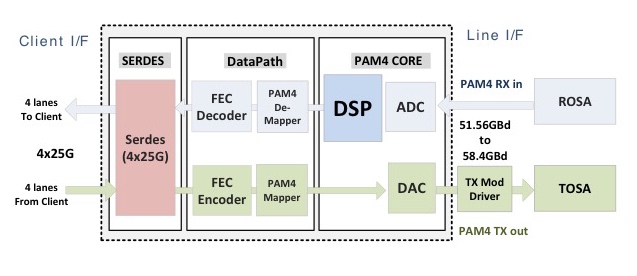
The chip’s electrical input is four 25-gigabit lanes that are multiplexed and encoded into a 50-plus gigabaud PAM-4 signal that is fed to a modulator driver, part of a 100-gigabit single-channel transmitter optical sub-assembly (TOSA). A 100-gigabit receiver optical sub-assembly (ROSA) feeds the received PAM-4 encoded signal to the chip’s DSP before converting the 100-gigabit signal to 4x25 gigabit electrical signals (see diagram).
“If you need now only one laser and one optical path [for 100 gigabits] instead of four [25 gigabits optical paths], that creates a significant cost reduction,” says Shabtai.
The advent of a single-wavelength 100-gigabit module promises several advantages to the industry. One is lower cost. Estimates that MultiPhy is hearing is that a single-wavelength 100-gigabit module will be half the cost of existing 4x25-gigabit optical modules. Such modules will also enable higher-capacity switches as well as 100-gigabit breakout channels when connected to a 400-gigabit four-wavelength module. Lastly, MultiPhy expects the overall power consumption to be less.
Availability
MultiPhy says first 100-gigabit single-wavelength QSFP28s will appear sometime in 2018.
The company is being coy as to when it will have a 400-gigabit PAM-4 chip but it points out that by having working MPF3101 silicon, it is now an integration issue to deliver a 4-channel 400-gigabit design.
As for the overall market, new high-capacity switches using 400-gigabit modules will start to appear next year. The sooner four-channel 400-gigabit PAM-4 silicon and optical modules appear, the less opportunity there will be for eight-wavelength 400-gigabit designs to gain a market foothold.
“That is the race we are in,” says Shabtai.

MultiPhy raises $17M to develop 100G serial interfaces
MultiPhy is developing chips to support serial 100-gigabit-per-second transmission using 25-gigabit optical components. The design will enable short reach links within the data centre and up to 80km point-to-point links for data centre interconnect.
 Source: MultiPhy
“It is not the same chip [for the two applications] but the same technology core,” says Avi Shabtai, the CEO of MultiPhy. The funding will be used to bring products to market as well as expand the company’s marketing arm.
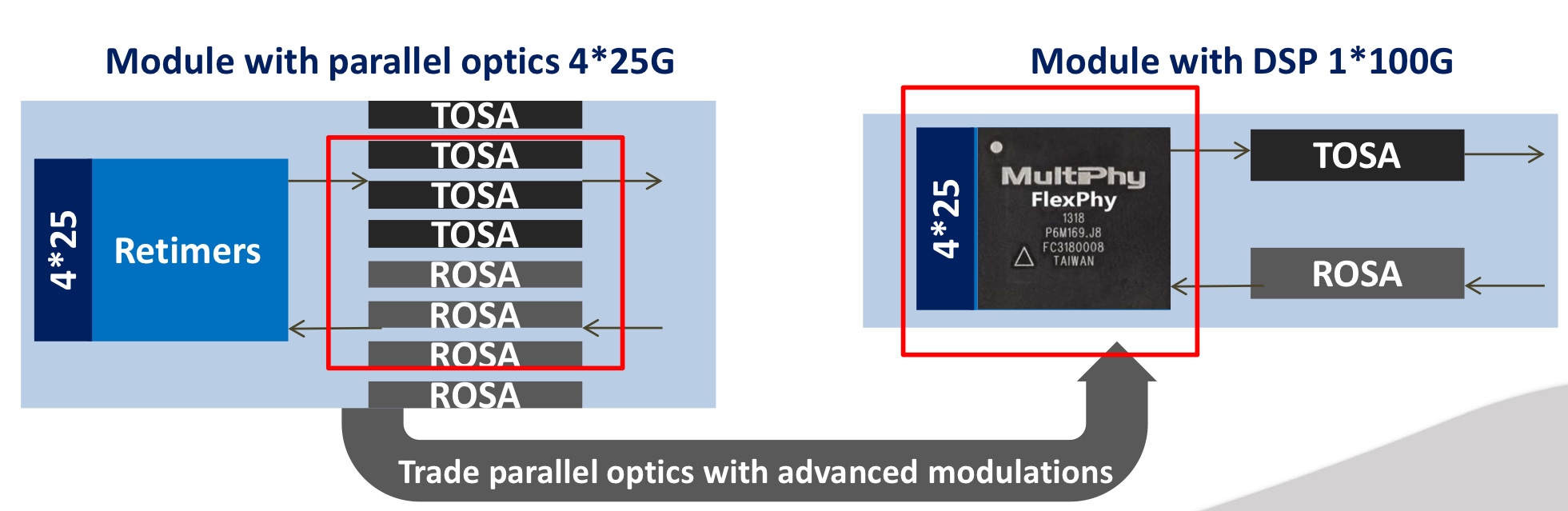
There is a huge benefit in moving to a single-wavelength technology; you throw out pretty much three-quarters of the optics
100 gigabit serial
The IEEE has specified 100-gigabit lanes as part of its ongoing 400 Gigabit Ethernet standardisation work. “It is the first time the IEEE has accepted 100 gigabit on a single wavelength as a baseline for a standard,” says Shabtai.
The IEEE work has defined 4-by-100 gigabit with a reach of 500 meters using four-level pulse-amplitude modulation (PAM-4) that encodes 2 bits-per-symbol. This means that optics and electronics operating at 50 gigabit can be used. However, MultiPhy has developed digital signal processing technology that allows the optics to be overdriven such that 25-gigabit optics can be used to deliver the 50 gigabaud required.
“There is a huge benefit in moving to a single-wavelength technology,” says Shabtai. ”You throw out pretty much three-quarters of the optics.”
The chip MultiPhy is developing, dubbed FlexPhy, supports the CAUI-4 (4-by-28 gigabit) interface, a 4:1 multiplexer and 1:4 demultiplexer, PAM-4 operating at 56 gigabaud and the digital signal processing.
The optics - a single transmitter optical sub-assembly (TOSA) and a single receiver optical sub-assembly (ROSA) - and the FlexPhy chip will fit within a QSFP28 module. “Taking into account that you have one chip, one laser and one photo-diode, these are pretty much the components you already have in an SFP module,” says Shabtai. “Moving from a QSFP form factor to an SFP is not that far.”
MultiPhy says new-generation switches will support 128 SFP28 ports, each at 100 gigabit, equating to 12.8 terabits of switching capacity.
Using digital signal processing also benefits silicon photonics. “Integration is much denser using CMOS devices with silicon photonics,” says Shabtai. DSP also improves the performance of silicon photonics-based designs such as the issues of linearity and sensitivity. “A lot of these things can be solved using signal processing,” he says.
FlexPhy will be available for customers this year but MultiPhy would not say whether it already has working samples.
MultiPhy raised $7.2 million venture capital funding in 2010.
MultiPhy readies 100 Gigabit serial direct-detection chip
MultiPhy is developing a chip that will support serial 100 Gigabit-per-second (Gbps) transmission using 25 Gig optical components. The device will enable short reach links within the data centre and up to 80km point-to-point links for data centre interconnect. The fabless chip company expects to have first samples of the chip, dubbed FlexPhy, by year-end.
 Figure 1: A block diagram of the 100 Gig serial FlexPhy. The transmitter output is an electrical signal that is fed to the optics. Equally, the input to the receive path is an electrical signal generated by the receiver optics. Source: Gazettabyte
The FlexPhy IC comprises multiplexing and demultiplexing functions as well as a receiver digital signal processor (DSP). The IC's transmitter path has a CAUI-4 (4x28 Gig) interface, a 4:1 multiplexer and four-level pulse amplitude modulation (PAM-4) that encodes two bits per symbol. The resulting chip output is a 50 Gbaud signal used to drive a laser to produce the 100 Gbps output stream.
"The input/output doesn't toggle at 100 Gig, it toggles at 50 Gig," says Neal Neslusan, vice president of sales and marketing at MultiPhy. "But 50 Gig PAM-4 is actually 100 Gigabit-per-second."
The IC's receiver portion will use digital signal processing to recover and decode the PAM-4 signals, and demultiplex the data into four 28 Gbps electrical streams. The FlexPhy IC will fit within a QSFP28 pluggable module.
As with MultiPhy's first-generation chipset, the optics are overdriven. With the MP1101Q 4x28 Gig multiplexer and MP1100Q four-channel receiver, 10 Gig optics are used to achieve four 28 Gig lanes, while with the FlexPhy, a 25 Gig laser is used. "Using a 25 GigaHertz laser and double-driving it to 50 GigaHertz induces some noise but the receiver DSP cleans it up," says Neslusan.
The use of PAM-4 incurs an optical signal-to-noise ratio (OSNR) penalty compared to non-return-to-zero (NRZ) signalling used for MultiPhy's first-generation direct-detection chipset. But PAM-4 has a greater spectral density; the 100 Gbps signal fits within a 50 GHz channel, resulting in 80 wavelengths in the C-band. This equates to 8 terabits of capacity to connect data centres up to 80 km apart.
Within the data centre, MultiPhy’s physical layer IC will enable 100 Gbps serial interfaces. The design could also enable 400 Gig links over distances of 500 m, 2 km and 10 km, by using four FlexPhys, four transmitter optical sub-assemblies (TOSAs) and four receiver optical sub-assemblies (ROSAs).
Meanwhile, MultiPhy's existing direct-detection chipset has been adopted by multiple customers. These include two optical module makers – Oplink and a Chinese vendor – and a major Chinese telecom system vendor that is using the chipset for a product coming to market now.
MultiPhy eyeing 400 Gig after completing funding round
MultiPhy is developing a next-generation chip design to support 100 and 400 Gigabit direct-detection optical transmission. The start-up raised a new round of funding in 2013 but has neither disclosed the amount raised nor the backers except to say it includes venture capitalists and a 'strategic investor'.
The start-up is already selling its 100 Gig multiplexer and receiver chips to system vendors and module makers. The devices are being used for up to 80km point-to-point links and dense WDM metro/ regional networks spanning hundreds of kilometers. "In every engagement we have, the solutions are being sold in both data centre and telecom environments," says Avi Shabtai, CEO of MultiPhy.
The industry has settled on coherent technology for long-distance 100 Gig optical transmission but coherent is not necessarily a best fit for certain markets if such factors as power consumption, cost and compatibility with existing 10 Gig links are considered, says Shabtai.
The requirement to connect geographically-dispersed data centres has created a market for 100 Gig direct-detection technology. The types of data centre players include content service providers, financial institution such as banks, and large enterprises that may operate their own networks.
In every engagement we have, the solutions are being sold in both data centre and telecom environments
MultiPhy's two chips are the MP1101Q, a 4x25 Gig multiplexer device, and the MP1100Q four-channel receiver IC that includes a digital signal processor implementing the MLSE algorithm.
The chipset enables 10 Gig opto-electronics to be used to implement the 25 Gig transmitter and receiver channels. This results in a cost advantage compared to other 4x25 Gig designs. A design using the chipset can achieve 100 Gig transmissions over a 200GHz-wide channel or a more spectrally efficient 100GHz one. The latter achieves a transmission capacity of 4 Terabits over a fibre.
ADVA Optical Networking is one system vendor offering 100 Gig direct-detection technology while Finisar and Oplink Communications are making 100 Gigabit direct-detection optical modules. Oplink announced that it is using MultiPhy's chipset in 2013.
Overall, at least four system vendors are in advanced stages of developing 100 Gig direct-detection, and not all will necessarily announce their designs, says Shabtai. Whereas all the main optical transmission vendors have 100 Gig coherent technology, those backing 100 Gig direct detection may remain silent so as not to tip off their competitors, he says.
We assume we can do more using those [25 Gig] optical components with our technology
Meanwhile, the company is using the latest round of funding to develop its next-generation design. MultiPhy is focussed on high-speed direct-detection despite having coherent technology in-house. "Coherent is on our roadmap but direct detection is a very good opportunity over the next two years," says Shabtai. "You will see us come with solutions that also support 400 Gig."
A 400 Gigabit direct-detection design using its next generation chipset will likely come to market only in 2016 at the earliest by which time 25 Gig components will be more mature and cheaper. Using existing 25 Gig technology, a 400 Gig design requires 16, 25 Gig channels. However, the company will likely extend the performance of 25 Gig components to achieve even faster channel speeds, just like it does now with 10 Gig components to achieve 25 Gig speeds. The result will be a 400 Gig design with fewer than 16 channels. "We assume we can do more using those [25 Gig] optical components with our technology," says Shabtai.
MultiPhy targets low-power coherent metro chip for 2013
MultiPhy has given first details of its planned 100 Gigabit coherent chip for metro networks. The Israeli fabless start-up expects to have samples of the device in 2013.

"We can tolerate greater [signal] impairments which means the requirements on the components we can use are more relaxed"
Avi Shabtai, CEO of MultiPhy
"Coherent metro is always something we have pushed," says Avi Shabtai, CEO of MultiPhy. Now, the company says it is starting to see a requirement for coherent technology's deployment in the metro. "Everyone expects to see it [coherent metro] in the next 2-3 years," he says. "Not tomorrow; it will take time to develop a solution to hit the target-specific [metro] market."
MultiPhy is at an advanced stage in the design of its coherent metro chip, dubbed the MP2100C. "It is going to be a very low power device," says Shabtai. MultiPhy is not quoting target figures but in an interview with the company's CTO, Dan Sadot, a figure of 15W was mentioned. The goal is to fit the design within a 24W CFP. This is a third of the power consumed by long-haul coherent solutions.
The design is being tackled from scratch. One way the start-up plans to reduce the power consumption is to use a one-sample-per-symbol data rate combined with the maximum-likelihood sequence estimation (MLSE) algorithm.
MultiPhy has developed patents that involve sub-Nyquist sampling. This allows the analogue-to-digital converters and the digital signal processor to operate at half the sampling rate, saving power. To use sub-Nyquist sampling, a low-pass anti-aliasing filter is applied but this harms the received signal. Using the filter, sampling at half the rate can occur and using the MLSE algorithm, the effects of the low-pass filtering can be countered. And because of the low-pass filtering, reduced bandwidth opto-electronics can be used which reduces cost.
This low-power approach is possible because the reach requirements in metro, up to 1,000km, is shorter than long haul/ ultra long haul optical transmission links. The shorter-reach requirements also impact the forward error correction codes, needed which can lessen the processing load, and the components, as mentioned. "We can tolerate greater [signal] impairments which means the requirements on the components we can use are more relaxed," says Shabtai.
The company also revealed that the MP2100C coherent device will integrate the transmitter and receiver on-chip.
MultiPhy says it is working with several system vendor and optical module partners on the IC development. Shabtai expects the first industry products using the chip to appear in 2014 or 2015. The timing will also be dependent on the cost and power consumption reductions of the accompanying optical components.
 A 100Gbps direct-detection optical module showing MultiPhy's multiplexer and receiver ICs. The module shown is a WDM design. Source: MultiPhy
100Gbps direct detection multiplexer chip
MultiPhy has also announced a multiplexer IC for 100 Gigabit direct detection. The start-up can now offer customers the MP1101Q, a 40nm CMOS multiplexer complement to its MP1100Q receiver IC that includes a digital signal processor to implements the MLSE algorithm. The MP1100Q was unveiled a year ago.
Testing the direct-detection chipset, MultiPhy says it can compensate +/-1000ps/nm of dispersion to achieve a point-to-point reach of 55km. No other available solution can meet such a reach, claims MultiPhy.
MultiPhy's direct-detection solution also enables 10 Gigabit-per-second (Gbps) opto-electronics components to be used for the transmit and receive paths. At ECOC, MultiPhy announced that it has used Sumitomo Electric's 10Gbps 1550nm externally-modulated lasers (EMLs) to demonstrate a 40km reach.
Using such 10Gbps devices simplifies the design since no 25Gbps components are required. It will also enable more optical module makers to enter the 100 Gigabit marketplace, claims MultiPhy. "It is twice the distance and about half of the cost of any other solution on the market - much below $10,000," says Shabtai.
 MultiPhy's HQ in Ness Ziona, Israel
The multiplexer device can also be used for traditional 4x28Gbps WDM solutions to achieve a reach in existing networks of up to 800km.
MultiPhy says that it expects the overall 100 Gigabit direct detection market to number 4 optical module makers and 4-5 system vendors by the end of 2012. At present ADVA Optical Networking is offering a 100Gbps direct-detection CFP-based design. ECI Telecom has detailed a 5x7-inch MSA direct-detection 100 Gigabit module, while Finisar and Oclaro have both announced that they are coming to market with 100Gbps direct-detection modules.
Dan Sadot on coherent's role in the metro and the data centre
Gazettabyte went to visit Professor Dan Sadot, academic, entrepreneur and founder of chip start-up MultiPhy, to discuss his involvement in start-ups, his research interests and why he believes coherent technology will not only play an important role in the metro but also the data centre.

"Moore's Law is probably the most dangerous enemy of optics"
Professor Dan Sadot
The Ben-Gurion University campus in Beer-Sheba, Israel, is a mixture of brightly lit, sharp-edged glass-fronted buildings and decades-old Palm trees.
The first thing you notice on entering Dan Sadot's office is its tidiness; a paperless desk on which sits a MacBook Air. "For reading maybe the iPad could be better but I prefer a single device on which I can do everything," says Sadot, hinting at a need to be organised, unsurprising given his dual role as CTO of MultiPhy and chairman of Ben-Gurion University's Electrical and Computer Engineering Department.
The department, ranked in the country's top three, is multi-disciplinary. Just within the Electrical and Electronics Department there are eight tracks including signal processing, traditional communications and electro-optics. "That [system-oriented nature] is what gives you a clear advantage compared to experts in just optics," he says.
The same applies to optical companies: there are companies specialising in optics and ASIC companies that are expert in algorithms, but few have both. "Those that do are the giants: [Alcatel-Lucent's] Bell Labs, Nortel, Ciena," says Sadot. "But their business models don't necessarily fit that of start-ups so there is an opportunity here."
MultiPhy
MultiPhy is a fabless start-up that specialises in high-speed digital signal processing-based chips for optical transmission. In particular it is developing 100Gbps ICs for direct detection and coherent.
Sadot cites a rule of thumb that he adheres to religiously: "Everything you can do electronically, do not do optically. And vice versa: do optically only the things you can't do electronically." This is because using optics turns out to be more expensive.
And it is this that MultiPhy wants to exploit by being an ASIC-only company with specialist knowledge of the algorithms required for optical transmission.
"Electronics is catching up," says Sadot. "Moore's Law is probably the most dangerous enemy of optics."
 Ben-Gurion University Source: Gazettabyte
Direct detection
Not only have developments in electronics made coherent transmission possible but also advances in hardware. For coherent, accurate retrieval of phase information is needed and that was not possible with available hardware until recently. In particular the phase noise of lasers was too high, says Sadot. Now optics is enabling coherent, and the issues that arise with coherent transmission can be solved electronically using DSP.
MultiPhy has entered the market with its MP1100Q chip for 100Gbps direct detection. According to Sadot, 100Gbps is the boundary data rate between direct detection and coherent. Below 100Gbps coherent is not really needed, he says, even though some operators are using the technology for superior long-haul optical transmission performance at 40Gbps.
"Beyond 100 Gig you need the spectral efficiency, you need to do denser [data] constellations so you must have coherent," says Sadot. "You are also much more vulnerable to distortions such as chromatic dispersion and you must have the coherent capability to do that."
But at 100 Gig the two - coherent and direct detection - will co-exist.
MultiPhy's first device runs the maximum likelihood sequence estimation (MLSE) algorithm that is used to counter fibre transmission distortions. "MLSE offers the best possible theoretical solution on a statistical basis without retrieving the exact phase," says Sadot. "That is the maximum you can squeeze out of direct detection."
The MLSE algorithm benefits optical performance by extending the link's reach while allowing lower cost, reduced-bandwidth optical components to be used. MultiPhy claims 4x10Gbps can be used for the transmit and the receive path to implement the 4x28Gbps (100Gbps) design.
Sadot describes MLSE as a safety net in its ability to handle transmitter and/or receiver imperfections. "We have shown that performance is almost identical with a high quality transmitter and a lower quality transmitter; MLSE is an important addition." he says.
 Ben-Gurion University Source: Gazettabyte
Coherent metro
System vendors such as Ciena and Alcatel-Lucent have recently announced their latest generation coherent ASICs designed to deliver long-haul transmission performance. But this, argues Sadot, is overkill for most applications when ultra-long haul is not needed: metro alone accounts for 75% of all the line side ports.
He also says that the power consumption of long-haul solutions is over 3x what is required for metro: 75W versus the CFP pluggable module's 24W. This means the power available solely for the ASIC would be 15W.
"This is not fine-tuning; you really need to design the [coherent metro ASIC] from scratch," says Sadot. "This is what we are doing."
To achieve this, MultiPhy has developed patents that involve “sub-Nyquist” sampling. This allows the analogue-to-digital converters and the DSP to operate at half the sampling rate, saving power. To use sub-Nyquist sampling, a low-pass anti-aliasing filter is applied but this harms the received signal. Using the filter, sampling at half the rate can occur and using the MLSE algorithm, the effects of the low-pass filtering can be countered. And because of the low pass filtering, reduced bandwidth opto-electronics can be used which reduces cost.
The result is a low power, cost-conscious design suited for metro networks.
Coherent elsewhere
Next-generation PON is also a likely user of coherent technology for such schemes as ultra-dense WDM-PON.
Sadot believes coherent will also find its way into the data centre. "Again you will have to optimise the technology to fit the environment - you will not find an over-design here," he says.
Why would coherent, a technology associated with metro and long-haul, be needed in the data centre?
"Even though there is the 10x10 MSA, eventually you will be limited by spectral efficiency," he says. Although there is a tremendous amount of fibre in the data centre, there will be a need to use this resource to the maximum. "Here it will be all about spectral efficiency, not reach and optical signal-to-noise," says Sadot.
Sadot's start-ups
Sadot had a research posting at the optical communications lab at Stanford University. The inter-disciplinary and systems-oriented nature of the lab was an influence on Sadot when he founded the optical communications lab at Ben-Gurion University around the time of the optical boom. "A pleasant time to come up with ideas," is how he describes that period - 1999-2000.
The lab's research focus is split between optical and signal processing topics. Work there resulted in two start-ups during the optical bubble which Sadot was involved in: Xlight Photonics and TeraCross.
Xlight focused on ultra-fast lasers as part of a tunable transponder. Xlight eventually merged with another Israeli start-up Civcom, which in turn was acquired by Padtek.
The second start-up, TeraCross, looked at scheduling issues to improve throughput in Terabit routers. "The start-up led to a reference design that was plugged into routers in Cisco's Labs in Santa Clara [California]," says Sadot. "It was the first time a scheduler showed the capability to support a one Terabit data stream, and route in a sophisticated, global manner."
But with the downturn of the market, the need for terabit routers disappeared and the company folded.
Sadot's third and latest start-up, MultiPhy, also has its origins in Ben-Gurion's optical communications lab's work on enabling system upgrades without adding to system cost.
MultiPhy started as a PON company looking at how to upgrade GPON and EPON to 10 Gigabit PON without changing the hardware. "The magic was to use previous-generation hardware which introduces distortion as it doesn't really fit this upgrade speed, and then to compensate by signal processing," says Sadot.
After several rounds of venture funding the company shifted its focus from PON, applying the concept to 100 Gigabit optical transmission instead.
100 Gigabit direct detection gains wider backing
More vendors are coming to market with 100 Gigabit direct detection products for metro and private networks.
The emergence of a second de-facto 100 Gigabit standard, a complement to 100 Gigabit coherent, has gained credence with 4x28 Gigabit-per-second (Gbps) direct detection announcements from Finisar and Oclaro, as well as backing from system vendor, ECI Telecom.

"We believe that in some cases operators will prefer to go with this technology instead of coherent"
Shai Stein, CTO, ECI Telecom
ECI Telecom and chip vendor MultiPhy announced at OFC/NFOEC that they have been collaborating to develop a 168-pin MSA, 5x7-inch 100 Gigabit-per-second (Gbps) direct detection module. Finisar and Oclaro used the show held in Los Angeles to announce their market entry with 100Gbps direct detection CFP pluggable optical modules.
Late last year ADVA Optical Networking announced the industry's first 100Gbps direct detection product. At the same time, MultiPhy detailed its MP1100Q receiver chip designed for 100Gbps direct detection.
According to ECI, by having the 168-pin MSA interface, one line card can support a 100Gbps coherent transponder or the 100Gbps direct detection. "This is important as it enables us to fit the technology and price to the needs of end customers," says Shai Stern, CTO of ECI Telecom.
100 Gigabit transmission
Coherent technology has become the de-facto standard for 100Gbps long-haul transmission. Using dense wavelength division multiplexing (DWDM), system vendors can achieve 1,500km and greater reaches using a 50GHz channel.
But coherent designs are relatively costly and 100Gbps direct detection offers a cost-conscious alternative for metro networks and for linking data centres, achieving a reach of up to 800km.
"It [100 Gig direct detection] provides needed performance at an attractive cost, in particular when you are looking at private optical networks," says Per Hansen, vice president of product marketing, optical networks solutions at Oclaro.
Such networks need not be owned by private enterprises, they can belong to operators, says Hansen, but they are typically simple point-to-point connections or 3- to 4-node rings serving enterprises. "Bonding adjacent [4x28Gbps] wavelengths to create a 100Gbps channel that connects efficiently to your [IP] router is very attractive in such networks," says Hansen.
For more complex mesh metro networks, coherent is more attractive. "Simply because of the spectral resources being taken up through the mesh [with 4x28Gbps], and the operational aspect of routeing that," says Hansen.
ECI Telecom says that it has yet to decide whether it will adopt 100Gbps direct detection. But it does see a role for the technology in the metro since the 100Gbps technology works well alongside networks with 10 and 40 Gigabit on-off keying (OOK) channels. "We believe that in some cases operators will prefer to go with this technology instead of coherent," says Stein.
Some operators have chosen to deploy coherent over new overlay networks, to avoid the non-linear transmission effects that result from mixing old and new technologies on the one network. "With this technology, operators can stay with their existing networks yet benefit from 100 Gig high capacity links," says Stein.
Finisar says 100Gbps direct detection is also suited to low-latency applications. "The fact that it is not coherent means it doesn't include a DSP chip, enabling it to be used for low latency applications," says Rafik Ward, vice president of marketing at Finisar.
Implementation
The announced 100Gbps direct detection designs all use 4x28Gbps channels and optical duo-binary (ODB) modulation, although MultiPhy also promotes an 80km point-to-point OOK version (see Table).
 Source: Gazettabyte
The module input is a 10x10Gbps electrical interface: a CFP interface or the 168-pin line side MSA. A 'gearbox' IC is used to translate between the 10x10Gbps electrical interface and the four 28Gbps channels feeding the optics.
"There are a few suppliers that are offering that [gearbox IC]," says Robert Blum, director of product marketing for Oclaro's photonic components. AppliedMicro recently announced a duplex multiplexer-demultiplexer IC.
MultiPhy's receiver chip has a digital signal processor (DSP) that implements the maximum likelihood sequence estimation (MLSE) algorithm, which is says enables 10 Gig opto-electronics to be used for each channel. The result is a 100Gbps module based on the cost of 4x10Gbps optics. However, over-driving the 10Gbps opto-electronics creates inter-symbol interference, where the energy of a transmitted bit leaks into neighbouring signals. MultiPhy's DSP using MLSE counters the inter-symbol interference.
 100G direct detection module showing MultiPhy's MP1100Q chip. Source: MultiPhy
Oclaro and Finisar claim that using ODB alone enables the use of lower-speed opto-electronics. "This is irrespective of whether you use MLSE or hard decision," says Blum. "The advantage of using optical duo-binary modulation is that you can use 10G-type optics."
Finisar's Ward points out that by using ODB, the 100Gbps direct-detection module avoids the price/ power penalty associated with a receiver DSP running MLSE to compensate for sub-optimal optical components.
Oclaro, however, has not ruled out using MLSE in future. The company endorsed MultiPhy's MLSE device when the product was first announced but its first 100G transceiver is not using the IC.
Finisar and Oclaro's modules require 200GHz to transmit the 100Gbps signal: 4x50GHz channels, each carrying the 28Gbps signal. "This architecture will enable 2.5x the spectral efficiency of tunable XFPs," says Ward. Using XFPs, ten would be needed for a 100Gbps throughput, each channel requiring 50GHz or 500GHz in total.
MultiPhy claims that it can implement the 100Gbps in a 100GHz channel, 5x the efficiency but still twice the spectrum used for 100Gbps coherent.
Finisar demonstrated its 100Gbps CFP module with SpectraWave, a 1 rack unit (1U) DWDM transport chassis, at OFC/NFOEC. "It provides all the things you need in line to enable a metro Ethernet link: an optical multiplexer and demultiplexer, amplification and dispersion compensation," says Ward. Up to four CFPs can be plugged into the SpectraWave unit.
Operator interest
In a recent survey published by Infonetics Research, operators had yet to show interest in 100Gbps direct detection. Infonetics attributed the finding to the technology still being unavailable and that operators hadn't yet assessed its merits.
"Operators are aware of this technology," says ECI's Stein. "It is true they are waiting to get a proof-of-concept and to test it in their networks and see the value they can get.
"That is why ECI has not yet decided to go for a generally-available product: we will deliver to potential customers, get their feedback and then take a decision regarding a commercial product," says Stein.
However MultiPhy claims that this is the first technology that enables 100Gbps in a pluggable module to achieve a reach beyond 40km. That fact coupled with the technology's unmatched cost-performance is what is getting the interest. "Every time you show a potential user some way they can save on cost, they are interested," says Neal Neslusan, vice president of sales and marketing at MultiPhy.
Direct detection roadmap
Recent announcements by Cisco Systems, Ciena, Alcatel-Lucent and Huawei highlight how the system vendors will use advanced modulation and super-channels to evolve coherent to speeds beyond 100Gbps. Does direct detection have a similar roadmap?
"I don't think that this on-off keying technology is coming instead of coherent," says Stein. "Once we move to super-channel and the spectral densities it can achieve, coherent technology is a must and will be used." But for 40Gbps and 100Gbps, what ECI calls intermediate rates, direct detection extends the life of OOK and existing network infrastructure.
ECI and MultiPhy are members of the Tera Santa Consortium developing 1 Terabit coherent technology, and MultiPhy stresses that as well as its direct detection DSP chips, it is also developing coherent ICs.
Further reading: 100 Gigabit: The coming metro opportunity
MultiPhy boosts 100 Gig direct-detection using digital signal processing
The MP1100Q chip is being aimed at two cost-conscious metro networking requirements: 100 Gigabit point-to-point links and dense wavelength-division multiplexing (DWDM) metro networks.
 The MP1100Q as part of a 100 Gig CFP module design. Source: MultiPhy
The 100 Gigabit market is still in its infancy and the technology has so far been used to carry traffic across operators’ core networks. Now 100 Gigabit metro applications are emerging.
Data centre operators want short links that go beyond the IEEE-specified 10km (100GBASE-LR4) and 40km (100GBASE-ER4) reach interfaces, while enterprises are looking to 100 Gigabit-per-second (Gbps) DWDM solutions to boost the capacity and reach of their rented fibre. Existing 100Gbps coherent technologies, designed for long-haul, are too expensive and bulky for the metro.
“There is long-haul and the [IEEE] client interfaces and a huge gap in between,” says Avishay Mor, vice president of product management at MultiPhy.
It is this metro 'gap' that MultiPhy is targeting with its MQ1100Q chip. And the fabless chip company's announcement is one of several that have been made in recent weeks.
ADVA Optical Networking has launched a 100Gbps metro line card that uses a direct-detection CFP, while Transmode has detailed a 100Gbps coherent design tailored for the metro. The 10x10 MSA announced in August a 10km interface as well as a 40km WDM design alongside its existing 10x10Gbps MSA that has a 2km reach.
MultiPhy's MP1100Q IC will enable two CFP module designs: a point-to-point module to connect data centres with a reach of up to 80km, and a DWDM design for metro core and regional networks with a reach up to 800km.
"MLSE is recognised as the best solution for mitigating inter-symbol interference."
Design details
The M1100Q uses a 4x28Gbps direct-detection design, the same approach announced by ADVA Optical Networking for its 100Gbps metro card. But MultiPhy claims that the 100Gbps DWDM CFP module will squeeze the four bands that make up the 100Gbps signal into a 100GHz-wide channel rather than 200GHz, while its IC implements the maximum likelihood sequence estimation (MLSE) algorithm to achieve the 800km reach.
The four optical channels received by a CFP are converted to electrical signals using four receiver optical subassemblies (ROSAs) and sampled using the MP1100Q’s four analogue-to-digital (a/d) converters operating at 28Gbps.
The CFP design using MultiPhy’s chip need only use 10Gbps opto-electronics for the transmit and receive paths. The result is a 100Gbps module with a cost structure based on 4x10Gbps optics.
The lower bill-of-materials impacts performance, however. “When you over-drive these 10Gbps opto-electronics - on the transmit and the receive side - you create what is called inter-symbol interference," says Neal Neslusan, vice president of sales and marketing at MultiPhy.
Inter-symbol interference is an unwanted effect where the energy of a transmitted bit leaks into neighboring signals. This increases the bit-error rate and makes the detector's task harder. "The way that we get around it is using MLSE, recognised as the best solution for mitigating inter-symbol interference," says Neslusan.
Unwanted channel effects introduced by the fibre, like chromatic dispersion, also induce inter-symbol interference and are also countered by the MLSE algorithm on the MP1100Q.
MultiPhy is proposing two CFP designs for its chip. One is based on on-off-keying modulation to achieve 80km point-to-point links and which will require a 200GHz channel to accommodate the 100Gbps signal. The second uses optical duo-binary modulation to achieve the longer reach and more spectrally efficient 100GHz spacings.
The company says the resulting direct-detection CFP using its IC will cost some US $10,000 compared to an estimated $50,000 for a coherent design. In turn the 100G metro CFP’s power consumption is estimated at 24W whereas a coherent design consumes 70W.
MP1100Q samples have been with the company since June, says Mor. First samples will be with customers in the fourth quarter of this year, with general availability starting in early 2012.
If all goes to plan, first CFP module designs using the chip will appear in the second half of 2012, claims MultiPhy.
Terabit Consortium embraces OFDM
“This project is very challenging and very important”
Shai Stein, Tera Santa Consortium
Given the continual growth in IP traffic, higher-speed light paths are going to be needed, says Shai Stein, chairman of the Tera Santa Consortium and ECI Telecom’s CTO: “If 100 Gigabit is starting to be deployed, within five years we’ll start to see links with tenfold that capacity, meaning one Terabit.”
The project is funded by the seven participating firms and the Israeli Government. According to Stern, the Government has invested little in optical projects in recent years. “When we look at the [Israeli] academies and industry capabilities in optical, there is no justification for this,” says Stern. “We went with this initiative in order to get Government funding for something very challenging that will position us in a totally different place worldwide.”
Orthogonal frequency division multiplexing
OFDM differs from traditional dense wavelength division multiplexing (DWDM) technology in how fibre bandwidth is used. Rather than sending all the information on a lightpath within a single 50 or 100GHz channel – dubbed single-carrier transmission – OFDM uses multiple narrow carriers. “Instead of using the whole bandwidth in one bulk and transmitting the information over it, [with OFDM] you divide the spectrum into pieces and on each you transmit a portion of the data,” says Stein. “Each sub-carrier is very narrow and the summation of all of them is the transmission.”
“Each time there is a new arena in telecom we find that there is a battle between single carrier modulation and OFDM; VDSL began as single carrier and later moved to OFDM,” says Amitai Melamed, involved in the project and a member of ECI’s CTO office. “In the optical domain, before running to [use] single-carrier modulation as is currently done at 100 Gigabit, it is better to look at the OFDM domain in detail rather than jump at single-carrier modulation and question whether this was the right choice in future.”
OFDM delivers several benefits, says Stern, especially in the flexibility it brings in managing spectrum. OFDM allows a fibre’s spectrum band to be used right up to its edge. Indeed Melamed is confident that by adopting OFDM for optical, the spectrum efficiency achieved will eventually match that of wireless.
“OFDM is very tolerant to rate adaptation.”
Amitai Melamed, ECI Telecom
The technology also lends itself to parallel processing. “Each of the sub-carriers is orthogonal and in a way independent,” says Stern. “You can use multiple small machines to process the whole traffic instead of a single engine that processes it all.” With OFDM, chromatic dispersion is also reduced because each sub-carrier is narrow in the frequency domain.
Using OFDM, the modulation scheme used per sub-carrier can vary depending on channel conditions. This delivers a flexibility absent from existing single-carrier modulation schemes such as quadrature phase-shift keying (QPSK) that is used across all the channel bandwidth at 100 Gigabit-per-second (Gbps). “With OFDM, some of the bins [sub-carriers] could be QPSK but others could be 16-QAM or even more,” says Melamed.
The approach enables the concept of an adaptive transponder. “I don’t always need to handle fibre as a time-division multiplexed link – either you have all the capacity or nothing,” says Melamed. “We are trying to push this resource to be more tolerant to the media: We can sense the channels' and adapt the receiver to the real capacity.” Such an approach better suits the characteristics of packet traffic in general he says: “OFDM is very tolerant to rate adaptation.”
The Consortium’s goal is to deliver a 1 Terabit light path in a 175GHz channel. At present 160, 40Gbps can be crammed within the a fibre's C-band, equating to 6.4Tbps using 25GHz channels. At 100Gbps, 80 channels - or 8Tbps - is possible using 50GHz channels. A 175GHz channel spacing at 1Tbps would result in 23Tbps overall capacity. However this figure is likely to be reduced in practice since frequency guard-bands between channels are needed. The spectrum spacings at speeds greater than 100Gbps are still being worked out as part of ITU work on "gridless" channels (see OFC announcements and market trends story).
ECI stresses that fibre capacity is only one aspect of performance, however, and that at 1Tbps the optical reach achieved is reduced compared to transmissions at 100Gbps. “It is not just about having more Gigabit-per-second-per-Hertz but how we utilize the resource,” says Melamed. “A system with an adaptive rate optimises the resource in terms of how capacity is managed.” For example if there is no need for a 1Tbps link at a certain time of the day, the system can revert to a lower speed and use the spectrum freed up for other services. Such a concept will enable the DWDM system to be adaptive in capacity, time and reach.
Project focus
The project is split between digital and analogue, optical development work. The digital part concerns OFDM and how the signals are processed in a modular way.
The analogue work involves overcoming several challenges, says Stern. One is designing and building the optical functions needed for modulation and demodulation with the accuracy required for OFDM. Another is achieving a compact design that fits within an optical transceiver. Dividing the 1Tbps signal into several sub-bands will require optical components to be implemented as a photonic integrated circuit (PIC). The PIC will integrate arrays of components for sub-band processing and will be needed to achieve the required cost, space and power consumption targets.
Taking part in the project are seven Israeli companies - ECI Telecom, the Israeli subsidiary of Finisar, MultiPhy, Civcom, Orckit-Corrigent, Elisra-Elbit and Optiway- as well as five Israeli universities.
 Two of the companies in the Consortium
“There are three types of companies,” says Stern. “Companies at the component level – digital components like digital signal processors and analogue optical components, sub-systems such as transceivers, and system companies that have platforms and a network view of the whole concept.”
The project goal is to provide the technology enablers to build a terabit-enabled optical network. A simple prototype will be built to check the concepts and the algorithms before proceeding to the full 1Terabit proof-of-concept, says Stern. The five Israeli universities will provide a dozen research groups covering issues such as PIC design and digital signal processing algorithms.
Any intellectual property resulting from the project is owned by the company that generates it although it will be made available to any other interested Consortium partner for licensing.
Project definition work, architectures and simulation work have already started. The project will take between 3-5 years but it has a deadline after three years when the Consortium will need to demonstrate the project's achievements. “If the achievements justify continuation I believe we will get it [a funding extension],” says Stern. “But we have a lot to do to get to this milestone after three years.
Project funding for the three years is around US $25M, with the Israeli Office of the Chief Scientist (OCS) providing 50 million NIS (US $14.5M) via the Magnet programme, which ECI says is “over half” of the overall funding.
Further reading:
Webinar: MultiPhy on the 100G Direct Detect market
- An Ovum market forecast for 100 Gigabit Direct Detect to 2015
- The changes in the network creating demand for 100 Gigabit Direct Detect optical transport
- Emerging operator and vendor backing for the technology
- MultiPhy’s IC technology and its 100 Gigabit Direct Detect solution
- The performance metrics of 100 Gigabit Direct Detect
 "An internet giant is now firmly committed to an 80km pluggable solution. And if it is 80km and pluggable we know it is not coherent"
Neal Neslusan, MultiPhy
Presenting the webinar for MultiPhy is Neal Neslusan, vice president of sales and marketing.
To view, please register by clicking here. You will then receive an email with a link to the 100 Gigabit webinar.
Further reading: