

Infinera goes multi-terabit with its latest photonic IC
In his new book, The Great Acceleration, Robert Colvile discusses how things we do are speeding up.
In 1845 it took U.S. President James Polk six months to send a message to California. Just 15 years later Abraham Lincoln's inaugural address could travel the same distance in under eight days, using the Pony Express. But the use of ponies for transcontinental communications was shortlived once the electrical telegraph took hold. [1]
The relentless progress in information transfer, enabled by chip advances and Moore's law, is taken largely for granted. Less noticed is the progress being made in integrated photonic chips, most notably by Infinera.
In 2000, optical transport sent data over long-haul links at 10 gigabit-per-second (Gbps), with 80 such channels supported in a platform. Fifteen years later, Infinera demonstrated its latest-generation photonic integrated circuit (PIC) and FlexCoherent DSP-ASIC that can transmit data at 600Gbps over 12,000km, and up to 2.4 terabit-per-second (Tbps) - three times the data capacity of a state-of-the-art dense wavelength-division multiplexing (DWDM) platform back in 2000 - over 1,150km.
Infinite Capacity Engine
Infinera dubs its latest optoelectronic subsystem the Infinite Capacity Engine. The subsystem comprises a pair of indium-phosphide PICs - a transmitter and a receiver - and the FlexCoherent DSP-ASIC. The performance capabilities that the Infinite Capacity Engine enables were unveiled by Infinera in January with its Advanced Coherent Toolkit announcement. Now, to coincide with OFC 2016, Infinera has detailed the underlying chips that enable the toolkit. And company product announcements using the new hardware will be made later this year, says Pravin Mahajan, the company's director of product and corporate marketing.
The claimed advantages of the Infinite Capacity Engine include a 82 percent reduction in power consumption compared to a system using discrete optical components and a dozen 100-gigabit coherent DSP-ASICs, and a 53 percent reduction in total-cost-of-ownership compared to competing dense WDM platforms. The FlexCoherent chip also features line rate data encryption.
"The Infinite Capacity Engine is the industry's first multi-terabit it super-channel, says Mahajan. "It also delivers the industry's first multi-terabit layer one encryption."
Multi-terabit PIC
Infinera's first transmitter and receiver PIC pair, launched in 2005, supported 10, 10-gigabit channels and implemented non-coherent optical transmission.
In 2011 Infinera introduced a 500-gigabit super-channel coherent PIC pair used with Infinera's DTN-X platforms and also its Cloud Xpress data centre interconnect platform launched in 2014. The 500 Gigabit design implemented 10, 50 gigabit channels that implemented polarisation-multiplexed, quadrature phase-shift keying (PM-QPSK) modulation. The accompanying FlexCoherent DSP-ASIC was implemented using a 40nm CMOS process node and support a symbol rate of 16 gigabaud.
The PIC design has since been enhanced to also support additional modulation schemes such as as polarisation-multiplexed, binary phase-shift keying (PM-BPSK) and 3 quadrature amplitude modulation (PM-3QAM) that extend the DTN-X's ultra long-haul performance.
In 2015 Infinera also launched the oPIC-100, a 100-gigabit PIC for metro applications that enables Infinera to exploit the concept of sliceable bandwidth by pairing oPIC-100s with a 500 gigabit PIC. Here the full 500 gigabit super-channel capacity can be pre-deployed even if not all of the capacity is used. Using Infinera's time-based instant bandwidth feature, part of that 500 gigabit capacity can be added between nodes in a few hours based on a request for greater bandwidth.
Now, with the Infinite Capacity Engine PIC, the effective number of channels has been expanded to 12, each capable of supporting a range of modulation techniques (see table below) and data rates. In fact, Infinera uses multiple Nyquist sub-carriers spread across each of the 12 channels. By encoding the data across multiple sub-carriers a lower-baud rate can be used, increasing the tolerance to non-linear channel impairments during optical transmission.
Mahajan says the latest PIC has a power consumption similar to its current 500 Gigabit super-channel PIC but because the photonic design supports up to 2.4 terabit, the power consumption in gigabit-per-Watt is reduced by 70 percent.
FlexCoherent encryption
The latest FlexCoherent DSP-ASIC is Infinera's most complex yet. The 1.6 billion transistor 28nm CMOS IC can process two channels, and supports a 33 gigabaud symbol rate. As a result, six DSP-ASICs are used with the 12-channel PIC.
It is the DSP-ASIC that enables the various elements of the advanced coherent toolkit that includes improved soft-decision forward error correction. "The net coding gain is 11.9dB, up 0.9 dB, which improves the capacity-reach," says Mahajan. Infinera says the ultra long-haul performance has also been improved from 9,500km to over 12,000km.
 Source: Infinera
The DSP also features layer one encryption implementing the 256-bit Advanced Encryption Standard (AES-256). Infinera says the request for encryption is being led by the Internet content providers but wholesale operators and co-location providers also want to secure transmissions between sites.
Infinera introduced layer two MACsec encryption with its Cloud Xpress platform. This encrypts the Ethernet payload but not the header. With layer one encryption, it is the OTN frames that are encoded. "When we get down to the OTN level, everything is encrypted," says Mahajan. An operator can choose to encrypt the entire super-channel or encrypt at the service level, down to the ODU0 (1.244 Gbps) level.
System benefits
Using the Infinite Capacity Engine, the transmission capacity over a fibre increases from 9.5 terabit to up to 26.4 terabit.
And with the newest PIC, Infinera can expand the sliceable transponder concept for metro-regional applications. The 2.4 terabits of capacity can be pre-deployed and new capacity turned up between nodes. "You can suddenly turn up 200 gigabit for a month or two, rent and then return it," says Mahajan. However, to support the full 2.4 terabits of capacity, the PIC at the other end of the link would also need to support 16-QAM.
Infinera does say there will be other Infinite Capacity Engine variants. "There will be specific engines for specific markets, and we would choose a subset of the modulations," says Mahajan.
One obvious platform that will benefit from the first Infinite Capacity Engine is the DTN-X. Another that will likely use an ICE variant is Infinera's Cloud Xpress. At present Infinera integrates its 500-gigabit PIC in a 2 rack-unit box for data centre interconnect applications. By using the new PIC and implementing PM-16QAM, the line-side capacity per rack unit of a second-generation Cloud Xpress would rise from 250 gigabit to 1.2 terabit. And with layer one encryption, the MACsec IC may no longer be needed.
Mahajan says the Infinite Capacity Engine has already been tested in the Telstra trial detailed in January. "We have already proven its viability but it is not deployed and carrying live traffic," he says.

PMC unveils OTN framer for IP core and edge routers
The Meta-240G frames IP router traffic using OTN before passing the traffic to the transport network. Line-rate encryption is included on-chip to secure traffic between data centres and traffic in the cloud.
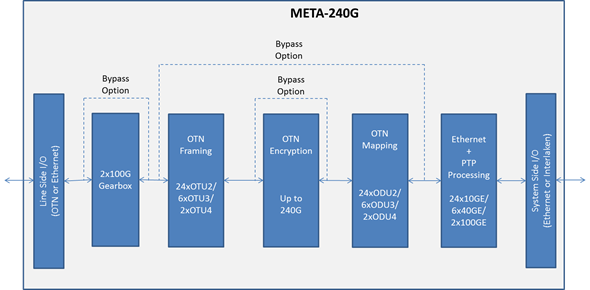 Source: PMC-Sierra
Adding OTN to a router delivers several benefits, says PMC. OTN helps identify networking faults more quickly and simplifies the monitoring and enforcement of service-level agreements. OTN also includes forward-error correction which benefits optical link performance.
Ethernet is the default router protocol interface while OTN is the dominant protocol in the transport network, says PMC. By moving OTN onto the router’s line port, the transport network extends its end-point reach to the router, says Stephen Docking, senior product line manager, communications unit at PMC. This leads to faster fault isolation and fault recovery.
“The transport network can now communicate with the router in a standard way, providing an extra level of protection that is faster than just IP layer protection,” says Docking.
OTN also supports the monitoring of error rates across the link.“By making the router part of the link, the service provider can not only monitor performance within the transport network but across the entire end-to-end link including the router,” says Docking. Such monitoring helps verify service-level agreements.
Meta-240G features
The Meta-240G is PMC’s third-generation framer for routers. The previous generation device, the 120 gigabit Meta-120G was PMC’s first to support OTU4 100 gigabit frames and was implemented in 40nm CMOS.
The Meta-240G doubles the total bandwidth: 240 gigabit facing the front panel optics and 240 gigabit interfacing to the network processor on the router’s line card. The device can thus support two 100 gigabit interfaces, six 40 gigabit interfaces and 24, 10 gigabit interfaces. “You can even have two 100 Gig and one 40 Gig, or two 100 Gig and four 10 Gig but most customers will just use 100 Gig [interfaces],” says Docking.
PMC has doubled the framer’s capacity while keeping overall power consumption fixed, in effect halving the power per port compared to its previous generation Meta-120G framer. Yet the chip also supports new features including a low-latency AES-256 encryption engine and an on-chip gearbox. The Meta-240G achieves the power savings by making the chip in 28nm CMOS and by improving the serdes design.
The gearbox function translates between 10 gigabit streams and 25 gigabit ones. Many devices use 10 gigabit serdes but to connect to a CFP2 or CFP4 100 gigabit optical modules, 25 gigabit electrical channels are required.
“Designers have had to use discrete gearbox devices [on the line card] which adds space, power and cost,” says Docking. “With the Meta-240G, the gearbox function is integrated into the device.”
Given IP traffic trends, will a 400 gigabit Meta device be needed in 2017? “It may be a bit longer - two to three years’ time - but we would need to [have such a device] to follow the existing trend,” says Docking.
Further information
PMC advances OTN with 400 Gigabit processor, click here