

Merits and challenges of optical transmission at 64 Gbaud
u2t Photonics announced recently a balanced detector that supports 64Gbaud. This promises coherent transmission systems with double the data rate. But even if the remaining components - the modulator and DSP-ASIC capable of operating at 64Gbaud - were available, would such an approach make sense?
Gazettabyte asked system vendors Transmode and Ciena for their views.
Transmode:
Transmode points out that 100 Gigabit dual-polarisation, quadrature phase-shift keying (DP-QPSK) using coherent detection has several attractive characteristics as a modulation format.
It can be used in the same grid as 10 Gigabit-per-second (Gbps) and 40Gbps signals in the C-band. It also has a similar reach as 10Gbps by achieving a comparable optical signal-to-noise ratio (OSNR). Moreover, it has superior tolerance to chromatic dispersion and polarisation mode dispersion (PMD), enabling easier network design, especially with meshed networking.
The IEEE has started work standardising the follow-on speed of 400 Gigabit. "This is a reasonable step since it will be possible to design optical transmission systems at 400 Gig with reasonable performance and cost," says Ulf Persson, director of network architecture in Transmode's CTO office.
Moving to 100Gbps was a large technology jump that involved advanced technologies such as high-speed analogue-to-digital (A/D) converters and advanced digital signal processing, says Transmode. But it kept the complexity within the optical transceivers which could be used with current optical networks. It also enabled new network designs due to the advanced chromatic dispersion and PMD compensations made possible by the coherent technology and the DSP-ASIC.
For 400Gbps, the transition will be simpler. "Going from 100 Gig to 400 Gig will re-use a lot of the technologies used for 100 Gig coherent," says Magnus Olson, director of hardware engineering.
So even if there will be some challenges with higher-speed components, the main challenge will move from the optical transceivers to the network, he says. That is because whatever modulation format is selected for 400Gbps, it will not be possible to fit that signal into current networks keeping both the current channel plan and the reach.
"From an industry point of view, a metro-centric cost reduction of 100Gbps coherent is currently more important than increasing the bit rate to 400Gbps"
"If you choose a 400 Gigabit single carrier modulation format that fits into a 50 Gig channel spacing, the optical performance will be rather poor, resulting in shorter transmission distances," says Persson. Choosing a modulation format that has a reasonable optical performance will require a wider passband. Inevitably there will be a tradeoff between these two parameters, he says.
This will likely lead to different modulation formats being used at 400 Gig, depending on the network application targeted. Several modulation formats are being investigated, says Transmode, but the two most discussed are:
- 4x100Gbps super-channels modulated with DP-QPSK. This is the same as today's modulation format with the same optical performance as 100Gbps, and requires a channel width of 150GHz.

- 2x200Gbps super-channels, modulated with DP-16-QAM. This will have a passband of about 75GHz. It is also possible to put each of the two channels in separate 50GHz-spaced channels and use existing networks The effective bandwidth will then be 100GHz for a 400GHz signal. However, the OSNR performance for this format is about 5-6 dB worse than the 100Gbps super-channels. That equates to about a quarter of the reach at 100Gbps.

As a result, 100Gbps super-channels are more suited to long distance systems while 200Gbps super-channels are applicable to metro/ regional systems.
Since 200Gbps super-channels can use standard 50GHz spacing, they can be used in existing metro networks carrying a mix of traffic including 10Gbps and 40Gbps light paths.
"Both 400 Gig alternatives mentioned have a baud rate of about 32 Gig and therefore do not require a 64 Gbaud photo detector," says Olson. "If you want to go to a single channel 400G with 16-QAM or 32-QAM modulation, you will get 64Gbaud or 51Gbaud rate and then you will need the 64 Gig detector."
The single channel formats, however, have worse OSNR performance than 200Gbps super-channels, about 10-12 dB worse than 100Gbps, says Transmode, and have a similar spectral efficiency as 200Gbps super-channels. "So it is not the most likely candidates for 400 Gig," says Olson. "It is therefore unclear for us if this detector will have a use in 400 Gigabit transmission in the near future."
Transmode points out that the state-of-the-art bit rate has traditionally been limited by the available optics. This has kept the baud rate low by using higher order modulation formats that support more bits per symbol to enable existing, affordable technology to be used.
"But the price you have to pay, as you can not fool physics, is shorter reach due to the OSNR penalty," says Persson.
Now the challenges associated with the DSP-ASIC development will be equally important as the optics to further boost capacity.
The bundling of optical carriers into super-channels is an approach that scales well beyond what can be accomplished with improved optics. "Again, we have to pay the price, in this case eating greater portions of the spectrum," says Persson.
Improving the bandwidth of the balanced detector to the extent done by u2t is a very impressive achievement. But it will not make it alone into new products, modulators and a faster DSP-ASIC will also be required.
"From an industry point of view, a metro-centric cost reduction of 100Gbps coherent is currently more important than increasing the bit rate to 400Gbps," says Olson. "When 100 Gig coherent costs less than 10x10 Gig, both in dollars and watts, the technology will have matured to again allow for scaling the bit rate, using technology that suits the application best."
Ciena:
How the optical performance changes going from 32Gbaud to 64Gbaud depends largely on how well the DSP-ASIC can mitigate the dispersion penalties that get worse with speed as the duration of a symbol narrows.
BPSK goes twice as far as QPSK which goes about 4.5 times as far as 16-QAM
"I would also expect a higher sensitivity would be needed also, so another fundamental impact," says Joe Berthold, vice president of network architecture at Ciena. "We have quite a bit or margin with the WaveLogic 3 [DSP-ASIC] for many popular network link distances, so it may not be a big deal."
With a good implementation of a coherent transmission system, the reach is primarily a function of the modulation format. BPSK goes twice as far as QPSK which goes about 4.5 times as far as 16-QAM, says Berthold.
"On fibres without enough dispersion, a higher baud rate will go 25 percent further than the same modulation format at half of that baud rate, due to the nonlinear propagation effects," says Berthold. This is the opposite of what occurred at 10 Gigabit incoherent. On fibres with plenty of local dispersion, the difference becomes marginal, approximately 0.05 dB, according to Ciena.
Regarding how spectral efficiency changes with symbol rate, doubling the baud rate doubles the spectral occupancy, says Berthold, so the benefit of upping the baud rate is that fewer components are needed for a super-channel.
"Of course if the cost of the higher speed components are higher this benefit could be eroded," he says. "So the 200 Gbps signal using DP-QPSK at 64 Gbaud would nominally require 75GHz of spectrum given spectral shaping that we have available in WaveLogic 3, but only require one laser."
Does Ciena have an view as to when 64Gbaud systems will be deployed in the network?
Berthold says this hard to answer. "It depends on expectations that all elements of the signal path, from modulators and detectors to A/D converters, to DSP circuitry, all work at twice the speed, and you get this speedup for free, or almost."
The question has two parts, he says: When could it be done? And when will it provide a significant cost advantage? "As CMOS geometries narrow, components get faster, but mask sets get much more expensive," says Berthold.

Optical transmission's era of rapid capacity growth
Kim Roberts, senior director coherent systems at Ciena, moves from theory to practice with a discussion of practical optical transmission systems supporting 100Gbps, and in future, 400 Gigabit and 1 Terabit line rates. This discussion is based on a talk Roberts gave at the Layer123's Terabit Optical and Data Networking conference held in Cannes recently.
Part 2: Commercial systems
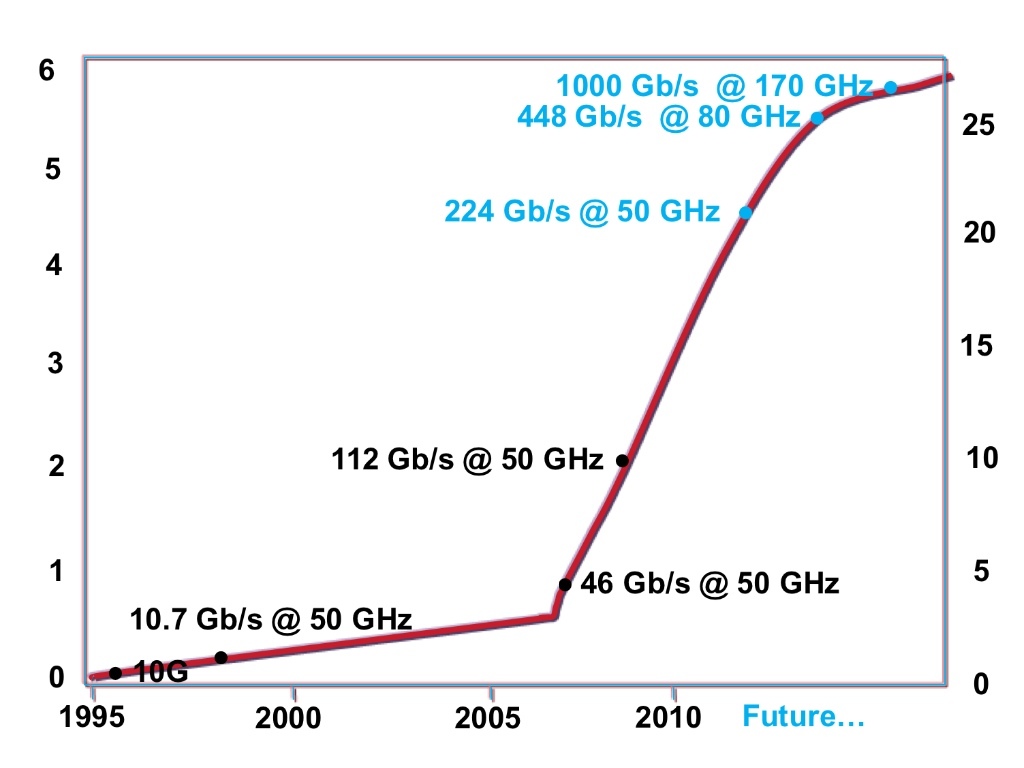
The industry is experiencing a period of rapid growth in optical transmission capacity. The years 1995 till 2006 were marked by a gradual increase in system capacity with the move to 10 Gigabit-per-second (Gbps) wavelengths. But the pace picked up with the advent of first 40Gbps direct detection and then coherent transmission, as shown by the red curve in the chart.
 Source: Ciena
The chart's left y-axis shows bits-per-second-Hertz (bits/s/Hz). The y-axis on the right is an alternative representation of capacity expressed in Terabits in the C-band. "The C-band remains, on most types of fibre, the lowest cost and the most efficient," says Roberts.
The notable increase started with 40Gbps in a 50GHz ITU channel - 46Gbps to accommodate forward error correction (FEC) - and then, in 2009, 100Gbps (112Gbps) in the same width channel. In Ciena's (Nortel's) case, 100Gbps transmission was achieved using two carriers, each carrying 56Gbps, in one 50GHz channel.
"It is going to get hard to achieve spectral efficiencies much beyond 5bits/s/Hz. Getting hard means it is going to take the industry longer"
The chart's blue labels represent future optical transmission implementations. The 224Gbps in a 50GHz channel (200Gbps data) is achieve using more advanced modulation. Instead of dual polarisation, quadrature phase-shift keying (DP-QPSK) coherent transmission, DP-16-QAM will be used based on phase and amplitude modulation.
At 448Gbps, two carriers will be used, each carrying 224Gbps DP-16-QAM in a 50GHz band. "Two carriers, two polarisations on each, and 16-QAM on each," says Roberts.
As explained in Part 1, two carriers are needed because squeezing 400Gbps into the 50GHz channel will have unacceptable transmission performance. But instead of using two 50GHz channels - one for each carrier - 80GHz of spectrum will be needed overall. That is because the latest DSP-ASICs, in this case Ciena's WaveLogic 3 chipset, use waveform shaping, packing the carriers closer and making better use of the spectrum available. For the scheme to be practical, however, the optical network will also require flexible-spectrum ROADMs.
One Terabit transmission extends the concept by using five carriers, each carrying 200Gbps. This requires an overall spectrum of 160-170GHz. "The measurement in the lab that I have shown requires 200GHz using WaveLogic 3 technology," says Roberts, who stresses that these are labs measurements and not a product.
Slowing down
Roberts expects progress in line rate and overall transmission capacity to slow down once 400Gbps transmission is achieved, as indicated by the chart's curve's lesser gradient in future years.
"It is going to get hard to achieve spectral efficiencies much beyond 5bits/s/Hz" says Roberts. "Getting hard means it is going to take the industry longer." The curve is an indication of what is likely to happen, says Roberts: "We are reaching closer and closer to the Shannon bound, so it gets hard."
Roberts says that lab "hero" experiments can go far beyond 5 or 6 bits/s/Hz but that what the chart is showing are system product trends: "Commercial products that can handle commercial amounts of noise, commercial margins and FEC; all the things that make it a useful product."
Reach
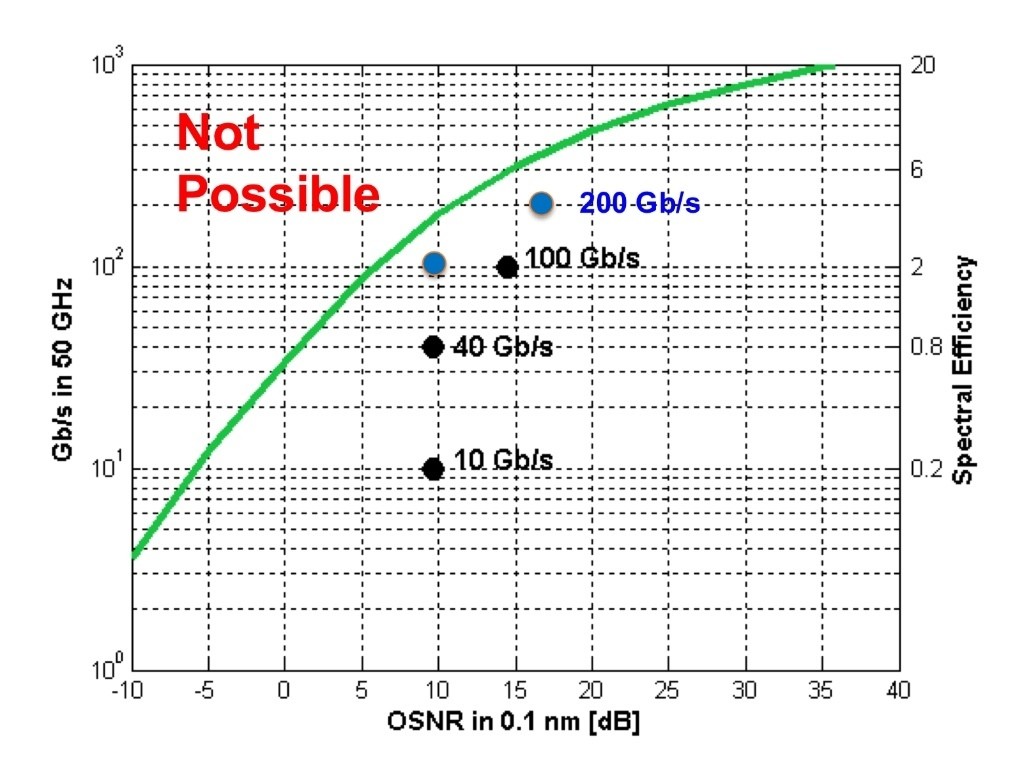
What the chart does not show is how transmission reach changes with the modulation scheme used. To this aim, Roberts refers to the chart discussed in Part 1.
 Source: Ciena
The 100Gbps blue dot is the WaveLogic 3 performance achieved with the same optical signal-to-noise ratio (ONSR) as used at 10Gbps.
"If you apply the same technology, the same FEC at 16-QAM at the same symbol rate, you get 200Gbps or twice the throughput," says Roberts. "But as you can see on the curve, you get a 4.6dB penalty [at 200Gbps] inherent in the modulation."
What this means is that the reach of an optical transport system is no longer 3,000km but rather 500-700km regional reaches, says Roberts.
Part 1: The capacity limits facing optical networking
Part 3: 2020 vision