

Books of 2024: Part 2
Gazettabyte asks industry figures to pick their reads of the year. In Part 2, Scott Wilkinson, Nigel Toon and Kailem Anderson select their best reads.
Scott Wilkinson, Lead Analyst, Networking Components, Cignal AI
I spent the year enjoying a poem a day from Brian Bilston’s Days Like These: An Alternative Guide to the Year in 366 Poems.
You may have seen his poems on social media, as he’s sometimes called The Poet Laureate of Twitter. It’s been a joy to end the day with one of his hilarious, occasionally poignant, and always topical poems.
I ended the year completing Andrew Roberts’ Napoleon: A Life. After the disappointing 2023 film, I wanted to know more about the person for whom an era of European history is named. At almost 1,000 pages, the author is remarkably thorough. Napoleon had a brilliant mind and his many achievements are lost in the legend of his military wins and losses. There’s no way I’ll remember all the details in the biography, but living in it for a few months was fascinating.
One book that I recommend to everyone is An Immense World: How Animal Senses Reveal the Hidden Realms Around Us by Ed Yong. In this amazing book, the author spends a chapter on the senses and looks at how animals experience the world around us. We have historically coloured the world based on our ability to perceive it, which is just a small fraction of the stimuli surrounding us. The author doesn’t just cover the five senses that humans rely on but investigates echolocation, the ability of seals to follow fish trails through water, magnetic navigation, and more.
I guarantee you won’t be able to read a chapter without relaying fascinating facts to anyone sitting nearby. The chapter on smell will change how you walk your dog. The chapter on sight will help you understand why we use RGB colour codes – and why they wouldn’t be the right choice for other animals. The chapters on senses humans don’t use will blow your mind and leave you wondering how much you’re missing on a casual walk through the park. It’s a book that any engineer, scientist, or curious mind will enjoy, and it is a great gift. And no, I don’t get residuals.
Every year at the holidays, I get a huge stack of books, a few of which I discovered through these articles. I didn’t get through my complete stack this year thanks to Mr. Bonaparte’s rich history, but that won’t stop me from picking up a few more again this holiday season. I look forward to seeing everyone else’s picks.
Nigel Toon, co-founder and CEO at Graphcore
My recommendation is Henry Kissinger on China. The book offers amazing insights into the relationship between the USA and China, which is as relevant today as when it was written in 2011.
Kailem Anderson, Vice President, Global Products & Delivery, Blue Planet
I love reading books on the history of technology. I’m currently reading Palo Alto: A History of Silicon Valley Capitalism and the World by Malcolm Harris. As an industry, it’s amazing how new technology can become old and then the old becomes new again. We forget the old and recycle many of the same issues from one technology transition to the next. I’m fascinated by learning from the past to see if solutions from our technology past can apply to the future.
I’m also reading Stephen Hawking’s Brief Answer to the Big Questions. This is a great book that stretches the mind on abstract concepts such as the universe, technology, predicting the future, and examining whether artificial intelligence will outsmart us. The book provides an insight into one of the most amazing minds, Stephen Hawking, and asks big-picture questions that we are afraid to ask ourselves.
Lastly, I would recommend Ali—A Life by Jonathan Eig. The book is an amazing read about Muhammad Ali’s life, how he took on the establishment, and how he broke down stereotypes and prejudices. Despite being rejected for his beliefs, Ali stood by his convictions to change people’s perceptions and become one of the greatest and most admired people of the 20th century.

The market opportunity for linear drive optics
A key theme at OFC earlier this year that surprised many was linear drive optics. Its attention at the optical communications and networking event was intriguing because linear drive – based on using remote silicon to drive photonics – is not new.
“I spoke to one company that had a [linear drive] demo on the show floor,” says Scott Wilkinson, lead analyst for networking components at Cignal AI. “They had been working on the technology for four years and were taken aback; they weren’t expecting people to come by and ask about it. “
The cause of the buzz? Andy Bechtolsheim, famed investor, co-founder and chief development officer of network switching firm Arista Networks and, before that, a co-founder of Sun Microsystems.
“Andy came out and said this is a big deal, and that got many people talking about it,” says Wilkinson, author of a recent linear drive market research report.
Linear Drive
A data centre’s switch chip links to the platform’s pluggable optics via an electrical link. The switch chip’s serialiser-deserialiser (serdes) circuitry drives the signal across the printed circuit board to the pluggable optical module. A digital signal processor (DSP) chip inside the pluggable module cleans and regenerates the received signal before sending it on optically.
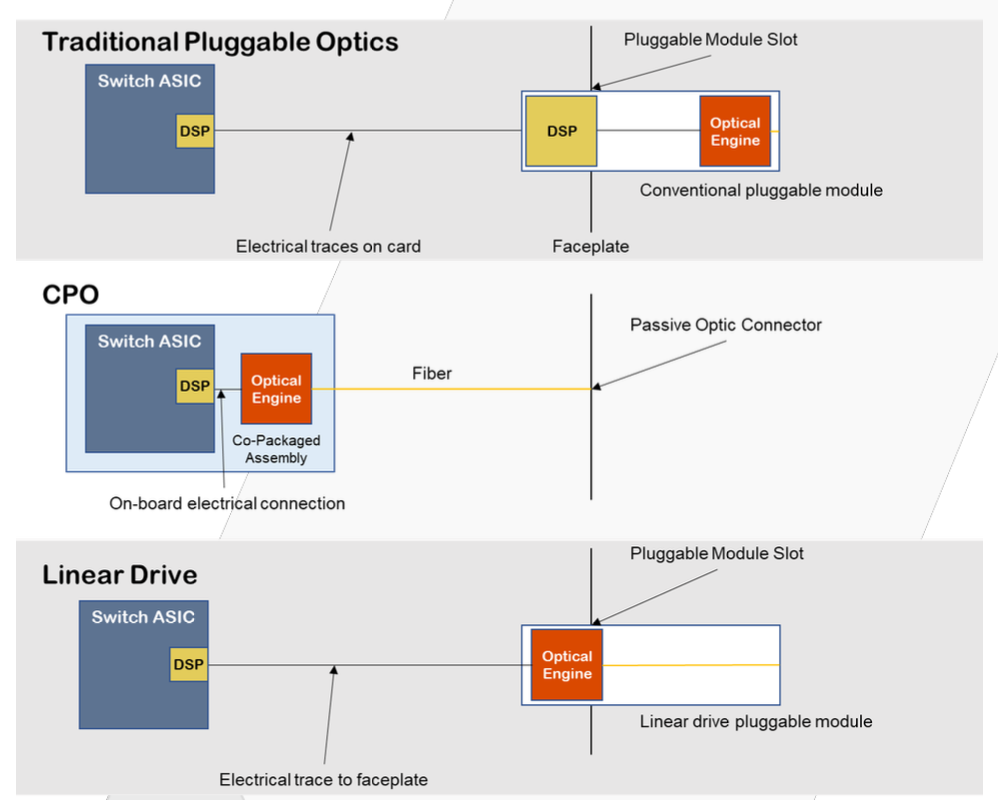
With linear drive optics, the switch ASIC’s serdes directly drives the module optics, removing the need for the module’s DSP chip. This cuts the module’s power consumption by half.
The diagram above contrasts linear drive optics compared with traditional pluggables and the emerging technology of co-packaged optics where the optics are adjacent to the switch chip and are packaged together. Linear drive optics can be viewed as a long-distance variant of co-packaged optics that comntinues to advance pluggable modules.
Proponents of linear drive claim that the power savings are a huge deal. “There will probably also be some cost savings, but it is not entirely clear how big they will be,” says Wilkinson. “But the only thing people want to discuss is the power savings.”
Misgivings
If linear drive’s main benefit is reducing power consumption, the technology’s sceptics counter with several technical and business issues.
One shortfall is that a module’s electrical and optical lanes must match in number and hence data rate. If there is a mismatch, the signal speeds must be translated between the electrical and optical lane rates, known as gearboxing. This task requires a DSP. Linear drive optics is thus confined to 800-gigabit optical modules: 800GBASE-DR8 and 800-gigabit 2xFR4. “There are people who think that at least 800 Gig – eight lanes in and eight lanes out – will continue to exist for a long time,” says Wilkinson.
Another question mark concerns the use of optics for artificial intelligence workloads. Adopters of AI will be early users of 200 gigabit-per-lane optics, requiring a gearbox-performing DSP.
Moreover, the advent of 200-gigabit electrical lanes will challenge serdes developers and, hence, linear drive designs. “It will be a technical challenge, the distances will be shorter, and some think it may never work,” says Wilkinson. “No matter how good the serdes is, it will not be easy.”
Co-packaged optics will also hit its stride once 200-gigabit serdes-based switch chips become available.
Another argument is that there are many ways to save power in the data centre; if linear drive introduces complications, why make it a priority?
Linear drive optics requires the switch chip vendors to develop high-quality serdes. Wilkinson says the leading switch vendors remain agnostic to linear drive, which is not a ringing endorsement. And while hyperscalers are investing time and resources into linear-drive technology, none have endorsed the technology such that they can withdraw at any stage without penalty.
“There is one story for linear drive and many stories against it,” admits Wilkinson. “When you compile them, it’s a pretty big story.”
Market opportunity
Cignal AI believes linear-drive optics will prove a niche market, with 800-gigabit linear-drive modules capturing 10 per cent of overall 800-gigabit pluggable shipments in 2027.
Wilkinson says the most promising example of the technology is active optical cables, where the modules and cables are a closed design. And while many companies are invested in the technology, and it will be successful, the opportunity will not be as significant as the proponents hope.
ECOC 2022 Reflections - Part 1

Gazettabyte is asking industry and academic figures for their thoughts after attending ECOC 2022, held in Basel, Switzerland. In particular, what developments and trends they noted, what they learned, and what, if anything, surprised them.
In Part 1, Infinera’s David Welch, Cignal AI’s Scott Wilkinson, University of Cambridge’s Professor Seb Savory, and Huawei’s Maxim Kuschnerov share their thoughts.
David Welch, Chief Innovation Officer and Founder of Infinera
First, we had great meetings. It was exciting to be back to a live, face-to-face industry event. It was also great to see strong attendance from so many European carriers.
Point-to-multipoint developments were a hot topic in our engagements with service providers and component suppliers. It was also evident in the attendance and excitement at the Open XR Forum Symposium, as well as the vendor demos.
We’re seeing that QSFP-DD ZR+ is a book-ended solution for carriers; interoperability requirements are centred on the CFEC (concatenated or cascaded FEC) market; oFEC (Open FEC) is not being deployed.
Management of pluggables in the optical layer is critical to their network deployment, while network efficiency and power reduction are top of mind.
The definition of ZR and ZR+ needs to be subdivided further into ZR – CFEC, ZR+ – oFEC, and ZR+-HP (high performance), which is a book-ended solution.
Scott T. Wilkinson, Lead Analyst, Optical Components, Cignal AI.
The show was invaluable, given this was our first ECOC since Cignal AI launched its optical components coverage.
Coherent optics announcements from the show did not follow the usual bigger-faster-stronger pattern, as the success of 400ZR has convinced operators and vendors to look at coherent at the edge and inside the data centre.
100ZR for access, the upcoming 800ZR specifications from the OIF, and coherent LR (coherent designed for 2km-10km) will revolutionise how coherent optics are used in networks.
Alongside the coherent announcements were developments from the direct-detect vendors demonstrating or previewing key technologies for 800 Gigabit Ethernet (GbE) and 1.6 Terabit Ethernet (TbE) modules.
800GbE is nearly ready for prime time, awaiting completion of systems based on the newest 112 gigabit-per-second (Gbps) serialiser-deserialiser (serdes) switches. The technology for 224Gbps serdes is just starting to emerge and looks promising for products in late 2024 or 2025.
While there were no unexpected developments at the show, it was great to compare developments across the industry and understand the impact of supply chain issues, operator deployment plans, and any hints of oversupply.
We came away optimistic about continued growth in optical components shipments and revenue into 2023.
Seb Savory, Professor of Optical Fibre Communication, University of Cambridge
My overwhelming sense from ECOC was it was great to be meeting in person again. I must confess I was looking at logistics as much as content with a view to ECOC 2023 in Glasgow where I will be a technical programme committee chair.
Maxim Kuschnerov, Director of the Optical and Quantum Communications Laboratory at Huawei
In the last 12 months, the industry has got more technical clarification regarding next-generation 800ZR and 800LR coherent pluggables.
While 800ZR’s use case seems to be definitely in the ZR+ regime, including 400 gigabit covering metro and long-haul, the case for 800LR is less clear.
Some proponents argue that this is a building block toward 1.6TbE and the path of coherence inside the data centre.
Although intensity-modulation direct detection (IMDD) faces technical barriers to scaling wavelength division multiplexing to 8×200 gigabit, the technological options for beyond 800-gigabit coherent aren’t converging either.
In the mix are 4×400 gigabit, 2×800 gigabit and 1×1.6 terabit, making the question of how low-cost and low-power coherent can scale into data centre applications one of the most interesting technical challenges for the coming years.
Arista continues making a case for a pluggable roadmap through the decade based on 200-gigabit serdes.
With module power envelopes of around 40W at the faceplate, it shows the challenge that the industry is facing and the case co-packaged optics is trying to make.
However, putting all the power into, or next to, the switching chip doesn’t make the cooling problem any less problematic. Here, I wonder if Avicena’s microLED technology could benefit next-generation chip-to-chip or die-to-die interconnects by dropping the high-speed serdes altogether and thus avoiding the huge overhead current input-output (I/O) is placing on data centre networking.
It was great to see the demo of the 200-gigabit PAM-4 externally modulated laser (EML) at Coherent’s booth delivering high-quality eye diagrams. The technology is getting more mature, and next year will receive much exposure in the broader ecosystem.
As for every conference, we have seen the usual presentations on Infinera’s XR Optics. Point-to-multipoint coherent is a great technology looking for a use case, but it is several years too early.
At ECOC’s Market Focus, Dave Welch put up a slide on the XR ecosystem, showing several end users, several system OEMs and a single component vendor – Infinera. I think one can leave it at this for now without further comment.


Books in 2019
Gazettabyte asks industry figures each year to cite the memorable books they have read. These include fiction, non-fiction and work-related titles.
Here are the choices of Cisco’s Bill Gartner, Sylvie Menezo of silicon photonics start-up, Scintil Photonics, and Andrew Schmitt, directing analyst at Cignal AI.
Bill Gartner, Senior Vice President and General Manager, Cisco Optical Systems and Optics.
At the top of my list is The Gene: An Intimate History, by Siddhartha Mukherjee. Mukherjee does an amazing job of telling the story of the gene, providing historical context dating back to pre-Darwin times through to modern advances in gene therapy. The material is complex but he is great at describing the evolution of thinking about genes and progress in the genome project in layman’s terms.
The book leaves me in awe of how much has been accomplished, especially in the past 20 years, and yet how much more we have to learn about this fascinating topic, how progress in this area might be applied to solve some of medicine’s most challenging problems, and the moral dilemma that we confront as we think about altering nature’s work.
The Billionaire Who Wasn’t: How Chuck Feeney Secretly Made and Gave Away a Fortune by Conor O’Clery is an amazing story of a man who went from rags to riches, built one of the most profitable private businesses in history (Duty-Free Shops), and earned billions. He then gave it all away and did so anonymously. He lived frugally and was adamant that his contributions be kept secret. It is an inspiring story of an American hero who touched the lives of millions who will never know.
Longitude: The True Story of a Lone Genius Who Solved the Greatest Scientific Problem of His Time by Dava Sobel includes a foreword by Neil Armstrong. I am fascinated by stories that highlight how one individual persists in a vision and has a major impact on the world. In the 18th century, it was common for entire fleets of ships to run aground or get lost as navigation techniques were primitive.
Latitude was relatively straightforward, based on the angle of the sun relative to the horizon (and the date), but determining longitudinal position was often guesswork. After several disasters, including one where over 200 sailors were killed, the British government established a prize for the solution.
This is a fantastic story of a relatively unknown watchmaker who single-handedly solved the problem and then persuaded the sceptics that his chronometer was superior to any available method.
Lastly, I read Franklin and Winston: An Intimate Portrait of an Epic Friendship by Jon Meacham. This is a fantastic story of the intimate and at times stormy relationship between FDR and Winston Churchill. The story, unlike many WWII narratives, is told from the perspective of their interactions. FDR and Churchill were magnificent leaders, each of whom took a principled stand against Nazism and Fascism. It is also frightening to contemplate the course history may have taken had lesser leaders been in place.
Sylvie Menezo, CEO and CTO of Scintil Photonics.
The book I recommend is a novel I read this summer, La Tresse (The Braid) by Laetitia Colombani. It is a tale of three women, each from a different continent and experiencing different living conditions, yet their lives happen to be connected by something at the end of the book. To me, all three are very beautiful and strong women figures, moved by a ‘different something’ deep inside them, and that is what makes them beautiful!
Andrew Schmitt, founder and directing analyst at Cignal AI
It was a good reading year for me. Starting with fiction, my overall pick of the year is the Three-Body Problem series by Cixin Liu, a science fiction story of epic scale that stretches from the Cultural Revolution in China into the distant future.
It was written in Chinese and as a result, the style, prose and cultural perspective are different in a refreshing way. This series is right up there with Dune, Asimov and all the sci-fi greats. It is a must-read if that is your thing.
Martha Wells turned out more short novels to conclude the Murderbot Diaries, a series that I reviewed in 2018. I also read Neal Stephenson’s FALL; or, Dodge in Hell: A Novel this year. He’s maintained a steady production of books but I don’t think his latest books are as good as his archive (Snow Crash, Cryptonomicon, others). FALL was very disappointing, particularly the second half – I don’t recommend it. Read the archive instead.
It was an intense non-fiction year, so I’ll hit the good stuff that I strongly recommend.
I picked up Nobody Wants to Read Your Sh*t: And Other Tough-Love Truths to Make You a Better Writer by Steven Pressfield on a twitter recommendation and it resonated with me. So much written market research lacks respect and appreciation of the client’s time and Pressfield shares simple, useful tips to make your reader care about what you are writing. Anyone who writes for others should read this, and it is quick.
This book leads me to one of Pressfield’s big hits, Gates of Fire: An Epic Novel of the Battle of Thermopylae, a narrative history of the Spartans and the battle. As an engineer, I never had the time – and frankly, the interest – to study Ancient Greece. Pressfield vividly brings Sparta and Greece to life and recounts the events leading up to the battle of the famous “300”. A fantastic book.
My son had to read Midnight in Chernobyl: The Untold Story of the World’s Greatest Nuclear Disaster by Adam Higginbotham over the summer for High School.
We read it together; a highly recommended thing to do with your teenagers. Better yet, after the book, we were treated with the excellent “Chernobyl” drama on HBO. If you liked the HBO series, definitely read the book as it tells the story in a comprehensive and detailed way without an artistic license. The size, scale, and sacrifices endured by the Soviets to contain the disaster are incredible. The organisational ineptitude before and right after the event are horrifying. The same top-down decision hierarchy that caused the problem was paradoxically the only way to get it cleaned up.
My last recommendation is Shoe Dog: A Memoir – by the Creator of Nike, by Phil Knight. It recounts the genesis of the company as a supplier of track shoes made in Japan following WWII as the country rapidly emerged as an export powerhouse. It is a book about post-war Japan, raw entrepreneurship, and building what at the time was a new sales and marketing model combining athletics and fashion. One of the better business books I’ve read.
Books in 2019 – Final part, click here

Books in 2018 - Part 2
Some more books consumed in 2018, as recommended by Maxim Kuschnerov and Andrew Schmitt.
Maxim Kuschnerov, senior R&D manager at Huawei.
It is hard to believe the book Fire and Fury: Inside the Trump White House by Michael Wolff was published in 2018. Judging by what has happened since Trump’s inauguration, this recollection of his first days in the White House seems outdated. But it was fun to read while the memory of the election was still fresh. It is hard to judge whether all the book’s sources are truthful but the main message is certainly not too far off.

John Carreyrou’s Bad Blood: Secrets and Lies in a Silicon Valley Startup deals with the rise and fall of Elizabeth Holmes and her infamous blood testing start-up, Theranos. If it wasn’t for the fact that Holmes endangered the lives of thousands of people with her erroneous tests, one could be almost amazed on how she secured $1 billion from investors based on absolutely no technology whatsoever. It is also hard to believe how big chains could go along deploying Theranos tests without qualification of the products or the necessary Food and Drug Administration (FDA) approval.
As a westerner working for Huawei, Henry Kissinger’s On China was an important read to understand better how China sees itself and the world. There is no other nation capable of looking decades ahead like it is the fourth quarter of the next financial year. This is a worthwhile book for anyone wanting to make sense of the world.
Being a huge poker fan, buying the book Poker Brat: Phil Hellmuth’s Autobiography was a no-brainer. Hellmuth has his place in poker history, being one of the youngest World Series of Poker (WSOP) main event winners and the record holder with 15 bracelets. However, the book offers little insight on poker strategy. Or maybe it is the lack of strategy which makes Hellmuth who he is. If someone is really interested in learning from a great poker player, I’d recommend Every Hand Revealed by Gus Hansen. Hansen may have lost more than $20 million in online playing, but his book offers a better view on poker strategy back in the day of the big poker boom, before German maths wizards and game theory optimal strategy rewrote poker rules once again.
If a book has already been turned into a movie starring Brad Pitt, it means I am very late to the party with Michael Lewis’s Moneyball: The Art of Winning an Unfair Game. But being an artificial intelligence and machine-learning aficionado, everything is about recognising the underlying patterns, whether it is in images, optical signals or in such a beautiful and simple game like baseball. Most likely baseball strategists already apply machine learning to further optimise their strategy.
Andrew Schmitt, Founder and directing analyst at Cignal AI
The Winter Fortress: The Epic Mission to Sabotage Hitler's Atomic Bomb by Neal Bascomb is my pick of the year. I can’t believe this story isn't already a movie. It is about the Allies’ attempt to destroy the heavy-water plant in German-occupied Norway that was critical to the development of a German Atomic Weapon. Norwegians in exile in the UK, working with locals, pulled off a stunning attack that crippled the plant and set back the German effort. But the book is mostly about the events leading up to the mission, as well as the escape afterwards. The men who pulled it off were as hardcore as they come, and the sacrifices and impossible decisions they faced need to be shared. It is a story I imagine most Norwegians know, and it is a story that should be told to the world.
Hillbilly Elegy: A Memoir of a Family and Culture in Crisis by J.D. Vance is a good autobiography of someone who managed to escape people and situations that could easily have misdirected him. I am not going to join the chorus of folks who point to this book as reasoning for Trump getting elected; I avoid political discussions at all costs in a work environment. But reading this makes you appreciate the positive advantages you may have had growing up. The author, on the surface, had none but he highlights the people and situations that were formative for him and how they guided him on the right path. The best part about the book is that it isn’t preachy and Vance goes out of his way to explain that the problems he avoided have no easy or clear solutions.
Ray Dalio’s whitepapers, essays and explainer videos have always impressed me with concise formats and clear ideas. However, his book, Principles: Life and Work, is a big meal that I didn’t finish. I would recommend his YouTube videos and whitepapers and unless you are a hardcore self-help reader, which I’m not, then skip this.
My son had to read War by Sebastian Junger over the summer for High School. We read it together; a highly recommended thing to do with your teenagers. Junger was embedded in the Korengal Valley in Afghanistan with the US Army and was in the thick of some of the worst fighting. He also wrote The Perfect Storm which was a great book (and a terrible movie). In this book, he brings you right in the midst of events. If you want to know what being at the sharp end in Afghanistan is like, and the physical and mental sacrifices soldiers are making, then read this.
Michael Lewis is one of my favourite authors so I had to read his latest book, The Fifth Risk. It is well-written but it is about politics. I’m tired of politics. I don't think we need more of it so I won't recommend it.
I ripped through two volumes of Martha Wells’s The Murderbot Diaries on the way back from China. It’s about a security robot that figures out how to disable its governor software and become self-aware. A killing machine with a conscience, struggling with the details of being human. Some of the best Sci-Fi I’ve read in a long time. Netflix or Amazon need to give their money to this author right now and turn it into a series.

Books in 2017
Andrew Schmitt, founder and lead analyst of Cignal AI
I didn’t have a good year with books. I bought more than these and either didn’t read them or I lost interest. Hopefully, 2018 will be better.
A Mind at Play: How Claude Shannon Invented the Information Age by Jimmy Soni and Rob Goodman was a big disappointment. It is a well-researched book and has tons of great history on Claude Shannon but there was something about the writing style that made it turgid. I struggled to finish it but learned a lot about Claude Shannon, including that his home in Boston wasn’t far from mine.
The Hard Thing about Hard Things: Building a Business When There are No Easy Answers by Ben Horowitz was the year’s winner. Ben Horowitz started the VC firm A16Z with Marc Andreessen, and both worked at Netscape and later founded Loudcloud. This is easily one of my favourite management books. Each chapter of the book covers an operational topic via a narrative of experiences from the author. Examples include how to build culture and how to scale a sales organisation. The book is highly readable and enjoyable, rare for a title about management advice. Horowitz talks about another book, High Output Management by Andy Grove, which I am reading now.
I reread Cryptonomicon by Neal Stephenson this year for fun. Entertaining book, particularly in light of all the crypto-currency mania. It was written 18 years ago and was way ahead of its time. As William Gibson said, the future is already here, it’s just not evenly distributed. Seveneves was good too (from 2015), but I sure hope that isn’t our future.
The King and Queen of Malibu: The True Story of the Battle for Paradise by David Randall is a history of the large parcel of land now known as Malibu in Southern California. One person owned it after the Spanish American war, and the book is the story of how a rapidly encroaching Los Angeles, spurred on by the automobile, led to its eventual taking by eminent domain. If you know the area and are interested in the history, it is a great book. Otherwise, it is probably of little interest.
I also read a few other sci-fi fiction books while on the road that came highly recommended (Ready Player One, Fortress at the End of Time, Blindsight) but I thought they were not that great.
Vladimir Kozlov, founder and CEO of LightCounting Market Research
I read two books in 2017 that I would highlight.
The first is War and Peace by Leo Tolstoy.
The second is Makers and Takers: The Rise of Finance and the Fall of American Business by Rana Foroohar. The book offers a sobering outlook on modern economic developments and questions the sustainability of growth.
Books of the year 2016 - Part 1
Each year Gazettabyte asks industry figures to comment on books that they recommend. Here are BT's Andrew Lord's and Cignal's Andrew Schmitt's recommendations to kick off this year's reviews.
Andrew Lord, Head of Optical Research at BT.
Quantum technologies are flavour of the month, with huge government investments from around the world. The title and cover of Bananaworld: Quantum Mechanics for Primates by Jeffrey Bub, suggest a book that will ‘unpeel’ a tough but increasingly important subject for general readers.
The book itself is, however, far deeper than its cover suggests, going way beyond the basics, and attempting to forge a link between quantum mechanics and the structure of information.
Imagining a strange world in which bananas exhibit quantum effects might just confuse rather than aid the general reader, but those wishing to probe the deeper information theory questions will find much here to ‘chew on’.
Andrew Schmitt, founder of Cignal AI
Starting a company with a wide customer base requires a lot of ‘infrastructure’ that I didn’t realise would consume so much time. I like to build things so it has been a real thrill but also a lot of work. I think I gravitated towards fun things to read as a result of having my hands full. All of them were outstanding.
A Fire Upon The Deep by Vernor Vinge, and Seveneves by Neal Stephenson require a great deal of mental fortitude but unfold on such a grand scale that they are very appealing. Stephenson is a favourite of mine, ever since reading Snow Crash in college. He’s like William Gibson except with a sense of humour.
I also reread Fahrenheit 451 by Ray Bradbury. Let’s just say it felt a lot less sci-fi the second time around. If you look at the monoculture of ideas in politics, education, even business – it’s a dangerous situation. A big reason populism is emerging in the West is because people are sick of getting told what to think by “smart” people, and the perceived loss of control. It is a healthy rebellion despite a lot of the downside because the alternative – everyone thinking in lockstep – is far more dangerous.
I had greater ambitions for non-fiction and have several unread Kindle books on my iPhone. I wanted to read The Hard Thing about Hard Things from Ben Horowitz but have not. Other titles include The Comeback: How Larry Ellison's Team Won the America's Cup by G. Bruce Knecht and American Sniper: The Autobiography of the Most Lethal Sniper in U.S. Military History by Chris Kyle.
The book Elon Musk: Tesla, SpaceX, and the Quest for a Fantastic Future by Ashlee Vance is a great read. There are a lot of haters out there who don’t like Tesla for various reasons – his government funding, climate-change skeptics who don’t like his views, and who knows what else? Fine by me. But after reading this book you have to acknowledge the massive, ridiculous undertaking of starting both a rocket company and an electric car company. It is insane. Yet this guy has managed to keep the wheels from coming off so far. He has burned through people, capital, and relationships but the results are impressive.
He may not be everyone's idea of a nice guy – whatever - but he is a walking, breathing, living image of the American ethos of invention and capitalism. Whatever money it costs the US government is more than offset by the example he sets for others that anything is possible provided you have enough time, money, and guts.
Books in 2015 - Part 1
Andrew Schmitt, founder and CEO at Cignal AI
I didn’t read that much this year but I did read The Wright Brothers by David McCullough. That was outstanding. McCullough is a great historical author and wrote a book that was both a biography of the Wrights as well as a narrative of their efforts to build the first powered airplane.
I didn't know of all of the other simultaneous, better-financed efforts that fell far short of the efforts of two brothers from Dayton, Ohio. I also was unaware of how the effort transfixed the world when they did complete it.
There is so much chattering today about Lean Development and Devops (how many people use that word and really know what it means?) as if these are new developments. But the Wrights are a case study in lean development and simultaneous development and deployment. Read this and see Devops in action over 100 years ago and I'm sure there are lots more examples.
Rupert Baines, CEO at UltraSoC
This year has been rather frantic: starting a new role and being very full on has meant I've read less than I usually do. Perhaps that's wrong: a friend and mentor advises this precisely is the time to read more, for sanity and perspective. But she is wiser than I, or perhaps more self-disciplined.
Inevitably, reading less does not mean buying less! The Japanese have a term which is not yet a loanword but ought to be: Tsundoku.
Many of the books I have read have been non-taxing but fun (Trigger Mortis: the new James Bond; The Martian; Robert Harris' Cicero trilogy etc.) but I have read a few brilliant books worth recommending.
The Narrow Road To The Deep North by Richard Flanagan deservedly won the Booker prize last year and is a lovely, haunting, tragic novel. It describes an Australian surgeon who is captured and becomes a war hero as commander of a Japanese PoW camp - and the consequences for him and others after the war. It is not an easy read, harrowing and sad. But brilliant scenes, astonishingly vivid characters and insights on what it means to be "a good man" and the effect of war make the hard work worthwhile. A brilliant book.
A Place of Greater Safety by Hilary Mantel. I loved Wolf Hall (if you haven't read it, then do so) so read her earlier historic novel. Thank God for e-books because this is huge - and if I had realised how hefty it was I might not have read it. Set in the French Revolution, this describes in feverish intensity and hyper-real vividness the run-up to revolution, the Bastille and then the Terror. Robespierre, St. Just, Danton, and many, many more feature in utterly fascinating, compelling detail. There is a lot of information, and a LOT of pages but fascinating and enjoyable.
I really enjoy David Mitchell's novels. A clever, complex, interwoven set of stories (within the books and between them). The Bone Clocks was a fun novel: flitting through characters and decades (1984-2043) in a gripping science fiction/ adventure romp. Slade House is a shorter Halloween horror-ride of a creepy page-turner.
In non-fiction, it is interesting I haven't read much this year.
I finally read Thinking, Fast and Slow by Daniel Kahneman. To be honest, it is a fascinating insight but suffers the fault of so many business books: it has one great idea, but that isn't enough to support a whole book. Reading it late and being aware of that idea I found myself turning pages rather fast as a familiar concept was explained and repeated. That is perhaps ironic in a book about modes of thinking and contrasting quick impressions with deeper reflection.
A slight cheat as I haven't read them yet (remember what I said about book piles?), are SuperForecasting: The Art and Science of Forecasting by Philip Tetlock and Dan Gardner and Act Like a Leader, Think Like a Leader by Herminia Ibarra.
Both were highly recommended by several people independently. Both have travelled the world on my Kindle without being started yet. Maybe over the holidays.
For Part 2, click here