

Effdon Networks extends the 10x10 MSA to 80km
Effdon Networks has demonstrated a 100 Gigabit CFP module with an 80km reach; a claimed industry first. The company has also developed the Qbox, a 1 rack unit (1RU) extended reach platform capable of 400-800 Gigabit-per-second (Gbps) with a reach of 80-200km.
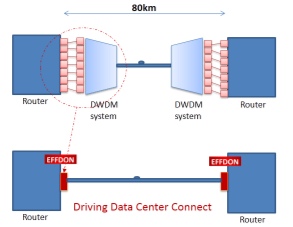 Effdon's CFP does not require the use of external DWDM multiplexing/ demultiplexing and can be added directly onto a router. Source: Effdon Networks
Available 100 Gigabit CFP modules have so far achieved 10km. Now with the Effdon module a 80km reach has been demonstrated that uses 10Gbps optics and no specialist silicon.
Effdon's design is based on the 10x10 MSA (multi-source agreement). "We have managed to resolve the technology barriers - using several techniques - to get to 80km," says Eitan Efron, CEO of Effdon Networks.
There is no 100 Gigabit standard for 80km. The IEEE has two 100 Gigabit standards: the 10km long reach 100GBASE-LR4 and the 40km extended reach 100GBASE-ER4.
Meanwhile, the 100 Gigabit 10x10 MSA based on arrays of 10, 10 Gigabit lasers and detectors, has three defined reaches: 2km, 10km and 40km. At the recent OFC/NFOEC exhibition, Oplink Communication and hybrid integration specialist, Kaiam, showed the 10x10 MSA CFP achieving 40km.
Effdon has not detailed how it has achieved 80km but says its designers have a systems background. "All the software that you need for managing wavelength-division multiplexing (WDM) systems is in our device," says Efron. "Basically we have built a system in a module."
These system elements include component expertise and algorithmic know-how. "Algorithms and software; this is the main IP of the company," says Efron. "We are using 40km components and we are getting 80km."
100 Gigabit landscape
Efron says that while there are alternative designs for 100 Gigabit transmission at 80km or more, each has challenges.
A 100Gbps coherent design achieves far greater reaches but is costly and requires a digital signal processor (DSP) receiver ASIC that consumes tens of watts. No coherent design has yet been implemented using a pluggable module.
Alternative CFP-based 100Gbps direct-detection designs based on a 4x28Gbps architecture exist. But their 28Gbps lanes experience greater dispersion that make achieving 80km a challenge.
MultiPhy's MP1100Q DSP chip counters dispersion. The chip used in a CFP module achieves a 55km point-to-point reach using on-off keying and 800km for dense WDM metro networks using duo-binary modulation.
Finisar and Oclaro also offer 100Gbps direct detection CFP modules for metro dense WDM using duo-binary modulation but without a receiver DSP. ADVA Optical Networking is one system vendor that has adopted such 100Gbps direct-detect modules. Another company developing a 4x28Gbps direct detect module is Oplink Communications.
But Effdon points out that its point-to-point CFP achieves 80km without using an external DWDM multiplexer and demultiplexer - the multiplexing/demultiplexing of the wavelengths is done within the CFP - or external amplification and dispersion compensation. As a result, the CFP plugs straight into IP routers and data centre switches.
"What they [data centre managers] want is what they have today at 10 Gig: ZR [80km] optical transceivers," says Efron

Market demand
"We see a lot of demand for this [80km] solution," says Efron. The design, based on 10 Gigabit optics, has the advantage of using mature high volume components while 25Gbps component technology is newer and available in far lower volumes.
"This [cost reduction associated with volume] will continue; we see 10 Gig lasers going into servers, base stations, data centre switches and next generation PON," says Efron. "Ten Gigabit optical components will remain in higher volume than 25 Gig in the coming years."
The 10x10 MSA CFP design can also be used to aggregate multiple 10 Gig signals in data centre and access networks. This is an emerging application and is not straightforward for the more compact, 4x25Gbps modules as they require a gearbox lane-translation IC.
Reach extension
Effdon Networks' Qbox platform provides data centre managers with 400-800Gbps capacity while offering a reach up to 200km. The box is used with data centre equipment that support CXP or QSFP modules but not the CFP. The 1RU box thus takes interfaces with a reach of several tens of meters to deliver extended transmission.
Qbox supports eight client-side ports - either 40 or 100 Gbps - and four line-facing ports at speeds of 100Gbps or 200Gbps for a reach of 80 to 200km. In future, the platform will deliver 400Gbps line speeds, says Efron.
Samples of the 80km CFP and Qbox are available for selected customers, says Effdon, while general availability of the products will start in the fourth quarter of 2013.


ECI Telecom demos 100 Gigabit over 4,600km
- 4,600km optical transmission over submarine cable
- The Tera Santa Consortium, chaired by ECI, will show a 400 Gigabit/ 1 Terabit transceiver prototype in the summer
- 100 Gigabit direct-detection module on hold as the company eyes new technology developments
 "When we started the project it was not clear whether the market would go for 400 Gig or 1 Terabit. Now it seems that the market will start with 400 Gig."
Jimmy Mizrahi, ECI Telecom
ECI Telecom has transmitted a 100 Gigabit signal over 4,600km without signal regeneration. Using Bezeq International's submarine cable between Israel and Italy, ECI sent the 100 Gigabit-per-second (Gbps) signal alongside live traffic. The Apollo optimised multi-layer transport (OMLT) platform was used, featuring a 5x7-inch MSA 100Gbps coherent module with soft-decision, forward error correction (SD-FEC).
"We set a target for the expected [optical] performance with our [module] partner and it was developed accordingly," says Jimmy Mizrahi, head of the optical networking line of business at ECI Telecom. "The [100Gbps] transceiver has superior performance; we have heard that from operators that have tested the module's capabilities and performance."
One geography that ECI serves is the former Soviet Union which has large-span networks and regions of older fibre.
Tera Santa Consortium
ECI used the Bezeq trial to also perform tests as part of the Tera Santa Consortium project involving Israeli optical companies and universities. The project is developing a transponder capable of 400 Gigabit and 1 Terabit rates. The project is funded by seven participating firms and the Israeli Government.
"When we started the project it was not clear whether the market would go for 400 Gig or 1 Terabit,” says Mizrahi. “Now it seems that the market will start with 400 Gig."
The Tera Santa Consortium expects to demonstrate a 1 Terabit prototype in August and is looking to extend the project a further three years.
100 Gigabit direct detection
In 2012 ECI announced it was working with chip company, MultiPhy, to develop a 100 Gigabit direct-detection module. The 100 Gigabit direct detection technology uses 4x28Gbps wavelengths and is a cheaper solution than 100Gbps coherent. The technology is aimed at short reach (up to 80km) links used to connect data centres, for example, and for metro applications.
“We have changed our priorities to speed up the [100Gbps] coherent solution,” says Mizrahi. “It [100Gbps direct detection] is still planned but has a lower priority.”
ECI says it is monitoring alternative technologies coming to market in the next year. “We are taking it slowly because we might jump to new technologies,” says Mizrahi. “The line cards will be ready, the decision will be whether to go for new technologies or for direct detection."
Mizrahi would not list the technologies but hinted they may enable cheaper coherent solutions. Such coherent modules would not need SD-FEC to meet the shorter reach, metro requirements. Such a module could also be pluggable, such as the CFP or even the CFP2, and use indium phosphide-based modulators.
“For certain customers pricing will always be the major issue,” says Mizrahi. “If you have a solution at half the price, they will take it.”
MultiPhy targets low-power coherent metro chip for 2013
MultiPhy has given first details of its planned 100 Gigabit coherent chip for metro networks. The Israeli fabless start-up expects to have samples of the device in 2013.

"We can tolerate greater [signal] impairments which means the requirements on the components we can use are more relaxed"
Avi Shabtai, CEO of MultiPhy
"Coherent metro is always something we have pushed," says Avi Shabtai, CEO of MultiPhy. Now, the company says it is starting to see a requirement for coherent technology's deployment in the metro. "Everyone expects to see it [coherent metro] in the next 2-3 years," he says. "Not tomorrow; it will take time to develop a solution to hit the target-specific [metro] market."
MultiPhy is at an advanced stage in the design of its coherent metro chip, dubbed the MP2100C. "It is going to be a very low power device," says Shabtai. MultiPhy is not quoting target figures but in an interview with the company's CTO, Dan Sadot, a figure of 15W was mentioned. The goal is to fit the design within a 24W CFP. This is a third of the power consumed by long-haul coherent solutions.
The design is being tackled from scratch. One way the start-up plans to reduce the power consumption is to use a one-sample-per-symbol data rate combined with the maximum-likelihood sequence estimation (MLSE) algorithm.
MultiPhy has developed patents that involve sub-Nyquist sampling. This allows the analogue-to-digital converters and the digital signal processor to operate at half the sampling rate, saving power. To use sub-Nyquist sampling, a low-pass anti-aliasing filter is applied but this harms the received signal. Using the filter, sampling at half the rate can occur and using the MLSE algorithm, the effects of the low-pass filtering can be countered. And because of the low-pass filtering, reduced bandwidth opto-electronics can be used which reduces cost.
This low-power approach is possible because the reach requirements in metro, up to 1,000km, is shorter than long haul/ ultra long haul optical transmission links. The shorter-reach requirements also impact the forward error correction codes, needed which can lessen the processing load, and the components, as mentioned. "We can tolerate greater [signal] impairments which means the requirements on the components we can use are more relaxed," says Shabtai.
The company also revealed that the MP2100C coherent device will integrate the transmitter and receiver on-chip.
MultiPhy says it is working with several system vendor and optical module partners on the IC development. Shabtai expects the first industry products using the chip to appear in 2014 or 2015. The timing will also be dependent on the cost and power consumption reductions of the accompanying optical components.
 A 100Gbps direct-detection optical module showing MultiPhy's multiplexer and receiver ICs. The module shown is a WDM design. Source: MultiPhy
100Gbps direct detection multiplexer chip
MultiPhy has also announced a multiplexer IC for 100 Gigabit direct detection. The start-up can now offer customers the MP1101Q, a 40nm CMOS multiplexer complement to its MP1100Q receiver IC that includes a digital signal processor to implements the MLSE algorithm. The MP1100Q was unveiled a year ago.
Testing the direct-detection chipset, MultiPhy says it can compensate +/-1000ps/nm of dispersion to achieve a point-to-point reach of 55km. No other available solution can meet such a reach, claims MultiPhy.
MultiPhy's direct-detection solution also enables 10 Gigabit-per-second (Gbps) opto-electronics components to be used for the transmit and receive paths. At ECOC, MultiPhy announced that it has used Sumitomo Electric's 10Gbps 1550nm externally-modulated lasers (EMLs) to demonstrate a 40km reach.
Using such 10Gbps devices simplifies the design since no 25Gbps components are required. It will also enable more optical module makers to enter the 100 Gigabit marketplace, claims MultiPhy. "It is twice the distance and about half of the cost of any other solution on the market - much below $10,000," says Shabtai.
 MultiPhy's HQ in Ness Ziona, Israel
The multiplexer device can also be used for traditional 4x28Gbps WDM solutions to achieve a reach in existing networks of up to 800km.
MultiPhy says that it expects the overall 100 Gigabit direct detection market to number 4 optical module makers and 4-5 system vendors by the end of 2012. At present ADVA Optical Networking is offering a 100Gbps direct-detection CFP-based design. ECI Telecom has detailed a 5x7-inch MSA direct-detection 100 Gigabit module, while Finisar and Oclaro have both announced that they are coming to market with 100Gbps direct-detection modules.
Optical components enter an era of technology-pull
Gazettabyte asked ADVA Optical Networking, Ciena, Cisco Systems and Ovum about their impressions following the recent OFC/NFOEC 2012 exhibition and conference.
OFC/NFOEC reflections: Part 2
 "As the economy continues to navigate its way through yet another very difficult period, it was good to see so many companies innovating and introducing solutions."
Massimo Prati, Cisco Systems
Massimo Prati, Cisco Systems
For Cisco Systems, 100 Gigabit was a key focus at the show. "There were many system and component vendors, including Cisco, demonstrating newly available, economically feasible 100 Gig innovations," says Massimo Prati, vice president and general manager for Cisco.
Linking data centres was another conference theme. "Inter-data centre connectivity continues to focus on scalable and simple solutions in long-haul and metro networks connecting data centres worldwide." Cisco believes metro 100 Gigabit deployments will become prevalent in 2013 and 2014, especially if low‐cost coherent technology becomes available.
"A dedicated workshop focused on data centre architectures, held on the first day of the conference, was heavily attended," says Prati. "So certainly the link between cloud and optical is being established and is a key driver for high-speed transport networks."
Another conference theme was interconnect within the data centre, and the need for photonic integration for low‐cost, low‐power links, says Prati: "From a Cisco standpoint, several of our customers were pleasantly surprised by our recently completed acquisition of Lightwire, which develops advanced optical interconnect technology for high-speed networking applications." Lightwire is a silicon photonics startup that Cisco acquired recently for US $271 million.
What Cisco says it learned from OFC/ NFOEC was that service providers are planning 100Gbps deployments within the next 12 months and are looking at second- and third-generation solutions. "There is quite a bit of energy around future upgrades to 400 Gig and one Terabit transport solutions, but service providers continue to monitor if and how these solutions will operate within their existing fibre plants."
Prati expects more industry consolidation. "With the influx of 100 Gig solutions, it appears we may be ripe for further consolidation within the industry, particularly further down the technology food chain," he says.
He also remains optimistic about the industry's prospects.
"We believe that the excitement around high-speed, long-haul transport, combined with cloud and data centre innovation, continues to fuel a lot of new product solutions and architectures," he says. "Content providers like Google and Facebook have clearly expressed interest in optical technologies addressing their issues with bandwidth demands and need for high-speed interconnect for their data centres."
Joe Berthold, Ciena
Whereas last year there was much discussion about of the next rate for Ethernet - 400 Gig or one Terabit - this year 400 Gigabit had most mindshare, says Joe Berthold, vice president of network architecture at Ciena. "I barely heard any mention of one Terabit in the context of a contest with 400 Gigabit," he says.
 "I could hear some rumblings about alternative form factors – which might lead to fragmentation of the market"
Joe Berthold, Ciena
400 Gigabit was given a boost with the line-side transmission component announcements. Ciena announced its WaveLogic3 and Alcatel-Lucent detailed its Photonic Service Engine.
Another noteworthy development was the buzz around silicon photonics, stirred in part by Cisco's Lightwire acquisition. "Silicon photonics has passed from a technology of research interest to one that has progressed to serious development," says Berthold. "Data centre interconnects look like a promising initial application."
There was no developments at the show that surprised Berthold. But he is concerned about the potential for proliferation of 100 Gigabit client-side form factors, especially for pluggable modules.
"I am going under the assumption that there is still broad industry support for the CFP progression - from the current CFP to a CFP2 followed by a CFP4 for single-mode fiber applications over metro distances," he says.
Even though there are a variety of technologies appearing in the CFP form factor, this common physical module has helped control system development cost. "I could hear some rumblings about alternative form factors – which might lead to fragmentation of the market," he says.
Berthold is encouraged by the broad base of development efforts underway, particularly for 100Gbps transceivers, but also lower-cost 10Gbps and 40Gbps client-side modules. He notes the progress in reducing the cost of 100 Gigabit client interfaces over the next year. "Their high cost has held back adoption of 100 Gig," says Berthold. "We have had very cost effective 10 Gig multiplexing technology to fall back on, but it looks like native 100G interfaces are poised for growth."
Jörg-Peter Elbers, ADVA Optical Networking
Jörg-Peter Elbers, vice president, advanced technology at ADVA Optical Networking, was struck by the wide range of hot topics discussed at the show.
These include software-defined optics based on programmable transceivers that use advanced DSP technology and flexgrid ROADMs as the basis of a new coherent express layer. He also notes that control plane technologies are becoming an essential asset in managing network complexity when unleashing untapped network capacity.
 "Traffic and content keeps growing at exponential scale - the fundamental demand-drivers are intact"
Jörg-Peter Elbers, ADVA Optical Networking
Meanwhile, the rapid increase in end-user traffic, specifically mobile, is driving PON. As a result WDM is moving closer to the network edge, entering aggregation and access networks. He believes dense WDM-PON is gaining traction for mobile backhaul as fibre becomes the bottleneck when moving from Long Term Evolution (LTE) to the LTE-Advanced cellular technology.
Other trends to note, he says, are software-defined networking (SDN) and OpenFlow. "Originating from the campus and data centre world, network programmability is increasingly seen as key for tighter integration, more automation, and virtualisation of IT and computing services," says Elbers.
The industry increasingly sees the metro market as important to ramp up 100Gbps volumes, with different modulation solutions being promoted by vendors. These include performance reduced 100Gbps DP-QPSK (dual polarisation, quadrature phase-shift keying), 200Gbps DP-16QAM (dual polarisation, 16-quadrature amplitude modulation) and 4x28G direct-detection.
While some people expressed concerns about a fragmentation of the 100 Gig market, power consumption, footprint and cost are of primary importance in the metro, he says. "One analyst at the Ovum 100Gbps metro workshop at OFC said: 'Maybe, for a hammer everything looks like a nail…'," says Elbers. "With 4x28G optical duobinary being able to make use of 10Gbps T-XFP/SFP+, IEEE 802.3ba and CFP technologies, we believe there is a justification to differentiate."
ADVA demonstrated its 4x28Gbps optical duobinary direct-detection product at the show.
Elbers noted an interest in multi-core and few-mode fibres. "The next x10 in bandwidth is difficult to reach as additional gains from amplification, modulation, FEC and denser carrier spacing will be limited." he says. "The research community therefore is looking into new fibre types to add the spatial and modal dimensions alongside the current optimisation strategy." An area interesting to watch, but fundamental technical and economic challenges remain, he says.
He too is optimistic about the industry's prospects: "Traffic and content keeps growing at exponential scale - the fundamental demand drivers are intact." As a result, optical innovation will play an even bigger role in the future to keep pace with the bandwidth growth, he says.
Karen Liu, Ovum
"We're clearly in a technology-pull phase rather than technology-push phase with multiple system vendors doing 400Gbps-capable stuff instead of component guys showing demonstrations years in advance of system activity," says Karen Liu, principal analyst, components telecoms at Ovum.
 "Optical burst mode switching may be crossing over from rather 'pie-in-the-sky' to practical"
Karen Liu, Ovum
It is not that that the components vendors aren't making innovative products, she says, just that they are not making announcements until there is real demand. "Corning, for example, showed a fiber that has already been shipping into Lightpeak," says Liu.
What surprised Liu at the show was Huawei's optical burst transport network prototype. "Optical burst mode switching may be crossing over from rather 'pie-in-the-sky' to practical," says Liu.
She notes how there isn't as much optics-versus-electronics positioning anymore but more a case of optics working with electronics. "Huawei's OBTN is an example," says Liu. "Instead of using optical burst mode to make an all-optical network, optics is part of a hybrid design."
Liu says there are now multiple relationships between silicon and optics including the two working together instead of in competition. "In networking, the term translucent networks seems to have gained popularity."