

Ciena launches the 8700 metro Ethernet-over-WDM platform
- The 8700 Packetwave is an Ethernet-over-DWDM platform
- The 8700 is claimed to deliver double the Ethernet density while halving the power consumption and space required.
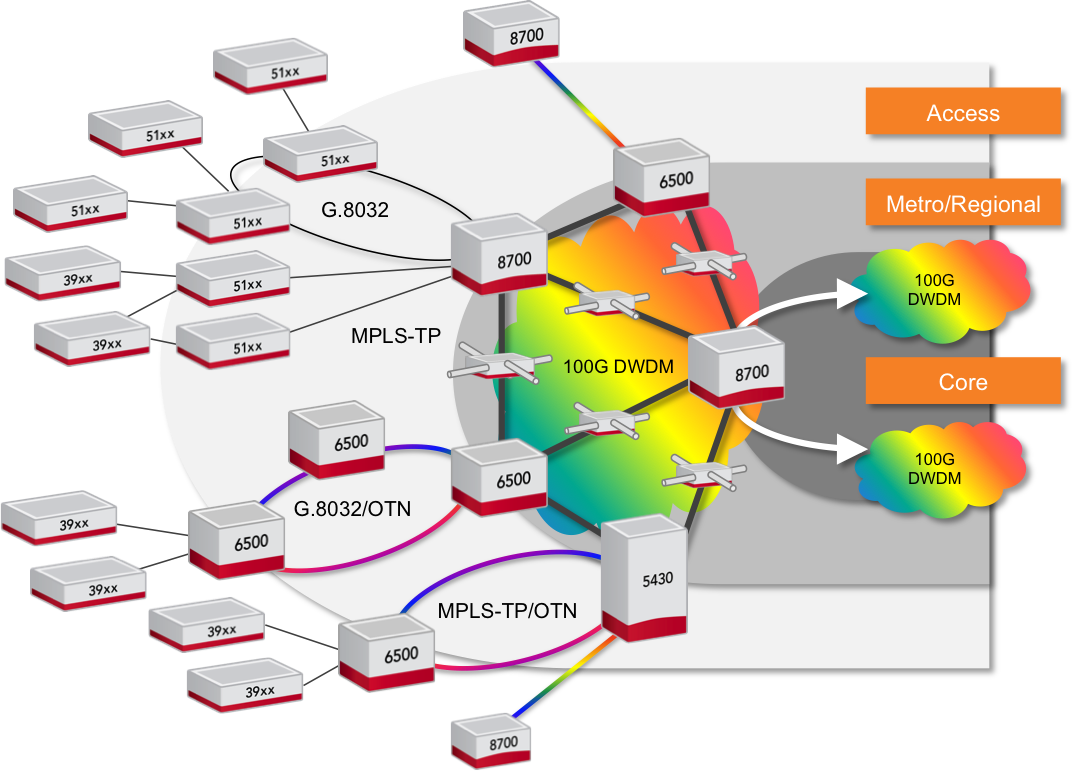 Source: Ciena
Ciena has launched the 8700 Packetwave platform that combines high-capacity Ethernet switching with 100 Gigabit coherent optical transmission.
The platform is designed to cater for the significant growth in metro traffic, estimated at between 30 and 50 percent each year, and the ongoing shift from legacy to Ethernet services.
 Brian Lavallée
Analysts predict that by 2017, 75 percent of the overall bandwidth in the metro will be Ethernet-based.
"In the major markets we compete in, our customers are telling us that Ethernet has already surpassed 75 percent," says Brian Lavallée, director of technology & solutions marketing at Ciena.
"What you're seeing is a trend towards convergence," says Ray Mota, managing partner at ACG Research. "The economics make sense and it should have happened but organisational issues have caused the delay."
Many service providers have two separate groups, one for packet and another for transport. "Now, many service providers are merging the two groups, feeling the time is right, so you will see more and more converge products get more penetration," says Mota.
The 8700 can be viewed as a slimmed-down packet-optical transport system (P-OTS), tailored for Ethernet. The platform's packet features include Ethernet and MPLS-TP for connection-oriented Ethernet, while optically it has 100 Gigabit coherent WDM.
"This is a more specialised machine hitting this target spot in the aggregation networks," says Michael Howard, co-founder and principal analyst, carrier networks at Infonetics Research. "It doesn't need much MPLS, it doesn’t need OTN switching, and it doesn’t need SDH/TDM."
The main applications for the 8700 include aggregation of telcos' business services, data centre interconnect, wireless backhaul, and the distribution of cable operators' Ethernet traffic. "It [the 8700] is a good product for edge aggregation, where the bandwidth is getting cranked up," says Howard. "I see it as an Ethernet-over-DWDM platform, performing the aggregation on the customer side and the fan-in on the upstream side."
 Ray MotaTwo Packetwave platforms have been announced: an 800 Gigabit full-duplex switching capacity platform and a 2-Terabit one. The platform's line cards support 10, 40 and 100 Gigabit client-side interfaces while a line-side card has two 100 Gigabit coherent interfaces based on Ciena's WaveLogic DSP-ASIC technology.
Ciena says the platform will support double the capacity when it introduces WaveLogic devices that deliver 100 and 200 Gig rates. "It has been tested," says Lavallée. "It is just a matter of changing the cards."
The 8700 is claimed to deliver double the Ethernet density compared to competing platforms, while halving the power consumption and space required. "Given it is a new category of product, we don't have a direct competitor," says Lavallée. "But when we say half the power and space, that is the average across these multiple products from competitors."
Lavallée would not detail the competitor platforms used in the comparison but Mota cites Alcatel-Lucent's 7450 and 7950 platforms, Juniper's MX and PTX platforms and Cisco's ASR 9000 as the ones likely used.
Using merchant silicon for the Ethernet switching has helped achieve greater density, as has using Ciena's own WaveLogic DSP-ASIC. "The further development we have done on our [WaveLogic] coherent optical processor does give us significant savings, not just in power but also real-estate," says Lavallée.
Being a layer-2 platform, the 8700 has none of the packet processing and specialist memory hardware requirements associated with layer-3 IP routers, also benefitting the platform's overall power consumption.
 Michael HowardCiena stresses that P-OTS is not going away and that it will continue to deliver significant value for certain customers. "The biggest concern of customers is complexity," says Lavallée. "There are a lot of ways of reducing complexity in your network and some customers believe that is Ethernet-over-dense WDM."
ACG's Mota sees the launch of the 8700 as an important move by Ciena. "The metro is the hot area that needs transitioning," he says. "Many of the traditional core requirements are moving to the metro so the timing of Ciena playing in this space with a converge platform could be strategic, providing they partner well with companies like Ericsson and the network functions virtualisation software providers."
Lavallée says that with the advent of software-defined networking and the applications that make use of the technology, there is an underlying shift from the hardware towards software. But he dismisses the notion that hardware is becoming less important.
"What is lost in this whole discussion is that if you don't have a programmable piece of hardware below, you can't write these apps," says Lavallée. The 8700 hardware is programmable and there are open interfaces to access it, he says: "We have a lot of knobs and switches that the software can use."
Further reading
Paper: Ciena 8700 Packetwave platform, click here

Webinar: MultiPhy on the 100G Direct Detect market
- An Ovum market forecast for 100 Gigabit Direct Detect to 2015
- The changes in the network creating demand for 100 Gigabit Direct Detect optical transport
- Emerging operator and vendor backing for the technology
- MultiPhy’s IC technology and its 100 Gigabit Direct Detect solution
- The performance metrics of 100 Gigabit Direct Detect
 "An internet giant is now firmly committed to an 80km pluggable solution. And if it is 80km and pluggable we know it is not coherent"
Neal Neslusan, MultiPhy
Presenting the webinar for MultiPhy is Neal Neslusan, vice president of sales and marketing.
To view, please register by clicking here. You will then receive an email with a link to the 100 Gigabit webinar.
Further reading:
Fujitsu Labs adds processing to boost optical reach

“That is one of the virtues of the technology; it is not dependent on the modulation format or the bit rate”
Takeshi Hoshida, Fujitsu Labs
Why is it important?
Much progress has been made in developing digital signal processing techniques for 100Gbps coherent receivers to compensate for undesirable fibre transmission effects such as polarisation mode dispersion and chromatic dispersion (See Performance of Dual-Polarization QPSK for Optical Transport Systems). Both dispersions are linear in nature and are compensated for using linear digital filtering. What Fujitsu Labs has announced is the next step: a digital filter design that compensates for non-linear effects.
A key challenge facing optical-transmission designers is extending the reach of 100Gbps transmissions to match that of 10Gbps systems. In the simplest sense, reach falls with increased transmission speed because the shorter-pulsed signals contain less photons. Channel impairments also become more prominent the higher the transmission speed.
Engineers can increase system reach by boosting the optical signal-to-noise ratio but this gives rise to non-linear effects in the fibre. “When the signal power is higher, the refractive index of the fibre changes and that distorts the phase of the optical signal,” says Takeshi Hoshida, a senior researcher at Fujitsu Labs.
The non-linear effect, combined with polarisation mode dispersion and chromatic dispersion, interact with the signal in a complicated way. “The linear and non-linear effects combine to result in a very complex distortion of the received signal,” says Hoshida.
Fujitsu has developed a non-linear distortion compensation technique that recovers 2dB of the transmitted optical signal. Moreover, the compensation technique will equally benefit 400 Gigabit or 1 Terabit channels, says Hoshida: “That is one of the virtues of the technology; it is not dependent on the modulation format or the bit rate.”
Fujitsu plans to extend the reach of its long-haul optical transmission systems using the technique. The 2dB equates to a 1.6x distance improvement. But, as Hoshida points out, this is the theoretical benefit. In practice, the benefit is less since a greater transmission distance means the signal passes through more amplifier and optical add-drop stages that introduce their own signal impairments.
Method used
Fujitsu Labs has implemented a two-stage filtering block. The first filter stage is linear and compensates for chromatic dispersion, while the second unit counteracts the fibre's non-linear effect on the optical signal. To achieve the required compensation, Fujitsu Labs uses multiple filter-stage blocks in cascade.
According to Hoshida, optical phase is rotated according to the optical power: “If the power is higher, the more phase rotation occurs – that is the non-linear effect in the fibre.” The effect is distributed, occurring along the length of the fibre, and is also coupled with chromatic dispersion. “Chromatic dispersion changes the optical intensity waveform, and that intensity waveform induces the non-linear effect,” says Hoshida. “Those two problems are coupled to each other so you have to solve both.”
Fujitsu tackles the problem by applying a filter stage to compensate for each optical span – the fibre segment between repeaters. For a terrestrial transmission system there can be as many as 20 or 30 such spans. “But [using a filter stage per span] is rather inefficient,” says Hoshida. By inserting a weighted-average technique, Fujitsu has reduced by a factor of four the filter stages needed.
Weighted-averaging is a filtering operation that smoothes the signal in the time domain. “It is not necessary to change the weights [of the filter] symbol-by-symbol; it is almost static,” says Hoshida. Changes do occur but infrequently, depending on the fibre’s condition such as changes in temperature, for example.
Fujitsu has been surprised that the weighted-averaging technique is so effective. The technique’s use and the subsequent 4x reduction in filter stages reduce by 70% the hardware needed to implement the compensation. The reason it is not the full 75% is that extra hardware for the weighted averaging must be added to each stage.
What next?
Fujitsu has demonstrated that the technique is technically feasible but practical issues remain such as power consumption. According to Hoshida, the power consumption is too high even using an advanced 40nm CMOS process, and will likely require a 28nm process. Fujitsu thus expects the technique to be deployed in commercial systems by 2015 at the latest.
There are also further optical performance improvements to be claimed, says Hoshida, by addressing cross-phase modulation. This is another non-linear effect where one lightpath affects the phase of another.
Fujitsu Labs has developed two algorithms to address cross-phase modulation which is a more challenging problem since it is modulation-dependent.
For a copy of Fujitsu’s ECOC 2010 slides, please click here.
ASICs and digital signal processing heat up the optical marketplace

Guest blog on Lightwave magazine, click here
Infinera PICs 100Gbps coherent
Infinera is expediting its product plans, basing its optical transmission roadmap on coherent detection.
The company plans to launch a 100Gbps coherent transmission system in 2012. The design will be based on a pair of 5x100Gbps ultra-long-haul photonic integrated circuit (PIC) chips that will enable its systems to deliver 8 Terabits-per-second (Tbps) over a fibre.

“This change in roadmap is because of the successful development of our 100G coherent ASIC programme, and we have integrated five 100Gbps coherent channels onto one card.”
Drew Perkins, Infinera
Infinera also announced that it will be adding 40Gbps coherent detection to its DTN system in 2011. The 40Gbps will be based on optical modules and not its PIC technology. Using its planar technology and working with optical module suppliers to integrate its in-house coherent technology, Infinera’s DTN system will support 25GHz channel spacings to cram 160 lightpaths across the C-band, to deliver 6.4Tbps capacity.
Why is the announcement important?
Infinera had still to launch its 10x40Gbps PIC. This announcement marks a shift in Infinera’s strategy to focus on 100Gbps and gain a technology edge by offering the highest line speed at an unmatched density.
“It’s a good roadmap for Infinera,” says Jimmy Yu, a director at the Dell'Oro Group. “From an optical market perspective, I think 2012 is the right time for having a 100Gbps DWDM long-haul system. And it'll definitely be coherent.”
Dell’Oro expects to see early adopters of 100Gbps in 2010 and 2011, but it will be 2012/2013 when the market for 100Gbps will ramp.
What has motivated Infinera’s shift has been its success in developing coherent technology, says Drew Perkins, Infinera’s CTO. Coherent technology in combination with PICs is the best of all worlds, he says, marrying the two most significant optical developments of the last decade.
Perkins admits Infinera has been slow in offering 40Gbps technology.
“We are late to a very small market,” he says. “We think there is a 40G squeeze going on – it took the industry so long to get 40Gbps right with coherent technology such that 100Gbps is now just around the corner, as we are proving here.”
Yet Infinera will offer 40Gbps next year and will seek to differentiate itself with 25GHz channel spacing. “But it [the 40Gbps design] will be rapidly superseded by our 100Gbps, 8Tbps technology and then we believe we will be early to market with 100Gbps,” says Perkins.
Dell’Oro says 40Gbps is growing rapidly and it expects continued growing. “In 2009, 40Gbps wavelength shipments grew a little over 160 percent, and we’re forecasting it to grow nearly 90 percent in 2010,” says Yu. “If Infinera delivers 40Gbps on 25GHz channel spacing, it'll be a good interim step to 100Gbps.”
What’s being done?
Infinera has now scrapped its 10x40Gbps differential quadrature phase-shift keying (DQPSK) PIC, going to a 5x100Gbps polarisation multiplexing quadrature phase-shift keying (PM-QPSK) design instead. Interestingly, Perkins says that the 10x40Gbps transmitter PIC was designed from the start to also support 5x100Gbps PM-QPSK modulation.
The challenge is designing the coherent receiver PIC which is significantly different, and has required Infinera to gain coherent expertise in-house.
The receiver PIC also requires a local oscillator laser. “We have integrated the laser onto the receiver PIC per channel,” says Perkins. Infinera’s PICs already use lasers that are tuned over a significant number of channels though not the whole C-band so this is using technology it already has.
Another key aspect of the coherent receiver is the associated electronics that comprises very high-speed A/D converters, a digital signal processor and most likely advanced forward error correction. Developing such an ASIC is a significant challenge.
Is Infinera developing such a design? Infinera points to its Ottawa, Ontario-based research facility that was announced in September last year. “That team is working on ASIC level coherent technology,” says Perkins. “This change in roadmap is because of the successful development of our 100G coherent ASIC programme, and we have integrated five 100Gbps coherent channels onto one card.”
Did Infinera consider designing a 10x100Gbps PIC? “It comes down to the size of the line card,” says Perkins. Infinera believes the resulting terabit line card would have been too large a jump for the industry given the status of associated electronics such as switching technology.
What next?
Infinera says that in 2012 it will ship systems based on its 100Gbps coherent PICs to customers but it is unwilling to detail the key development milestones involved between now and then.
As for future product developments, Infinera claims it can extend overall capacity of its coherent technology in several directions.
It says it can integrate 10, 100Gbps channels onto a PIC. “Somewhere in the future we undoubtedly will”, says Perkins. The company also states that in the “fullness of time” it could deliver 100Gbps over 25GHz channel spacings.
Perkins also reconfirmed that Infinera will continue to advance the modulation scheme used, going from QPSK to include higher order quadrature amplitude modulation (QAM) schemes.